
Ask ten Firebird owners what a "Sky Bird" is and six will guess wrong. That is the problem with Pontiac's late-1970s color option packages: they were real, they were factory, and they left almost no paper trail. Sky Bird, Red Bird and Yellow Bird were dealer-facing appearance packages built on the second-generation Firebird Esprit and Formula, and today they sit in an odd spot in the market. Not rare enough to be a unicorn, not documented enough to be simple. That gap between scarcity and proof is exactly where a buyer either finds a bargain or gets burned.
Car Features
6 min read
Sky Bird, Red Bird and Yellow Bird: The Firebird Appearance Packages
Sky Bird, Red Bird and Yellow Bird were Pontiac's late-1970s color option packages. Here is what they actually were and what they are worth today.
What the color-bird packages actually were
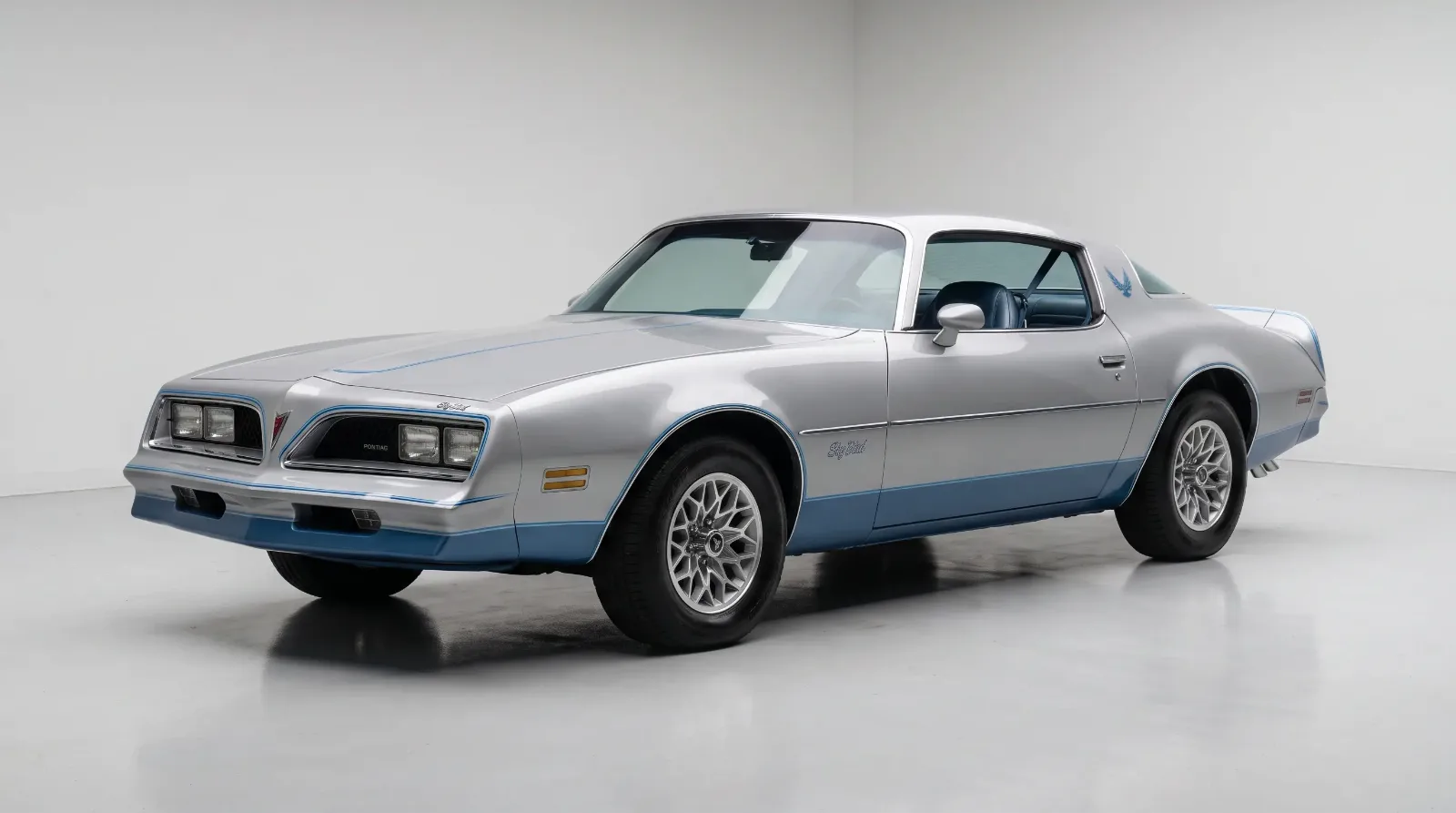
These were not separate models. They were option packages, RPO codes bolted onto an existing Esprit or Formula order, built around a two-tone paint scheme, matching interior accents and a handful of trim details. Sky Bird came first for the 1977 model year, pairing a silver body with blue lower accents on the Esprit. Red Bird followed, arriving mid-year 1978 in Roman Red with gold striping and carrying into 1979. Yellow Bird came last, a 1980-only package restricted to the Esprit, in yellow with gold trim and a tan interior rather than a matching color. Pontiac marketing treated them as seasonal specials, the kind of thing a regional sales manager could point to when a customer wanted something that did not look like every other car on the lot.
The production numbers get repeated a lot online and rarely cited. Sky Bird is the one package with a documented figure: roughly 5,600 to 5,700 built in 1977 out of just over 34,000 Esprits that model year. Red Bird and Yellow Bird never got the same paper trail. Owners' groups put Red Bird in the low thousands for its 1979 carryover year and lower still for the partial 1978 debut, and Yellow Bird's count is unrecorded beyond the fact that total Esprit production for 1980 was 17,277 cars, of which the Yellow Bird was a small slice. Pontiac's own recordkeeping for these packages was inconsistent enough that no verified count survives for either one. That gap matters more than it sounds like it should, because a package advertised as "rare" without a number attached to it is just a marketing claim with a color swatch.
Sky Bird: 1977's quiet debut
Sky Bird arrived on the 1977 Esprit, the same year Pontiac leaned hard into the second-gen Firebird as a design that could carry both a base buyer and an aspirational one. The package did not chase performance. It sold on visual differentiation at a moment when the Firebird lineup already had five distinct visual identities across base, Esprit, Formula, Trans Am and Skybird. Buyers who wanted a Trans Am's attitude without the price or the insurance bill increasingly looked at Esprit with an appearance package, and Sky Bird gave them a reason to check that box instead of walking past it.
What survives today skews toward cars that were maintained as show pieces rather than driven hard, which distorts the pool a buyer actually sees at auction. A clean, numbers-consistent Sky Bird is not common at a random regional sale. It is common at a specialty Pontiac event where sellers have already filtered for exactly this kind of car.
Red Bird and Yellow Bird: chasing the same trick
Red Bird and Yellow Bird followed the same playbook in the years after, and by 1978 Pontiac had figured out that a two-tone Esprit moved off the lot faster than a single-color one sitting next to it. The mechanics under the paint were unchanged. Buyers picked their engine and drivetrain as they normally would, then layered the appearance package on top. That means a Red Bird or Yellow Bird could show up with a six-cylinder or a small V8, and the paint package tells you nothing about what is actually under the hood.
This is where I see buyers make the same mistake twice. They price the car off the appearance package's rarity and skip past the drivetrain math entirely. A Yellow Bird with a modest engine is a nicer-looking Esprit, not a performance investment. Treat the two variables separately: paint rarity is one number, drivetrain desirability is a completely different one, and the sale price should reflect both, not just whichever one the seller mentions first.
| Package | Model year | Base trim | Primary color theme |
|---|---|---|---|
| Sky Bird | 1977 | Esprit | Silver over blue |
| Red Bird | 1978 to 1979 | Esprit | Roman Red with gold striping |
| Yellow Bird | 1980 | Esprit | Yellow with gold trim |
Why collectors argue about numbers
Ask around any Pontiac forum and you will find someone insisting their car is one of a few hundred, and someone else insisting the same package ran into the low thousands. Both are probably repeating a number they read once and never checked. Factory build sheets and dealer invoices from this era exist for some cars and not others, so a shop or seller with genuine documentation has real leverage in a negotiation. A shop without it is selling you a color and a story.
I put more weight on a documented, matching-numbers Yellow Bird with a thin paper trail behind it than I do on an undocumented car described as rare by word of mouth. The premium for proof is real, and it should be, because the alternative is buying a claim instead of a car.
"The color packages get sold on romance and bought on paperwork. If a seller can't show you the build sheet, price the car like an unverified Esprit, not like a rare bird."
David Mercer
What they're worth today
These packages currently trade at a modest premium over an equivalent base Esprit or Formula in the same condition and drivetrain, not at a multiple of it. That premium widens noticeably when the seller can produce a build sheet or period invoice confirming the RPO code, and it narrows to almost nothing when the only evidence is the paint job itself, since repaints in period-correct color combinations are not hard to fake.
My actual read: buy, but only with documentation in hand, and only after pricing the drivetrain on its own merits first. If you want to see what is currently on the market before you commit to chasing one specific package, browsing classic Firebirds for sale gives you a faster read on real asking prices than any forum thread will. For readers who want the full color history across every second-gen trim, a related deep-dive covers the broader palette these packages sat inside.
Sources and notes
- 78ta.com: 1977 Pontiac Firebird Esprit Skybird Edition
- 78ta.com: 1978-1979 Pontiac Firebird Esprit Redbird Edition
- 78ta.com: 1980 Pontiac Firebird Esprit Yellowbird Edition
- Autopolis: Birds of a Different Color
- Curbside Classic: 1977 Pontiac Firebird Esprit Sky Bird
- Hagerty: 1979 Pontiac Firebird Esprit Red Bird valuation
Related Reading
Have a
Pontiac Firebird
for Sale?
Reach thousands of serious classic car collectors across the US.
Sell It Here →
Are You a Classic Car Dealer?
List your full inventory and connect with targeted classic car buyers.
Join as a Dealer →
#pontiac firebird
#Firebird Formula
#second-gen Firebird
#Firebird Esprit
#appearance packages
#Firebird market values

About the author
David Mercer
Classic car market analyst with two decades of experience tracking collector car valuations, auction results, and investment trends.
Related Listings - Pontiac Firebird
Comments
Be the first to comment on this article.