
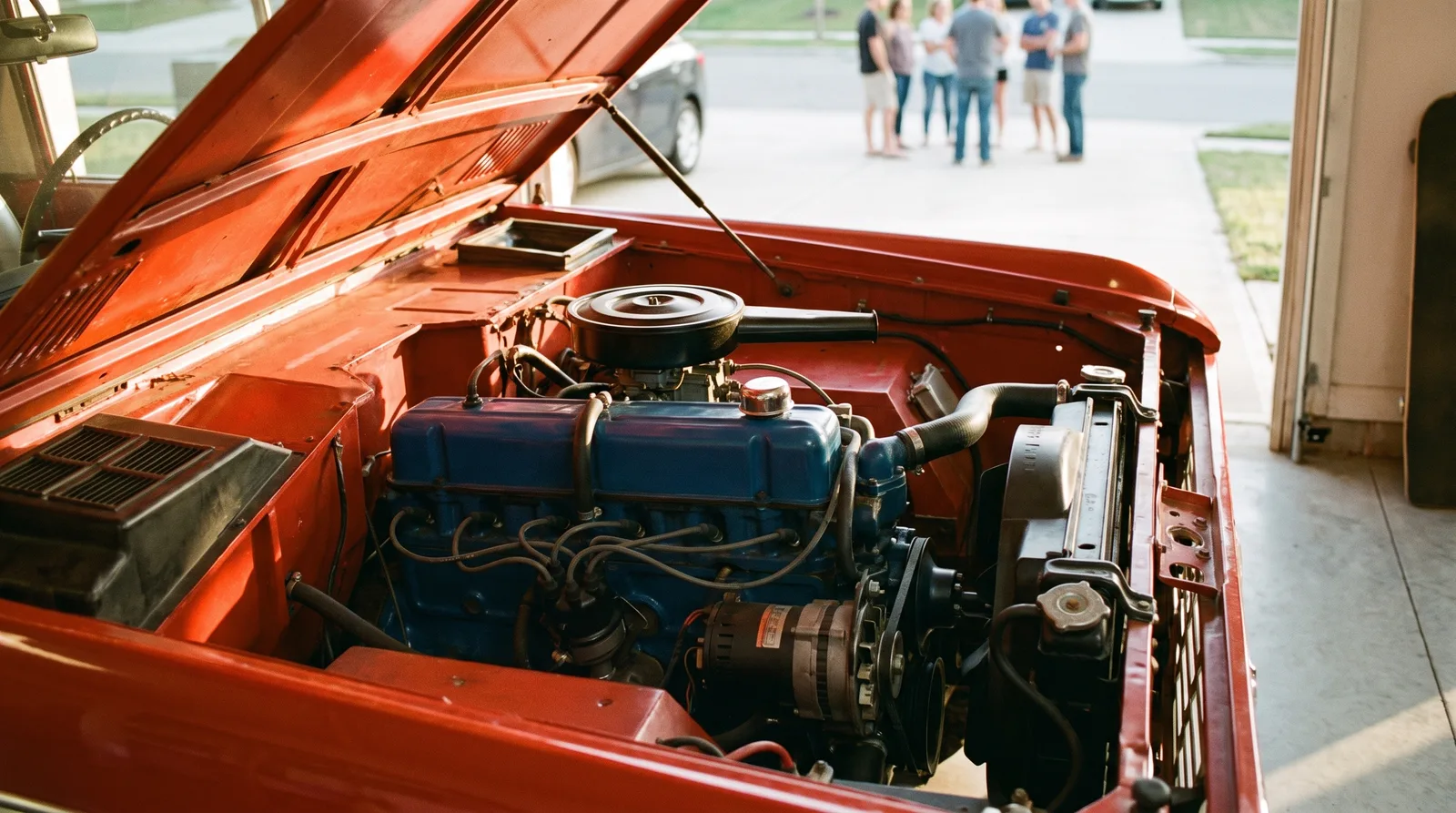
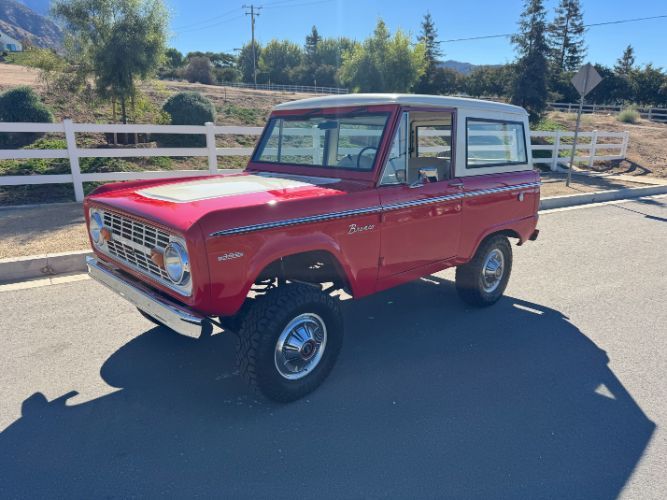
No V8 at launch. No turbo. Just a small inline six doing a job it was built to do. The ford bronco 1966 170 six was not glamorous, and it did not need to be. It was the only engine Ford offered when the 1966 Bronco went on sale, and it worked.
Car Features
6 min read
The 170 Cubic Inch Six That Powered the First Broncos
The ford bronco 1966 170 six was the sole engine option at launch, a modest inline six built for reliability instead of horsepower.
The numbers, straight up
170 cubic inches. Inline six cylinder. That is the engine every early 1966 Bronco left the factory with, regardless of body style. There was no optional V8 at launch and no performance trim to chase, until Ford added the 289 V8 as an option in March 1966. Ford built one engine choice into the truck's initial launch and let the chassis, suspension, and body variants do the differentiating instead.
105 hp (gross rating) is the figure most commonly cited for the 170 six's output in this application, modest by any standard, even by 1966 standards. But horsepower was never the point of this engine. Torque delivery low in the rev range, mechanical simplicity, and a long service life mattered more to the buyers Ford was chasing than a number on a spec sheet.
| Spec | Detail |
|---|---|
| Displacement | 170 cubic inches |
| Configuration | Inline six cylinder |
| Availability | Standard; sole engine until the 289 V8 option arrived in March 1966 |
| Transmission pairing | Three-speed manual, column shift |
| Chassis | 92 inch wheelbase, dedicated Bronco frame |
Why Ford picked a small six over a V8
Simple reasoning. A V8 adds weight over the front axle, increases fuel and maintenance costs, and complicates a truck Ford wanted to sell as accessible and easy to own. Buyers cross-shopping the Jeep CJ-5 were not expecting big power. They wanted reliability, decent low-end torque for crawling over rough ground, and an engine a rural mechanic could service without specialized tools.
The 170 six delivered on all three. It was already a known quantity in Ford's lineup before the Bronco, proven in other applications, which cut development risk and kept the truck's launch on schedule. Ford was not trying to win a horsepower contest against International Harvester or Jeep. It was trying to build something that would not break down two hundred miles from the nearest dealer.
Fuel economy factored into the decision too, even if nobody in 1966 called it that explicitly. A smaller displacement six sipped less fuel than a V8 would have, a real consideration for buyers who used the truck for long stretches of rural driving where the nearest filling station might be a genuine distance away. Lower fuel consumption paired with the engine's mechanical simplicity meant lower total cost of ownership over the life of the truck, a quiet but persistent selling point that mattered as much to budget-conscious buyers as any single spec sheet number. Owners who kept detailed logs of fuel and maintenance costs over the truck's early years, and some did, tended to report a total cost of ownership that compared favorably against both the CJ-5 and the larger, thirstier trucks in Ford's own lineup. None of that shows up on a spec sheet, but it showed up plainly in a rancher's ledger at the end of the year, and that quiet arithmetic did as much to sell the 170 six as any horsepower figure ever could, even if nobody printed that arithmetic in a brochure or bragged about it at a dealer showroom the way they might a bigger number under the hood.
"Nobody bought a 1966 Bronco because the engine impressed them on paper. They bought it because the engine kept running long after flashier trucks needed work. That is the whole story, and it does not need more words than that."
- Dan Reeves
What made it easy to keep running
Simplicity was the 170 six's whole argument, and it showed in how the engine was built. Few emission controls, a straightforward carburetor setup, and mechanical components that a rural garage or a competent owner could service without specialized tooling or factory diagnostic equipment. That mattered enormously to the customer base Ford was chasing. A rancher two hours from the nearest dealer needed an engine he could keep running with basic tools and common sense, not one that required a trip to a specialist for anything beyond an oil change.
That serviceability also meant the 170 six aged well in the used market. Trucks that changed hands multiple times over subsequent decades, often moving from original owner to a second or third buyer who used the Bronco for genuine work rather than collecting, kept running because the engine underneath them was never complicated enough to become a maintenance nightmare. Compare that to more powerful, more complex engines from the same era in other applications, many of which became expensive to keep alive once specialized parts grew scarce, and the 170 six's basic design looks less like a limitation and more like a deliberate strength.
How it held up against the competition
Compared to the Jeep CJ-5's engine options of the same period, the 170 six was competitive on reliability and roughly in line on output, without a clear advantage either direction on raw numbers. What set the Bronco apart was not the engine in isolation, it was the engine combined with the coil-spring front suspension and dedicated chassis, a package that rode better than most rivals while still delivering the low-range grunt buyers needed off-road. Read our 1966 ford bronco retrospective for the full picture of how the chassis and engine worked together, and see a related story for a direct comparison against the Bronco's biggest early rival.
The bottom line on the 170 six
It was not designed to impress anyone. It was designed to start every morning, pull a truck through mud without drama, and keep doing that for a decade or more with basic maintenance. Judged against that standard, not against a spec sheet, the 170 six did exactly what Ford needed it to do, and it is a big part of why so many original 1966 Broncos are still running today.
If you want to feel what that engine and chassis combination actually drives like, Broncos for sale now is where to start looking.
Buyers evaluating a 170-six Bronco today should treat the engine's simplicity as a genuine asset rather than a compromise to work around. A well-maintained example of this engine is not hard to keep running, parts remain reasonably available given how widely Ford used the 170 across its lineup during this period, and the low state of tune means it tolerates decades of ownership without the fragility that plagues more highly strung engines from the same era. It will never be the reason someone falls in love with a 1966 Bronco. It is the reason so many of them are still capable of being driven and enjoyed today.
Sources and notes
Related Reading



About the author
Dan Reeves
Performance engine builder from North Carolina's motorsports corridor, focused on swaps, forced induction and making real, repeatable power.
Related Listings - Ford Bronco




Comments (1)
P
Pete Nakamura
1 day ago
170 is the Falcon family six. Intake is cast into the head, so no separate manifold gasket to leak. Four main bearings. The later 200 got seven.
T
Tammy R.
14 hours ago
Four mains means don't wind it out in low range. Simple.
P
Pete Nakamura
11 hours ago
Correct. Short stroke helps, but sustained high rpm still loads the center mains. Shift early.