
Two vehicles, one customer base, and a rivalry that shaped how an entire segment of the American market developed for the next three decades. The ford bronco 1966 vs cj5 comparison was not an abstract exercise for buyers standing in dealer lots in the mid 1960s. It was a genuine choice between two very different philosophies of what a compact 4x4 should be.
Car Features
6 min read
1966 Bronco vs Jeep CJ-5, the Rivalry Begins
The ford bronco 1966 vs cj5 rivalry pitted Ford's clean-sheet engineering against Jeep's decade of proven, battle-tested simplicity.
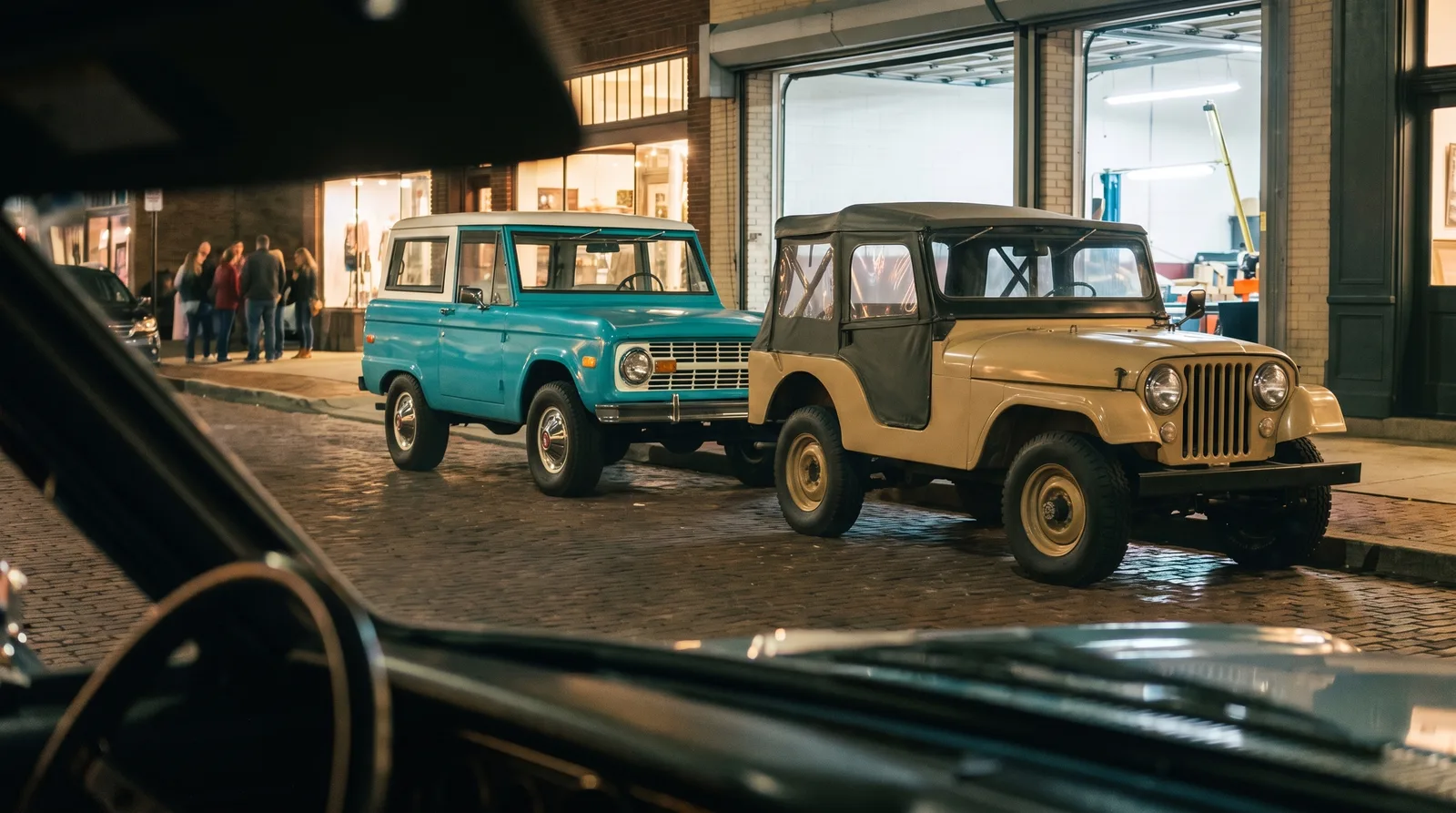
Two vehicles built from different starting points
The Jeep CJ-5 traced its lineage directly back to the military Jeeps of the Second World War, a design philosophy built around simplicity, minimal weight, and maximum mechanical directness. By 1966, the CJ-5 had already been in production for years, refined incrementally but fundamentally unchanged in its basic approach, leaf springs front and rear, a stripped-down body, and an emphasis on raw capability over comfort.
The Bronco arrived with none of that heritage and none of that baggage. Ford built it from a clean sheet in the early 1960s specifically to compete in this category, which meant its engineers could make different choices without being constrained by decades of established design. The most significant of those choices was the coil-spring front suspension, a genuine departure from the leaf-spring setup nearly every rival used, including the CJ-5.
Where the CJ-5 held the advantage
Documented period road tests and dealer records from the era generally credit the CJ-5 with a lighter overall curb weight and, in certain trail conditions, a tighter approach angle that suited extremely technical terrain. Its long production history also meant an established parts and service network that a brand-new Ford entry could not immediately replicate. For buyers who valued proven simplicity above all else, the CJ-5's decade of refinement was itself a selling point that a first-year Bronco could not counter directly.
The CJ-5's stripped-down construction also kept its price competitive, an important factor for the ranch and agricultural buyers who made up a meaningful share of this market segment and who weighed purchase cost carefully against a vehicle's working utility.
Where the Bronco pulled ahead
Ford's coil-spring front end gave the Bronco a documented ride quality advantage on rough, uneven terrain compared to the CJ-5's leaf-spring setup, a difference period reviewers noted consistently. That mattered for buyers who split their time between trail use and road driving, since the ride difference was noticeable on pavement as well as off it.
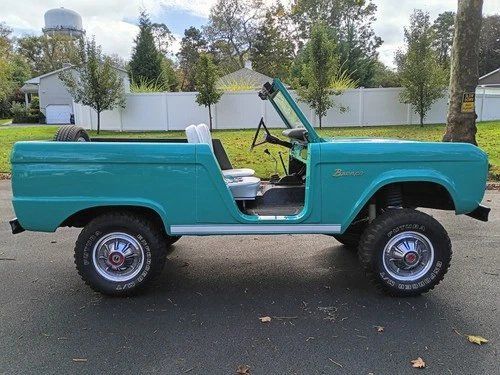
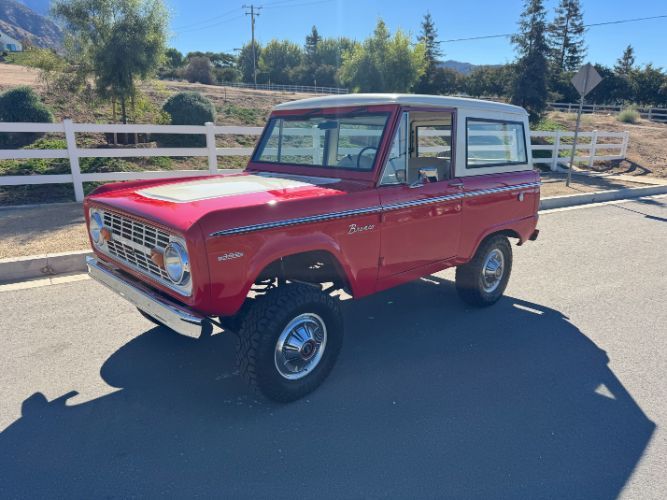
The Bronco's three-body strategy also gave Ford an answer for a broader range of buyers within a single platform, something the CJ-5's more singular configuration did not match as directly. A buyer who wanted an enclosed daily driver could choose the U15 wagon. A buyer who wanted something closer to the CJ-5's stripped-down character could choose the U13 roadster. That flexibility let the Bronco compete across more of the market simultaneously than a single-configuration rival could.
Interior refinement was another point of contrast worth noting. Even in its most basic form, the Bronco's cabin design and seating position drew more favorable comment from period reviewers than the CJ-5's more spartan layout, a difference that mattered increasingly as the compact 4x4 buyer base expanded beyond purely rural, working customers into a broader recreational market during the later 1960s. That recreational shift, more than any single spec comparison, is arguably what cemented the Bronco's long-term reputation as the more approachable of the two trucks for a buyer who wanted genuine capability without sacrificing everyday comfort.
"The CJ-5 had the pedigree. The Bronco had the engineering choices that a decade of legacy design could not easily match. Neither truck was objectively better. They were built for buyers who wanted different things from the same basic category."
- Sarah Whitfield
How period reviewers framed the choice
Automotive and outdoor publications covering the compact 4x4 segment in the mid 1960s generally avoided declaring an outright winner between the Bronco and CJ-5, and for good reason. The two trucks were built around different priorities, and testing them purely on trail performance metrics missed the point of why buyers chose one over the other. Reviewers who focused on pure off-road articulation and minimal weight tended to favor the CJ-5. Reviewers who weighted overall driving comfort, versatility across body configurations, and daily usability tended to favor the Bronco.
That split in reviewer opinion mirrored the split among actual buyers, and it is part of why both trucks continued selling steadily rather than one immediately overtaking the other. A publication's road test rarely changed which vehicle a rancher or outdoorsman ultimately bought, since that decision usually came down to which local dealer network the buyer trusted, what their neighbors already drove, and which specific body configuration matched their actual daily needs. The Bronco versus CJ-5 debate was less a single verdict and more an ongoing conversation that played out differently in every region and every customer's driveway. Even dealers who sold both brands under the same roof in some markets reported that customers rarely arrived undecided between the two. Most had already made up their minds based on word of mouth long before they ever sat behind either wheel, shaped by what a neighbor drove, what a father or uncle recommended, or what the local dealer happened to stock and push hardest that particular season.
How the rivalry played out over time
Neither vehicle displaced the other in this period. Both continued in production and continued selling to loyal, sometimes overlapping customer bases through the following decade, a genuine coexistence rather than a decisive victory for either side. What the rivalry did accomplish was pushing both manufacturers to keep refining their trucks rather than resting on early success, benefiting buyers on both sides of the showroom floor.
You can read read the background on how Ford built the Bronco specifically to compete in this space, understanding the CJ-5's established position as the target Ford's engineers were aiming to beat.
What the comparison tells us today
Looking back, the Bronco versus CJ-5 rivalry is a useful lens for understanding why both trucks still command such dedicated followings among collectors. Each represents a genuinely different engineering philosophy applied to the same basic problem, and that authenticity is part of why neither has faded from serious collector interest decades later. If the Bronco's side of that rivalry appeals to you, find a classic Bronco currently listed for sale.
Collectors today often end up owning examples of both trucks rather than picking a permanent side, a practical acknowledgment that the CJ-5 and Bronco reward different kinds of driving and different kinds of restoration projects. Understanding the original rivalry helps explain why that dual ownership makes sense, since the two trucks were never really trying to be the same thing in the first place, and appreciating that difference is part of what makes owning either one, or both, genuinely rewarding.
Sources and notes
Related Reading

About the author
Sarah Whitfield
Third-generation classic car collector specializing in pre-war American and European coachbuilt automobiles. Researcher and concours enthusiast.
Related Listings - Ford Bronco




Comments (1)
R
Rosa Villarreal
2 days ago
Respectfully, I am not sure the dealer network mattered as much as you suggest. My father bought his Bronco over a CJ-5 purely because of the ride on the drive home from the lot. Did period sales figures ever show a regional split? And were any dealer surveys kept?
Rosa, your father's reason is exactly the one the coil-spring front end was built to win, so I would not argue with it. On your questions: Ford's regional breakdowns for those years are not widely published, and I have not seen a dealer survey that survives. Most of what we know about why buyers chose one truck over the other comes from road tests and dealer recollections, which is softer evidence than I would like.