
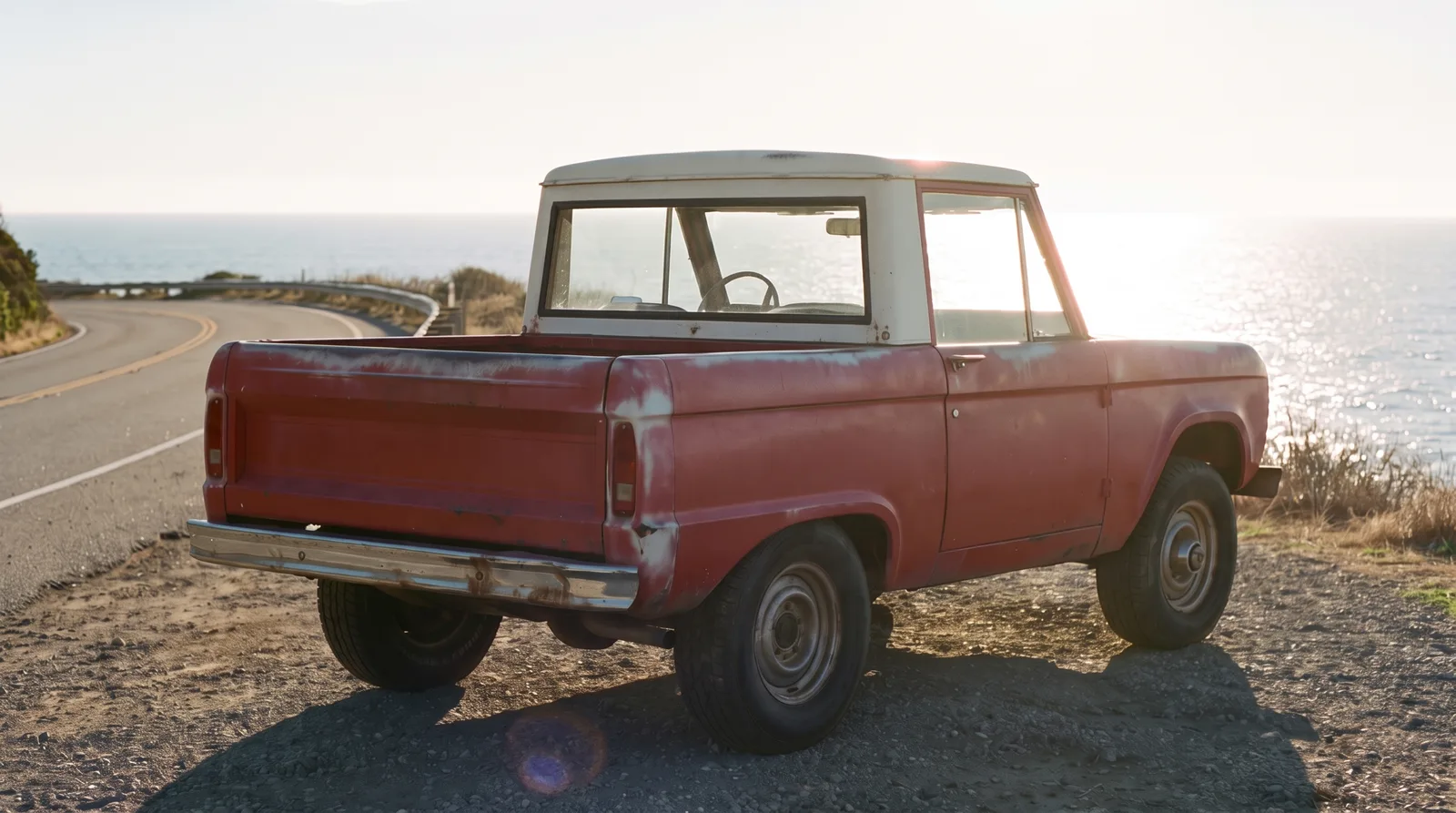
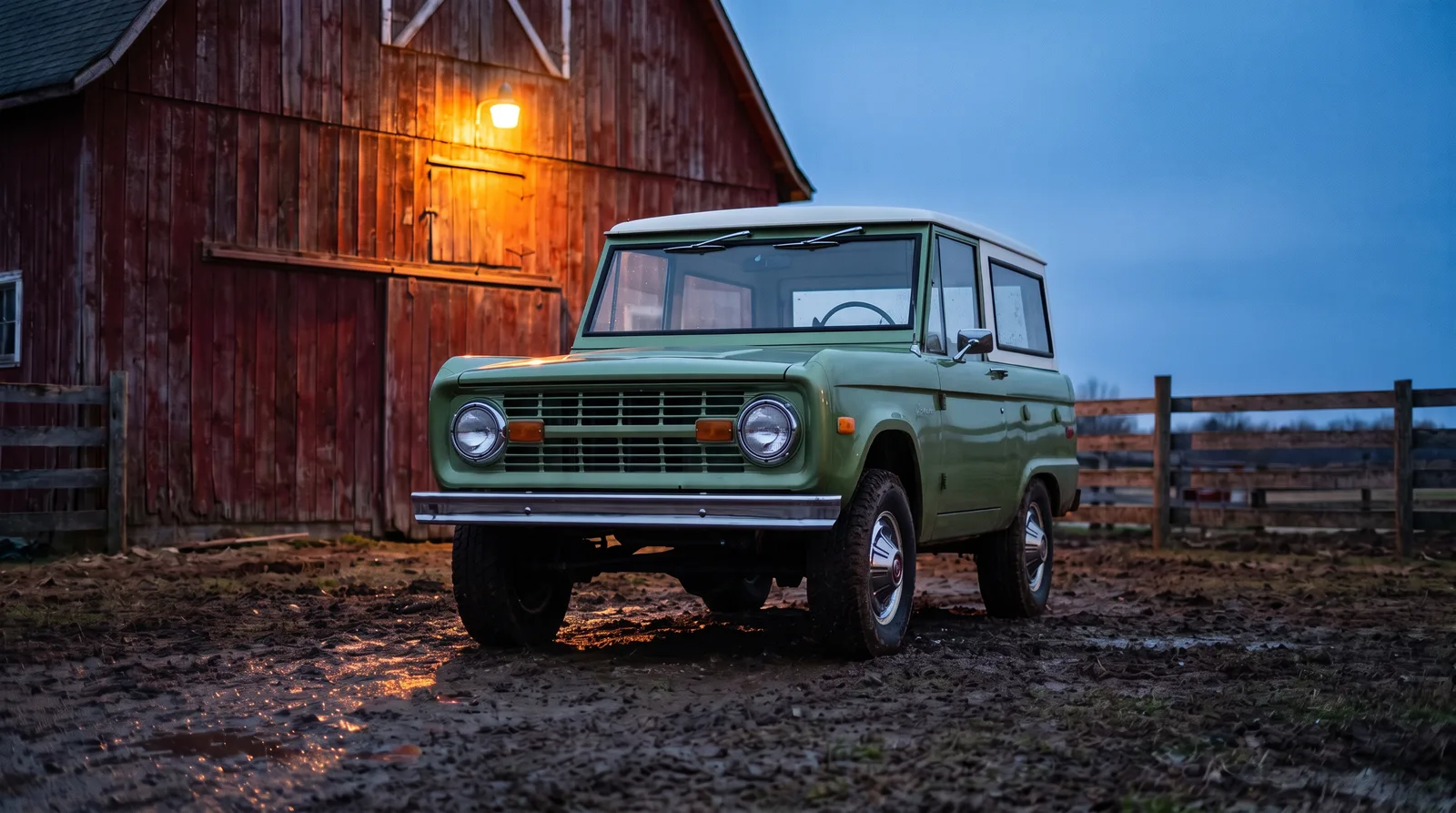
The truck was parked behind a machine shed for most of thirty years, tarp half rotted, tires flat, mice in the seat springs. Its owner had bought a newer truck sometime in the 1980s and simply stopped driving the old one rather than selling it. That kind of story, told with small variations, is how most surviving unrestored examples of the 1966 Bronco actually come back into the world. A Ford Bronco 1966 survivor culture has grown up around trucks exactly like that one, and it treats an untouched original with a kind of reverence that a fresh restoration rarely earns.
Car Features
7 min read
Chasing an Unrestored 1966 Bronco Survivor
Unrestored 1966 Broncos are treated almost like documents by the people who chase them. Here is why originality outweighs polish in this corner of the hobby.
What makes a survivor different from a restoration
A survivor, in the language collectors use, is a vehicle that has never been substantially disassembled or refinished. It may be dirty. It may run poorly or not at all. But its paint, its interior, its underhood components are the ones that left the factory or close to it, layered with decades of honest wear rather than a restorer's guesswork. For Broncos specifically, that distinction matters more than it might for some other classics, because so many examples from the 1966 model year have been modified, off road hardened, or simply used up over the decades. A truck that escaped all of that is treated as a kind of physical record.
Finding one requires patience and, more often than any online search, word of mouth. Estate sales, farm auctions, and tips from people who remember a truck sitting somewhere for years are still the most reliable paths to an unrestored 1966 Bronco. By the time a genuine survivor shows up in a national auction listing, serious collectors have often already been aware of it for years.
The hunt itself
People who chase survivors talk about the search almost the way anglers talk about a particular river. There is a specific pleasure in the process that has little to do with the eventual purchase price. A tip from a Bronco club member about a truck parked behind a barn in a neighboring county. A conversation with a farmer's grandson who half remembers his grandfather mentioning an old Ford he never got around to fixing. These leads rarely pan out cleanly, and most survivor hunters chase dozens of dead ends for every truck that turns out to be real and available.
Why originality outweighs polish for this community
A beautifully restored Bronco can be objectively nicer to look at than a survivor with faded paint and a cracked dash pad, and yet within this particular corner of the hobby, the survivor often commands more respect. The reasoning is straightforward once you sit with it. A restoration reflects the choices, skill, and budget of whoever did the work, sometimes decades after the fact. A survivor reflects the truck itself, unedited. For people drawn to these trucks specifically because of their history rather than their curb appeal, that distinction is the entire point.
"You can restore a Bronco to look like new, and plenty of people do it beautifully. But you can never un-restore one. Once the original finish is gone, it is gone for good, and that is exactly why the ones that survived get treated like they matter more."
- Nora Beckett
The emotional pull of an untouched truck
There is something specific that happens the first time a survivor hunter opens the door of a truck that has sat undisturbed for decades. The smell of old vinyl and dust, a dashboard that has not been touched by a detailer's chemicals, a seat cushion still holding the shape of whoever sat in it last. People who have found several of these trucks describe that first moment consistently, a mix of excitement and something closer to caution, as though the truck might somehow be disturbed by too much attention too quickly. That reaction is not really about the vehicle as a machine. It is about standing in front of an unbroken thread back to 1966, something almost nobody gets to experience with a restored car no matter how well the work was done.
That emotional weight is part of why survivor hunters so often talk about preservation rather than restoration once they actually locate a real find. The instinct to fix, clean, and improve runs hard against a community norm that says the most valuable thing you can do with a genuine survivor is often nothing at all, beyond stabilizing whatever needs it to keep the truck from deteriorating further.
What a survivor actually reveals
Beyond sentiment, unrestored trucks carry real research value. A survivor's original paint code, factory upholstery pattern, and unaltered underbody stamping give restorers and historians a genuine reference point rather than a guess based on old photographs or incomplete documentation. Every survivor that gets carefully documented before any work is done makes the next restoration on a different truck more accurate. That is part of why serious collectors photograph and catalog these finds so thoroughly before anyone even considers whether to restore or preserve them.
For more on the truck these survivors trace back to, 1966 ford bronco history covers how the model came together in the first place, which is worth reading alongside any survivor's specific story. And for readers curious how collector values track originality versus restoration quality, a related story breaks down exactly where the market currently draws that line.
The decision every survivor owner eventually faces
Even the most committed preservationist eventually confronts a version of the same question. A survivor with a failing brake system or a rotted floor pan cannot simply sit untouched forever without either becoming unsafe to drive or deteriorating past the point of any recovery. Owners in this position have to weigh mechanical safety and structural preservation against the purist instinct to leave everything alone, and reasonable people land in different places on that line. Some choose sympathetic, minimally invasive repairs that address safety without touching cosmetic originality. Others accept that a truck driven regularly will eventually need more work than a truck kept purely as a static artifact, and they make peace with that tradeoff deliberately rather than by accident.
There is no single right answer within the community, but there is a shared value underneath the disagreement. Whatever gets done to a survivor should be done with full awareness of what is being changed and why, documented as carefully as the original condition was documented before any work began.
Where the culture goes from here
As the pool of unrestored 1966 Broncos shrinks, and it shrinks every year, the culture around finding and preserving them has only gotten more organized. Club networks trade leads more systematically than they did a decade ago, and specialized shows now dedicate entire categories to unrestored originality rather than lumping survivors in with heavily modified trucks. Anyone drawn into this world eventually has to decide whether they are hunting for a project or hunting for a document, because those are genuinely different goals even when the trucks look similar sitting in a field. For buyers who want to see what is currently available, from rough survivors to fully sorted examples, there are always Broncos for sale now worth a careful look.
Sources and notes
Related Reading

About the author
Nora Beckett
Automotive features writer and photographer who tells the human stories behind the cars, from show fields to cross-country road trips.
Related Listings - Ford Bronco

Comments
Be the first to comment on this article.