
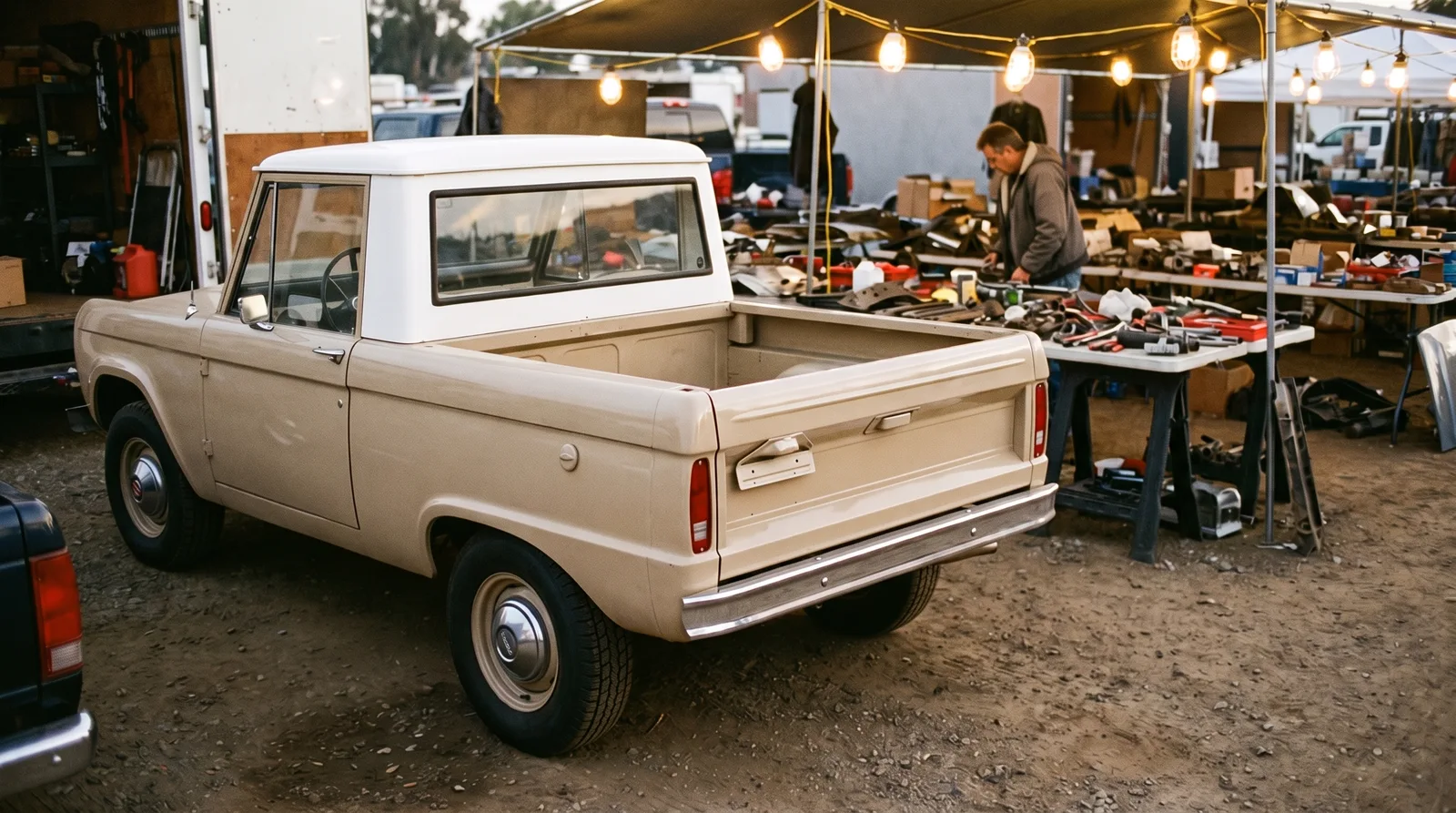
Between the fully enclosed wagon and the doorless roadster sat a body style that split the difference and, for a lot of practical buyers in 1965 and 1966, made the most sense of any of them. The ford bronco 1966 u14 halfcab paired a proper roof and doors up front with an open cargo bed behind, and it gave Ford's new truck a genuine working-vehicle identity that the other two body styles could not quite match.
Car Features
6 min read
The 1966 Bronco U14 Half-Cab and Its Pickup Charm
The ford bronco 1966 u14 halfcab split the difference between wagon comfort and roadster simplicity, giving Ford's new truck a genuine working identity.
A pickup for people who did not want a full pickup
Ford's engineers built the U14 on the same 92 inch wheelbase chassis and 170 cubic inch six as the wagon and roadster, but the body itself told a different story. The half-cab kept the front seating area enclosed, with a full windshield, doors, and a roof over the driver and passenger, then left the rear section open as a small cargo bed rather than continuing the enclosure back over a second row.
That layout made the U14 genuinely useful in a way pure passenger vehicles were not. A rancher hauling tools, feed, or fencing supplies had somewhere to put them without dragging cargo through a passenger cabin. A weekend hunter could throw muddy gear in the bed instead of the footwell. It was not trying to be a full-size pickup, and it did not need to be, since the point was compact utility, not maximum payload.
Where it landed against its siblings
In terms of popularity, the half-cab settled into a middle position among the three original body styles, more practical than the roadster for buyers who wanted real cargo capacity, but less versatile than the wagon for anyone who needed to carry passengers or gear that needed protection from the weather. That middle position gave it a specific, loyal customer base rather than the broadest possible appeal, and it never caught the wagon in total sales volume.
Still, the half-cab found real work. Utility companies, small ranches, and rural municipalities appreciated a compact 4x4 that could genuinely haul small loads while still fitting through gates and trails a full-size truck could not manage. That working history is part of why surviving U14 examples today often carry more honest wear and modification than their wagon counterparts. These trucks were bought to be used, not preserved.
Municipal and utility fleet use in particular left a distinct mark on many surviving U14s. Vehicles bought under fleet contracts often received practical, unglamorous modifications, aftermarket tool racks, reinforced bed liners, auxiliary lighting for work after dark, that were never intended to preserve originality but rather to keep the truck useful for as long as possible. Decades later, some of those same modifications have become part of a given truck's own documented history, telling a story about exactly what kind of work it did rather than detracting from its value the way an unexplained modification might. Buyers who appreciate that kind of provenance often find a documented working half-cab more compelling than a pristine, never-used example, since it offers tangible proof the truck actually did the job Ford designed it for. A half-cab with a known fleet history, old service records, or even faded lettering ghosted under later paint can tell a more interesting story than a truck with no history to speak of at all, and that story is often exactly what draws a buyer to choose one specific example over another that looks similar on the surface.
"The half-cab never got the glamour of the wagon or the cult reputation of the roadster, but it was the honest workhorse of the three, and honest workhorses rarely get written about until decades later when people realize how few are left."
- Tom Ramirez
The bed that made the difference
Ford kept the U14's cargo bed relatively compact, sized to match the truck's overall footprint rather than maximizing hauling capacity the way a full-size pickup bed would. That restraint was intentional. The half-cab was never meant to compete with Ford's own larger trucks for serious hauling duty. It was meant to give the compact 4x4 buyer just enough bed space for tools, feed sacks, fencing material, or camping gear, without adding the length and weight that would have compromised the tight turning radius and off-road agility the Bronco platform was built around.
That balance between cargo capacity and off-road nimbleness is part of what made the half-cab appealing to buyers whose work took them off maintained roads regularly. A larger bed would have meant a longer wheelbase or an awkward overhang, either of which would have hurt the approach and departure angles that mattered to a rancher navigating uneven pasture or a lineman working access roads that a standard pickup could not reach. Ford's engineers clearly understood that tradeoff and built the U14 to favor capability over raw capacity.
Collector interest today
For years, the U14 sat somewhat overlooked in the broader early Bronco collector market, overshadowed by wagon values on one end and roadster rarity on the other. That has shifted as buyers increasingly appreciate what the half-cab actually represents, a genuinely different use case built onto the same beloved chassis, and one that offers a more affordable entry point into original 1966 Bronco ownership than either of its siblings typically commands.
Original, unmodified examples with their bed intact and factory-correct cab configuration are not common, since decades of working use took a real toll on many surviving trucks. Buyers looking for one need patience, and often need to accept some honest wear as part of the package rather than expecting showroom condition.
Part of a bigger platform story
The U14 only makes full sense in the context of Ford's original three-body strategy for the Bronco, a decision that let one chassis serve wagon buyers, cargo buyers, and stripped-down trail buyers all at once. You can read where this started to understand how Ford arrived at that strategy and what it meant for the truck's first year on the market.
Half-cab examples do come up for sale periodically, and if you want a working-truck character with real period charm, classic Bronco for sale listings are the place to keep an eye on for one.
Buyers evaluating a U14 today should expect to see honest signs of its working history, bed wear, undercarriage evidence of off-road use, and possibly non-original modifications made by owners who valued function over originality during the decades before classic Bronco values climbed. That is not necessarily a downside. For buyers who want a truck with a genuine working past rather than one that spent its life in a climate-controlled garage, the half-cab's history is part of its appeal, a tangible link to the rural and utility customers Ford built it for in the first place.
Sources and notes
Related Reading

About the author
Tom Ramirez
Corvette researcher and historian based in Bowling Green, Kentucky. Two decades documenting Corvette production history from original factory records.
Related Listings - Ford Bronco




Comments
Be the first to comment on this article.