
The 1966 Ford Bronco did not arrive in an empty field. International Harvester had been selling the Scout since 1961, and by the time Ford's own compact four wheel drive reached showrooms in August 1965, the Scout already had a five year head start on buyers who wanted something smaller than a Jeep wagon and tougher than a car. Ford Bronco 1966 vs Scout is not a hypothetical comparison. It is the fight that actually happened on dealer lots, and understanding it explains half the decisions Ford made on the original Bronco.
Car Features
7 min read
1966 Bronco vs International Scout, the Segment Fight
Before the Bronco had a rival, it had a target. Here is how Ford's new 1966 truck stacked up against International Harvester's Scout on the showroom floor.
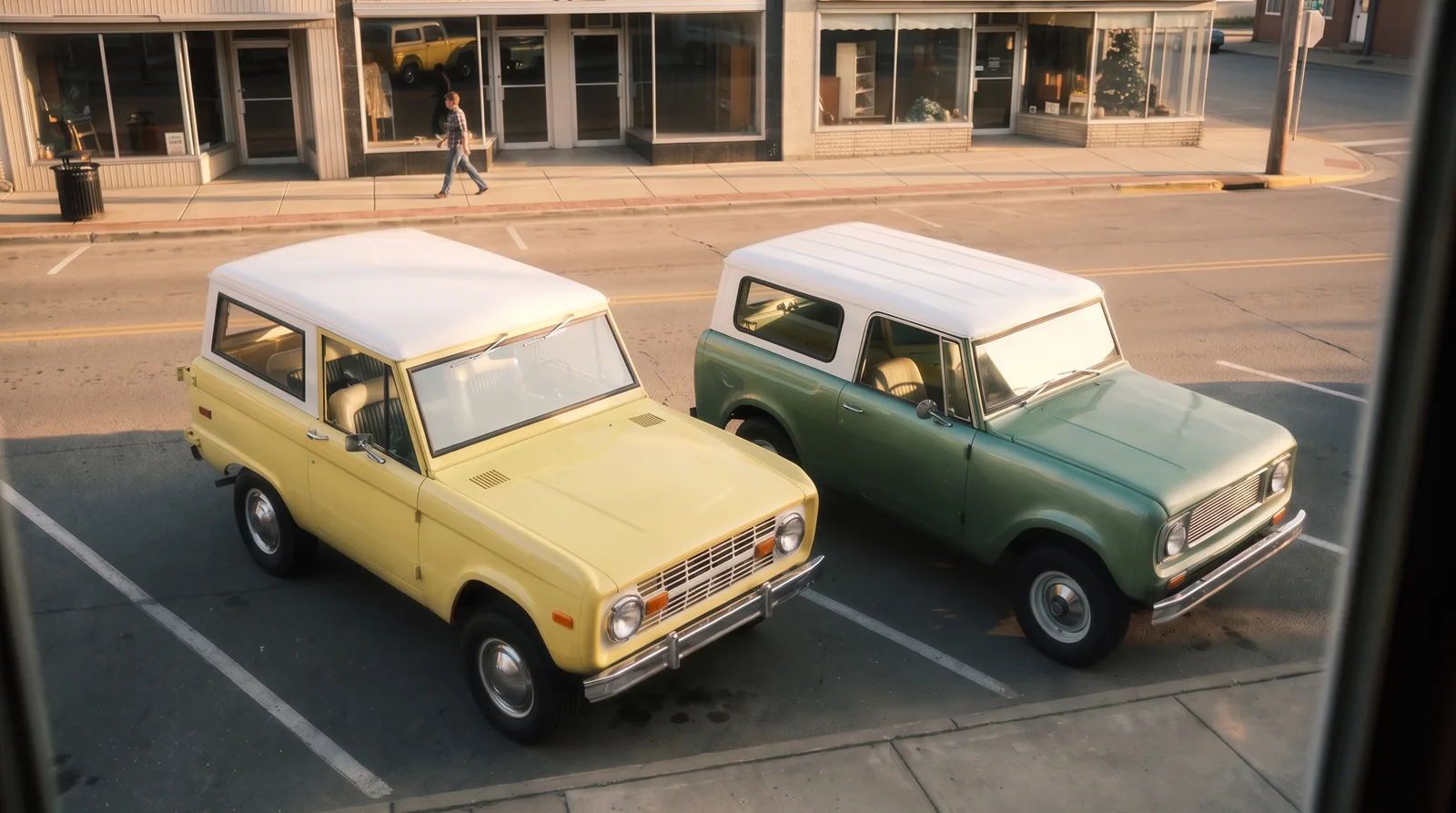
Two companies chasing the same customer
International Harvester built trucks and farm equipment long before it built the Scout, and that heritage showed. The Scout used a four cylinder engine derived from IH's V8, a simple frame, and a boxy cab that could be ordered as a pickup, a wagon, or a half cab. It sold well enough that Ford's product planners noticed. Chevrolet was also circling the segment with what would become the Blazer a few years later, but in 1965 the immediate target for Ford was Scout, and the Bronco's specification sheet reads like a direct answer to it.
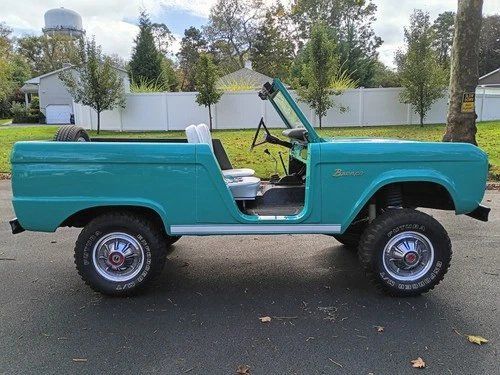
Ford gave the Bronco a purpose built frame rather than a shortened pickup chassis, a coil sprung Mono Beam front axle instead of a leaf sprung front end, and a choice of three body styles that mirrored the Scout's own lineup: a wagon, a half cab pickup, and an open bodied roadster with a removable top. The overlap was not an accident. Ford's engineers studied the Scout closely, and dealers cross shopped the two trucks constantly through the late 1960s.
Where the Scout had the edge
International's advantage was time on the market and a lower base price on certain configurations. The Scout had already built a following among ranchers, utility crews, and hunters who valued its simplicity and its four cylinder engine's fuel economy over the Bronco's six cylinder thirst. IH also offered the Scout with a diesel option later in its run, something Ford never matched on the early Bronco. For buyers who wanted the cheapest possible way into a four wheel drive utility vehicle, Scout often won on the sticker.
Where the Bronco pulled ahead
Ford's answer was refinement. The standard 170 cubic inch Thriftpower Six ran smoother than the Scout's four, and Ford added the 289 cubic inch V8 as an option partway through the 1966 model year, giving Bronco buyers a power option Scout could not touch until International's own V8 arrived later. The coil sprung front suspension also gave the Bronco a noticeably better ride on rough roads than the Scout's leaf sprung setup, a detail that mattered to buyers who drove the truck on pavement as often as off it.
Ford also leaned on its dealer network, which dwarfed International's truck focused outlets in most regions. A buyer in a mid sized American town was far more likely to have a Ford store nearby than an IH dealer that primarily sold combines and tractors. That distribution advantage did as much for Bronco sales as any engineering choice.
"Ford didn't invent the small four wheel drive utility segment. International Harvester did. What Ford did was walk into that segment with a bigger checkbook, a smoother engine option, and twice the dealers, and that combination is why the Bronco is the name people remember fifty years later."
- Tom Ramirez
The rivalry outlived both trucks
International Harvester stopped building Scouts in 1980 as the company retreated from the light truck business entirely. Ford kept the Bronco name alive through 1996 before retiring it, then reviving it decades later for a modern generation. That asymmetry, one nameplate surviving and one disappearing, has reshaped how collectors think about the rivalry today. Scouts are rarer in absolute terms and command real interest among IH loyalists, but the Bronco's longer production run and eventual revival gave it a much larger built in audience of buyers, parts suppliers, and clubs.
Restorers and collectors still argue about which truck handled better in its original form, but the market has largely settled the popularity question. For the whole picture on how the first Bronco came together and why Ford greenlit the project in the first place, the full story of the 1966 model fills in the context this rivalry only hints at.
Two design philosophies, one segment
Look past the spec sheets and the two trucks reveal two very different starting points. International Harvester built the Scout as an extension of its farm and light truck business, and it shows in the truck's utilitarian cab and its focus on low cost serviceability. Ford came at the same problem from the opposite direction, treating the Bronco as a new product line built specifically to compete in a segment IH had already proven existed. That is a meaningful distinction. Scout was IH adapting existing capability to a new body. Bronco was Ford building something purpose designed from the ground up to beat that existing capability on comfort and refinement, while still meeting the same rough duty requirements.
That difference in origin shows up in small details that period road tests noticed at the time. Reviewers frequently praised the Bronco's cabin as quieter and better sealed than the Scout's, a direct result of Ford applying passenger car engineering discipline to a truck that International had built with a more agricultural mindset. Neither approach was wrong. They simply produced trucks with different personalities that appealed to overlapping but distinct segments of the same broad buyer pool.
What the rivalry means for buyers today
Anyone shopping either nameplate now is not really choosing between two similar trucks. They are choosing between two different collector ecosystems. Bronco parts, from reproduction sheet metal to correct interior trim, are widely available because the demand base is so much larger. Scout parts exist but require more patience and more networking within IH specific clubs. That practical reality, not just nostalgia, is why so many buyers who cross shopped both trucks in the 1960s end up owning Broncos when they return to the hobby decades later.
Values for clean 1966 Broncos have climbed steadily as the segment they helped define has become a recognized collector category in its own right, and interest shows no sign of slowing. Scout values have followed a similar upward path among IH loyalists, though the pool of active bidders remains smaller, which keeps top condition Scouts from commanding quite the same premiums that comparable Broncos now reach at major auctions. That gap has narrowed in recent years as more general collectors, not just IH specialists, have started paying attention to the Scout's role in starting the segment in the first place.
Anyone weighing an original example against a restored one, or against alternatives from the same era, should shop classic Bronco listings to see how wide the current range of condition and price actually runs before settling on a target truck. The two nameplates will likely keep getting cross shopped by serious buyers for as long as both remain in circulation, and understanding the segment fight that started it all only sharpens that comparison.
Sources and notes
Related Reading

About the author
Tom Ramirez
Corvette researcher and historian based in Bowling Green, Kentucky. Two decades documenting Corvette production history from original factory records.
Related Listings - Ford Bronco




Comments
Be the first to comment on this article.