
Here is the short version. The ford bronco 1973 automatic transmission option turned a truck built for wrestling with a clutch into something your spouse would actually drive to the grocery store. That is not a small thing. Automatic take rate on the Bronco climbed steadily through the early 1970s, and 1973 is a good snapshot year to look at why.
Car Features
6 min read
The Automatic Option and the Everyday 1973 Bronco
The ford bronco 1973 automatic transmission option turned a truck built for wrestling with a clutch into an everyday driver, and that shift shaped how these trucks got used.
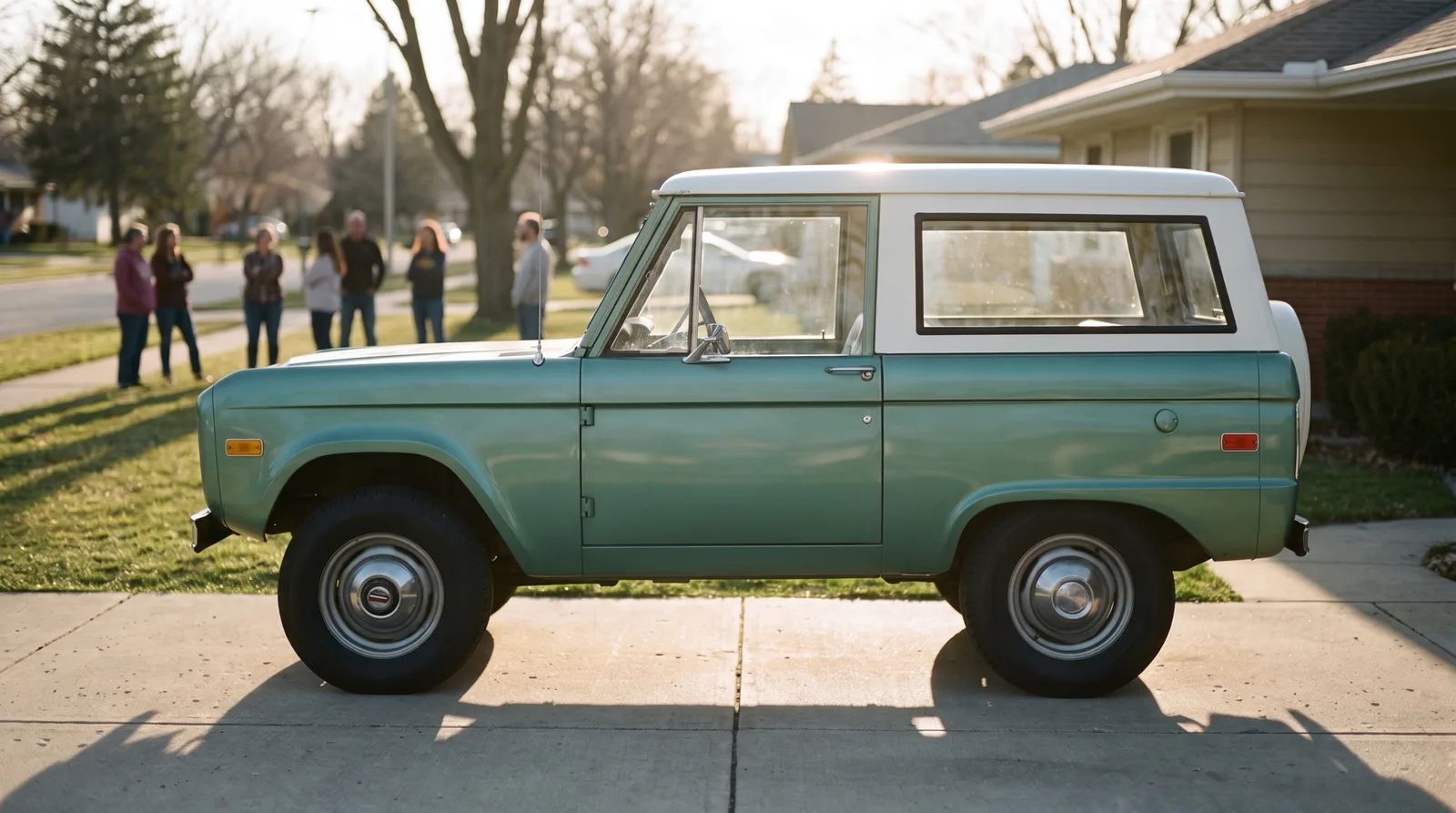
The transmission lineup, plainly stated
Base Broncos in 1973 came with a three-speed manual. Buyers who wanted more capability could step up to a heavier-duty manual gearbox. And buyers who wanted to skip shifting entirely could order Ford's C4 automatic, paired most commonly with the 302 V8. The six-cylinder could be had with an automatic too, though most buyers who cared about ease of driving also wanted the extra torque of the V8, so the two options tended to travel together on order sheets.
The specific gear ratios Ford used in the Bronco application varied by axle and engine pairing, and exact figures are best confirmed against a factory parts or shop manual for a given build rather than assumed from general C4 literature. The C4 itself was not new technology. Ford had been using it across its truck and car lineup for years by 1973. What was new was pairing it with a compact 4x4 that most buyers still associated with manual, rough-and-ready driving.
Why the automatic mattered more than it looks like on paper
Manual transmissions make sense for serious off-road work, where control over engine braking and low-speed crawling favors a clutch pedal. But most Bronco buyers in 1973 were not rock crawling every weekend. They were hauling feed, driving to town, and occasionally going somewhere the pavement ended. For that use case, an automatic removed friction from ownership without removing much real capability.
Two-wheel-drive stop-and-go traffic is where the automatic earns its keep. A driver who does not have to manage a clutch in traffic is a driver who is more likely to put the truck to daily use rather than parking it for weekend trips only. That shift in usage pattern is part of why 1973 sits at a meaningful point in Bronco history. The truck was quietly becoming more of an everyday vehicle and less of a specialty rig, and the transmission option list is direct evidence of that shift.
| Transmission | Common pairing | Typical buyer |
|---|---|---|
| 3-speed manual (standard) | 200 I6 or 302 V8 | Work truck, budget buyer |
| Heavy-duty manual (optional) | 302 V8 | Off-road focused buyer |
| C4 automatic (optional) | 302 V8, some I6 | Daily driver, family use |
Resale and originality, the numbers that actually hold up
Here is another number worth knowing. Documented, factory-correct C4 automatics in surviving 1973 Broncos are not as common as you might expect, because decades of driveline swaps and rebuilds have left plenty of trucks running transmissions that do not match their original build sheet. A buyer who confirms a matching-numbers automatic setup, with correct casting codes and period-appropriate linkage, is buying a truck with a cleaner paper trail, and cleaner paper trails sell for more money in this market every single time.
Manual trucks face the opposite problem less often, mostly because a manual transmission is simpler and less prone to the kind of catastrophic failure that forces an owner to swap in whatever gearbox happens to be available. That is not a knock on manual trucks. It is just a fact about which drivetrain configuration tends to stay original longer, and it is worth knowing before you pay a premium for claimed originality on either type.
What the automatic means for buyers today
Here is the number that matters. An automatic 1973 Bronco is easier to sell, easier to drive, and easier to live with than a manual example. That is true now and it was true in 1973. If your plan for the truck is regular street use, the automatic is the better daily companion. If your plan is serious trail work, a manual gives you more direct control, and plenty of serious off-roaders still prefer it for that reason.
Neither choice is wrong. But do not buy a manual truck assuming you will swap in an automatic later and recoup the cost. Drivetrain swaps on a fifty-year-old truck are expensive, and matching-numbers originality matters more to buyers every year. Buy the transmission configuration that fits how you will actually use the truck, not the one you think you might upgrade to eventually.
Readers who want the fuller picture on the model year can read the background on what else changed for 1973. The upscale Ranger trim, covered separately, is worth a look too if comfort options are your priority. And if you are actually in the market, you can shop classic Bronco listings and see what automatic versus manual trucks are actually asking right now.
"People romanticize the manual because it feels tougher. Fine. But the automatic is the reason more of these trucks got driven every single day instead of sitting in a barn. Usage is what kept them alive."
- Dan Reeves
How the automatic performed against the segment's other trucks
Chevrolet's K5 Blazer and, a year later, Dodge's Ramcharger both offered automatic transmissions as buyers across the segment made clear they wanted the option. That parallel development is not a coincidence. It reflects a broader shift happening across the entire compact and mid-size truck market in the early 1970s, where manufacturers were competing as much on ease of ownership as on raw off-road ability. The Bronco's automatic held its own against these rivals in real-world driving, even if the C4 was not the newest or most sophisticated automatic on the market by 1973.
What mattered more than technical sophistication was reliability, and the C4 had a well-earned reputation for durability by this point in its production life. Ford had already worked out most of the transmission's early issues in other applications, meaning Bronco buyers who chose the automatic in 1973 were getting a proven unit rather than an unproven new design. That track record is part of why so many automatic 1973 Broncos are still running their original transmissions today, a genuine rarity for a fifty-year-old vehicle.
The bottom line on the 1973 automatic option
The automatic did not make the 1973 Bronco a different truck. It made the truck accessible to a wider range of drivers. That is the entire story. No hype needed. A C4-equipped 1973 Bronco is a genuinely usable classic today, and that usability is exactly why the option still commands buyer interest fifty years later. Whichever configuration you end up buying, confirm it against the truck's documentation before you close the deal. That single check will tell you more about the vehicle's history than any amount of guessing based on how it drives in a test loop around the block.
Sources and notes
Related Reading
Have a
Ford Bronco
for Sale?
Reach thousands of serious classic car collectors across the US.
Sell It Here →
Selling a classic? Here's how: compare the places to sell classic cars
Are You a Classic Car Dealer?
List your full inventory and connect with targeted classic car buyers.
Join as a Dealer →

About the author
Dan Reeves
Performance engine builder from North Carolina's motorsports corridor, focused on swaps, forced induction and making real, repeatable power.
Related Listings - Ford Bronco
Comments
Be the first to comment on this article.