
Ask ten early Bronco people which year they would pick and you will get four answers for 1966, three for 1976, and a couple who say it does not matter because they are going to rebuild the whole thing anyway. My answer is the 1973 Ford Bronco, and I will tell you exactly why. It is the first year you could order one with an automatic transmission and power steering, and it is still early enough that the vehicle had not started collecting the extra weight and extra plumbing that came later in the decade.
Car Features
10 min read
The 1973 Ford Bronco: Peak of the First Generation
An automatic and power steering finally arrived, and the woodgrain had not. The 1973 Bronco sits in a narrow window that is worth understanding before you buy one.
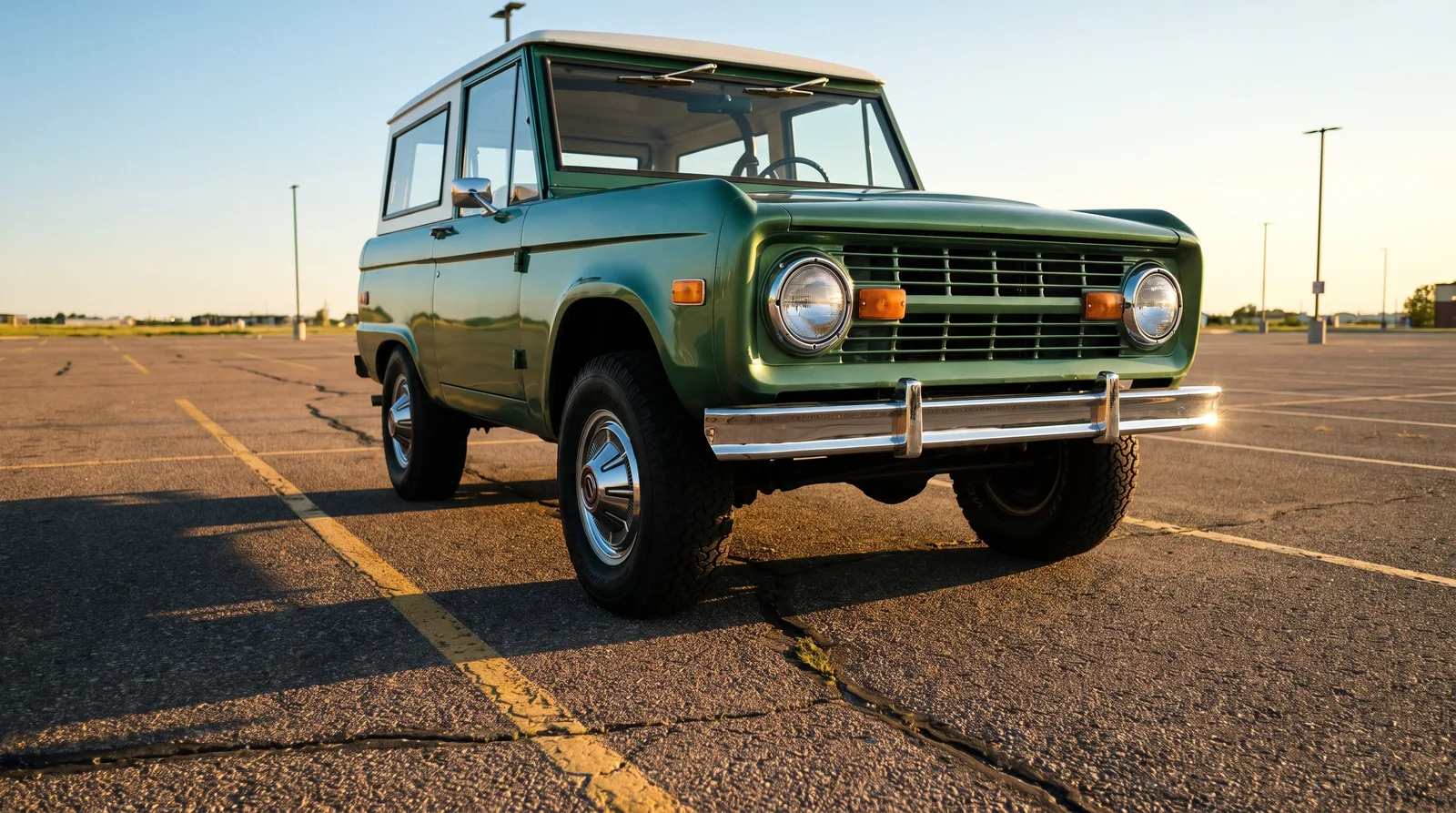
That is not a romantic argument. It is a practical one, made by somebody who has spent a lot of Saturdays under these things.
Ford finally fits an automatic
For seven model years the Bronco came one way: three-speed manual, non-synchronized first gear, and a clutch pedal that felt like it was attached to a garage door. If you wanted an automatic four-wheel-drive from Ford, you bought an F-Series and lived with the size.
In 1973 that changed. The C4 three-speed automatic went on the option sheet, bolted behind either engine, and the vehicle got noticeably easier to live with. Not faster. Not more capable. Easier. In low range and crawling over something ugly, an automatic torque converter does the low-speed modulation that a driver otherwise has to do with a clutch, and it never gets tired doing it.
The purists complained then and some of them still complain now. Fine. But the sales record is not ambiguous. Once buyers could get an automatic, a large share of them ordered one, and Ford never went back. Every full-size Bronco that followed sold overwhelmingly with two pedals.
What is worth knowing today is that this cuts one way in the collector market and the other way in the driving market. Manual cars carry a small premium with originality buyers. Automatic cars get driven more. Pick your side before you shop.
Power steering, which mattered more than horsepower
The other 1973 headline is power assist for the steering, and I would argue it changed the character of the vehicle more than any engine ever did.
A manual-steering early Bronco with a set of oversize tires on it is genuinely hard work. The steering box is slow, the geometry is what it is, and parking the thing is a shoulder exercise. Owners knew it. The aftermarket had been selling conversion kits for years before Ford got around to offering the option, which tells you how much demand was sitting there unanswered.
With factory power steering the Bronco turned into something a person could drive to work every day without thinking about it. That is the whole story of the 1970s four-wheel-drive market in one option box. These vehicles started as tools and turned into transportation, and every step in that direction sold more of them.
If you want the longer version of how that shift played out over thirty years and five generations, our ford bronco retrospective lays out the whole run.
The 200 six replaces the 170
Under the hood, the standard engine changed. The 170 cubic inch inline six that had been there since 1966 was replaced by the 200 cubic inch version of the same basic engine. More displacement, a bit more torque, and a bit more tolerance for the extra weight and the extra accessory drag that a power steering pump and an automatic bring with them.
The 302 V8 stayed as the option, now rated at 137 horsepower under the SAE net measurement the industry had adopted across the board by this point. That ratings change confuses people constantly. A 1971 brochure, still quoting gross figures, and a 1973 brochure, quoting net, are not measuring the same thing, so comparing the two numbers directly tells you nothing useful about the engines.
There is a fair amount of confusion about what else was and was not available in 1973, so here is the short version. The two body styles were the wagon and the half-cab Sports Utility, same as they had been since the Roadster left after 1968. The Dana 44 front axle had been standard since 1971, which is the axle most people want. The Dana 20 transfer case carried on. Free-running front hubs, a limited-slip rear, an auxiliary fuel tank, a swing-out spare carrier, tow hooks and a heavy-duty cooling package were all still on the sheet. Air conditioning was a dealer proposition rather than something Ford installed on the line, and the results varied wildly depending on who did the work.
Neither engine is exotic. Neither engine is fragile. The 302 in particular is about as well supported as any V8 on earth, which is a real consideration when you are buying a fifty-year-old truck and thinking about the decade ahead of you rather than the weekend.
| 1973 Ford Bronco | Detail |
|---|---|
| Body styles | Wagon, Sports Utility (half cab) |
| Wheelbase | 92 inches |
| Standard engine | 200 cu in inline six (new for 1973) |
| Optional engine | 302 cu in V8 |
| Transmissions | Three-speed manual, or C4 three-speed automatic (new) |
| Steering | Manual, or power assist (new) |
| Front axle | Dana 44, coil sprung with radius arms |
| Transfer case | Dana 20, two-speed |
| Brakes | Drums front and rear (front discs arrive 1976) |
| Approx. production | 21,894 units |
The case for calling 1973 the peak
Here is the argument, plainly. The 1973 car has the two options that make an early Bronco usable, on a body that is still the original clean shape, with the stronger Dana 44 front axle that arrived in 1971, and without the later emissions hardware that piled up as the decade went on.
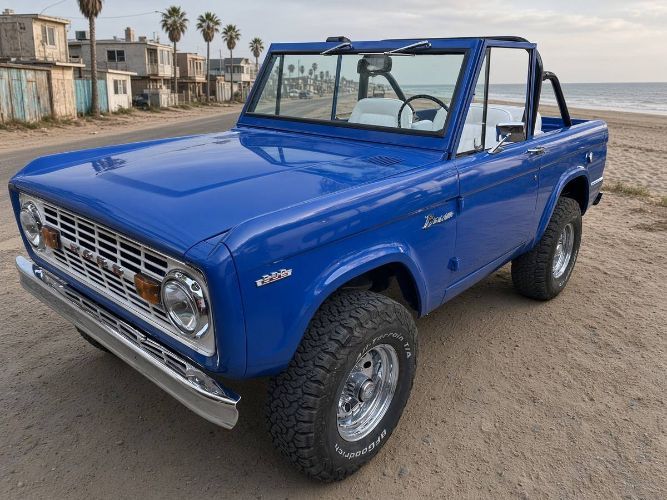
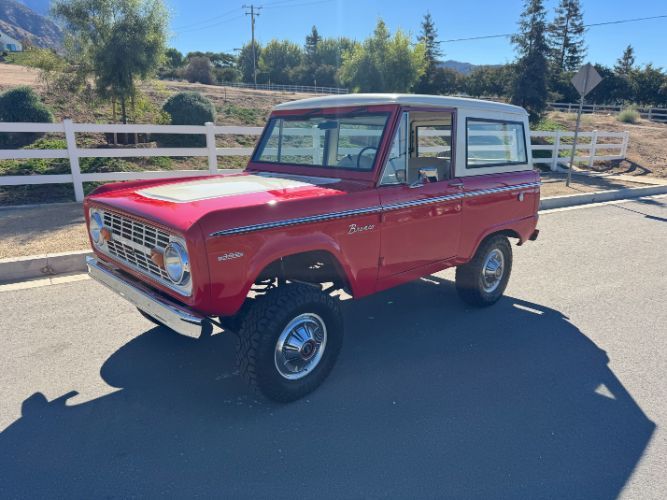
It also sits right before the trim inflation started. The Ranger package landed the following year and brought woodgrain, carpet, and a level of dress-up that some people love and some people cannot look at. In 1973 the interior is still mostly vinyl and painted steel, which is what this vehicle looks right in.
Now the case against, because I am not going to pretend it does not exist. The 1976 and 1977 cars got front disc brakes, and drum brakes on all four corners with a heavy vehicle and modern traffic are the one genuine weak point in the earlier design. If your priority is driving the thing regularly on public roads, a 1976 is the smarter buy, and anybody who tells you otherwise has not tried to stop a drum-braked Bronco behind a distracted driver.
There is a third view I hear at shows, which is that the 1966 to 1968 cars are the only ones that count because they are closest to the original idea. I understand the sentiment and I do not share it. A vehicle that is unpleasant enough that its owner leaves it in the garage is not being preserved, it is being stored. The 1973 sits at the point where an early Bronco becomes something you actually use, and used vehicles get maintained, sorted, and kept alive. The trailer queens get admired and quietly deteriorate.
The competitive picture supports the same reading. By 1973 the Chevrolet K5 Blazer was outselling the Bronco comfortably, and it did so with a bigger cabin, a bigger engine range, and, crucially, an automatic and power steering that Chevrolet had offered from the start. Ford was not innovating in 1973. Ford was catching up. That is exactly why the changes landed so well, because the demand had been proven by somebody else first.
So call 1973 the peak of the original recipe and call 1976 the peak of the engineering. Both statements survive contact with reality.
"An automatic and power steering did more for this truck than another fifty horsepower ever would have. Ford took seven years to figure that out. The buyers had it worked out by about 1968."
- Mike Sullivan
Production, the embargo, and the numbers
Ford built 21,894 Broncos for 1973, which was respectable but hardly enormous. The vehicle had never been a volume seller in the way the F-Series was, and it was not about to become one on a 92-inch wheelbase while Chevrolet was selling the much larger K5 Blazer against it.
The other thing that happened in 1973 was the oil embargo in October, and it landed on the four-wheel-drive market like a dropped transmission. Fuel prices spiked, availability got strange, and a vehicle that returned mid-teens on a good day suddenly looked like a poor decision to a lot of shoppers. Sales across the segment took a hit. The recovery came, but the early Bronco never got the volume it might have had in a calmer year.
That matters to survivors. Fewer built means fewer left, and the 1973 through 1977 cars have also been chewed on hard by the resto-mod trade, which values a clean early body far above any question of what year it is. Rust took a lot of the rest. These trucks had no meaningful corrosion protection in the rear quarters, the floors, the tailgate, or the lower rear body, and a Bronco that spent twenty winters on salted roads is usually beyond sensible economics.
What a 1973 is worth and what to look at
Values follow the same rules as the rest of the early Bronco market, which is to say the body decides almost everything. A rust-free southwestern wagon with tired paint and a healthy 302 is worth real money. A shiny eastern car with fresh seam sealer and no history is a gamble at any price.
Beyond the body, the things that move a 1973 up or down are straightforward. Documented original drivetrain helps. An honest interior helps more than people expect, because reproduction trim is available but never quite right. Uncut fenders matter, since the flare-and-oversize-tire era left a lot of these with hacked wheel openings. And the transmission choice matters both ways, depending on which buyer is looking.
The resto-mod market runs alongside all of this on its own terms, with coilover suspensions, fuel-injected engines and price tags that have nothing to do with model-year originality. Both markets are legitimate. Just be clear which one you are shopping in when you go to look at Broncos for sale now, because the same money buys two completely different objects.
The 1973 Ford Bronco is the year the original design got the two things it had always needed, and the last year before the dress-up packages arrived. That is a narrow window and it is worth knowing about. For the wider view across the whole 1966 to 1977 run, here is a related story.
Sources and notes
Related Reading


About the author
Mike Sullivan
Detroit-area muscle car enthusiast and restoration specialist with three decades of hands-on experience working on American iron.
Related Listings - Ford Bronco




Comments
Be the first to comment on this article.