
For one week in November 1927, the trade press counted 550 Fords built. In the same week Chevrolet built 6,682. A year earlier Ford had turned out about 20,000 cars in that week. Those three numbers frame the whole model a vs chevrolet contest: Ford was not defending a lead when the Model A arrived, it was trying to win one back from a rival that had already taken first place.
Car Features
6 min read
Model A vs Chevrolet: The Four Against the Six
Ford's Model A four took on Chevrolet's 1929 six on price and won first place back in 1929. The specs, the prices and how the fight ended.
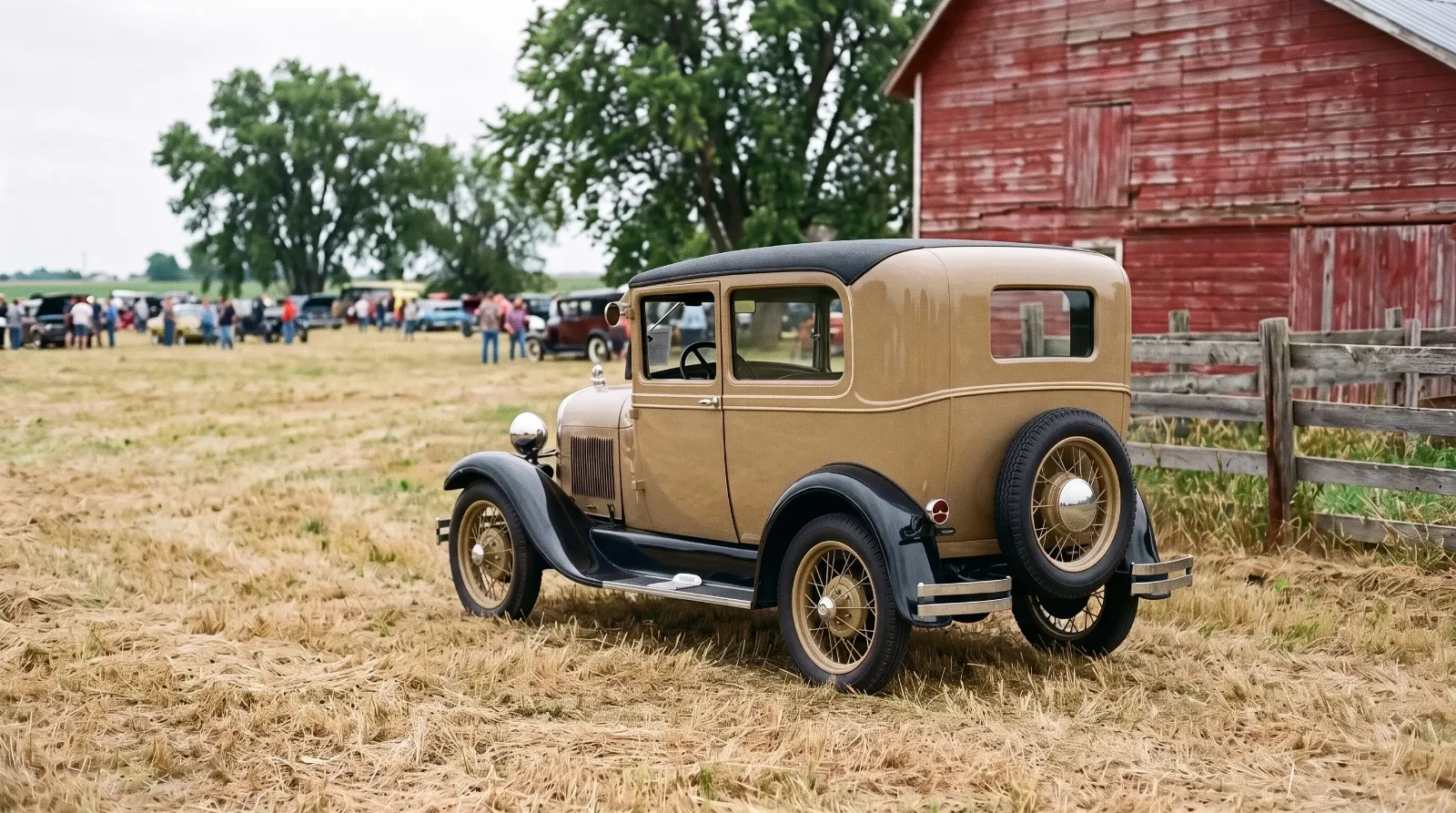
The Model A did win it back, briefly. Then Chevrolet answered with a six-cylinder engine at four-cylinder prices, and the fight became a straight argument about cylinders, price and what buyers in the low-price field would pay for. If you want the engineering jump from Ford's old car to its new one, read the Model T vs Model A first. This piece is about the market the Model A walked into.
How Chevrolet got ahead of Ford
The Model T's sales collapse is the backdrop. Ford built 1,817,891 cars in the United States in 1923. By 1927 the figure was 356,188, and production of the T stopped in May of that year for roughly six months while Ford retooled. Chevrolet, meanwhile, passed half a million cars in 1926 and took first place in 1927.
The strategy behind that came from General Motors president Alfred P. Sloan, who bet that Model T owners would trade up for comfort, features and style once they could afford to. Running Chevrolet through those years was William S. Knudsen, a former Ford production man, so the company that beat Ford was partly run on Ford training.
The product was the 1927 Chevrolet Capitol Series AA: an overhead-valve four with a three-speed sliding-gear transmission and steel disc wheels, in seven body styles from $525 to $745. The $695 two-door Coach was the best seller, roughly a quarter of the volume. Against it, Ford in early 1927 was still selling a two-speed planetary car designed in 1908.
Round one: the 1928 Model A against the Chevrolet four
The Model A went on sale on December 2, 1927, and it closed the gap on paper immediately. It had a 201 cubic inch L-head four rated at 40 hp, a three-speed sliding-gear transmission like the Chevrolet, four-wheel mechanical brakes, and a laminated safety glass windshield, which brought that feature to the low-price field as standard. It also undercut Chevrolet on price.
| Item | 1928 Ford Model A | 1927 Chevrolet Capitol AA | 1929 Chevrolet six |
|---|---|---|---|
| Engine | 201 cu in L-head four | Overhead-valve four | 194 cu in overhead-valve six |
| Rated power | 40 hp at 2,200 rpm | Not compared here | 46 hp |
| Transmission | 3-speed sliding gear | 3-speed sliding gear | Not compared here |
| List price range | $385 (Roadster) to $570 (Fordor) | $525 to $745 | $525 to $725 |
| Two-door sedan | Tudor $495 | Coach $695 | Not compared here |
A Tudor at $495 against a Chevrolet Coach at $695 is a $200 gap on the body style that sold best for both companies. That is the number that mattered most in 1928. For the full price list by year and body, see what it cost new.
Price alone did not put Ford back on top in 1928, though. The Model A launched into a long ramp-up, and contemporary reporting in TIME showed Chevrolet out-producing Ford for 1928. The production methods Ford leaned on to get back to volume were the ones it had built for the Model T, and that history is covered here.
Round two: the four against the six

Chevrolet introduced its six on November 17, 1928, for the 1929 model year. The engine was a 194 cubic inch overhead-valve inline six rated at 46 hp, six more than the Model A. It came in at $525 to $725, a range that sat on top of Ford's own prices rather than far above them.
Ford's 1929 list ran from a $435 Roadster to a $600 Fordor for the everyday body styles, with a $500 Tudor. So Chevrolet was offering two more cylinders and six more horsepower for money that overlapped with the dearer Fords. Ford's answer was not a six. It kept the four through the end of the Model A in 1931.
Here is the result that surprises people. Ford regained first place in US sales in 1929, the year Chevrolet launched the six. The Model A, now in full production, outsold the newer, smoother Chevrolet: Ford built 1,507,132 cars in the United States that year against 1,328,605 Chevrolets. My read is that a cheaper sedan and a fresh design beat the cylinder count, at least for a while.
"The six was the better engine on paper and the Model A was the better deal on the price tag. For two years the price tag won. That tells you what the low-price buyer was really shopping for in 1929."
David Mercer
How the contest ended
The lead did not last. Ford held first place in 1930 as well, building 1,155,162 cars in the US while Chevrolet sales fell to about 641,000 as the Depression bit. In 1931 Chevrolet took it back, as the Model A aged in its fourth year and Ford's replacement was not ready: Ford's US output dropped to 541,615, and Chevrolet built about 627,000. The counts mix production and sales, so read them as a guide rather than a ledger, but the rank order is clear: Chevrolet first in 1927 and 1928, Ford first in 1929 and 1930, Chevrolet first again in 1931.
Ford's response came in 1932 with the V8, which answered Chevrolet's six with eight cylinders, but that belongs to a different car.
What the rivalry means for buyers today
The market has its own verdict, and it favors volume. Ford built 4,858,644 Model As, and estimates put the survivors at about 250,000 cars, complete or in pieces. That population supports clubs, judging standards and a deep parts supply, which is a large part of why a Model A is still the easier car to own and sell. Liquidity follows numbers.
Prices stay modest for ordinary closed cars. A 1929 Model A Town Sedan kept by one family for 97 years sold at a public auction in Fenton, Michigan, in August 2026 for $19,000. That is one sale, not an index, but it fits what you see for honest, original closed Model As. I do not have comparable recorded sales for Chevrolet fours and sixes of the same years, so I will not pretend to quote a gap between them.
My view: buy the Model A if you want parts, community and an easy resale; look at the Chevrolet if you want the smoother six and are willing to do more homework on parts and values. Either way, both cars came out of the same fight that ended the era of Henry Ford and his Model T, and each one is a fair record of how its maker read the buyer.
Sources and notes
Related Reading


Have a
Ford Model A
for Sale?
Reach thousands of serious classic car collectors across the US.
Sell It Here →
Selling a classic? Here's how: sell my classic car
Are You a Classic Car Dealer?
List your full inventory and connect with targeted classic car buyers.
Join as a Dealer →

About the author
David Mercer
Classic car market analyst with two decades of experience tracking collector car valuations, auction results, and investment trends.
Related Listings - Ford Model A
Comments
Be the first to comment on this article.