
Ford took nine years to answer the Chevrolet K5 Blazer. That is the number that matters most about the 1978 Ford Bronco. Chevrolet put a short-wheelbase, V8-powered, removable-top full-size four-wheel drive on the market in 1969. Dodge followed with the Ramcharger in 1974. Ford, which had been first into the compact end of the segment in 1966, sat out the big-truck fight until the 1978 model year. When the answer finally came, it was very good and very late.
Car Features
11 min read
The 1978-1979 Ford Bronco: The Big Bronco Arrives
Ford waited nine years to answer the Chevrolet K5 Blazer. When the full-size Bronco finally landed for 1978, it lasted exactly two model years in that form, and that short run is why collectors care.
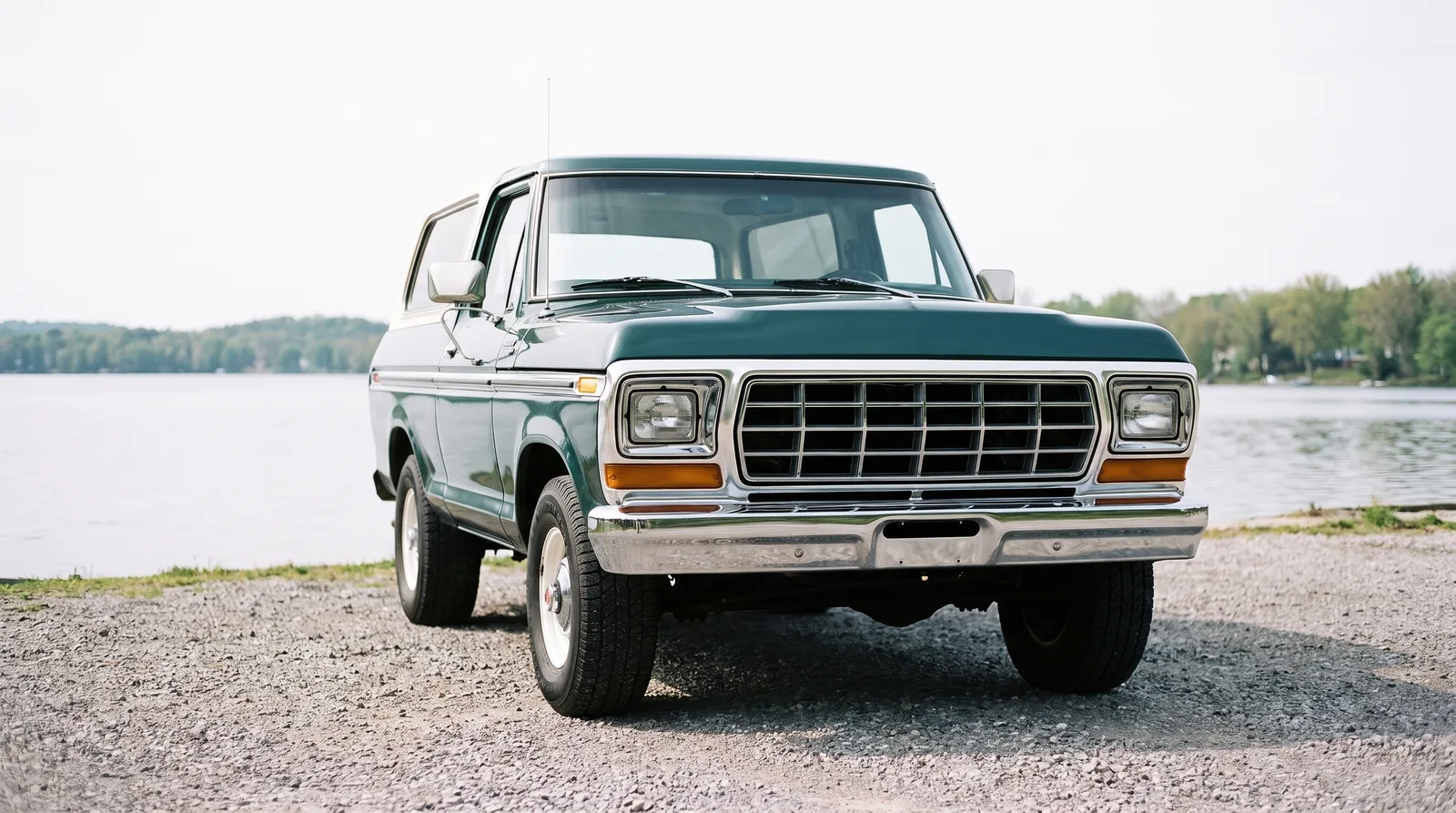
The result was a truck that lasted exactly two model years in that form. That short run is the reason collectors care. It is also the reason so many people get the story wrong.
Why Ford was late
Ford knew it had a problem by 1970. Internal work on a full-size Bronco ran under the project name Short-Horn, aimed at a 1974 launch on the F-Series chassis. Then the Arab oil embargo hit in October 1973, fuel prices doubled inside a year, and a 4,600-pound truck with a 400 cubic inch V8 stopped looking like a safe bet. Ford shelved it.
The delay cost real volume. Chevrolet and GMC sold Blazers and Jimmys by the tens of thousands every year through the mid seventies while Ford kept building the 92-inch-wheelbase early Bronco, a design that was already a decade old and selling in the low twenty thousands. For the full arc of how the nameplate got there, our ford bronco history covers the 1966 launch and the twelve years that preceded this reset.
By 1976 fuel prices had settled, truck demand was climbing, and Ford dusted off the plan. The 1978 Bronco arrived in dealerships in the spring of 1977 as an early-release 1978 model. The old Bronco and the new one overlapped on showroom floors, which is why 1977 brochures and 1978 brochures look like they describe two unrelated vehicles.
There is a second reason the delay mattered, and it is not about fuel. Between 1969 and 1977 the buyer changed. The four-wheel drive market stopped being farmers, foresters and hunters and started being suburban families who wanted a second vehicle that could tow a boat, carry four people in comfort and go to the lake with the roof off. Chevrolet had eight model years to learn what that customer wanted and to build dealer relationships around it. Ford arrived with a better-engineered product and no installed base. The 1978 sales figures reflect that. The 1979 figures show how quickly the gap closed once buyers actually drove one.
What actually changed in 1978
Everything except the badge. The 1978 Bronco is an F-150 with a shortened frame and a removable roof. Wheelbase went from 92 inches to 104. Overall length went from roughly 152 inches to about 180. Curb weight went from around 3,400 pounds to roughly 4,700. The early Bronco was a compact. The big Bronco was a full-size truck with the rear third of the cab cut off and replaced by fiberglass.
The engineering was straight F-Series. Solid Dana 44 front axle on coil springs and radius arms, the same layout Ford had put under the 1977 four-wheel drive F-150. Ford 9-inch rear on leaf springs. NP205 transfer case, gear driven, part time, the one nobody complains about. Four-speed New Process 435 manual with a granny first gear, or the C6 three-speed automatic. This was a truck built out of parts that were already proven in the highest-volume pickup line in the country, which is exactly why so many survive.
The removable top was the party trick. The entire fiberglass roof section behind the front seats came off, taking the rear side glass with it, leaving a very large open-air truck. It was heavy enough that Ford recommended two people and most owners did it once, admired it, and never did it again.
Inside, the gain over the early Bronco was enormous and rarely discussed. The 1966 to 1977 truck had a flat dash, a cramped footwell and seats that treated comfort as optional. The 1978 truck inherited the F-Series cab, which meant real seat travel, a proper heater, an instrument panel designed to be read at speed, and enough shoulder room that two adults could sit in it for six hours without a fight. Rear passengers got a bench with actual legroom instead of a jump seat. That single change is why the big Bronco found families and the early Bronco mostly found enthusiasts.
| Specification | 1978-1979 Ford Bronco |
|---|---|
| Wheelbase | 104 in |
| Overall length | 180.3 in |
| Curb weight | approx. 4,663-4,718 lb depending on configuration |
| Standard engine | 351M V8, 5.8 L |
| Optional engine | 400 V8, 6.6 L |
| Transmissions | NP435 4-speed manual, C6 3-speed automatic |
| Transfer case | NP205, part-time, gear driven |
| Front axle | Dana 44, solid, coil springs with radius arms |
| Rear axle | Ford 9-inch, leaf springs |
| Fuel capacity | approx. 25 gal standard, larger tank optional |
| Model years in this body | 1978 and 1979 only |
The engines, and what they were really worth
Two V8s, no six, no small block. Standard was the 351M, a 5.8-liter member of the 335 family that shares a tall deck and a bell housing pattern with the 400. Optional was the 400 itself, 6.6 liters. On paper the 1978 numbers were about 156 horsepower for the 351M and 158 for the 400, both net ratings, both strangled by the emissions hardware of the period. Torque is where the 400 earned its money, roughly 277 pound-feet against about 262 for the smaller engine.
Those are not exciting figures. They were not exciting in 1978 either. A 1971 Bronco with the 302 made a similar amount of net power in a truck a thousand pounds lighter. What the big engines bought was low-rpm pull, the ability to move 4,700 pounds plus a boat without drama, and a service life measured in decades. Fuel economy sat in the low double digits at best, and honestly, single digits in real use with 33-inch tires.
The 351M and 400 have a reputation problem that is mostly undeserved. They are not powerhouses. They were never meant to be. They are torque engines built for trucks, and the failure mode people remember, the timing chain and the smog-era carburetor calibration, was a maintenance issue rather than a design flaw.
1979: rectangles, catalysts and the volume year
The 1979 Bronco is the better seller and the more common survivor. Ford built 77,917 units for 1978 and 104,038 for 1979. Two things drove that. First, word had gotten around that the truck was good. Second, 1979 was the last model year before the 1980 redesign, and the market had figured out that a big, simple, coil-sprung Bronco was a useful thing to own.
The visual change was the front end. Rectangular headlights across the range, a revised grille, and a cleaner hood line brought the Bronco in step with the 1979 F-Series facelift. Under the skin, catalytic converters arrived on most configurations and compression stayed low. Power did not improve. Emissions compliance did.
Anyone shopping the era should decide early which face they want, because it drives price more than mileage does. The 1978 round-headlight trucks carry a small premium among purists. The 1979 trucks are easier to find in good condition. If you are weighing the two, the generation that followed is worth a look too, since the 1980 redesign changed the front suspension and the whole character of the truck.
Trim, paint and the Free Wheeling era
Two trim levels: Custom at the bottom and Ranger XLT at the top. Custom meant a rubber floor, a bench seat, and painted steel. Ranger XLT meant carpet, woodgrain on the dash, chrome bumpers, and better door panels. In between sat the Ranger, which is where a lot of the survivors landed.
The paint is what people remember. This was the Free Wheeling period at Ford, and the Free Wheeling package put wide rainbow band stripes down the sides in orange, red and yellow, added blacked-out trim, white-spoke wheels and raised-white-letter tires. It looks exactly like 1978 looked. Buyers who lived through it either love it or find it embarrassing, and there is no middle ground.
Colors ran to the period as well. Chrome Yellow, Bright Blue Glow, Candyapple Red, Wimbledon White, Dark Jade. A correct two-tone with the factory tape stripe intact is now a genuine value add, because reproducing the multi-color band graphics correctly is expensive and most trucks lost them to a repaint decades ago.
The option list is where the money went. Air conditioning, tilt steering, an AM/FM stereo with an eight-track, a swing-away spare carrier, a front bumper winch, auxiliary fuel, limited slip in the 9-inch, and the Ranger XLT interior could push a truck from the low six thousands to well past eight thousand dollars. That was serious money in 1978, roughly the price of a well-equipped mid-size sedan. It also explains why the surviving trucks skew toward high-trim examples. People who spent that much on a Bronco tended to look after it, and the stripped Custom work trucks were used up and thrown away.
"People argue about which Bronco is the real one. The market already answered. The 1966 to 1977 trucks are the collectibles, the 1980s trucks are the users, and the 1978 to 1979 pair sits in the middle with two model years of supply and a decade of demand. That gap is the whole investment case."
- Dan Reeves
What the two-year truck is worth now
Start with supply. Roughly 182,000 units across both years, built forty-plus years ago, in a body style that rusted at the rear wheel arches, the rocker panels, the cab corners and the tailgate. Then subtract the ones that went to the crusher during the cheap-truck decades, the ones that got lifted onto 44-inch tires in 1994 and never came back, and the ones that were parted out for the 400 and the NP205.
What is left is a small pool. Clean, unmodified, rust-free examples with the original drivetrain now trade in a range that would have looked absurd in 2010. Project trucks are still cheap in absolute terms and expensive in practice, because bodywork on a 1978 Bronco costs the same as bodywork on anything else and the truck is worth less when finished than an early Bronco of similar quality.
The honest opinion: buy the best one you can find, not the cheapest one you can fix. The gap between a driver and a project on this generation is wider than the purchase price suggests. If you are ready to look at what is actually available, shop classic Bronco listings and pay attention to how few 1978 and 1979 trucks appear compared with the 1980s cars.
Why the big Bronco matters
The 1978 Ford Bronco is the moment the nameplate stopped being a niche compact and became a mainstream American truck. That shift is why the Bronco survived into the nineties, why it was on television during the most-watched vehicle pursuit in history, and why the name still carried enough weight in 2021 for Ford to bring it back.
It also settled an argument inside Ford. The early Bronco had been a specialty product built in modest numbers on its own unique chassis, with its own tooling and its own economics. The big Bronco shared almost everything with the F-Series, which meant it could be built profitably at four times the volume without a dedicated line. Every full-size Bronco after 1978 followed that logic, and so did the Expedition that replaced it in 1997. The 1978 truck is where the nameplate stopped being a project and became a business.
Two model years. One solid front axle. A truck that was late to the fight and won anyway. The numbers on the 1978 and 1979 Broncos are not the biggest in Bronco history, but they are the ones that changed what the badge meant.
Sources and notes
Related Reading


About the author
Dan Reeves
Performance engine builder from North Carolina's motorsports corridor, focused on swaps, forced induction and making real, repeatable power.
Related Listings - Ford Bronco




Comments (1)
R
Ray Staubach
4 days ago
The 1978 truck is the one to own if the goal is appreciation. Ford built 77,917 of them against 104,038 for 1979, and the round headlights make a 1978 easy to identify from across a lot. Buyers should verify the 400 option against the VIN engine code rather than the air cleaner decal. A 351M truck wearing a 400 decal is not unusual, and it is not a 400 truck.