
Ask a shop full of Ford people about the bullnose Ford Bronco and you will get an argument before you get an answer. Bullnose is what everybody calls the 1980 through 1986 trucks, on account of the rounded, forward-leaning nose that replaced the flat squared-off face of 1979. Nobody at Ford ever printed the word in a brochure. It came out of parts counters and swap meets, the same place the other two nicknames came from, and it stuck because it is accurate and short.
Car Features
10 min read
The 1980-1996 Ford Bronco: Bullnose, Brick and OBS
Bullnose, Bricknose and OBS cover seventeen model years of full-size Bronco. Here is what actually changed, what the Twin Traction Beam argument is really about, and which years are worth owning.
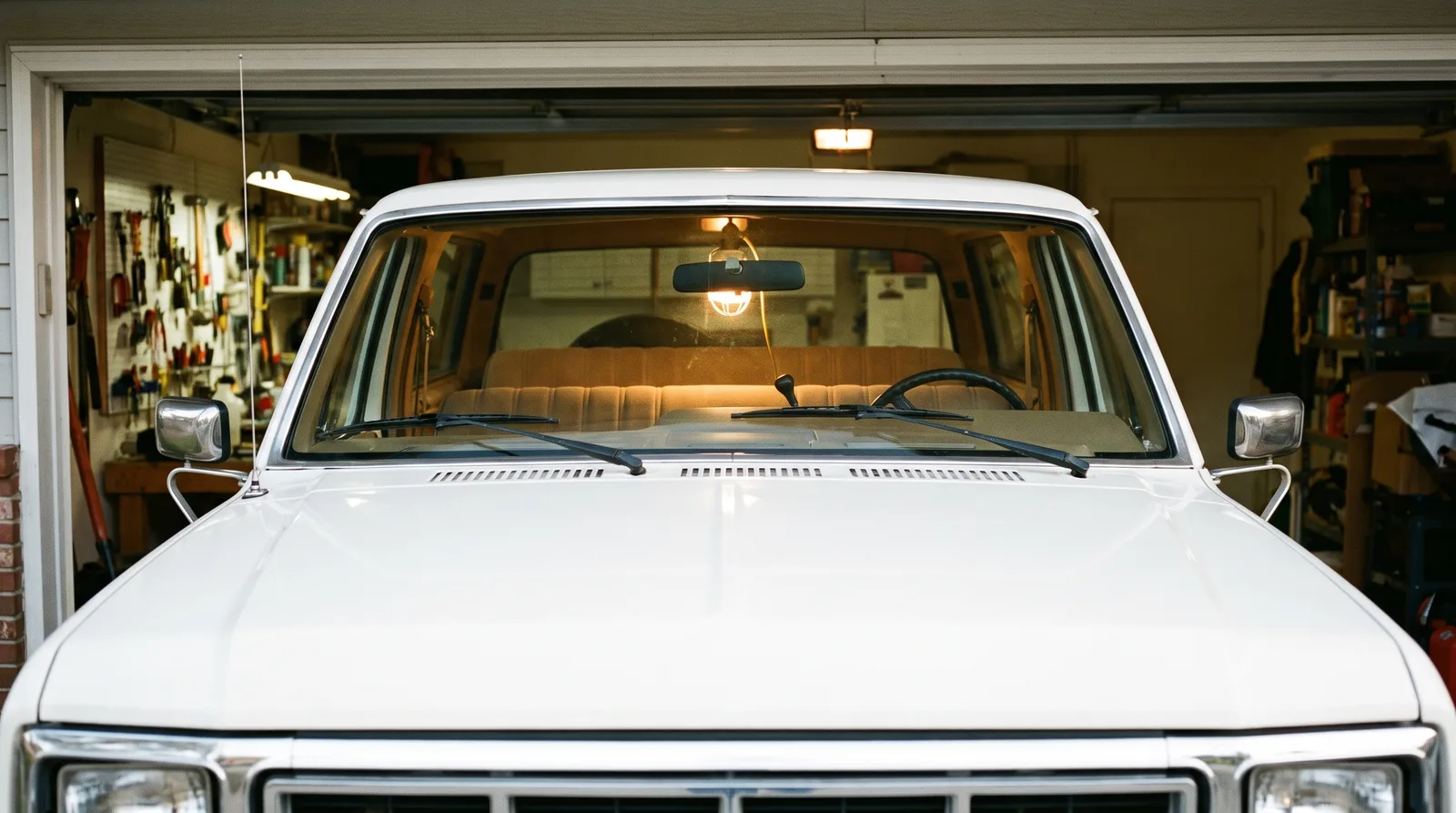
Those three nicknames cover seventeen model years of full-size Bronco. Bullnose from 1980 to 1986. Bricknose from 1987 to 1991. OBS, meaning old body style, from 1992 to 1996. Same basic idea the whole way through, three different faces, and a running disagreement about which one Ford got right.
1980: lighter, slipperier, and a new front end underneath
The 1978 and 1979 Bronco was an F-150 with the back of the cab cut off. Good truck. Heavy truck. For 1980 Ford threw out the body and the frame and started over with fuel economy as the target, because the second oil shock in 1979 had put diesel at the pumps and panic in the product planning meetings.
The weight came down by roughly 500 pounds depending on how the truck was equipped. Ford did it the way everybody did it in 1980, with thinner steel, aluminum in places that used to be cast iron, plastic where plastic would hold up, and a body shaped to slide through the air instead of push it. The grille leaned forward. The hood dropped at the front. The windshield laid back a couple of degrees. None of it was dramatic, and all of it added up.
The bigger change was underneath, and it is the one that people still fight about. Out went the solid coil-sprung Dana 44 front axle. In came Twin Traction Beam, Ford's independent front suspension for four-wheel drive, which took a Dana 44 and cut it in half so each wheel rode on its own long pivoting beam. On the highway it was a clear improvement. In the woods it was a different animal, and not everybody liked the animal.
Twin Traction Beam and the argument that never ended
Here is the honest version. TTB rides better than a solid axle on pavement, which is where these trucks spent 95 percent of their lives. It keeps the wheels more upright over small bumps. It made the Bronco pleasant to drive to work, and that mattered more to Ford's sales numbers than anything else.
It also changes camber as it moves, which means a lifted truck on tall tires develops a taste for the inside edges of its front tires and an opinion about which lane it wants. Alignment on a TTB truck is not a suggestion. The guys who ran them hard learned to check it after every serious outing, and the guys who did not learned it from their tire bill.
There is a second reason Ford went that way, and it had nothing to do with ride quality. By 1980 the same front suspension design was going under the two-wheel drive F-Series as Twin I-Beam, and a shared architecture across the whole light-truck line saved money at a moment when Ford was losing a great deal of it. The Bronco was never engineered in isolation. It went where the pickup went, every time, for seventeen years.
The people who hate TTB are usually comparing it to a solid axle in mud. The people who like it are usually comparing it to a solid axle on a two-hour drive at 70 miles an hour. Both are right. Ford picked the one that sold more trucks, and given that the Bronco outlived the Ramcharger by twelve years, it is hard to say the call was wrong.
| Era | Model years | Nickname | Key changes |
|---|---|---|---|
| Bullnose | 1980-1986 | Bullnose | New lighter body, Twin Traction Beam front suspension, 351 Windsor replaces 351M for 1983, EFI arrives on the 5.0 |
| Bricknose | 1987-1991 | Bricknose | Flush headlights, aero grille, redesigned dash, rear-wheel anti-lock brakes, fuel injection across the range by 1988 |
| Aero / OBS | 1992-1996 | OBS | Rounded body, new interior, side door beams, driver airbag for 1994, E4OD automatic, last year 1996 |
Engines: from the 351M to the day the carburetor died
The 1980 Bronco standardized on the 4.9-liter 300 inline six, offered only with a manual transmission, the first time a six had been standard equipment in the full-size Bronco since 1977. The 302, a 5.0-liter Windsor small block, was newly available as an option; the 1978 and 1979 trucks had no small block option at all. Above the 302 sat the 351M and the 400, both carried over, both breathing through a carburetor and both making numbers that looked embarrassing on paper. The 400 was gone after 1982 and the 351M went with it.
For 1983 the 5.8-liter 351 Windsor took over as the big engine, and it was the right call. Same family as the 302, better parts availability, easier to work on, and it did not have the tall-deck oddities of the 335 series. The 4.9-liter 300 inline six continued as the base engine through the bullnose years, still paired only with a manual gearbox. It was slow. It also ran roughly forever, which is why people still talk about it with affection they would never waste on a 351M.
Fuel injection is the dividing line that matters most for anybody buying one of these today. The 5.0 got EFI in the mid eighties, the 5.8 followed for 1988, and by the end of that year the carburetor was gone from the range. An injected Bronco starts on the first turn of the key at 15 below and idles the same in July. A carbureted one does neither without attention. If you are shopping and you do not enjoy choke linkage as a hobby, buy 1988 or later and thank me in January.
Bricknose, 1987 to 1991
The 1987 facelift is the one that made these trucks look modern, and the nickname tells you why. Flush composite headlights, a wide slatted grille that sat almost flat, body-color trim on the higher models. Bricknose. Nobody was being poetic.
The interior got the bigger upgrade. New dash, better switchgear, real gauges, seats that a person could sit in. Ford also made rear-wheel anti-lock braking standard on the full-size trucks for the 1987 model year, which was ahead of most of the field at the time. On a short-wheelbase truck with a heavy tail and a habit of swapping ends on wet pavement, that was not a marketing item. That was a genuine safety improvement.
This is also the window where the Bronco stopped being sold to people who needed one. Look at the advertising from 1988 and 1989 and you see driveways, ski racks and boat ramps, not logging roads. The truck had not changed much. The customer had. A Bronco in 1989 was competing with a Jeep Grand Wagoneer and a Chevrolet Blazer for the same family that would buy an Explorer three years later, and everybody in that showroom knew it.
Eddie Bauer trim showed up in this window and did more for the Bronco's image than any amount of advertising. Two-tone paint, tan leather, the works. It turned a truck into a family vehicle without pretending it was a car. If you want the whole arc of how a doorless 1966 runabout ended up as a leather-lined suburban wagon, the ford bronco story lays out the full run.
The aero years and the OBS badge
For 1992 the body went round. Softer corners, a rounded nose, flush glass, and an interior with a curved dash that finally looked like something built in the nineties. Underneath, the chassis was the same idea it had been since 1980, and that is exactly why the trucks are called OBS today. When the 1997 F-150 arrived with its all-new body, everything that came before became the old body style. The name stuck to the 1992 to 1996 trucks hardest because they were the last of the line.
The mechanical improvements in this window are the ones that make these the easiest full-size Broncos to live with. The E4OD four-speed automatic with overdrive replaced the ancient C6 and dropped highway rpm by a useful margin. Side door impact beams went in. A driver airbag arrived for 1994. Trim ran from the plain XL through XLT to Eddie Bauer, plus the blacked-out Nite package in 1992 and 1993 for people who wanted their truck to look like a stereo cabinet.
"Everybody wants the 1966 truck and everybody can afford a 1994 truck. That is the whole story of this generation. You get a V8, air conditioning, fuel injection and a removable roof for the price of a decent set of wheels on an early Bronco. The only thing you give up is bragging rights, and those cost about forty grand."
- Mike Sullivan
June 17, 1994, and how it ended
A white 1993 Bronco driving slowly up a Los Angeles freeway with a helicopter fleet overhead is the single most-watched moment in the nameplate's history. Roughly 95 million people saw some part of it. It was Al Cowlings behind the wheel of his own truck, not O. J. Simpson's, a detail that gets lost every single time the story is retold. That Bronco survived and now sits in a museum. Ford, for its part, reported that showroom traffic went up afterward, which tells you something about people.
The end came for ordinary reasons. Buyers wanted four doors. The two-door Bronco could not be stretched into one without a new platform, and Ford already had that platform coming. The last full-size Bronco rolled off the line at the Michigan Truck Plant in Wayne on June 12, 1996, and the four-door Expedition, unveiled that May and launched that October, took its place for 1997. It sold better immediately. It was also not a Bronco, and Ford spent the next twenty-four years finding that out.
Where these trucks sit now
For twenty years the 1980 to 1996 Broncos were just used trucks, and they were treated like it. Plow rigs, mud trucks, farm hacks, first vehicles for teenagers in 2003. That is why finding a clean one is harder than the production numbers suggest. Hundreds of thousands were built. Very few were looked after.
The market has caught on in the last few years, mostly because early Bronco prices went somewhere ordinary people cannot follow. Clean low-mileage Eddie Bauer and XLT trucks from the 1992 to 1996 window have moved up sharply, the 1987 to 1991 Bricknose trucks trail slightly behind, and honest bullnose survivors are the sleeper, because there are fewer of them left and the market has not fully worked that out yet. If you want to see what condition actually costs today, look at classic Broncos on the market and compare a rust-free bullnose against a tidy 1995 truck.
One more thing worth knowing before you spend the money. These trucks carry a name that was earned in the desert long before it was earned in a suburban driveway, and if the racing side of the badge is what pulls you, the next chapter is where that history lives. The bullnose and the trucks that followed inherited all of it, whether their owners knew it or not.
Sources and notes
Related Reading

About the author
Mike Sullivan
Detroit-area muscle car enthusiast and restoration specialist with three decades of hands-on experience working on American iron.
Related Listings - Ford Bronco




Comments
Be the first to comment on this article.