
There is a photograph that circulates every few years of a white Ford Bronco parked on hard sand somewhere on the California coast, tailgate down, two surfboards leaning against the rear bumper, and nobody in the frame. No model, no logo, no caption. It could be 1968 or it could be last Tuesday, and that ambiguity is most of what you need to know about the first generation Bronco. Ford built a small four-wheel-drive to fight the Jeep CJ, and somewhere in the twelve years that followed it turned into a piece of American shorthand instead.
Car Features
10 min read
The Early Bronco 1966-1977: The First-Generation Legend
Twelve years, three body styles, one Baja 1000 overall win and no restyle at all. How the early Bronco went from a sales problem to American shorthand.
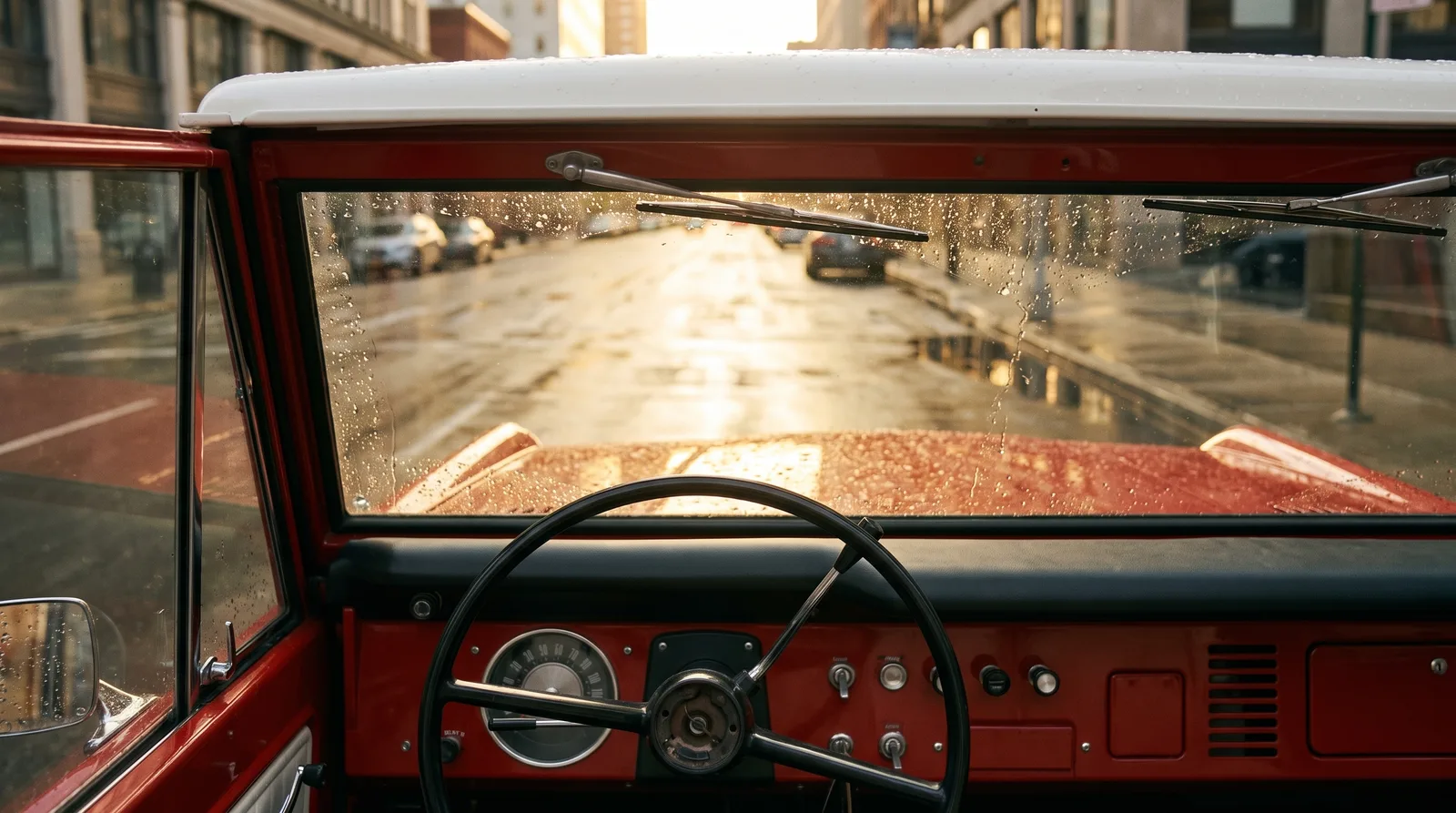
The 1966 to 1977 run is the part of the story people mean when they say "early Bronco." It is a short vehicle with flat glass and almost no styling, and it has outlived every rational explanation for why anyone should still want one.
An answer to a question Ford had been ignoring
The origin is unglamorous. Through the early 1960s Ford dealers watched Willys and then Kaiser sell CJ-5s, and watched International Harvester sell Scouts in numbers nobody at Ford had forecast, and had nothing at all to sell against either. Product planning under Donald N. Frey moved the idea forward. Lee Iacocca approved it. Paul G. Axelrad did the engineering and design work that turned it into a real vehicle.
What Axelrad drew was not a compromise. It was a purpose-built platform: a 92-inch wheelbase, a frame of its own, a coil-sprung solid front axle located by long radius arms, and leaf springs at the rear. Nothing underneath it was borrowed from a passenger car. The body was drawn with almost no compound curves in it, partly for cost and partly because a vehicle meant to be hit by rocks does not benefit from delicate surfacing.
The coil-sprung front end is the part that mattered. It gave the Bronco ride quality that a CJ-5 could not touch, without giving up the wheel travel that made it worth owning. Period road testers said so in almost identical language. Ford had built the first vehicle in the class that a person could drive on pavement without treating it as an endurance event.
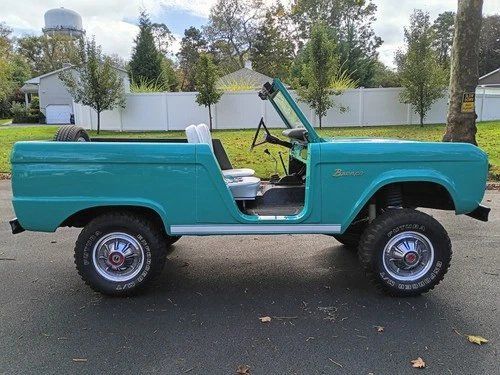
Three body styles launched in August 1965: the doorless U13 Roadster, the U14 Sports Utility half-cab, and the U15 Wagon. Ford used the phrase "Sports Utility" as an actual model name, decades before the letters SUV meant anything to anyone. For the complete arc across all five generations, there is more on the ford bronco elsewhere in the archive.
Twelve years, and the slow drift toward comfort
The first generation Bronco is often described as unchanged, and that is only true if you are looking at it from fifty feet. Ford never spent money restyling it, which is a different thing from leaving it alone.
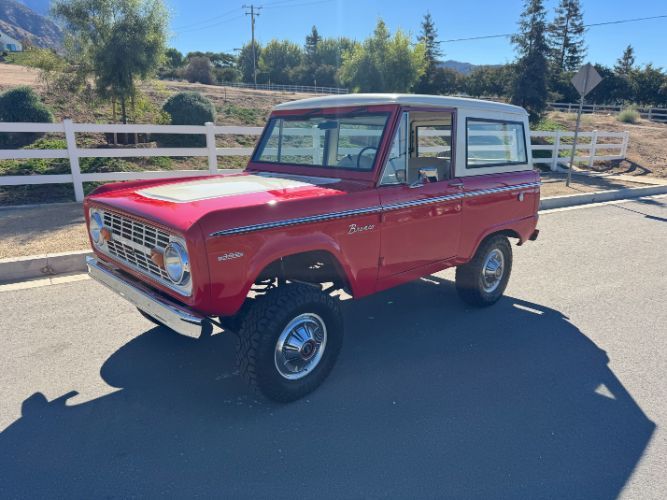
The 289 V8 arrived as an option partway through 1966 and gave way to the 302 for 1969. The Roadster left after 1968. The Sport package appeared in 1967 and grew into a proper trim level, bringing chrome, brighter interior materials and the first hint that somebody might buy this vehicle for reasons other than work. The stronger Dana 44 front axle came in 1971. The 200 cubic inch six replaced the 170 in 1973, the same year Ford finally offered an automatic transmission and power steering. The Ranger package followed in 1974 with woodgrain and carpet. Front disc brakes arrived in 1976.
Read that list in order and you can watch a tool turn into a vehicle. Each individual change is small. Together they describe the entire history of the American four-wheel-drive market compressed into one nameplate, and they explain why the last first-generation cars feel so different to drive from the first ones despite looking nearly identical.
The end came in 1977. Ford had watched the Chevrolet K5 Blazer outsell the Bronco for years on the strength of being bigger, and the 1978 replacement answered with a full-size truck built off the F-Series. That is a different animal with a different following, and there is more from this era worth reading if the big ones interest you.
| First generation Bronco, 1966 to 1977 | Detail |
|---|---|
| Body styles | Roadster (1966 to 1968), Sports Utility half cab, Wagon |
| Wheelbase | 92 inches throughout |
| Sixes | 170 cu in (1966 to 1972), 200 cu in (1973 to 1977) |
| V8s | 289 cu in (from March 1966), 302 cu in (1969 onward) |
| Automatic offered | From 1973 (C4 three-speed) |
| Power steering offered | From 1973 |
| Front disc brakes | From 1976 |
| Front axle | Dana 30 to 1970, Dana 44 from 1971 |
| Notable variant | Stroppe Baja Bronco, 1971 to 1975 |
| Approx. total production | 245,585 units across twelve years |
Baja, Stroppe, and a Bronco called Big Oly
The competition history is where the legend hardens into something you can point at.
In November 1969 Rod Hall and Larry Minor won the Baja 1000 overall in a Bronco. Not a class win. The overall win, against the light buggies that had owned the event, in a steel-bodied production four-wheel-drive. No four-wheel-drive has done it since. If you want one fact that explains why this vehicle has the reputation it has, that is the fact.
The other thread runs through Bill Stroppe's shop in Long Beach. Stroppe had been preparing Fords for competition since the 1950s and the Bronco became his life's work. With Ford's blessing he built the Baja Bronco, a factory-approved package with rounded fender flares, a padded roll bar, quick-ratio steering, an automatic and a set of suspension changes that made the vehicle genuinely fast in the rough. Just 650 were completed across the 1971 to 1975 run, and today they are the most sought-after early Broncos in existence, with a documentation problem to match, because the clones vastly outnumber the real ones.
Then there is Big Oly, the tube-framed, fiberglass-bodied, wing-topped machine Parnelli Jones and Stroppe built together, which won the Baja 1000 in 1971 and again in 1972 and looks less like a Bronco than like something drawn for a film that had not been made yet. It sold at Mecum's Indianapolis auction in May 2021 for $1.87 million, which is a strange fate for a race truck that was originally built to be used up.
"Nothing about the early Bronco was designed to be charming. It got there anyway, which is usually how these things happen. The cars built to be loved rarely are."
- Patrick Walsh
Where the culture came from
The Bronco found its people quickly and they were not the people Ford's brochures kept guessing at.
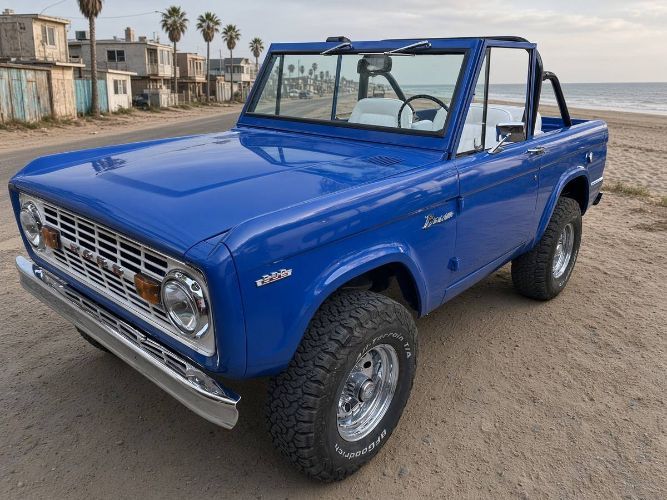
Ranchers took to it because it was short enough to be useful on a two-track and simple enough to fix with what was in the barn. The Forest Service and county road departments bought them by the fleet. Ski towns filled up with them. And on both coasts, surfers worked out that a vehicle with a removable roof, a flat load floor and no carpet to ruin was close to ideal, which is how the Bronco ended up permanently associated with sand and salt water despite being engineered for mud and snow.
The colors helped more than anyone planned. Ford painted these things out of the passenger car chart, so a working vehicle with a rubber floor could arrive in Rangoon Red, Caribbean Turquoise, Chrome Yellow or Poppy Red. That mismatch between the seriousness of the machine and the cheerfulness of the paint is a large part of why the early Bronco photographs so well, and photography is ultimately what built the modern market for them.
Hollywood arrived late but arrived thoroughly. The early Bronco became reliable set dressing for anything meant to read as rural, coastal or slightly out of time, and it has held that job ever since, turning up in films and television as a signal about a character before the character says anything. That is a peculiar kind of fame for a vehicle Ford sold in modest numbers and advertised without much conviction, and it happened because the shape is unmistakable at a glance. Almost nothing else from the period reads that fast on screen.
By the late 1990s the restoration industry had noticed. By the 2010s the Bronco had become the single most commercially developed resto-mod platform in America, with a whole tier of shops building six-figure examples on fuel injection and modern suspension. When Ford revived the name in 2021 it borrowed the round headlights and the boxy shoulders from these cars specifically, which tells you which generation the company itself considers the definitive one.
Buying into the first generation now
The market has split into three parts and they behave differently enough that lumping them together will cost you money.
There are unrestored survivors, valued on originality, documentation and honest patina. There are correct restorations, valued on quality of work and period accuracy. And there is the resto-mod tier, which answers to no model-year logic at all and is priced on the builder's name as much as on the vehicle.
Across all three, the body decides everything. These trucks had essentially no corrosion protection, and rot in the rear quarters, floors, rockers, tailgate and lower rear body is the single largest expense in any early Bronco project. It hides behind fresh undercoating and it hides behind good paint. Cut fenders from the oversize-tire era are common and permanent. Uncut original sheet metal is worth a real premium.
Documentation is the other lever, and it is undervalued in this corner of the hobby. Early Broncos were work vehicles, so the survival rate for original window stickers, build sheets and dealer paperwork is poor. When a file does exist it should move the price, because in a market this heavily modified the only reliable way to establish what a vehicle left the factory as is a piece of paper written at the time. Photographs from the 1970s and 1980s count for a great deal as well, particularly if they show the vehicle before whatever was done to it.
The year matters less than people think, with two exceptions worth remembering. Nineteen seventy-three brought the automatic and power steering, and 1976 brought front disc brakes. Both change how the vehicle drives far more than any engine choice does. Anyone about to find a classic Bronco should decide first whether this is going to be a driver or a display piece, because that single question answers most of the others.
The first generation Bronco was a rational vehicle built for practical reasons by people solving a sales problem. It became something else entirely, and it did it without ever being restyled, marketed properly, or sold in large numbers. That is a rare thing, and it is why the surfboards keep leaning against the same rear bumper sixty years later.
Sources and notes
Related Reading

About the author
Patrick Walsh
Automotive journalist covering classic car shows, events, and the enthusiast community across North America.
Related Listings - Ford Bronco




Comments
Be the first to comment on this article.