
Every Bronco club meeting eventually gets around to the same argument, and it usually starts with someone asking about Ford Bronco Baja Bronco production numbers. The Baja Bronco was the dealer-installed dress-up package that let an ordinary buyer drive home a truck that looked like it belonged on the Baja 1000 starting line, and because so few were built, figuring out exactly how many exist has become its own small obsession among collectors.
Car Features
7 min read
How Few Baja Broncos Ford Actually Built
The Baja Bronco dress-up package never had a clean factory build sheet, which is why its true production numbers are still debated at club meetings.
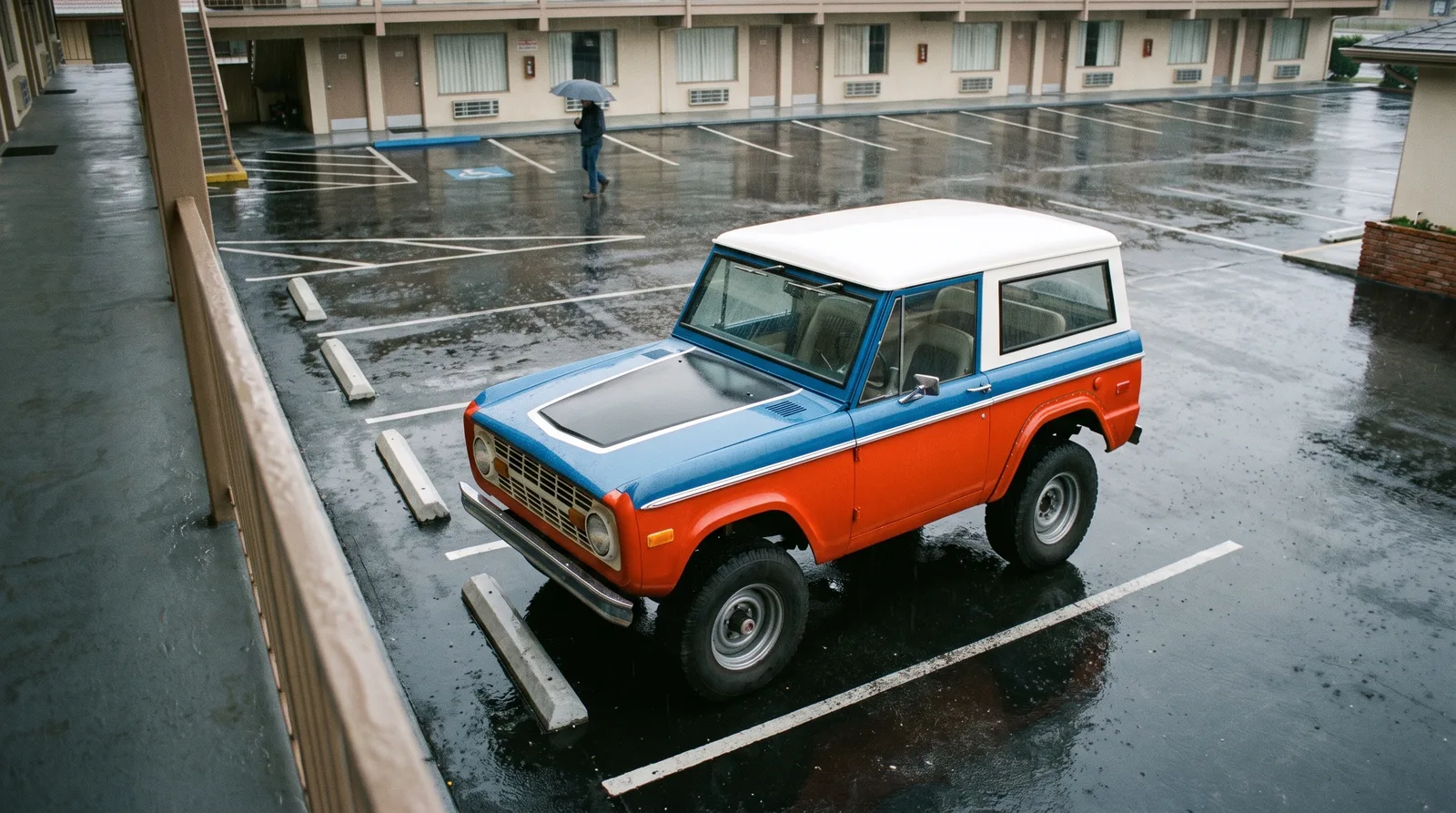
How the Baja Bronco package came to be
After Bill Stroppe's race-prepared Broncos, including the famous Big Oly, started winning attention at Baja events in the early 1970s, Ford saw an opportunity to sell some of that image to ordinary buyers who would never see a race course. The Baja Bronco package, developed through Stroppe's shop and offered through participating Ford dealers starting around 1971, dressed a standard Bronco in wide fender flares, a bold graphics package, upgraded shocks, and styled wheels that echoed the look of the race trucks without the actual race-spec chassis underneath.
It was a clever piece of product strategy. Buyers got a truck that looked the part of a desert racer, with genuine handling improvements from the upgraded suspension components, while Ford avoided the cost and liability of selling an actual competition vehicle to the public. Dealers marketed the package hard, leaning into the racing connection that Stroppe's program had already built, and for a certain kind of buyer in the early 1970s, nothing else on a Ford lot looked as purposeful.
Why the exact production number stays contested
This is where the story gets genuinely difficult to pin down. The Baja Bronco was never a standard factory model with its own dedicated production line and tracked build sheet the way a regular trim level would have been. It was assembled through a combination of factory content and dealer-installed or aftermarket-supplied components, which means the paperwork trail is thinner and less consistent than it is for mainstream Bronco variants from the same years.
The commonly cited figure, drawn from Ford sales records referenced by historians, puts total Baja Bronco production at around 650 units sold over the roughly four years the package was offered starting in 1971, priced at $5,566 against a standard V8 Bronco's $3,665. Even that widely used number gets treated cautiously by serious researchers, since dealer-installed content leaves room for undercounted or partial builds. Some trucks may have received partial packages. Some dealers may have applied elements of the look without ordering the full official kit. Distinguishing a genuine, fully documented Baja Bronco from a truck that simply wears similar graphics requires careful attention to the specific hardware and, ideally, surviving dealer or Stroppe shop paperwork.
What low production means for today's market
Scarcity, real or perceived, drives collector interest, and the Baja Bronco benefits from both. A verified, well-documented example commands a serious premium over a standard early Bronco, and the gap has only widened as interest in the entire classic Bronco platform has grown. That premium creates an obvious incentive for sellers to overstate a truck's originality, which is precisely why buyers need to approach any claimed Baja Bronco with real scrutiny rather than taking a seller's word for it.
For the full context of how the Baja Bronco package connects to the racing program that inspired it, read the ford bronco baja story, which covers Stroppe's shop and the Big Oly race truck that set the visual template the dealer package borrowed from. Anyone researching the broader classic Bronco story, generations, engines, and how the truck evolved across three decades of production, can also find the full story useful background before diving into a niche variant like the Baja package specifically.
"Everybody at the show claims their truck is a real Baja Bronco until you start asking for paperwork. The scarce ones are scarce because so few dealers ever ordered the whole package, not because everyone who says they have one is telling the truth."
- Wayne Coburn
How the package changed across its run
Another wrinkle that complicates any clean production count is that the Baja Bronco package itself was not static across the years it was offered. Early examples reflected the visual details closest to the original Big Oly inspiration, while later versions saw variations in graphics, wheel choices, and available color combinations as Ford and Stroppe's shop adjusted the offering to buyer response and changing supplier availability. A truck built toward the end of the package's run may look meaningfully different from one built at the start, even though both are legitimately Baja Broncos.
That variation makes it harder to establish a single, universally agreed specification against which every claimed example can be checked. Researchers and club historians have worked to document the differences year by year, but gaps remain, and honest disagreement between knowledgeable enthusiasts over a given truck's exact originality is not unusual even among people who have studied the package closely for years.
Sorting a genuine example from a tribute
Careful buyers look past the flares and graphics, which are relatively easy to reproduce, and focus on the harder-to-fake details: the specific shock and spring components used by the original package, any surviving build documentation, and a chain of ownership that can be traced back toward the original dealer sale where possible. None of this guarantees certainty on a truck this many decades removed from new, but it separates a well-supported claim from a hopeful one.
Given how few genuine Baja Broncos exist and how much documentation gaps complicate the market, most buyers are better served understanding this history as context rather than treating every truck wearing similar graphics as the genuine article. Those looking to start a collection with a solid early Bronco, Baja package or not, can browse classic Broncos on the market and use what they now know about production scarcity to ask sharper questions before any purchase.
What the debate itself tells us
The fact that Bronco clubs are still arguing about exact production figures decades after the package stopped being offered says something about how the collector community treats this variant. It is not a footnote. It is a genuinely contested piece of the truck's history, and that level of continued interest is itself part of why documented examples command such a premium. A truck nobody cared about would not generate this much ongoing research and debate.
For newer collectors entering the hobby, that debate is worth understanding before assuming any number quoted online or by a seller is settled fact. The honest answer, at this point, is that nobody has a fully reliable production count, and anyone claiming certainty on the exact figure should be treated with the same scrutiny as a seller claiming certainty about a specific truck's originality without paperwork to back it up.
Sources and notes
Related Reading

Have a
Ford Bronco
for Sale?
Reach thousands of serious classic car collectors across the US.
Sell It Here →
Selling a classic? Here's how: the best sites to sell a classic car
Are You a Classic Car Dealer?
List your full inventory and connect with targeted classic car buyers.
Join as a Dealer →

About the author
Wayne Coburn
Longtime Corvette owner, judge and club figure who knows the cars, the records and the people behind them.
Related Listings - Ford Bronco



Comments
Be the first to comment on this article.