
Ford sold the Bronco in three body styles in 1966 and only one of them lasted the full run. The wagon survived twelve model years. The roadster lasted three. The ford bronco half cab, which Ford called the Sports Utility, made it seven. Those three numbers explain almost everything about how the early Bronco is priced today, and they explain it better than any argument about which one looks best.
Car Features
10 min read
Ford Bronco Body Styles and Engines: Roadster, Half-Cab, Wagon and V8s
Three body styles launched in 1966 and only the wagon lasted twelve years. Here is what the roadster, half cab and wagon actually were, plus the six and the two V8s that powered them.
Add the engine story on top and the picture is complete. One six, two V8s, and a twelve-year drift from gross horsepower ratings to strangled net figures. Here is how the whole thing actually worked.
Three bodies on one chassis
Every early Bronco, regardless of roof, sat on the same thing. A 92-inch wheelbase, a box-section frame, a solid front axle on coil springs, a live rear axle on leaf springs, and an overall length of about 152 inches. Body-on-frame, front engine, part-time four-wheel drive. Ford designed the platform to accept three different upper bodies from day one, which was unusually sensible for 1965.
The model codes are the fastest way to keep them straight. U13 is the roadster. U14 is the half cab pickup. U15 is the wagon. Those codes appear in factory literature and in the VIN, and they are how the collector market talks about the cars now.
| Code | Body style | Years offered | 1966 production |
|---|---|---|---|
| U13 | Roadster, doorless, folding windshield | 1966-1968 | approx. 4,090 |
| U14 | Sports Utility, half cab pickup | 1966-1972 | approx. 6,930 |
| U15 | Wagon, full-length roof | 1966-1977 | approx. 12,756 |
Total 1966 output landed at 23,776 units. That is the whole first year, all three bodies combined. For context, Ford built more Mustangs in a good month.
The roadster, gone in three years
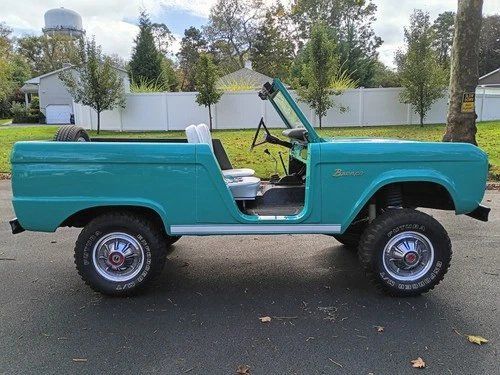
The U13 is the strangest thing Ford put on a truck price list in the sixties. No doors. No top. A windshield that folded flat onto the hood. The idea was a beach and ranch runabout, something closer to a civilian Jeep than to a station wagon, and Ford priced it as the cheapest way into a Bronco.
Buyers did not want it. Doors became an option almost immediately because customers kept asking for them, a soft top followed, and once a roadster had doors and a top the reason to buy it over a wagon disappeared. The body was dropped after 1968 with roughly 5,000 built across three model years.
There is a lesson buried in that failure. Ford built the roadster because the Jeep CJ existed and because somebody in product planning assumed the Bronco's competition was a stripped military descendant. The buyers who actually turned up wanted weather protection, a heater and somewhere to put a dog and two children. The roadster answered a question nobody in the showroom was asking, and the sales figures said so within eighteen months.
Scarcity did what scarcity does. The U13 is now the most valuable early Bronco body style by a wide margin, and correct ones are rare enough that the community tracks individual cars. It is also the body most often faked, because a wagon can be cut down and a folding windshield frame can be sourced. If you are buying a roadster, the paperwork matters more than the paint by a factor of about ten.
The half cab, or what Ford called a Sports Utility
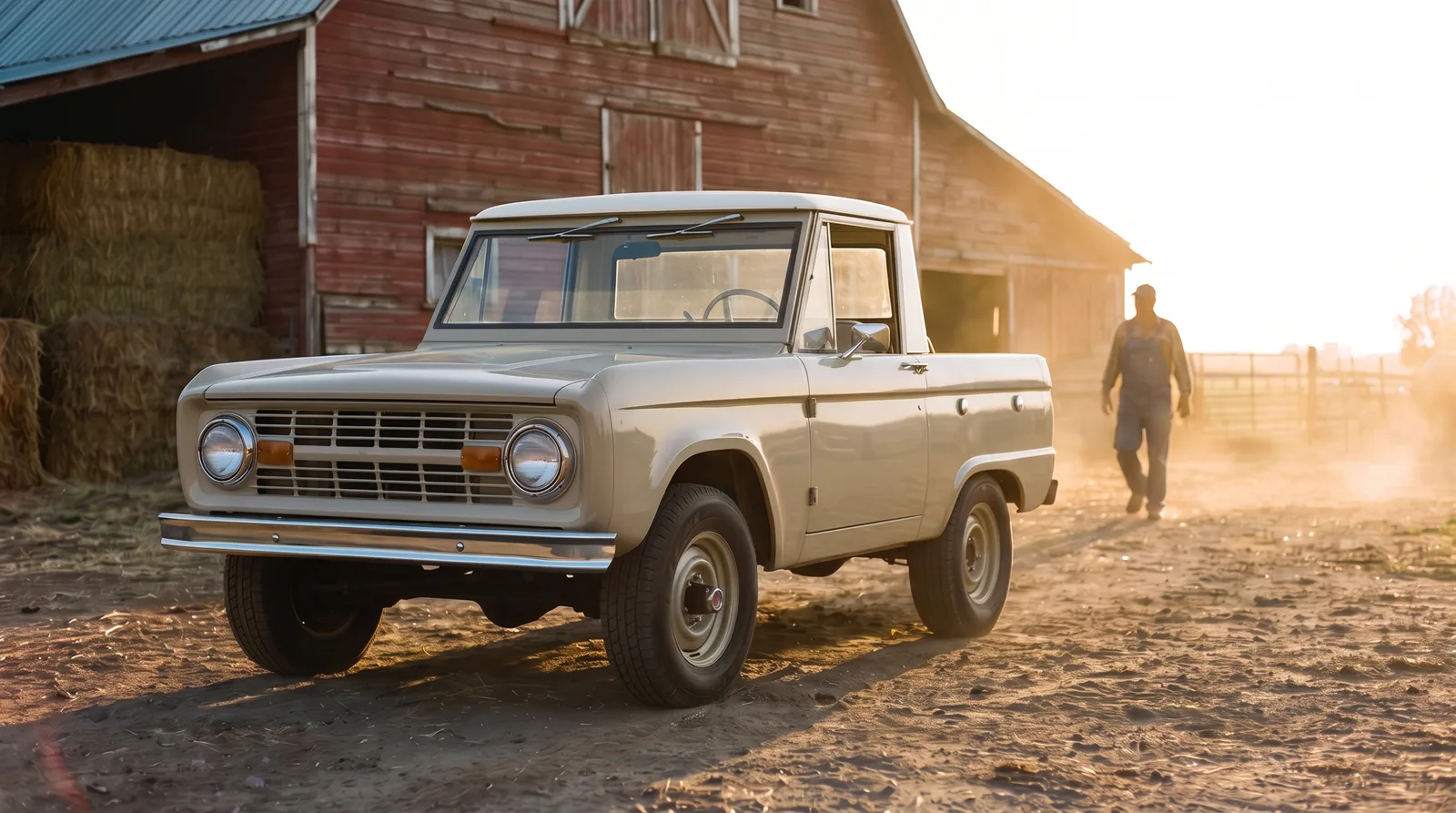
The U14 had a roof over the front seats and an open bed behind. Ford's official name for it was Sports Utility, printed exactly that way in 1966 literature, which is a small piece of automotive history worth holding onto given what that phrase became. Everyone else called it the half cab, and the nickname won.
It made real sense as a product. You got Bronco maneuverability with a usable pickup bed and a lockable tailgate, in a footprint smaller than any domestic pickup on the market. Ranchers bought them. Utility companies bought them. Forest Service fleets bought them. That fleet history is exactly why so few survive in original condition: they were tools, and tools get used up.
The half cab also solved a problem the wagon never could. With the roof section removed on a wagon you have an open truck and nowhere dry to put anything. The U14 gave you a permanently sealed cab and a bed you could throw wet, dirty or sharp things into without ruining an interior. Anybody who has loaded fence posts into a carpeted vehicle understands the appeal.
The half cab outsold the roadster comfortably in 1966 and then faded through the late sixties as buyers moved to the wagon. Ford dropped it after 1972. Today it sits in an interesting spot, worth more than a comparable wagon and less than a roadster, and prized by people who find the wagon a bit too domesticated.
The wagon that outlived both
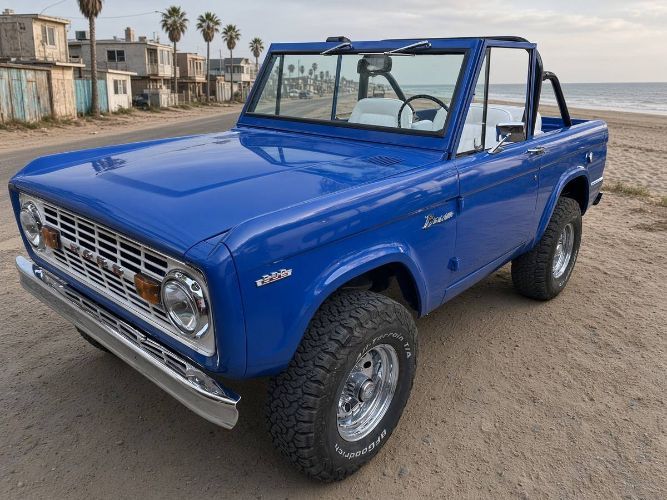
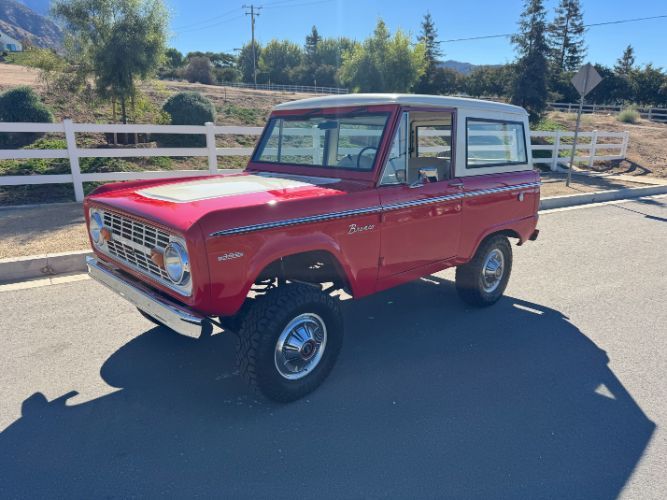
The U15 wagon accounted for more than half of 1966 production and its share only grew. Full-length removable fiberglass roof, rear side windows, a tailgate with a lift-up glass, seating for a family. It is the body most people picture when they hear the word Bronco, and it is the only one Ford still offered when the early truck ended after 1977.
That dominance is why the wagon is the accessible entry point today and why restoration parts support for it is far better than for the other two. Reproduction floors, quarters, tailgates, glass and trim are all available for a wagon. For a roadster, a lot of it is not.
The wagon is also where all the later trim development happened. The Sport package arrived in 1967 with chrome, better seats and exterior brightwork. The Ranger package took over as the luxury tier from 1972 through 1977 with carpet, woodgrain and cloth. Explorer special editions and decor groups filled in the gaps. None of that appeared on a roadster, because the roadster was long gone. For the full generational story around these bodies, more on the ford bronco puts the 1966 to 1977 run in context.
Engines: one six and two V8s in twelve years
The standard engine at launch was a 170 cubic inch inline six, 105 horsepower gross, roughly 158 pound-feet of torque. It was a passenger-car engine adapted for truck duty with a heavier crank and a better oiling setup. In a 3,400-pound four-wheel drive with the aerodynamics of a filing cabinet, 105 gross horsepower meant a top speed you could measure with a calendar.
The 289 V8 arrived as an option partway through the 1966 model year, in March, rated at 200 horsepower gross. That is the engine that made the Bronco interesting. Nearly double the power in a truck that weighed a couple of hundred pounds more. Early V8 cars are worth a premium today and the reason is simple physics.
Worth noting what the V8 did to the rest of the truck. Ford did not simply drop a bigger engine in and walk away. V8 cars generally came with a heavier front axle assembly as the years went on, larger brakes and a different cooling package, and the weight distribution shifted forward enough that the steering feel is genuinely different from a six. Anyone who has driven both back to back will tell you the V8 truck feels planted and the six feels light in the nose. That is not imagination.
For 1969 the 302 replaced the 289, rated at 205 horsepower gross, and it stayed for the rest of the early Bronco's life. In 1973 the 170 six gave way to a 200 cubic inch unit, and the industry-wide switch to net ratings dropped the published figures across the board. By the mid seventies a 302 Bronco was advertised at around 139 net horsepower. The engine had not gotten worse. The measurement had gotten honest, and emissions calibration took a real bite as well.
| Engine | Displacement | Years | Rating |
|---|---|---|---|
| Inline six | 170 cu in, 2.8 L | 1966-1972 | approx. 105 hp gross |
| Inline six | 200 cu in, 3.3 L | 1973-1977 | approx. 84 hp net |
| V8 | 289 cu in, 4.7 L | 1966-1968 | approx. 200 hp gross |
| V8 | 302 cu in, 5.0 L | 1969-1977 | 205 hp gross, later approx. 139 hp net |
What the option sheet actually did to the price
Transmission choice was not a choice for the first seven years. A three-speed manual was all Ford offered. The C4 automatic did not arrive until 1973, and its appearance changed the buyer profile immediately, because an automatic Bronco could be sold to somebody who was not already a truck person. Power steering and power front disc brakes followed in 1976, one model year before the body was retired.
That timeline matters when shopping. A 1976 or 1977 wagon with the 302, an automatic, power steering and front discs is by a wide margin the easiest early Bronco to actually drive, and it is priced accordingly. A 1966 roadster with a three-speed, manual steering and drum brakes all round is the most valuable and the most work. There is no version of this generation where the best driver and the best investment are the same vehicle.
"The body style decides the price, not the mileage and not the paint. Roadster, half cab, wagon. That order has held for thirty years and nothing in the market suggests it is about to change. Buy the body you want and negotiate on everything else."
- Dan Reeves
What is left and what it costs
Early Bronco production across all twelve years came to roughly 225,585 units. A meaningful share of those are gone. These trucks rusted at the rear quarters, the floors, the rocker panels and the tailgate, and for three decades they were cheap enough that nobody fixed them properly.
What is left splits three ways. Restored show cars and high-end restomods sit at the top, and the restomod segment has pulled the whole market up behind it. Honest survivors and driver-quality trucks sit in the middle, and that is where most sensible money goes. Projects sit at the bottom and cost more to finish than they will ever be worth unless the body code says U13.
The practical advice is boring and correct. Decide on the body style first, because it sets the ceiling. Then check the engine actually matches the paperwork, because 289 and 302 blocks are easy to swap and frequently were. Then look at the floors. When you are ready to compare real cars against real asking prices, browse classic Bronco listings and pay attention to how the U13 and U14 cars are described versus how they are documented.
One last note for anyone starting at the beginning of this story rather than the middle. The launch year set every one of these patterns, and another one worth knowing is how the 1966 model itself came together, because the three body styles and the first V8 were decisions made before a single truck reached a dealer.
Sources and notes
Related Reading

About the author
Dan Reeves
Performance engine builder from North Carolina's motorsports corridor, focused on swaps, forced induction and making real, repeatable power.
Related Listings - Ford Bronco




Comments
Be the first to comment on this article.