
Every swap meet has one guy who corners you by the coffee table and starts talking about the Eddie Bauer Bronco like it invented the idea of a nice truck. I used to roll my eyes at that until I actually sat in one, tan leather gone soft with age, and understood what the fuss was about. The ford bronco eddie bauer package did not just add stripes and a nameplate. It told a segment of buyers that a full-size four-by-four could be furnished like a den, and that idea stuck around long after Ford stopped building the trucks that wore it.
Car Features
7 min read
The Eddie Bauer Bronco, Rugged Luxury
The Eddie Bauer package turned the full-size Ford Bronco into a boutique-trimmed truck, and the badges still command a premium from collectors today.
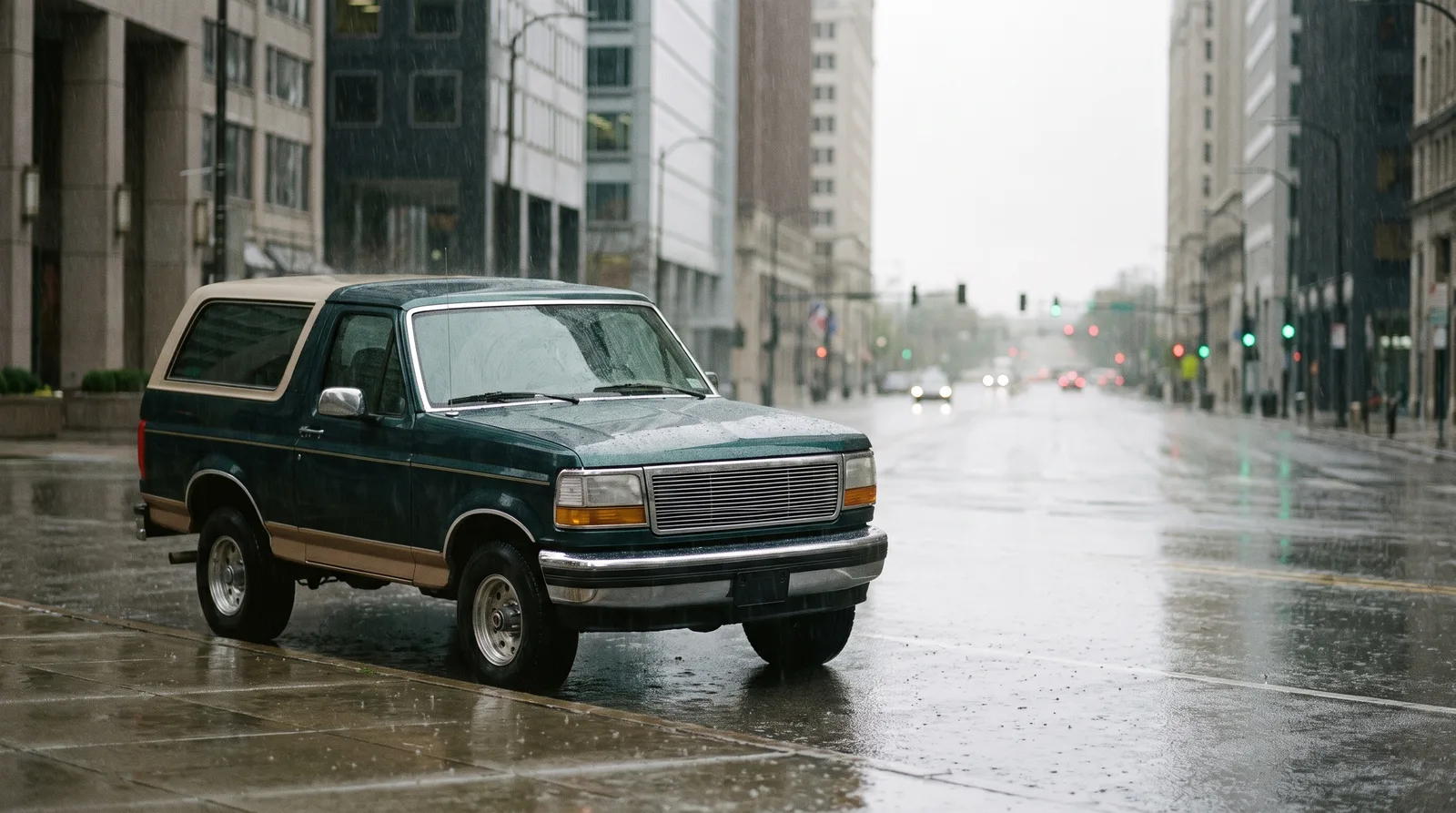
How an outdoor catalog ended up on a Ford fender
Eddie Bauer the company built its name on down jackets and hunting gear, the kind of catalog that showed up in mailboxes promising you could survive a mountain if you bought the right parka. Ford's marketing people noticed that the outdoor lifestyle image sold clothing at a premium, and they wanted some of that shine on the showroom floor. The partnership arrived on the Bronco for 1985, riding on the second wave of the full-size trucks that had already replaced the smaller early Bronco back in 1978. It was not a novel idea in Detroit. Jeep had done something similar with its own boutique trim packages, and Ford had already tried outdoor-branded trucks on other models. But the Bronco was the right canvas. It was a family hauler with real off-road ability, and Eddie Bauer buyers wanted to look capable without necessarily proving it on a trail every weekend.
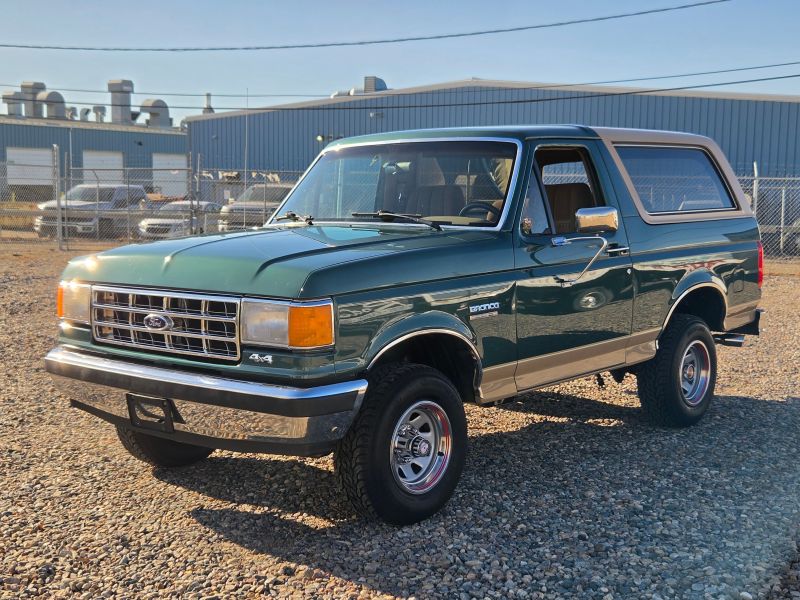
The package leaned on two-tone paint, usually a deep color low with a contrasting upper body and a thin pinstripe dividing them, plus Eddie Bauer badging on the front fenders and tailgate. Inside, the truck got the nicest cloth or leather Ford offered on a Bronco, color-keyed carpet, and enough extra trim that owners genuinely felt like they had bought something a step above the XLT. It was not a mechanical package. The Eddie Bauer Bronco used the same 302 or 351 V8 options, the same frame, the same Twin Traction Beam front suspension as any other well-equipped Bronco of the era. This was a truck that sold on the strength of how it looked and felt to sit in, not on any new hardware under the skin.
The years that mattered
Eddie Bauer editions ran through the rest of the full-size Bronco's life, evolving with each facelift. The 1987 restyle brought smoother, more aerodynamic front sheetmetal to the whole lineup and the Eddie Bauer package rode along with fresh two-tone combinations to match. By the early nineties the package had settled into a familiar rhythm: a premium interior, badges, alloy wheels, and paint that set the truck apart from a base or XLT model parked next to it at a dealership. The final full-size Broncos left the line in 1996, and Eddie Bauer trucks from that last year are some of the more sought-after examples today, partly because buyers assume, correctly in most cases, that a top-trim truck was more likely to be cared for than a stripped-down base model doing ranch duty.
What is easy to miss, looking back, is how much the Eddie Bauer name did for Ford's truck image generally. Once buyers saw that a four-by-four could carry a premium badge and command a premium price, the door opened wider for what eventually became the modern luxury truck market. You can trace a line from these two-tone Broncos through to the loaded trucks that dominate dealer lots now, where the top trim on any given pickup or SUV often costs nearly twice what the base model does. The Eddie Bauer Bronco was an early, unglamorous ancestor of that shift, dressed in earth tones and corduroy-look upholstery instead of the piano black and leather quilting buyers expect today.
What the badges are worth to a buyer now
Collectors chase Eddie Bauer Broncos for reasons that have little to do with rarity in the strict sense. Ford built plenty of them across the run, so they are not scarce the way a first-year early Bronco is scarce. What buyers are really after is the completeness of the package and the condition of the interior, because a torn or sun-baked Eddie Bauer cabin loses most of what made the trim special in the first place. A clean example with intact badging, correct two-tone paint, and unmolested upholstery commands real money at auction, more than a comparable XLT in similar mechanical shape. The gap has widened over the past several years as buyers who grew up wanting one of these trucks now have the means to actually buy one.
Where the Eddie Bauer fits in the bigger Bronco story
None of this happens in a vacuum. The Eddie Bauer trim is one chapter in a longer arc that runs from the compact early Bronco through the big-block seventies trucks and into the bullnose and later full-size generations. If you want the full story of how those later trucks developed, the mechanical changes, the styling updates, and the reasons Ford eventually walked away from the platform, it is worth the read. The Eddie Bauer package only makes sense in that context, as the moment when a working four-by-four decided it also wanted to be furniture.
"People ask me why I chase Eddie Bauer trucks specifically instead of any clean Bronco. It is simple. Somebody paid extra for this one when it was new, which usually means somebody cared for it a little harder too."
- Wayne Coburn
That logic holds up more often than not. A buyer willing to spend for the top trim in 1988 was frequently the same kind of owner who kept the truck garaged, changed the oil on schedule, and did not use it to haul firewood every weekend. It is not a guarantee, plenty of Eddie Bauer trucks got worked hard and show it, but the odds tilt in a shopper's favor.
Buying one today
If you are shopping for one, start with the interior and the paint before you worry about the drivetrain, because the V8s in these trucks are generally tough and well documented, while a correct two-tone respray and a matching set of undamaged Eddie Bauer badges are harder to source. Check the seats for cracking, especially on leather-equipped trucks that sat outside for years, and look closely at the carpet and door panels for water staining that points to a leaky windshield seal or door gasket, a common issue on trucks this age. If the numbers line up and the truck feels right in person, there is no shortage of options out there. Anyone ready to go looking can find a classic Bronco for sale without much trouble, though the good Eddie Bauer examples tend to move fast once they are listed. Buy the cleanest one you can afford and skip anything with a torn interior no matter how good the price looks, because refinishing that cabin correctly will cost more than the discount saved you.
The Eddie Bauer Bronco was never the fastest or the toughest version Ford built. It was the one that made a Bronco feel like an event to climb into, and that idea aged better than anyone at Ford probably expected back in 1985.
Sources and notes
Related Reading
Have a
Ford Bronco
for Sale?
Reach thousands of serious classic car collectors across the US.
Sell It Here →
Selling a classic? Here's how: where to sell your classic car online
Are You a Classic Car Dealer?
List your full inventory and connect with targeted classic car buyers.
Join as a Dealer →

About the author
Wayne Coburn
Longtime Corvette owner, judge and club figure who knows the cars, the records and the people behind them.
Related Listings - Ford Bronco




Comments
Be the first to comment on this article.