
Every truck stop in the Midwest had this argument going at some point in the eighties and nineties. Ford guy in one corner, Chevy guy in the other, and the ford bronco later gen vs blazer debate settled absolutely nothing except who was buying the next round of coffee. I have owned both trucks at different points in my life, and I think the honest answer is more interesting than either side wants to admit.
Car Features
7 min read
Later Broncos vs the K5 Blazer's Last Stand
Ford's full-size Bronco and Chevrolet's K5 Blazer fought for the same buyer for over a decade, and the Bronco outlasted its rival's two-door form by five years.
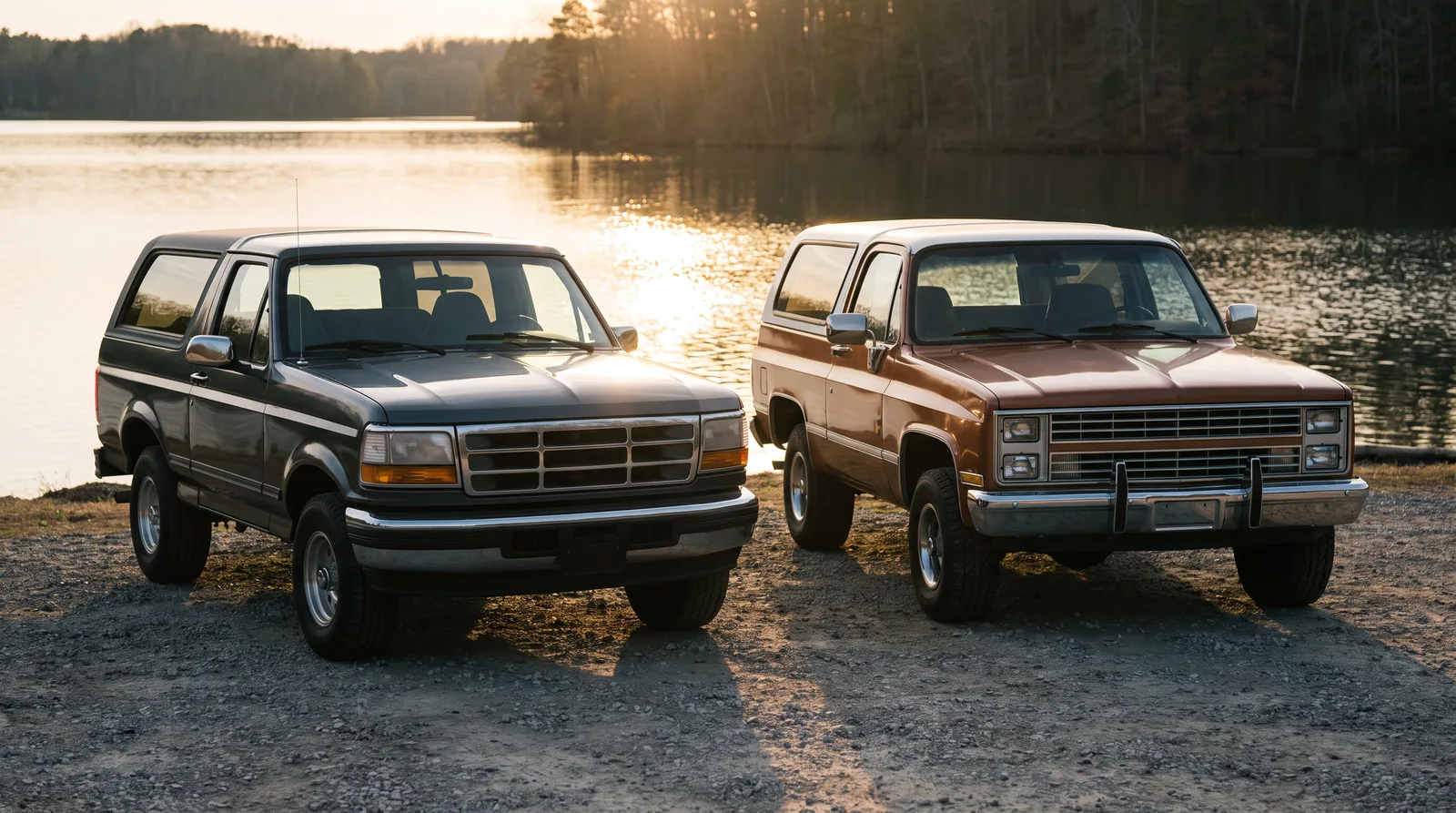
Two full-size trucks built for the same job
By the 1980s, the full-size Bronco and the Chevrolet K5 Blazer were chasing the same buyer. Both were body-on-frame, four-wheel-drive trucks built off their maker's pickup platform, both offered removable or fixed tops depending on the year, and both wore the same basic mission statement: a family-friendly truck that could still do real work and go off-road when asked. Ford's Bronco had grown into this full-size form for 1978, after the smaller original Bronco ran from 1966 through 1977, while Chevrolet's K5 Blazer had actually beaten Ford to the full-size SUV concept, arriving back in 1969 as a shortened Chevy pickup with a removable fiberglass top.
By the time both trucks reached their later years in the eighties and into the K5's final year of 1991, the two companies had settled into a genuine rivalry. From 1976 the Blazer paired a steel roof over the front seats with a removable fiberglass top over the rear, a half-cab design that gave it a more finished, permanent feel compared to some of the Bronco's own configuration choices over the years. Ford countered with steady updates of its own, including the 1987 restyle that smoothed out the Bronco's front end and modernized the interior.
Where the Bronco had the edge
Ford's Twin Traction Beam front suspension, introduced on the full-size Bronco and shared with the F-150, gave the truck an independent front end that some drivers preferred for ride quality over the K5's solid front axle, though off-road purists sometimes argued the opposite, since a solid axle has its own advantages in extreme articulation. The Bronco also had the advantage of the 302 and 351 V8 engines, both well proven, easy to service, and backed by an enormous parts network thanks to how widely Ford used those same blocks across its truck and car lineup.
Buyers who wanted the Bronco to feel like something special, rather than just a work truck, had options the Blazer's lineup did not always match trim for trim, particularly once the Eddie Bauer package arrived in 1985 and gave Ford a genuine premium trim story to sell against Chevrolet's own upscale offerings.
Where the Blazer held its ground
Chevrolet was not standing still during any of this. The K5's steel front roof section, standard from 1976, gave it a quieter, more rattle-free cabin than some owners reported from Broncos of the same era, and GM's small block V8 lineup had its own loyal following and equally deep aftermarket support. The K5 Blazer also carried a reputation for slightly better around-town manners in some configurations, a result of GM's own suspension tuning choices, though the difference came down to individual truck condition as much as any factory design decision by that point in both trucks' development.
The real story of the rivalry is that Chevrolet actually blinked first. GM retired the removable-top K5 Blazer after the 1991 model year, replacing it with a fixed-roof two-door Blazer on the new GMT400 pickup platform, renamed Tahoe for 1995, that abandoned the open-top formula entirely. Ford kept building the full-size Bronco in its traditional two-door form all the way through 1996, giving it a longer run in the segment the two trucks had shared for over a decade.
| Full-size Ford Bronco | Chevrolet K5 Blazer | |
|---|---|---|
| Full-size form introduced | 1978 | 1969 (full removable top), steel front roof with removable rear top from 1976 |
| Front suspension (later years) | Twin Traction Beam independent front | Solid front axle |
| Two-door full-size production ended | 1996 | 1991 |
| Common V8 options | 302 and 351 Windsor | Chevrolet small block V8 variants |
"I have had both trucks in my garage and I will not tell you one is objectively better, because that argument never ends well at a swap meet. What I will say is Ford stuck with the two-door full-size formula longer, and that staying power counts for something now that both trucks are collectible."
- Wayne Coburn
How the rivalry played out in advertising
Ford and Chevrolet did not just compete on the showroom floor, they competed loudly in print and television advertising through the eighties, each side taking direct aim at the other's weaknesses. Chevrolet ads leaned on the K5's steel-roofed cab as a sign of refinement compared to earlier full-removable-top trucks, while Ford countered by touting the F-150 shared components and V8 torque as proof the Bronco was the more serious truck underneath the family-friendly packaging. Neither company ever fully conceded the argument, which is part of why the rivalry stayed lively for as long as both trucks remained in production side by side.
That competitive pressure arguably made both trucks better than they might have been standing alone. Every time Chevrolet upgraded interior comfort or added a new trim level, Ford answered within a model year or two, and vice versa. Buyers in the eighties benefited from that back and forth even if they never thought about it in those terms at the time, and collectors now benefit from it too, since both trucks ended up better equipped and more thoughtfully updated than they might have been without a direct rival pushing each manufacturer to keep improving.
What it means for buyers today
Neither truck is the wrong choice, and plenty of collectors own examples of both. What matters more than the badge is condition, documentation, and how well a given truck has been maintained over its decades on the road. Rust is the enemy for both platforms, parts availability is strong for both thanks to their shared components with full-size pickups, and both have genuine enthusiast communities keeping knowledge and parts circulating. If you already lean Ford, or if the Bronco's longer production run and the story behind it appeals to you, our complete history covers how the truck developed across those years in far more depth than a single comparison can.
If you want to keep comparing the Bronco against its other major rival, the Toyota that eventually reshaped the whole midsize SUV category, you can keep exploring that side of the story too. And whichever direction the comparison pushes you, there is a healthy market of classic Bronco for sale right now if you decide Ford's truck is the one you want parked in your garage.
One last thing worth saying plainly. Neither of these trucks is a bad buy just because the other one exists. The Bronco and Blazer rivalry made both trucks sharper competitors during their production years, and that same rivalry gives collectors today two genuinely solid full-size choices instead of one. Pick the badge that speaks to you, buy the cleanest example your budget allows, and do not let a coffee shop argument talk you out of a truck you actually like sitting in.
Sources and notes
Related Reading
Have a
Ford Bronco
for Sale?
Reach thousands of serious classic car collectors across the US.
Sell It Here →
Selling a classic? Here's how: compare the places to sell classic cars
Are You a Classic Car Dealer?
List your full inventory and connect with targeted classic car buyers.
Join as a Dealer →
#Ford Bronco
#Ford truck history
#full-size bronco
#K5 Blazer
#Bronco vs Blazer
#classic SUV comparison

About the author
Wayne Coburn
Longtime Corvette owner, judge and club figure who knows the cars, the records and the people behind them.
Related Listings - Ford Bronco




Comments
Be the first to comment on this article.