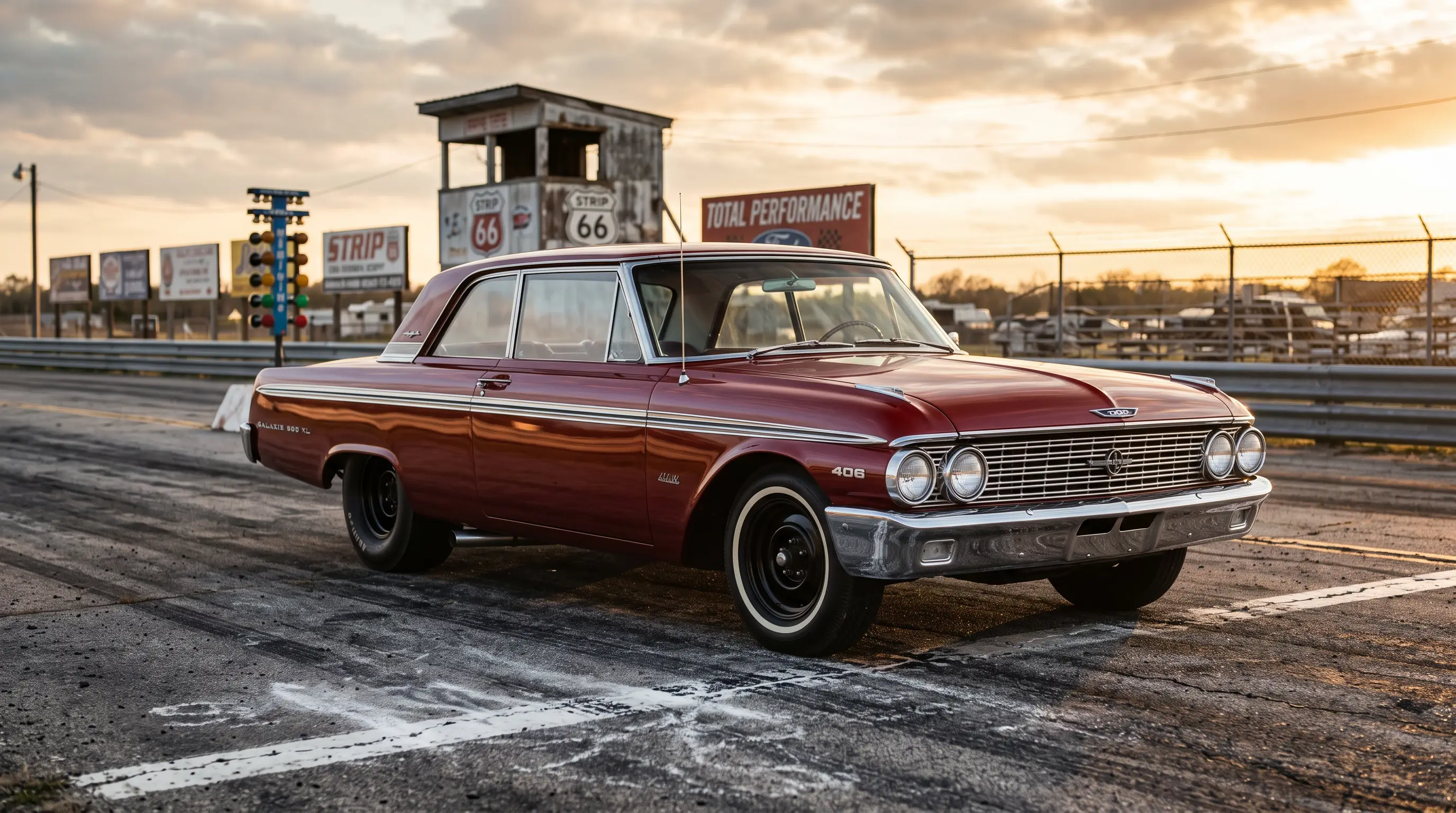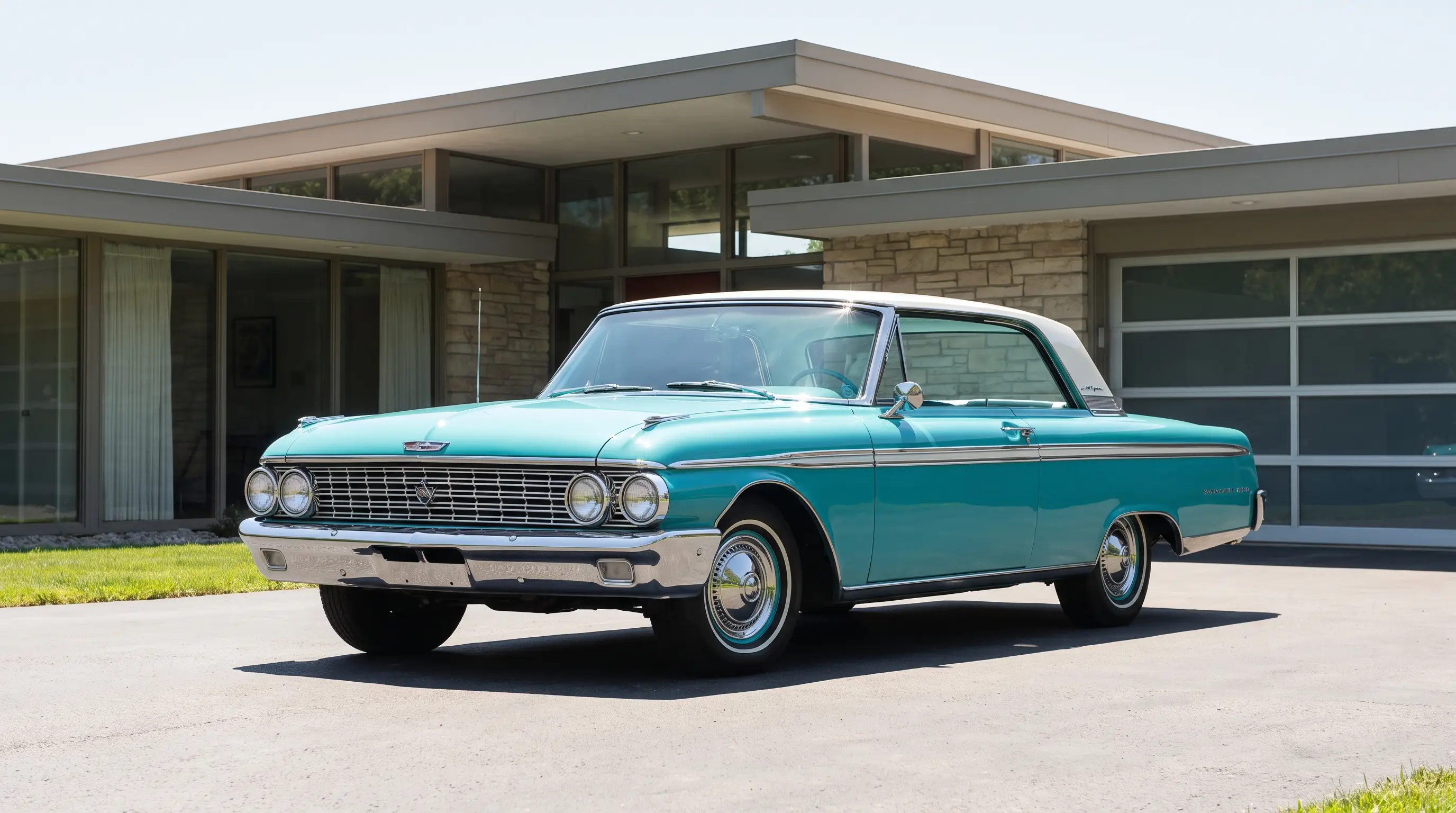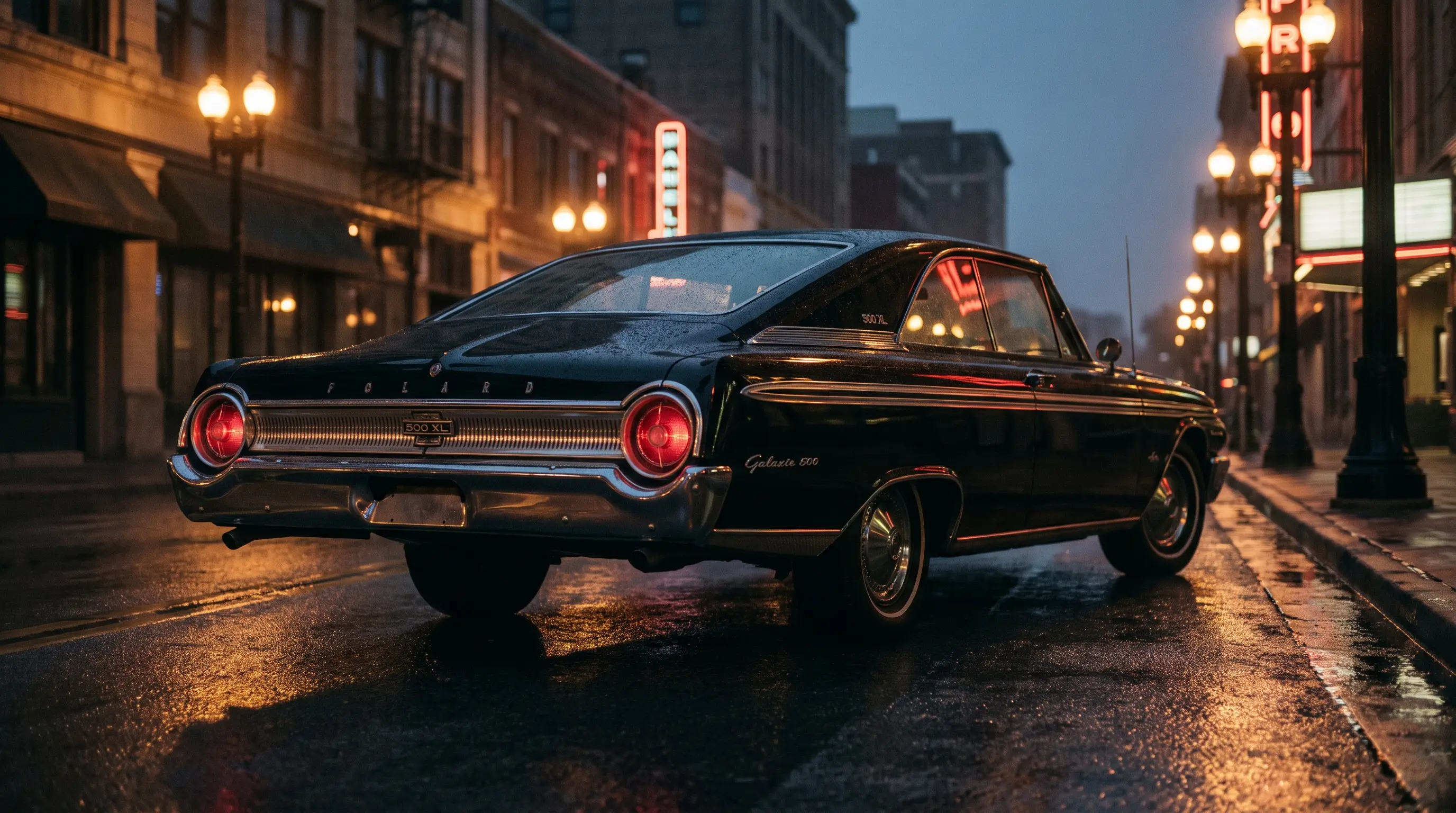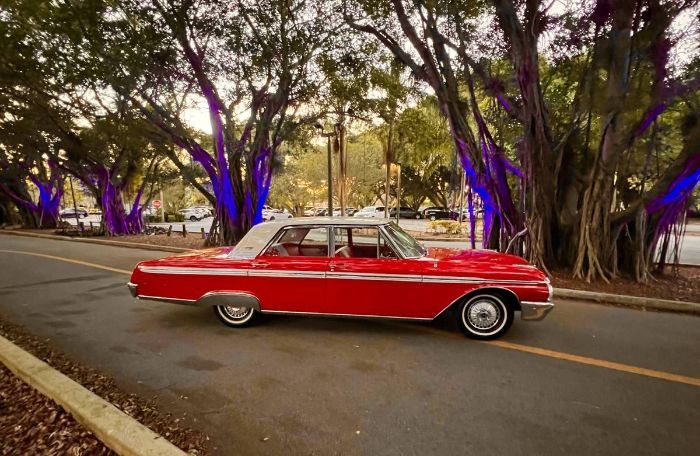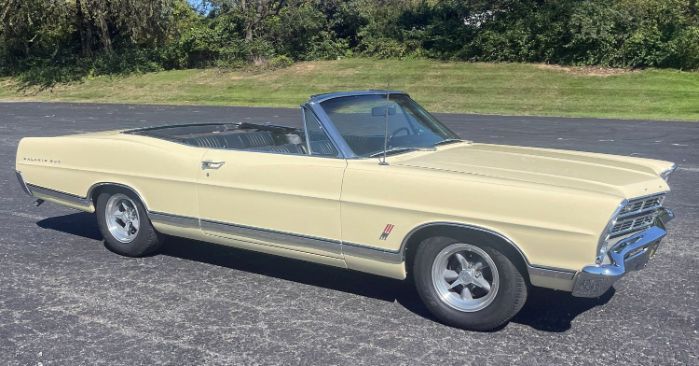
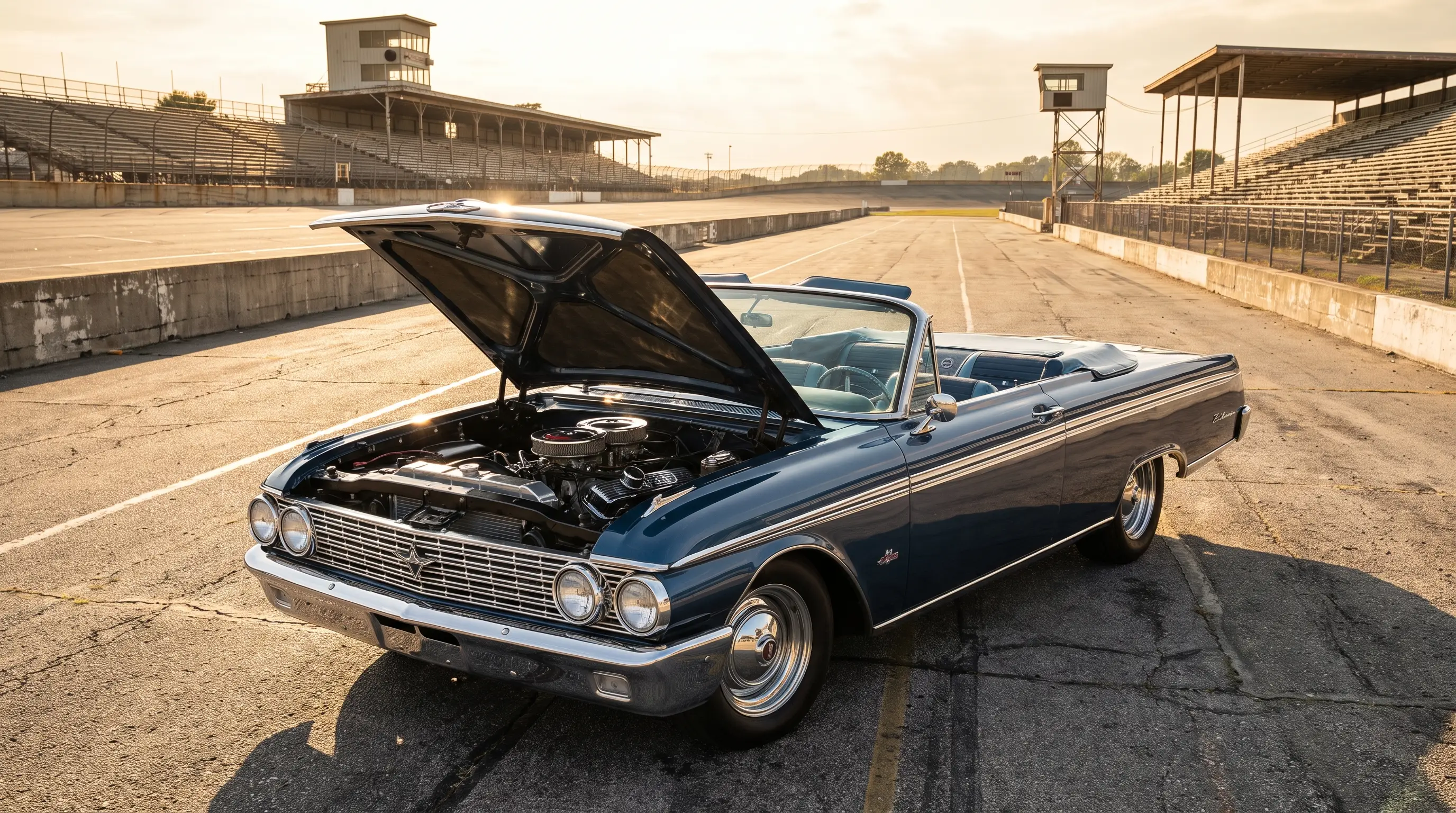
The 427 gets all the glory in Ford's FE-series story, and it earned it. But the ford galaxie 1962 406 big block is the engine that did the unglamorous work of proving the concept a year earlier, and it deserves more credit than the history books usually give it. Every lesson Ford learned building the 406 for one model year in the Galaxie went straight into making the 427 the engine everyone actually remembers.
What the 406 actually was
The 406 is a bored-out evolution of the FE-series big block that had already grown from 352 to 390 cubic inches earlier in its short life. For 1962, Ford pushed the bore further, arriving at 406 cubic inches through a combination of bore and stroke changes over the 390. The result was offered in the Galaxie lineup in two distinct states of tune: a single four-barrel carburetor version rated at 385 horsepower and 440 lb-ft of torque, and a triple two-barrel Tri-Power version rated at 405 horsepower and 448 lb-ft of torque. Both used solid-lifter valvetrains and stronger internals than the passenger-car 390, because Ford built this engine with drag strips and superspeedways in mind, not grocery runs.
What is genuinely interesting from an engineering standpoint is how narrow the intended service life was. Ford knew going in that 406 cubic inches was close to the practical limit of what the existing FE block casting could handle reliably at high output. The bore spacing left very little wall thickness once you pushed the cylinders out that far, and engineers were already working on a larger-bore version of the block, strengthened with cross-bolted main bearing caps, that would become the 427 before the 406 had even finished its first full production year.
Reliability at the edge of the design
Running an engine near the structural limit of its casting is never free, and the 406 shows the tradeoffs plainly. Thin cylinder walls at that bore size mean less margin for detonation, less margin for overheating, and less tolerance for the kind of abuse a competition car takes lap after lap. Owners and racers of the era reported the 406 as a capable but demanding engine, one that rewarded careful tuning and punished neglect more than the milder 390 ever did. That is not a knock on the design. It is what happens any time an engineering team pushes an existing architecture past its comfortable operating window to buy a season of extra performance while a proper redesign is still in development.
The Tri-Power version in particular asked more of drivetrain components than most 1962 buyers were used to. Higher compression, a more aggressive cam profile, and three carburetors feeding an engine built for sustained high RPM operation are not specs aimed at a daily commuter, and Ford marketed the 406 accordingly, positioning it as the serious buyer's option rather than a mainstream upsell.
A short production run with a long legacy
The 406 essentially existed for one full model year before the 427 replaced it for 1963, making it one of the shorter-lived engine options in the FE family's history. That brevity is exactly why it gets overlooked. It never had multiple model years to build a reputation the way the 390 or 427 did. But every dimension that mattered for the 427's success, the larger bore, the cross-bolted main bearing caps that appeared on late 406 blocks and carried over in full to the 427, the understanding of how far the FE architecture could reasonably be pushed, traces directly back to what Ford's engineers learned running the 406 hard for one season in real competition.
How the 406 compared to its rivals on paper
Set against the competition it was built to beat, the 406 sat in reasonable company. Chevrolet's 409 and Chrysler's 413 max wedge occupied similar displacement territory, and all three engines shared the same basic engineering challenge: how far a passenger-car block architecture could be stretched before the cylinder walls and bearing surfaces stopped being able to handle sustained competition loads. Ford's Tri-Power 406 topped out at 405 horsepower, close behind Chevrolet's high-output 409 at 409 horsepower and Chrysler's first-year 413 Max Wedge, which was rated at 410 to 420 horsepower depending on compression. The three engines landed in roughly the same peak-output neighborhood, but the tradeoff shows up in long-term durability margin rather than raw numbers, since the 406 was already closer to the practical limit of its block casting than the 409 or the 413 were of theirs.
The Tri-Power induction setup also deserves a closer technical look, since it is often treated as simply a horsepower trick rather than the tuning tool it actually was. Running three two-barrel carburetors let engineers stage fuel delivery so that the center carburetor handled part-throttle and low-speed driving efficiently, while the outer two opened progressively as the throttle went down, giving the engine a wider effective powerband than a single large four-barrel could deliver on its own. That staged approach mattered more on a superspeedway, where sustained high RPM operation for hundreds of miles put a premium on consistent fuel delivery rather than a single peak dyno number.
Reading the 406 correctly today
If you are evaluating a 1962 Galaxie with a claimed 406, the honest engineering answer is that verification matters more with this engine than with almost any other FE variant, precisely because it had such a short window and because the visual differences between a 390 and a 406 block are not obvious to a casual inspection. Casting numbers and broadcast sheets do the real work here, not guesswork based on carburetor count alone, since Tri-Power setups were swapped onto other FE engines often enough over the decades to make an untrained eye unreliable.
"The 406 is what happens when an engineering team says, we know this isn't the final answer, but let's ship what we've got while the real solution is still on the drafting table. It worked. It just did not get to stick around long enough to get famous for it."
- Emily Chen
None of this diminishes what the 406 accomplished. It gave Ford a genuine competition engine a full year before the 427 was ready, it validated the direction the FE architecture needed to grow, and it did real work on real racetracks in 1962 before quietly stepping aside for its more famous successor. For the full context of how this engine fit into the model year, our complete history of the 1962 Galaxie covers the broader lineup around it, and anyone chasing one of these engines in person should go find a classic Galaxie from the current listings with documentation to match the claim.
There is also a practical lesson here that applies well beyond this one engine. Any time a manufacturer pushes an existing architecture to its known limit as a stopgap while a proper replacement is still in development, the resulting part tends to be simultaneously more capable and more fragile than either the design it replaced or the one that eventually replaces it. That pattern shows up across the automotive industry repeatedly, and the 406 is simply a particularly well-documented example of it, precisely because Ford's Total Performance program generated enough competition data and enough surviving cars to let engineers and historians reconstruct the whole story decades later with reasonable confidence.