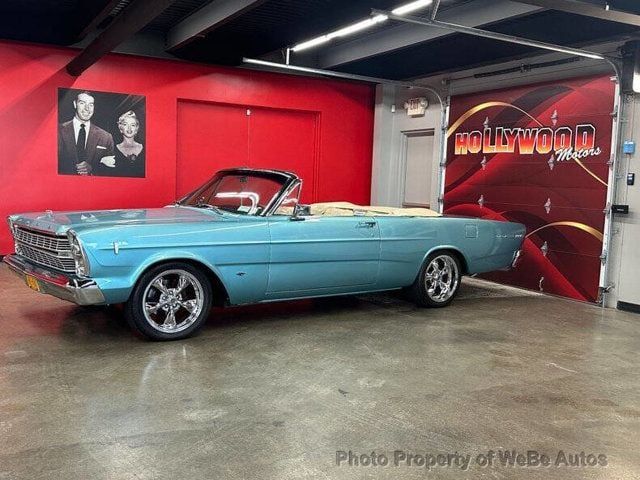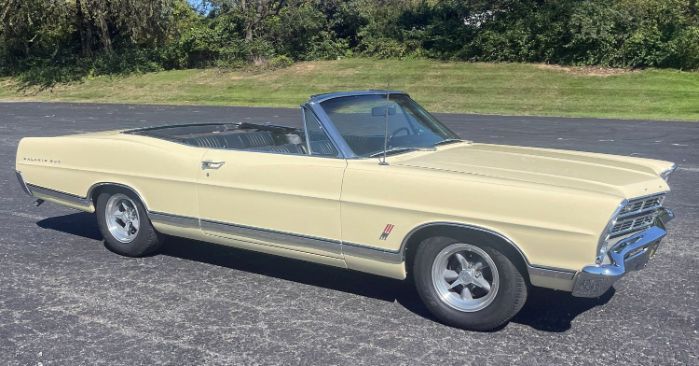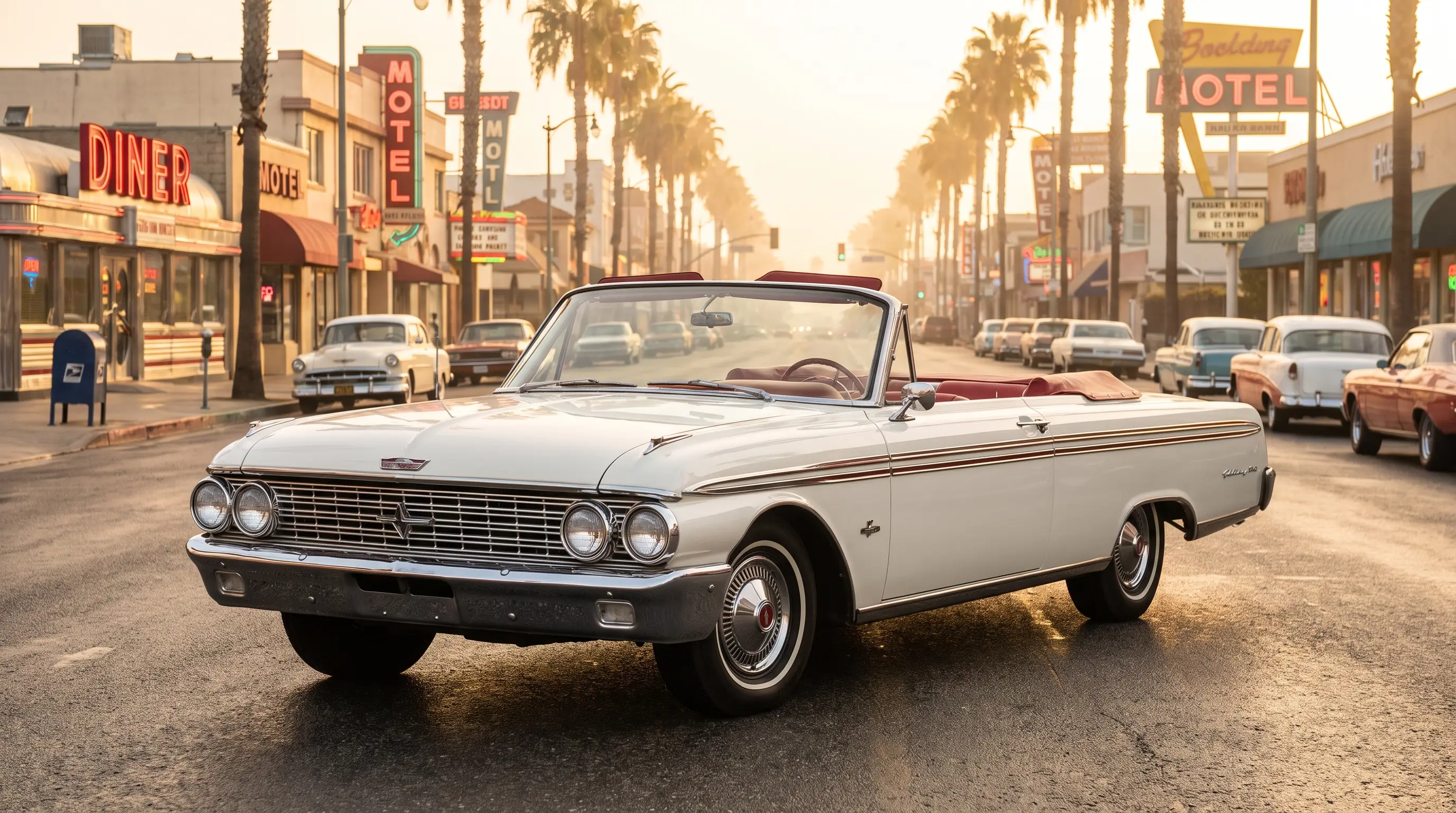
Not every full-size Ford from this era gets remembered for a race track or an engine option. The ford galaxie 1962 sunliner convertible feature is a reminder that plenty of buyers just wanted the top down, the chrome catching the sun, and a car built for boulevard cruising rather than superspeedway competition. The Sunliner name carried the Galaxie's convertible identity through one of the last true chrome-heavy years of American full-size design before styling started trending cleaner through the mid-1960s.
Where the Sunliner name fit in the lineup
By 1962, Sunliner had been Ford's full-size convertible name for several years running, carried over from earlier Fairlane 500 and Galaxie generations as the open-top counterpart to the closed hardtop and sedan body styles. For this model year, the Sunliner sat within the Galaxie 500 series, giving buyers the option of a power-operated soft top over the same basic chassis and drivetrain choices available across the rest of the lineup. It was not marketed as a separate performance trim the way the 500/XL was. Instead, it was positioned as the lifestyle choice within the mainstream Galaxie 500 range, aimed at buyers who wanted style and open-air driving more than they wanted bucket seats or a console.
That positioning matters for understanding who actually bought one. Convertibles across the industry in this era carried a real price premium over comparable hardtops and sedans, largely because of the added structural reinforcement and the complexity of the folding top mechanism itself, and that premium tended to attract a buyer who valued the visual statement of a convertible enough to pay for it directly, rather than one chasing outright performance.
Styling at the tail end of the chrome era
The 1962 model year sits at an interesting point in Ford's design language. The full-size lineup carried forward plenty of the chrome trim and ornamentation that had defined the late 1950s, but the overall shape had already started trending toward cleaner, more restrained lines that would define the mid-1960s Galaxie. The Sunliner wore that transitional styling well, with enough brightwork to feel properly dressed up for the era but a body line underneath it that pointed clearly toward where Ford's full-size design was heading next. Buyers who wanted the last real taste of the heavier chrome treatment before it faded out found the Sunliner a genuine sweet spot.
The convertible top itself, when specified with power operation, added a mechanical complexity that buyers of the era treated as a genuine luxury feature rather than an expected convenience. Getting that mechanism to fold cleanly into the trunk space without compromising luggage room too badly was one of the quieter engineering achievements of the full-size convertible body style during this period, and it is a detail original owners of the era genuinely noticed and valued.
How it compared to the rest of the drop-top field
The Sunliner was not competing in a vacuum. Chevrolet's Impala convertible and Pontiac's Catalina and Bonneville soft-top offerings all chased the same buyer through this period, and the competition kept every manufacturer honest about fit, finish, and top mechanism reliability. Ford's approach with the Sunliner leaned on a slightly more restrained, formal presentation compared to some of its rivals, favoring a clean beltline and conservative chrome placement over the more aggressive ornamentation some competitors used to signal luxury. That restraint aged well. Where some of the more heavily chromed convertibles from this general period can look busy to modern eyes, the Sunliner's cleaner presentation still reads as tasteful rather than dated.
Price positioning also mattered to how the Sunliner was cross-shopped. Sitting within the Galaxie 500 series rather than as a stripped-down Custom convertible or a fully loaded 500/XL soft top, if one had even been catalogued that way, the Sunliner occupied a comfortable middle ground that let Ford compete across a wide swath of the convertible-buying public without forcing a choice between economy and image. That flexibility is part of why the nameplate had staying power across several model years rather than existing as a single-season experiment.
Rarity and survival today
Convertibles from this era survive at meaningfully lower rates than hardtops and sedans from the same production run, a pattern true across nearly every full-size American nameplate of the period. Soft tops wear out, water intrusion causes rust damage that closed cars never see, and the higher original price point meant fewer were built in the first place relative to the mainstream body styles. A well-preserved 1962 Sunliner today represents a genuinely smaller surviving population than an equivalent hardtop, which is a meaningful consideration for anyone evaluating one against the broader Galaxie market.
That relative scarcity does not automatically translate into chasing the highest-optioned example available. Plenty of collectors specifically want the Sunliner precisely because it represents the boulevard-cruiser side of the Galaxie story rather than the competition side, and a well-kept example with the base or mid-range engine option can be just as satisfying an ownership experience as a documented big-block car, at a meaningfully lower price of entry.
"Not every good Galaxie story involves a racetrack. The Sunliner is the car people bought because they wanted to feel good driving to dinner on a Saturday night, and that is a perfectly legitimate reason to own a classic."
- Tom Ramirez
What to know before you go looking
Anyone researching or shopping a 1962 Sunliner should treat the top mechanism and the structural condition of the rocker panels and floor pans as the first priorities, well ahead of drivetrain specifics, since those are the areas most likely to show the accumulated cost of decades of exposure and prior neglect. For the fuller history of how the Sunliner fit into this specific model year, where this started covers the broader 1962 lineup in more depth. If the open-top experience is what you are after, the current classic Galaxie for sale listings are worth checking for a genuine Sunliner with its top mechanism and structure intact.
There is something worth appreciating in a car built for no other reason than to feel good on a good day. The Sunliner never carried a race number, never chased a lap record, and never needed to justify itself with a spec sheet. It simply gave a generation of buyers a well-built, good-looking way to enjoy a summer evening, and that kind of straightforward appeal has aged into its own form of collectibility, one that does not depend on horsepower figures to make its case. Owning one today means owning a piece of that same simple pleasure, largely unchanged by six decades of automotive fashion.
Sources and notes
- 1962 Ford Galaxie 500 Sunliner full range specs - Automobile Catalog
- 1962 Ford Galaxie 500 Facts: Complete Specifications Guide - Piston Press
- 1962 Ford Galaxie Specifications & Dimensions - conceptcarz.com
- 1962 Ford Galaxie 500 XL Sunliner - American Muscle Car Museum
- Ford Galaxie - Wikipedia
- 1962 Ford Galaxie 500 Sunliner - Fusion Motor Company