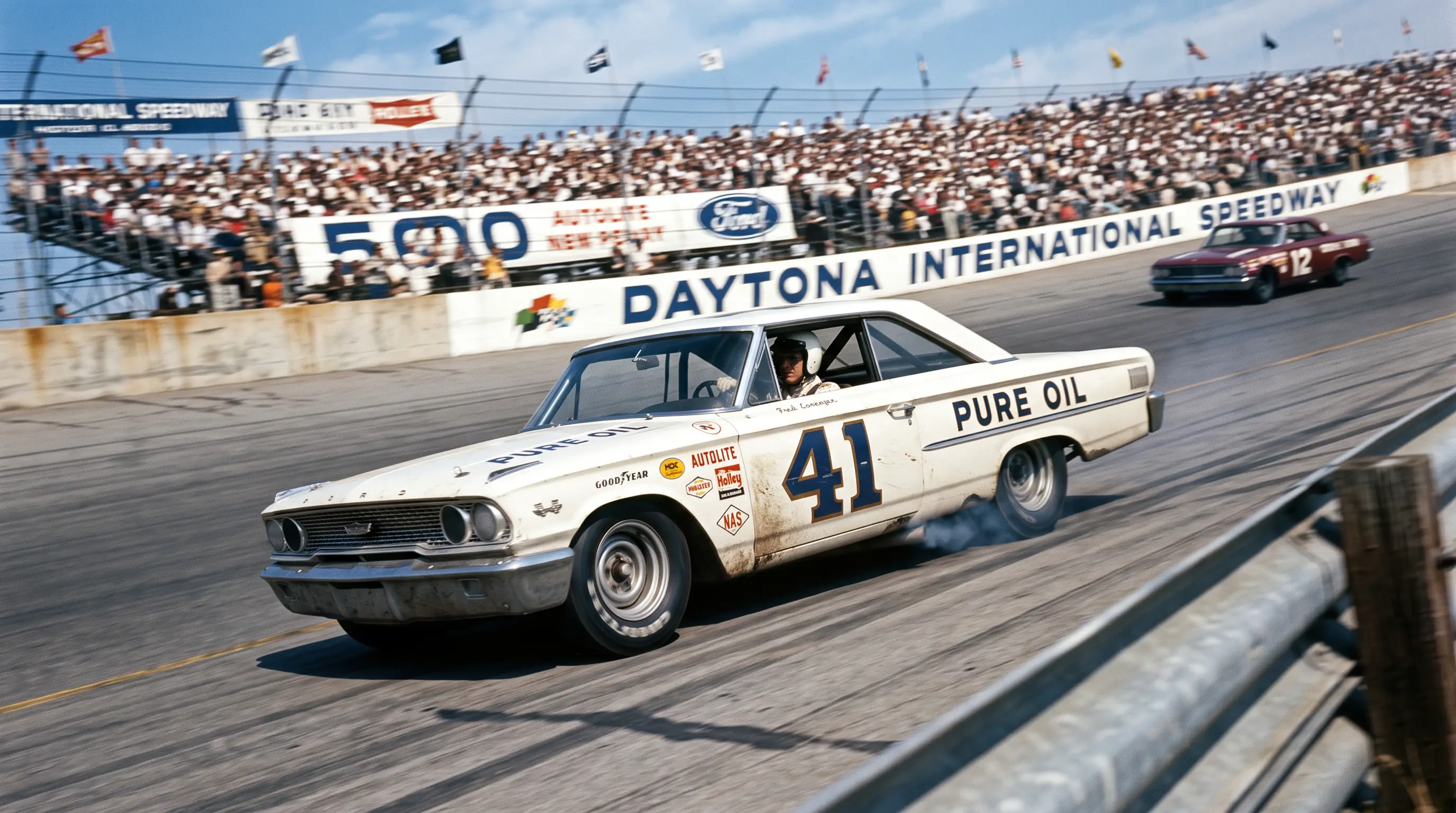

Start with the number NASCAR actually cared about: 427 cubic inches, the displacement ceiling the sanctioning body had settled on for stock car competition. Everything interesting about the ford galaxie 1963 427 r code nascar story flows from that one regulatory line, because Ford did not build this engine to impress anyone in a showroom. It built it to hit a number a rulebook demanded, and the R-code designation on the engine tag is the paper trail proving exactly how deliberately that happened.
The engineering constraint, not the marketing pitch
NASCAR's displacement limit forced every manufacturer chasing stock car wins toward the same ceiling, and Ford's answer was a big-block built specifically to sit at that number rather than under it with room to spare. The R-code designation identified the high-performance dual four-barrel version of that 427, distinct from the single-carburetor variant Ford also offered, and the difference between the two was not a marketing tier, it was a genuine output gap built into the induction hardware. Ford's factory rating for the R-code was 425 horsepower and roughly 480 lb-ft of torque, achieved with an 11.5:1 compression ratio and a solid-lifter camshaft. Ford's own documentation from the era is widely considered conservative on horsepower claims for its high-performance engines, a pattern researchers see across most manufacturers in this exact period, so that 425 figure is best treated as a floor rather than the engine's true ceiling.
What is better documented is the engine's mechanical specification relative to the standard 427. Stronger internal components, a more aggressive camshaft profile, and the dual-quad induction setup together produced a genuine gap in real-world output between the R-code and its single-carburetor sibling, not just a badge difference. This is the kind of detail that separates an actual engineering story from a nostalgia piece, because the R-code's value rests entirely on documented hardware differences, not on a bigger number printed on a fender emblem.
Where the R-code actually succeeded, and where it did not
The honest engineering assessment has to include the failure modes, because that is what separates a real evaluation from a highlight reel. The 427 R-code was a heavy engine in a heavy car, and Ford's full-size platform, however successful on superspeedways where sustained high speed rewarded raw displacement, was never going to be the light, nimble package that smaller-displacement rivals could offer in shorter-track or road-course conditions. The engine's real strength was pure top-end power delivered over long green-flag runs, which is precisely the environment superspeedway racing provided and precisely why Ford concentrated its 1963 NASCAR effort on exactly those tracks.
Reliability across a full racing season is the other half of the honest picture. High-output engines built to the edge of a displacement rule inevitably carry more risk of component failure under sustained racing loads than a detuned equivalent, and period race results show retirements from mechanical failure were a real part of Ford's 1963 season, not just wins, though a precise season-wide DNF rate specific to 427-equipped entries is not consistently broken out in surviving records. A complete engineering account of the R-code has to hold both facts at once, genuine competitive success on the tracks where its strengths mattered, and genuine vulnerability on the tracks or in the races where those strengths did not translate into a finish.
| Spec area | What distinguishes the R-code |
|---|---|
| Displacement | 427 cubic inches, built to NASCAR's competition ceiling |
| Induction | Dual four-barrel carburetors versus the standard single four-barrel 427 |
| Internal components | Reinforced rotating assembly relative to the standard-output 427 |
| Best-suited racing environment | Sustained high-speed superspeedway competition |
"Treat every period horsepower claim on this engine as a starting point for verification, not a finished fact. The R-code's real story is in the induction hardware and the internal components Ford actually changed, and that story holds up under scrutiny a lot better than any single number printed on a 1963 sales brochure."
- Emily Chen
How the R-code stacks up against the competition's answer
Every manufacturer racing NASCAR's 1963 season faced the same displacement ceiling, which means the R-code did not exist in a vacuum. Rival big-blocks from competing makes were built to the same regulatory number and pursued broadly similar solutions, stronger internals and more aggressive induction within the same cubic-inch limit, though period-advertised output for those rival engines carries the same conservative-rating caveat as Ford's own figures. What is more useful than a horsepower shootout nobody can fully verify from surviving period sources is the pattern itself: a shared rule produced convergent engineering across the entire field, which is exactly what a well-designed regulation is supposed to do. The R-code's place in that story is as one well-documented example of the pattern, not as a unique outlier.
That convergence also explains why race results from 1963 hinged so heavily on chassis setup, driver skill, and reliability rather than a single manufacturer holding a dominant horsepower advantage. When every competitive engine sits near the same displacement ceiling with broadly similar induction strategies, the margin between winning and losing shifts toward execution rather than raw specification. That is a useful corrective to any retelling of 1963 that treats the R-code as an unbeatable trump card rather than one well-engineered answer among several roughly comparable ones. It is a more honest, and frankly more interesting, way to read the season than the simplified version where one manufacturer's engine wins races by itself.
Why the R-code still matters as a data point
Sixty years on, the R-code's value to anyone studying this era is less about bragging rights and more about what it demonstrates, that a rulebook constraint can produce genuinely interesting engineering when a manufacturer decides to take the constraint seriously rather than build the minimum compliant product. Ford could have built a 427 that simply met the displacement rule without pushing the induction and internal hardware as far as the R-code did. It chose not to, and the surviving documentation, incomplete as it is on exact output figures, is consistent on the fact that this was a purpose-built racing engine wearing a production engine's part number.
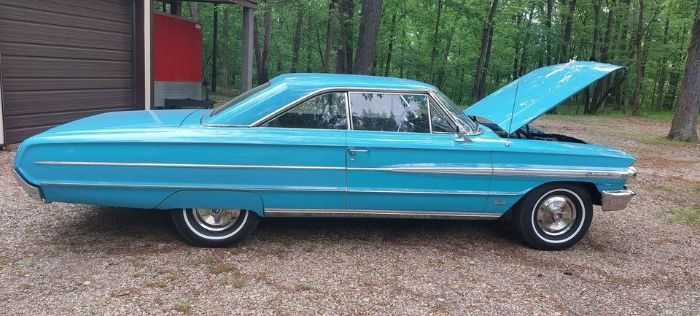
Anyone researching this engine should place it in the context of the model year it belonged to rather than treating it as an isolated curiosity, since the R-code did not exist independent of everything else Ford was doing to its full-size lineup that season. For the fuller picture, see more on the 1963 ford galaxie beyond just this one engine option, and for the earlier context of how the Galaxie nameplate got to this point at all, where this started covers the broader model history. Buyers who want to see how many surviving cars still carry documented R-code hardware today can check current classic Galaxies on the market, though genuine matching-numbers examples remain the exception rather than the rule.