
Strip the doors, hood, and front fenders off a full-size Ford Galaxie and replace them with aluminum, pull the sound deadening and half the interior, drop in a 427 built to breathe better than anything in Ford's regular catalog, and you get something that barely resembles the family sedan it started as. That is exactly what Ford did with a small run of 1963 Galaxies built specifically to win at the drag strip, and the lightweight program remains one of the strangest, most focused chapters in the model's entire history.
Car Features
7 min read
The 1963 Galaxie Lightweight: Aluminum, Fiberglass and Fury
Ford built a rare run of aluminum-paneled 1963 Galaxies stripped for the drag strip, and surviving examples are among the most sought-after cars of the model year.
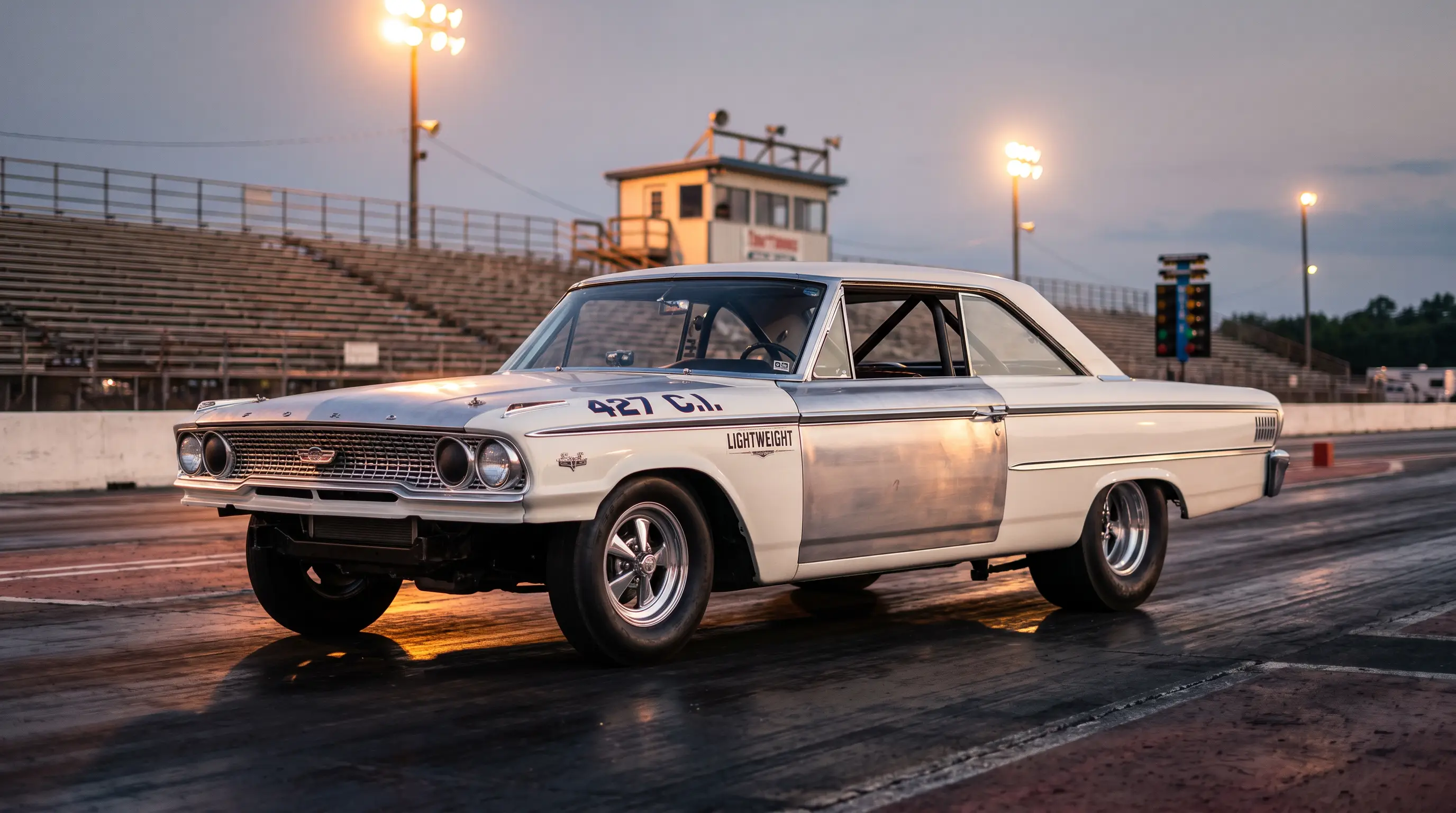
A factory car built to lose weight, not comfort
By 1963, NHRA's Super Stock classes had turned into a horsepower and weight arms race between Detroit's big three, and Ford needed an answer that could compete with Chevrolet's and Mopar's factory lightweight efforts. The solution was a run of full-size Galaxies with aluminum front-end panels, in some cases fiberglass front fenders, and a stripped interior that deleted sound insulation, the radio, and other comfort items that added pounds without adding speed. None of it was subtle. These cars were built for one job, and Ford's engineers cut everything that did not serve that job. Even trim pieces that seemed too minor to matter, badges, extra brightwork, sometimes even the heater, were candidates for deletion if a competitor thought the ounces saved might translate into a better sixty-foot time at the strip.
Under the hood sat the 427 R-code engine in its most aggressive tune, paired with hardware chosen for the drag strip rather than the boulevard: stiffer suspension components, altered front spring and shock rates to help the car launch, and in some batches a shift toward higher rear axle ratios suited to quarter-mile runs rather than highway cruising. The goal from the factory floor was simple: take pounds off the nose and put power to the ground as efficiently as possible.
How rare these cars actually are
Ford did not build the lightweight Galaxie in large numbers. Documented production puts the run at around 212 units of the 427 R-code lightweight, built in the Galaxie 500 Sport Special Tudor fastback body with fiberglass hood, trunk and front fenders and aluminum bumpers, transmission case and bellhousing, split between Ford's Norfolk and Los Angeles assembly plants. A small handful of earlier 289-powered test cars, assembled in January 1963 for that year's Winternationals, preceded the 427 R-code run. Whatever the precise final count, it was a tiny fraction of full-size Galaxie output for the year, built in a handful of batches specifically for teams and privateers competing in NHRA Super Stock and similar classes rather than for retail sale to ordinary buyers.
That scarcity, combined with the cars' direct connection to factory drag racing, is exactly why surviving examples command serious attention today. A regular 1963 Galaxie hardtop is a solid, honest classic. A documented lightweight with its original aluminum panels and correct 427 R-code drivetrain is a different animal entirely, chased by collectors who care as much about the paper trail as the sheet metal.
Life at the strip
These cars were raced hard, which is part of why so few survive in original, unmolested condition. Teams competing in Super Stock swapped parts constantly, chasing tenths of a second, and a lightweight Galaxie that ran a full season might see engine changes, gearing changes, and body damage from the kind of abuse a race car takes that a street car never does. Some cars were wrecked outright. Others were parted out once newer, faster machinery from Ford or its rivals made a given combination obsolete. The ones that survive with their original panels and drivetrain intact are survivors in the truest sense, cars that dodged both the wrecking yard and the parts bin.
The competition they faced was serious too. Chevrolet's lightweight Impalas and Chrysler's Max Wedge cars were running similar programs at the same time, each manufacturer trying to out-engineer the others within the loose rules NHRA allowed for factory-backed Super Stock entries. The 1963 lightweight Galaxie was Ford's answer to that pressure, not a vanity project but a direct competitive response built under real deadline pressure from the marketing department, which wanted results at the strip to point to in advertising.
"A stock car with the doors and hood in aluminum tells you everything about how seriously Detroit took the quarter-mile in 1963. Nobody does that for a car they expect to sell casually."
- Patrick Walsh
Identifying a genuine lightweight
Spotting a real lightweight Galaxie versus a car dressed up to look like one takes real homework, and that homework matters enormously to value. Original build sheets, factory invoices, and documented ownership history are what separate a legitimate lightweight from a standard Galaxie with a swapped engine and some aftermarket panels bolted on to chase the same reputation. Panel gauge, fastener types, and specific casting numbers on the drivetrain are the kind of details serious buyers and appraisers check before taking any seller's word for a car's history. Given how few of these left the factory, the population of cars claiming lightweight status is, unsurprisingly, larger than the actual production run would suggest, and that mismatch is exactly why documentation carries so much weight in this corner of the hobby.
Clubs dedicated to Ford's early Total Performance era have done a lot of the legwork here, cross-referencing known chassis and engine numbers against factory records where those records survive. Anyone chasing a genuine example benefits from that research rather than relying solely on a seller's account, since the difference between a documented lightweight and a well-built tribute car can be enormous both in historical significance and in what the car is actually worth on the market.
What it means for the model today
The lightweight program is a small footnote in total Galaxie production numbers, but it says something important about the car's character in period. This was not a model built only for comfortable family transportation with a big engine bolted in as an afterthought. Ford treated the 1963 Galaxie seriously enough as a performance platform to build a dedicated, low-volume drag racing variant around it, stripped and lightened with the same intent a Chevrolet or Mopar engineering team would recognize instantly. That context matters when you look at any 1963 Galaxie today, because it explains why the car earned a genuine reputation on the strip and not just on NASCAR ovals. The two efforts fed each other, since lessons learned building a stripped-down drag car informed how engineers thought about weight and power everywhere else in the lineup, and a company willing to build aluminum body panels for a handful of drag racers was a company that took performance seriously across the board, not just where the cameras happened to be pointed. For the whole picture of what the 1963 model year looked like across trims and applications, the full retrospective covers the rest of the story, and if the lightweight chapter has you wanting a Galaxie of your own, you can shop classic Galaxie listings currently available.
Sources and notes
Related Reading

Have a
Ford Galaxie
for Sale?
Reach thousands of serious classic car collectors across the US.
Sell It Here →
Are You a Classic Car Dealer?
List your full inventory and connect with targeted classic car buyers.
Join as a Dealer →

About the author
Patrick Walsh
Automotive journalist covering classic car shows, events, and the enthusiast community across North America.
Related Listings - Ford Galaxie



Comments
Be the first to comment on this article.