
Put a 1963 Ford Galaxie 427 next to a Chevrolet Impala 409 and you get two different engineering philosophies aimed at the same problem: how do you sell a family sedan on Monday and win a stoplight drag or a NASCAR superspeedway on the weekend. Both companies solved it with big-block V8s pushed to the edge of what a production line could reasonably build, and both cars developed passionate followings that, six decades later, still argue the point at car shows. The numbers, when you actually line them up, tell a more interesting story than either fan base usually admits.
Car Features
7 min read
1963 Galaxie 427 vs Impala 409: Big-Block Showdown
Ford's 427 side oiler and Chevrolet's 409 built two different reputations in 1963, one for NASCAR endurance and one for the drag strip.
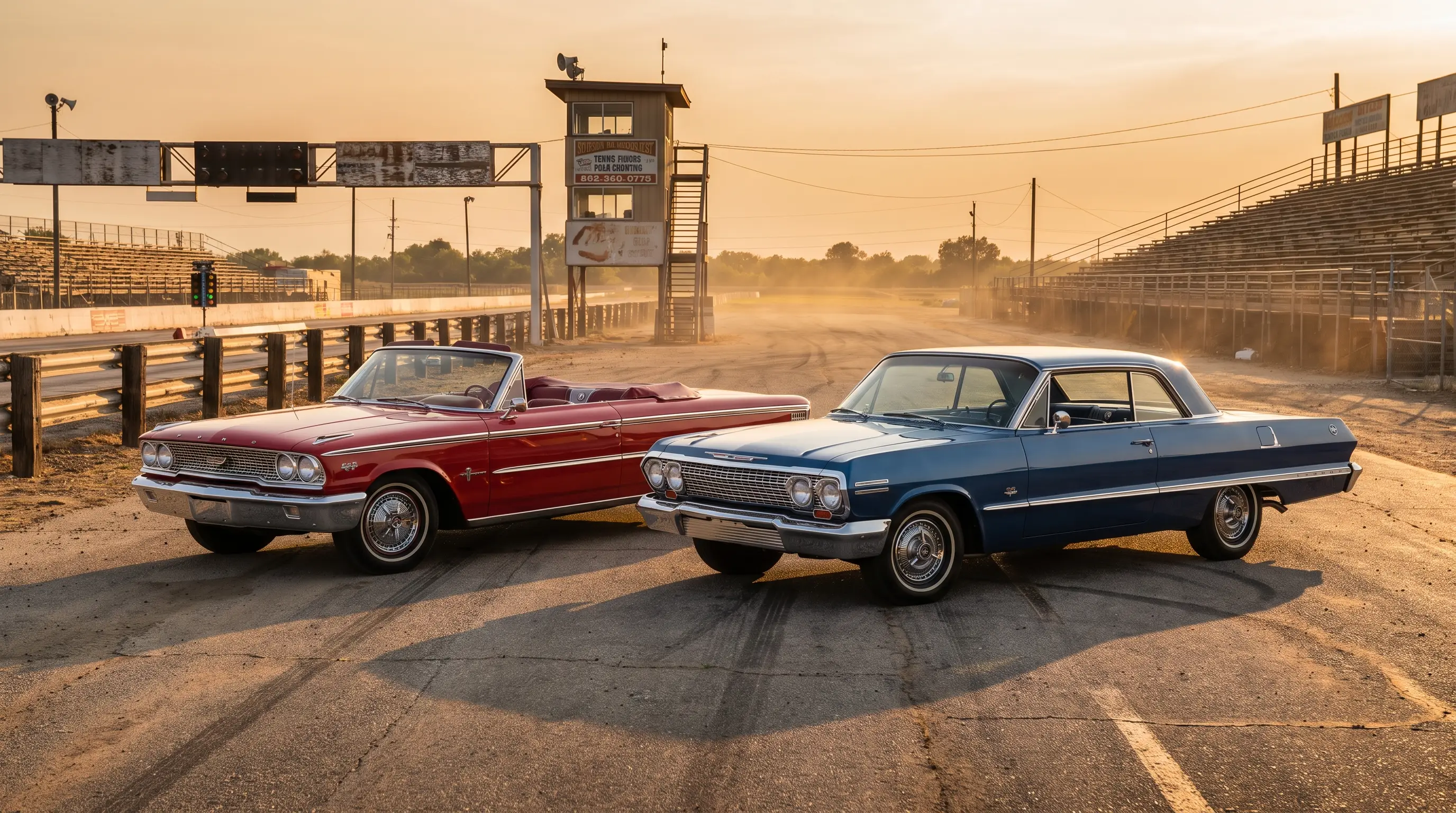
The engines, side by side
Ford's answer for 1963 was the 427 cubic inch V8, a top-oiler FE engine with a stout cross-bolted bottom end built to survive sustained high RPM running at NASCAR speeds. The famous side-oiler block, which fed the main bearings first, did not arrive until 1965. In factory tune it was offered with a single four-barrel carburetor rated at 410 horsepower, and with dual four-barrel carburetors rated at 425 horsepower. Chevrolet's 409 cubic inch V8, smaller in displacement but tuned aggressively for the same drag strip and stock car audience, was offered across three factory ratings that year, 340 horsepower with a single four-barrel and hydraulic lifters, 400 horsepower with a solid-lifter cam and higher compression, and up to 425 horsepower in its highest state of tune with dual four-barrel carburetors.
On paper the two engines look close in output, but they got there differently. Ford's 427 relied on displacement and a stout bottom end to make its power, an approach that suited long-distance NASCAR running where durability under sustained load mattered as much as peak output. Chevrolet's 409, smaller and revvier, built its reputation more on the drag strip, where quick bursts of power and a lighter overall package could make up ground that raw displacement alone would not close.
Where the cars actually differed
Weight told part of the story too. The full-size Galaxie was a genuinely large car, and even with the 427 under the hood it carried more mass to move than a comparably equipped Impala, which gave Chevrolet an advantage in straight-line acceleration in some matchups even when the raw horsepower figures were close. Ford answered that disadvantage partly through the aluminum-paneled lightweight Galaxie program built specifically for drag racing, and partly through chassis tuning aimed at getting the standard steel-bodied car's power to the ground as efficiently as possible.
On NASCAR ovals the equation flipped somewhat. The Galaxie's size, which hurt it in the quarter mile, became less of a liability at sustained high speed, and the 427's durability advantage showed up over the length of a 500-mile race in a way it rarely could in an eighth-of-a-mile burst. Chevrolet ran competitively in NASCAR that same era but never built quite the same reputation for long-run durability that Ford's 427 earned through Holman-Moody's development work.
| Spec | 1963 Galaxie 427 | 1963 Impala 409 |
|---|---|---|
| Displacement | 427 cubic inches | 409 cubic inches |
| Top factory horsepower rating | 425 hp (dual quad) | 425 hp (dual quad) |
| Primary competition strength | NASCAR superspeedway durability | Drag strip acceleration |
| Notable factory variant | Lightweight aluminum-panel Galaxie (about 212 built) | Z11 lightweight Impala, a special 427-cube package rather than a 409 (57 built) |
What the rivalry produced
The competition between these two engines pushed both manufacturers to develop specialized variants they otherwise might never have built for public sale. Ford's lightweight, aluminum-paneled Galaxies existed because the standard steel car needed help competing with lighter rivals at the strip. Chevrolet's answer was the Z11 package, a run of about 57 full-size Chevrolets built around a special 427-cubic-inch engine rather than the regular 409, paired with its own aluminum front-end panels for the same weight-saving reason. Neither company would have invested in these low-volume, purpose-built programs without a genuine rival pushing them, which is a large part of why enthusiasts today treat both the 427 Galaxie and the 409 Impala as more significant than an ordinary big-block family sedan from the period.
It also produced a lasting cultural rivalry that outlived the racing seasons that created it. Chevrolet's 409 got its own hit song and a permanent place in drag racing folklore. Ford's 427 Galaxie built its reputation more through NASCAR results and Holman-Moody's engineering credibility, a quieter kind of fame but no less real to anyone who actually followed the sport at the time.
"People love to argue which engine was actually stronger, but the honest answer is that they were optimized for different races. Compare them on a quarter mile and you get one answer. Compare them at Daytona and you get a different one."
- Emily Chen
How the two teams approached development
Ford's development effort on the 427 leaned heavily on Holman-Moody's NASCAR experience, feeding lessons learned on the track directly back into how the factory refined the engine for durability, oiling, and cooling under sustained load. That closed loop between the race shop and the engineering department gave Ford a practical advantage in long-distance events, since problems that showed up at 500 miles got solved before the next model year rather than discovered by customers on the street. Chevrolet's approach to the 409 leaned more on drag racing feedback, where the demands are different: short, violent bursts of load rather than hours of sustained high RPM running, and that difference in feedback loop shows up in how each engine's reputation developed. The 427 became known as the car you wanted for a long race. The 409 became known as the car you wanted at a stoplight or a strip.
Neither approach was objectively better engineering, they were simply optimized for different jobs, and that is worth remembering whenever someone tries to declare an outright winner between them. A fair comparison has to specify which contest is being judged before it can produce a meaningful answer, and both companies would have told you the same thing at the time if you had asked their own engineers directly. It is a lesson that still applies whenever someone tries to settle an old rivalry with a single number instead of the actual conditions each engine was built to survive.
Buying either car today
For collectors, the practical difference between chasing a 427 Galaxie or a 409 Impala today usually comes down to which side of the rivalry actually appeals to you, since both command strong interest and both carry documented racing pedigrees worth researching before any purchase. Verified numbers-matching examples of either engine are scarcer than the general production figures for the model years would suggest, since these were the performance halo engines within much larger lineups of six-cylinder and small-block cars sold to ordinary buyers. For the full story of the model this rivalry sits inside, the 1963 ford galaxie story covers the wider context, and the broader arc of the nameplate across its entire production run is available in the full story. If the comparison has you leaning toward the Ford side of the argument, classic Galaxies on the market shows what is currently available.
Sources and notes
- Ford Galaxie - Wikipedia
- 1963 Chevrolet Impala 409 V-8 400-hp Specs - Automobile Catalog
- 1963 Impala Engine Options - ChevyHardcore
- The Story of the 1963 Chevrolet Impala Z11 - autoevolution
- Chevrolet's 1963 Z-11 Impala - 348-409.com
Updated October 6, 2026: Corrected the 427 details: the 1963 engine was a top-oiler, and the side-oiler block did not arrive until 1965.
Related Reading
Have a
Ford Galaxie
for Sale?
Reach thousands of serious classic car collectors across the US.
Sell It Here →
Are You a Classic Car Dealer?
List your full inventory and connect with targeted classic car buyers.
Join as a Dealer →

About the author
Emily Chen
Bay Area engineer with a deep focus on vintage Japanese and European performance cars. Approaches classic car research and restoration with an analytical eye.
Related Listings - Ford Galaxie

Comments (1)
R
Ramon Ibarra
1 day ago
My interest in these cars is less in the quarter mile than in how they were dressed when they left the dealer. A 1963 buyer ordering a 409 Impala could still walk over to the accessory counter, and I have seen period photographs of 409 cars wearing fender skirts, a spotlight on the driver's side, a tissue dispenser under the dash and even a continental kit, which seems an odd choice for a car bought to go fast. Were most 409 buyers ordering their cars stripped, as the drag racers did, or did a fair number dress them like any other Impala? And at judged shows today, do correct dealer accessories count against a 409 car?