
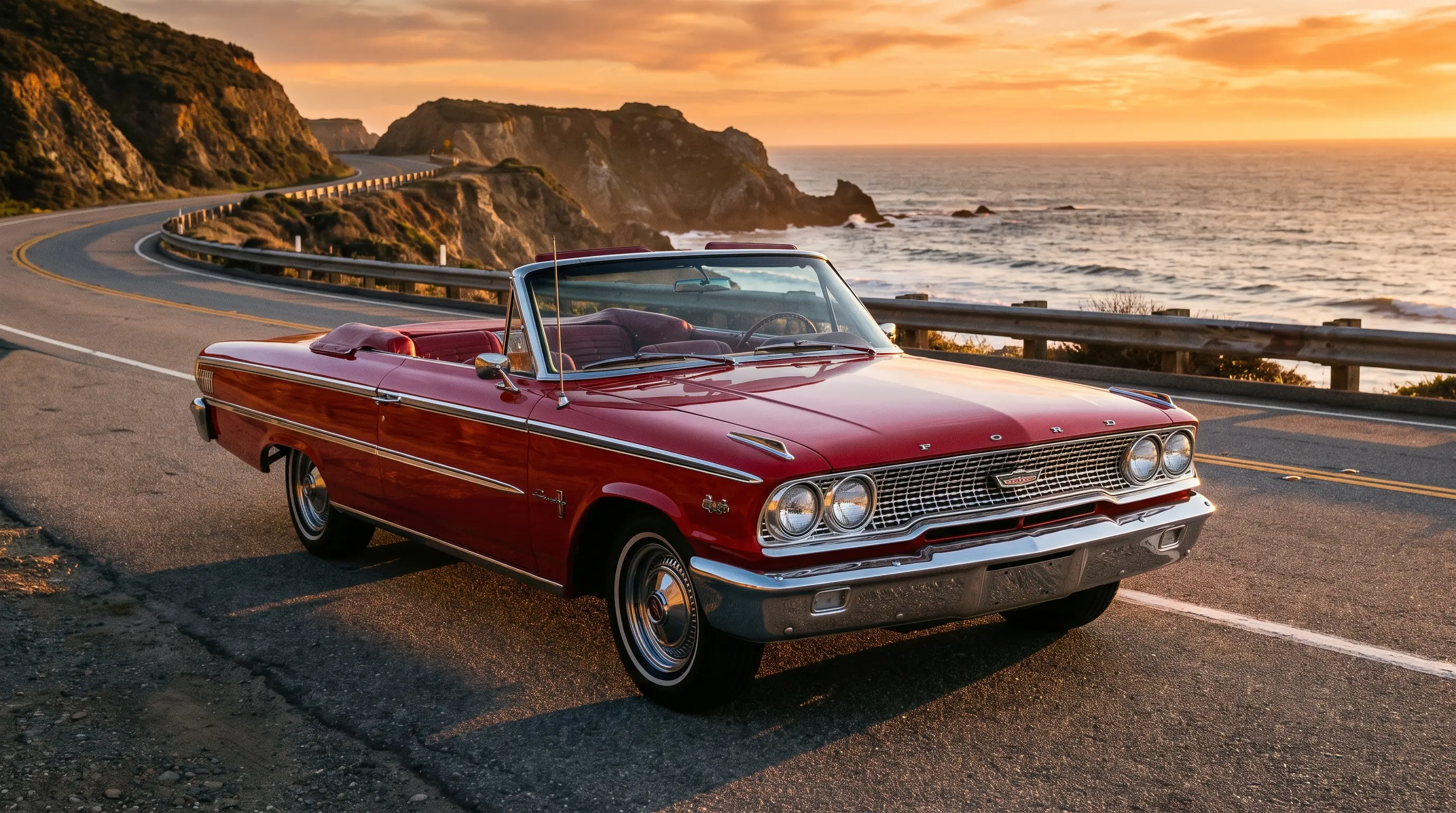
Factory records place the Sunliner name on Ford's full-size convertible lineup for one final year in 1963 before the badge quietly disappeared from the following year's catalog, folded into the general Galaxie 500 convertible designation. That makes the 1963 Sunliner the closing chapter of a nameplate with roots stretching back into the 1950s, and it arrived at exactly the moment Ford's racing program was putting the 427 into NASCAR winner's circles across the country.
Car Features
7 min read
The 1963 Sunliner: A Convertible With Racing in Its Blood
1963 was the last year for Ford's Sunliner convertible name, and it went out with the option of the same 427 winning races elsewhere in the Galaxie lineup.
The end of a long-running name
Ford had used the Sunliner name on its top convertible offering for years before 1963, and by the time it reached the full-size Galaxie generation, the badge carried an established identity as the open-top flagship of the lineup. Documentation from Ford's 1963 sales catalogs confirms the Sunliner designation applied specifically to the convertible body style within the Galaxie 500 series, distinct from the standard hardtop and sedan variants, though the name had already begun giving way on the sportier convertibles, with "Galaxie 500XL" script replacing the "Sunliner" badge on XL convertibles starting in 1962, and by the 1964 model year Ford had simplified its naming across the board so the base Sunliner script was retired as well.
That timing means the 1963 Sunliner represents the final full expression of a nameplate with real history behind it, produced during a model year when Ford's engineering department was also pushing the same basic full-size platform into some of its most competitive racing configurations, a coincidence of timing that gives the last Sunliners a slightly different historical weight than the ordinary convertible model years that preceded them. The convertible buyer and the NASCAR fan were, in a sense, looking at variations of the same car that year, something that was not always true across every era of Ford's full-size lineup.
What made the Sunliner distinct as a convertible
Factory records show the Sunliner shared its basic body structure with the Galaxie 500 hardtop but required the reinforced convertible-specific chassis and floor structure that every open-top full-size Ford of the era needed to maintain rigidity without a fixed roof. That reinforcement added weight compared to the hardtop, a detail worth remembering for anyone comparing straight-line performance data between hardtop and convertible Galaxies from the same model year, since the convertible's extra structural weight put it at a measurable disadvantage even when both cars carried an identical engine.
Buyers who wanted the 427 in a Sunliner could order it, and Ford's factory literature from 1963 lists the big-block as an available option across Galaxie 500 body styles including the convertible, though surviving factory records do not break out a precise production count for 427-equipped Sunliners specifically, and the general understanding among collectors is that they were considerably scarcer than the more common six-cylinder and small-block convertibles. That scarcity is a meaningful factor for anyone researching a specific car's history and trying to establish how rare its exact configuration actually is.
Racing connections without a racing convertible
NASCAR and NHRA competition that season ran almost exclusively in hardtop body styles, since the extra weight and reduced structural rigidity of a convertible offered no competitive advantage on an oval or at the strip. The Sunliner's connection to Ford's Total Performance era is therefore more cultural than literal, a car built on the same platform and available with the same 427 engine that was winning races elsewhere in the lineup, sold to a buyer who wanted the image and the option of real power without necessarily chasing a trophy. That distinction matters for anyone assuming every big-block 1963 Galaxie has direct racing pedigree; the Sunliner's significance comes from what it represents about the era rather than from a documented competition record of its own.
Still, the option to pair a genuine 427 with an open top gave period buyers something rare in the full-size convertible market, a combination few rivals matched at the same price point, and that pairing is part of why documented 427 Sunliners draw serious attention from collectors today even without a competition history attached to any specific car. The appeal is straightforward: real performance hardware in a body style that most manufacturers reserved for comfort-focused buyers rather than anyone chasing a stoplight.
"Factory paperwork rarely gets sentimental, but even a plain build sheet tells you the Sunliner name went out on a genuinely strong car, not a tired one being phased out for lack of options."
- Tom Ramirez
How the Sunliner compared to the rest of the drop-top field
Full-size convertibles were a competitive segment across Detroit in 1963, with Chevrolet, Pontiac, and Chrysler all fielding open-top variants of their own big sedans, and Ford's Sunliner had to compete on more than just nameplate history. What set the Sunliner apart, at least according to period sales materials, was the combination of a genuinely spacious interior with the option of serious big-block power, a pairing not every rival offered as cleanly across their own convertible lineups that year. Buyers cross-shopping a 1963 Sunliner against a comparable Impala or Bonneville convertible were often weighing similar tradeoffs between styling preference and available engine options, since horsepower figures across the segment were closely matched at the top end.
Ford's factory literature leaned on the same Total Performance messaging used for its NASCAR and drag racing efforts even when marketing the Sunliner specifically, tying the convertible's available big-block power back to the same 427 program that was winning races that season. That messaging strategy, common across the industry, meant a buyer walking into a Ford showroom in 1963 encountered the same performance story whether they were shopping a hardtop built for the strip or a convertible built for a Sunday drive, a detail that says as much about Ford's marketing discipline that year as it does about the Sunliner itself.
Collecting the last Sunliners
For collectors specifically interested in the final year of the Sunliner name, documentation matters even more than usual, since verifying original convertible top hardware, correct trim, and matching drivetrain against factory build records is the only reliable way to separate a genuine, well-preserved example from a car assembled after the fact from parts of varying provenance. Given that this was the closing year for the nameplate, interest in confirmed original examples has remained steady among Ford collectors who specifically chase nameplate history rather than just engine displacement, a niche within the larger Galaxie hobby but a genuine one, with its own club discussions and reference points distinct from the broader 427 performance crowd. Anyone researching the wider 1963 lineup that the Sunliner belonged to should start with 1963 ford galaxie history for the full context, and the styling choices that defined that final Sunliner year are covered in a related story worth reading alongside this one. Anyone hoping to find one of these convertibles for their own garage can check Galaxies for sale now for current listings.
Sources and notes
Related Reading
Have a
Ford Galaxie
for Sale?
Reach thousands of serious classic car collectors across the US.
Sell It Here →
Are You a Classic Car Dealer?
List your full inventory and connect with targeted classic car buyers.
Join as a Dealer →

About the author
Tom Ramirez
Corvette researcher and historian based in Bowling Green, Kentucky. Two decades documenting Corvette production history from original factory records.
Related Listings - Ford Galaxie
Comments
Be the first to comment on this article.