
Records at Ford's engineering archives make clear that the 1963 Galaxie's 427 program did not develop in a vacuum. Chrysler's Max Wedge engines, fitted into lighter Dodges and Plymouths that same season, were the specific target Ford's engineers had in mind when they pushed the 427 side oiler toward NASCAR and drag strip duty, and the factory correspondence from the period reads like two rival departments watching each other's every move. Neither company operated its performance program in isolation, and the paper trail left behind by both makes that competitive pressure easy to document rather than merely infer from results alone.
Car Features
6 min read
1963 Galaxie vs the Max Wedge Mopars
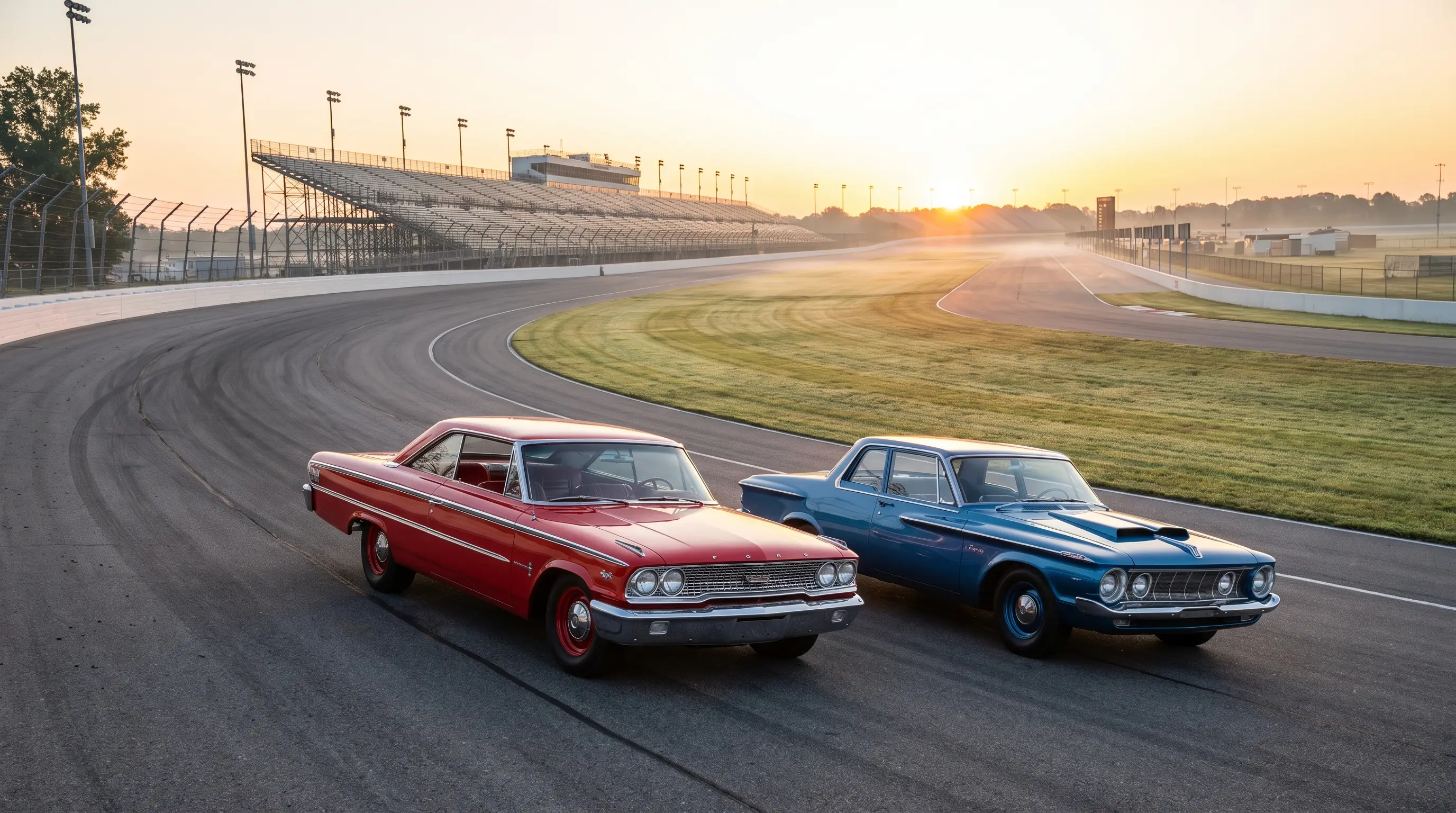
Ford's 427 Galaxie and Chrysler's Max Wedge Dodges and Plymouths fought a documented 1963 rivalry, one built for endurance and one built for the strip.
What the Max Wedge actually was
Chrysler's 426 Max Wedge, factory shorthand for its raised wedge combustion chamber design, arrived in 1963 as the corporation's answer to the horsepower race Ford and Chevrolet were both running at full speed. Fitted into the mid-size Dodge and Plymouth bodies, which weighed considerably less than a full-size Galaxie, the Max Wedge combination produced a power-to-weight ratio that made these cars formidable in NHRA Super Stock competition. Factory ratings on the 1963 426 Max Wedge ran 415 horsepower at 11.0:1 compression or 425 horsepower at 13.5:1 compression, both with dual four-barrel carburetors, numbers close to what Ford's 427 claimed in its own top state of tune, but delivered through a noticeably lighter chassis.
Chrysler's engineers had built the Max Wedge specifically around drag strip performance, prioritizing quick response and aggressive carburetion over the kind of sustained high-speed durability Ford was chasing for NASCAR. That is a documented, deliberate difference in engineering priority between the two programs, not an accident of parts availability, and it shows clearly in how each combination actually performed on different kinds of tracks. Chrysler's own factory literature from the period leaned into that identity rather than apologizing for it, marketing the Max Wedge cars explicitly as strip-ready machines rather than all-purpose performance sedans.
Weight versus displacement
The core competitive tension between the 1963 Galaxie and the Max Wedge Mopars came down to a straightforward equation: Ford had more car to move but a more durable, torque-rich engine built for long runs, while Chrysler had less car to move paired with an engine tuned for maximum aggression over shorter bursts. In factory Super Stock competition, where weight breaks and class rules shifted the calculus regularly, that balance produced closely matched, hotly contested racing throughout the 1963 season, with neither manufacturer holding a permanent, unquestioned advantage.
Ford's response, documented in period factory communications, was the aluminum-paneled lightweight Galaxie program, built specifically to close the weight gap against lighter competitors like the Max Wedge Mopars. That the factory considered this response necessary is itself evidence of how seriously Chrysler's package was taken inside Ford's own engineering offices, a rare case where an internal decision from the period can be traced back to a named competitor's specific product rather than a general industry trend.
| Spec | 1963 Galaxie 427 | 1963 Max Wedge Mopar |
|---|---|---|
| Displacement | 427 cubic inches | 426 cubic inches |
| Top factory horsepower rating | 425 hp (dual quad) | 425 hp (top tune, 13.5:1 compression) |
| Body platform | Full-size (heavier) | Mid-size (lighter) |
| Primary competitive strength | NASCAR superspeedway endurance | NHRA Super Stock drag strip |
NASCAR told a different story
On NASCAR's longer, faster ovals, the equation shifted in Ford's favor more clearly than it did at the drag strip. The Galaxie's size, a genuine handicap over a quarter mile, mattered less at sustained high speed, and the 427's durability, developed under Holman-Moody's close involvement, proved better suited to 500-mile events than Chrysler's Max Wedge combination in most documented comparisons from the season. Chrysler ran competitively in NASCAR during this period but did not build quite the same reputation for long-distance reliability that Ford's factory racing program established through repeated, well-documented superspeedway results.
That split, drag strip advantage leaning toward the lighter Mopars and superspeedway advantage leaning toward the Galaxie, is well represented in period records and remains the clearest way to understand why both cars developed such devoted, and distinct, followings. Trying to declare a single overall winner between the two misreads what each program was actually built to do, since Ford's engineers were optimizing for a 500-mile race and Chrysler's were optimizing for a quarter mile, and a fair judgment depends entirely on which contest you are asking about.
"Factory records from this era rarely admit uncertainty, but read enough internal correspondence and you see two engineering departments genuinely worried about a specific rival. Ford's 427 program and Chrysler's Max Wedge were each built with the other company's cars sitting on the same page of the same memo."
- Tom Ramirez
How each factory marketed the fight
Neither company was shy about pointing to race results in its advertising, and 1963 factory literature from both Ford and Chrysler leaned heavily on recent Super Stock and NASCAR finishes to sell an image of engineering seriousness to ordinary buyers who would never see a drag strip or a superspeedway in person. Ford's advertising under the Total Performance banner repeatedly referenced 427-powered Galaxie results, tying the family sedan on the showroom floor to the same basic engine winning races on Sunday. Chrysler ran a similar playbook around its Max Wedge results, using drag strip trophies to argue that its mid-size cars offered performance credentials that competitors could not match pound for pound.
That marketing strategy, common across Detroit in this period, is part of why period factory records survive in such detail. Both companies kept close internal track of competitors' results specifically because those results were about to become advertising copy, and the documentation trail left behind gives researchers today an unusually clear window into how seriously each manufacturer treated the rivalry at the time, not just in retrospect.
Documenting the rivalry today
For collectors and researchers, the 1963 Galaxie versus Max Wedge Mopar comparison holds up well against the primary record, better in fact than some more casually repeated engine rivalries from the same period. Factory build sheets, period race results, and NHRA and NASCAR documentation from the 1963 season together paint a consistent picture: two manufacturers making deliberate, opposite engineering choices, weight against durability, in pursuit of the same performance crown. Anyone researching a specific 1963 Galaxie or a Max Wedge Dodge or Plymouth today benefits from checking these primary sources directly rather than relying on secondhand hobby lore, since the actual factory record is more precise, and often more interesting, than the shorthand version repeated at car shows. Club archives dedicated to each marque have done substantial work cataloging surviving cars against known production and casting records, and that cross-referencing is the difference between a documented, historically significant example and a car simply wearing the right badges.
For the complete story of the model year this rivalry played out within, the full story covers the wider context of the 1963 Galaxie lineup, and if the comparison has left you wanting to own a piece of that history, classic Galaxie for sale shows current listings.
Sources and notes
Related Reading
Have a
Ford Galaxie
for Sale?
Reach thousands of serious classic car collectors across the US.
Sell It Here →
Are You a Classic Car Dealer?
List your full inventory and connect with targeted classic car buyers.
Join as a Dealer →

About the author
Tom Ramirez
Corvette researcher and historian based in Bowling Green, Kentucky. Two decades documenting Corvette production history from original factory records.
Related Listings - Ford Galaxie




Comments
Be the first to comment on this article.