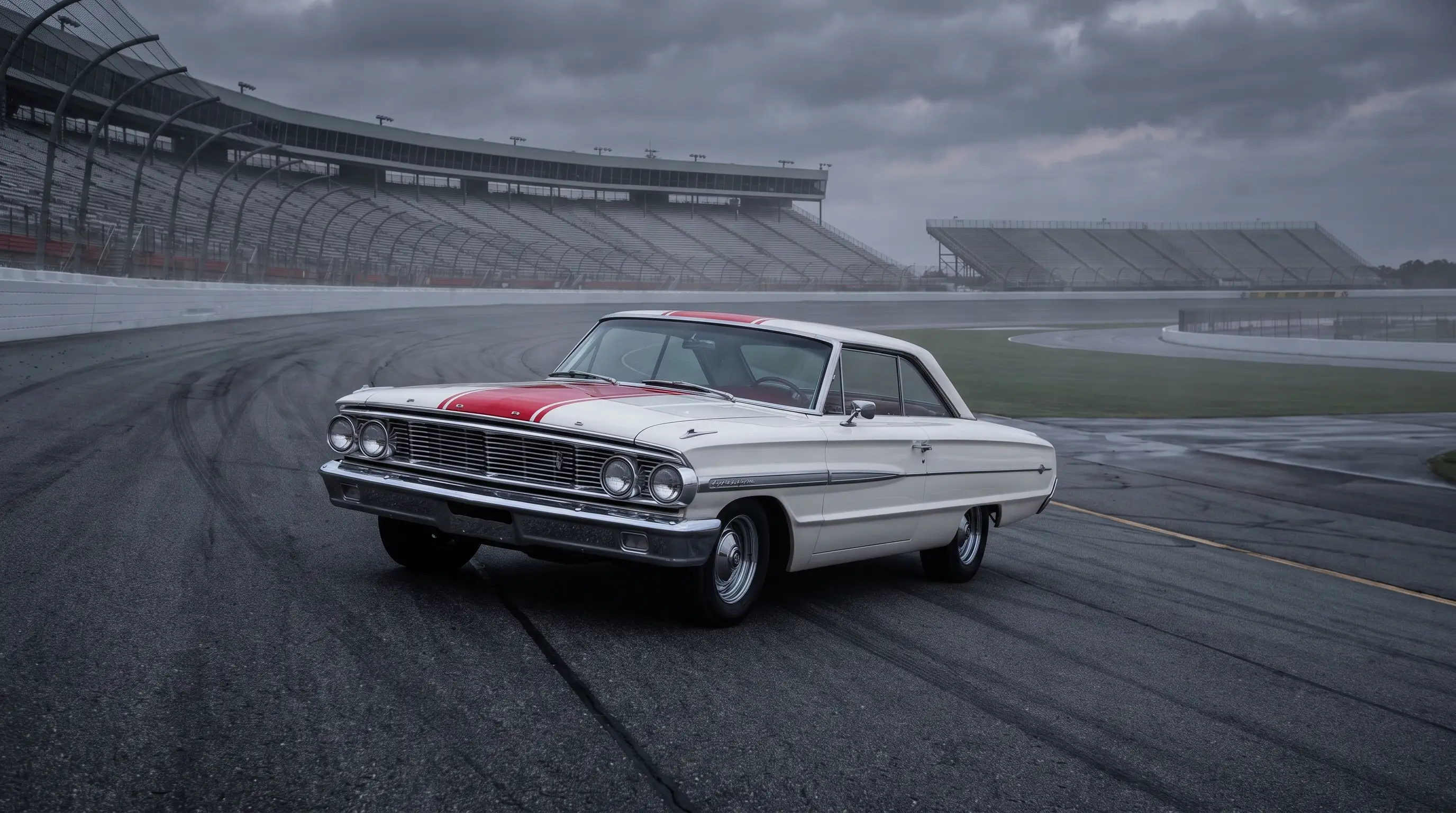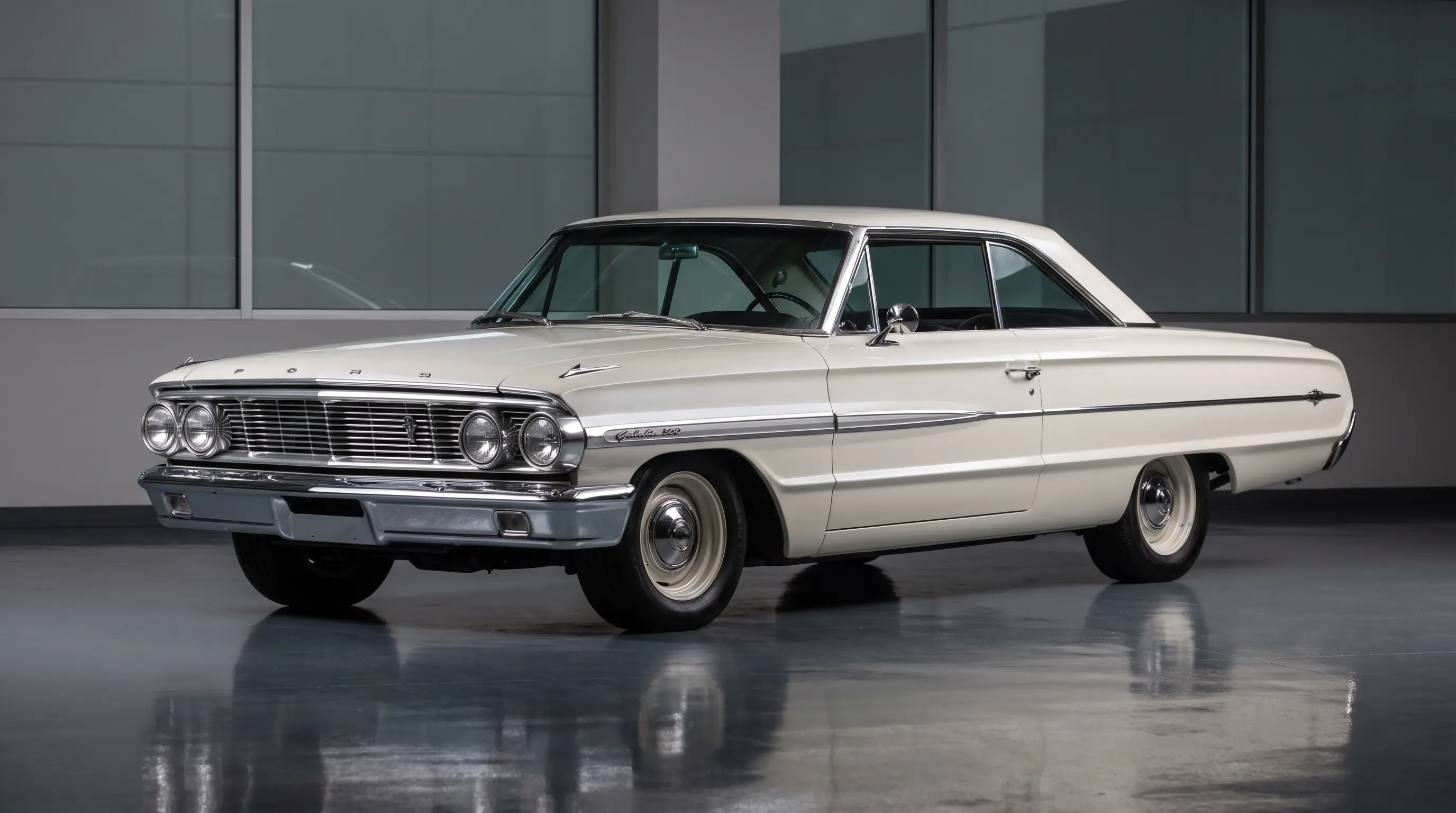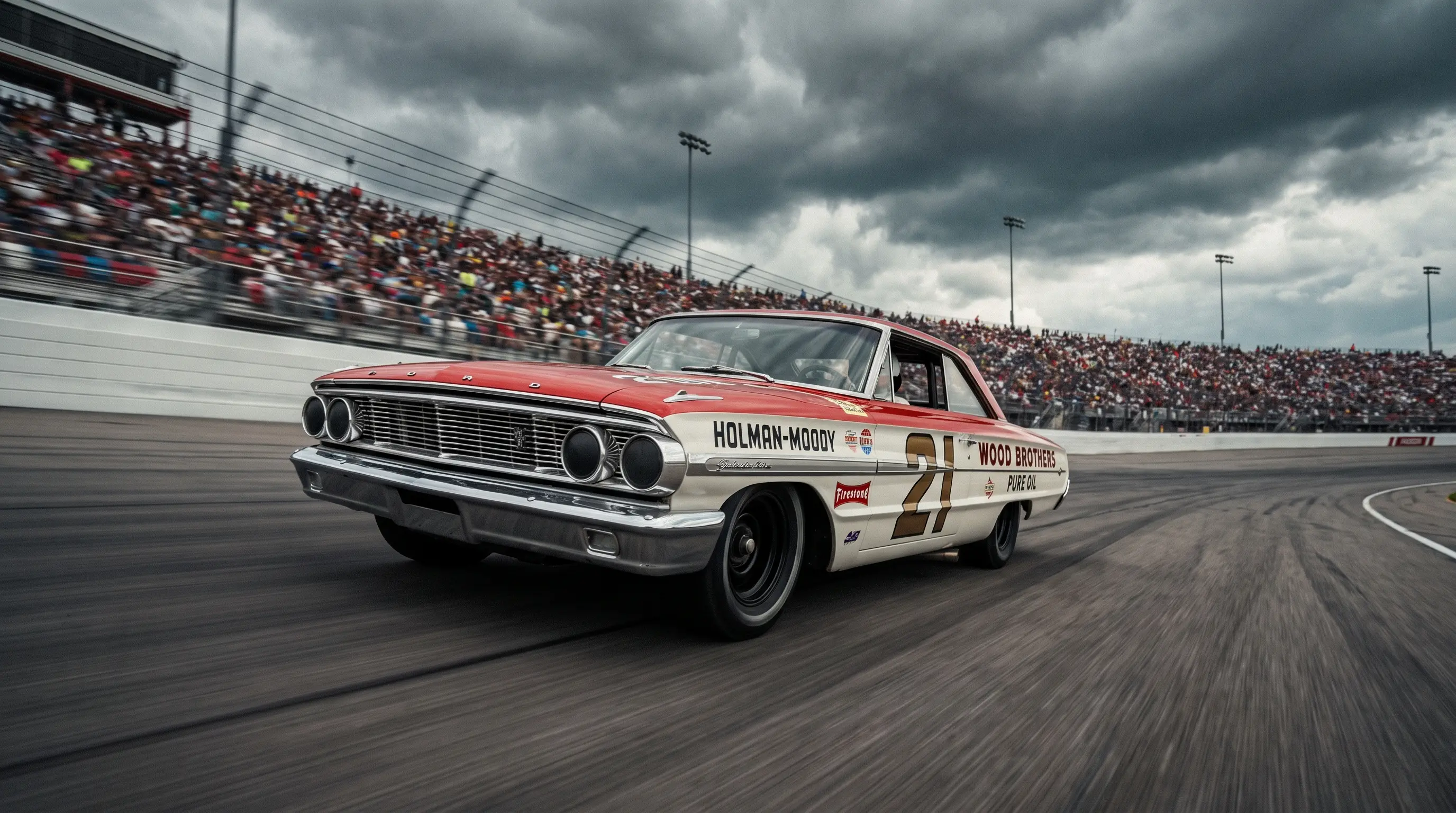
The Ford Galaxie's reputation as a factory hot rod rests almost entirely on one engine, and 1964 is the year that engine had to prove it still mattered. The 427 cubic inch FE big block had already made its name in 1963, but ford galaxie 1964 427 continues the fight is really a story about a company defending ground it had just won, against a rival that showed up mid-season with something Ford had not planned for.
What the 427 actually was by 1964
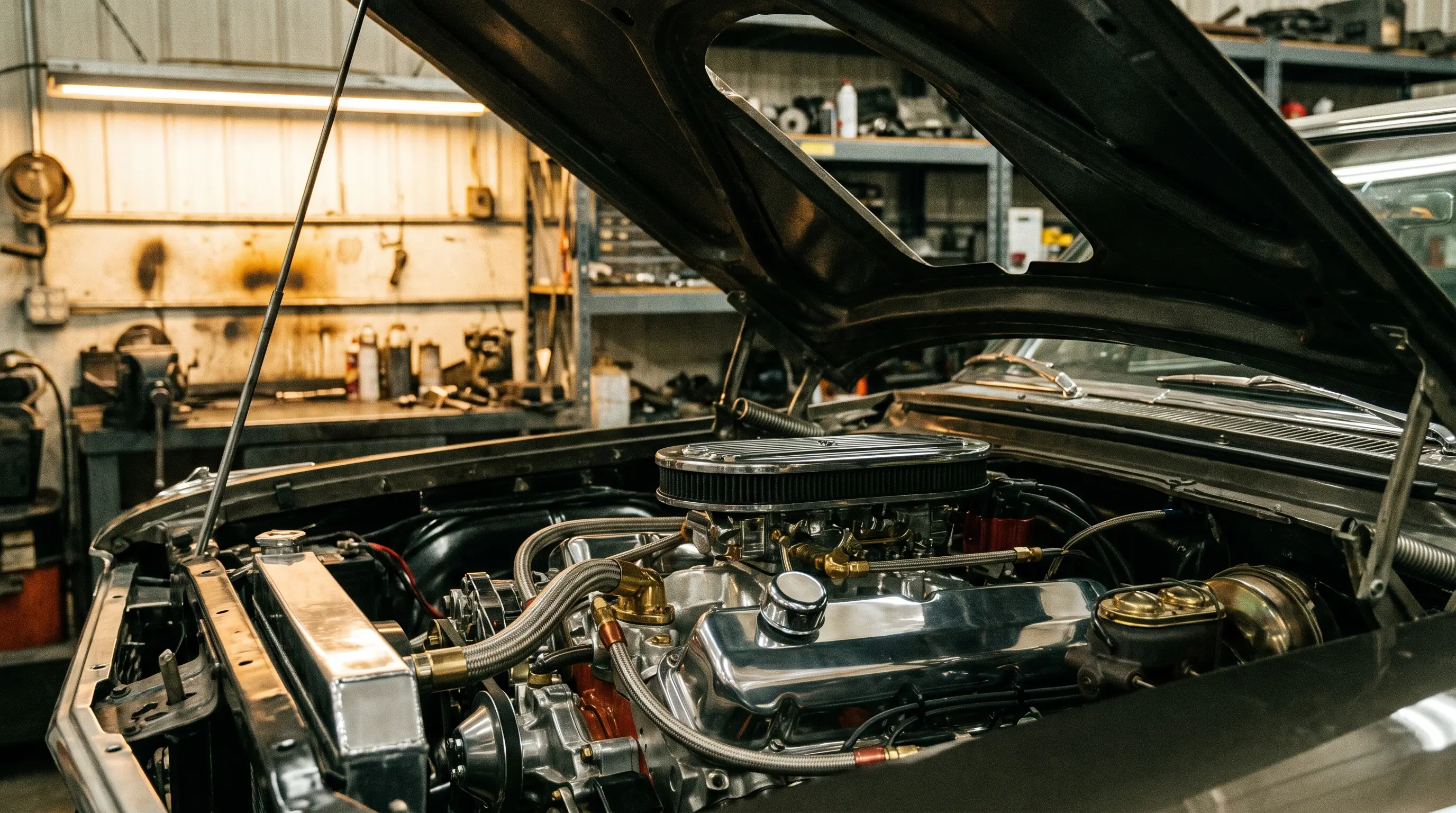
The 427 FE in the Galaxie was a evolution of Ford's 406 and 390 big blocks, built with a stronger block casting, cross-bolted main bearing caps for the lower two positions, and either a single four-barrel carburetor or dual four-barrel induction depending on the code. Ford rated the single-carb version at 410 horsepower and the dual-quad "R-code" version at 425 horsepower (advertised, gross), numbers that were already aggressive for a full-size passenger car body. The engine bay of a 1964 Galaxie was not designed around a motor this large, and fitting one in required a specific set of factory parts, from the exhaust manifolds to the accessory brackets, that differ from the smaller-block cars.
What made the 427 credible on the street and not just on paper was the drivetrain around it. Heavy-duty suspension components, a stouter rear end, and close-ratio manual transmissions or the available heavy-duty automatic were all part of the package when ordered correctly. A 427 Galaxie was never meant to be subtle, and Ford did not try to make it subtle.
Why 1964 was not a repeat of 1963
In 1963, the 427 Galaxie had been the car to beat, especially in NASCAR's superspeedway events where horsepower and top speed mattered more than cornering finesse. Ford went into 1964 expecting more of the same. Instead, Chrysler arrived with the 426 Hemi, a purpose-built racing engine that outmuscled the 427 in raw output on the high-speed tracks where it counted most. The Hemi's dominance that season is covered in more detail in our complete history of this model year, but the short version is that Ford spent 1964 reacting rather than dictating terms, which was a new and uncomfortable position after the previous season's success.
The engineering response to that pressure did not happen overnight. Ford's answer, the single overhead cam 427 "cammer," was already in development during 1964 specifically because the standard wedge-head 427 could not match the Hemi's output on paper. That the cammer would not race in NASCAR until the following year, and would then be effectively legislated out of contention, is a separate story. What matters for 1964 is that Ford knew mid-season it was outgunned and had already committed engineering resources to fixing the problem.
The numbers that actually separate the good cars from the ordinary ones
Production figures for factory 427 Galaxies in 1964 were low relative to the overall Galaxie run, with well under 3,000 427-equipped cars built against total full-size Ford production well north of 900,000 that year, since most buyers ordered smaller and cheaper engines for daily use. That scarcity is the whole reason correctly documented 427 cars command a premium today; the combination is rare specifically because it was an expensive, purpose-built option rather than a broad market choice. A car with a 427 block casting number and the correct heavy-duty running gear is a fundamentally different animal from a Galaxie with a smaller FE engine dressed up to look the part, and the difference shows up the moment you put load on the drivetrain, not just in a parts catalog.
This is where documentation earns its keep. Casting numbers on the block, date codes, and the presence of the correct heavy-duty components together tell a more reliable story than a data plate alone, since data plates can be swapped and casting numbers cannot be argued with in the same way. An engineer looking at two claimed 427 cars side by side will always ask for the block casting before the sales sheet, because the sales sheet reflects what someone wrote down and the casting reflects what actually left the foundry.
There is also a durability angle worth separating from the horsepower argument. The cross-bolted mains that kept the bottom end together under sustained high-RPM loads were an answer to a specific failure mode, not a marketing bullet point. Big-inch engines from this era without reinforced main caps had a well-known habit of walking the crankshaft under repeated hard use, and Ford's engineers addressed that problem directly rather than simply advertising a bigger number and hoping the bottom end would hold. That kind of unglamorous engineering is easy to overlook next to a horsepower figure, but it is the reason a well-maintained 427 can still be run hard today without the anxiety that comes with some of its contemporaries.
"Horsepower figures get argued over forever. A cross-bolted main cap either survives sustained load or it does not, and that is a much shorter argument."
- Emily Chen
What the rivalry actually cost Ford, in engineering terms
It is worth being precise about what "losing" to the Hemi in 1964 actually meant, because it was not a failure of the 427 as a design. The wedge-head 427 remained a strong, reliable, streetable engine that a buyer could option into a full-size car and drive home the same day. The Hemi that beat it on the superspeedways was a far more specialized piece, expensive to produce and not remotely intended for the kind of daily use a Galaxie buyer expected. Ford's actual cost was strategic rather than mechanical: engineering time and budget that might have gone toward refining the existing 427 got redirected into a clean-sheet racing engine, the single overhead cam cammer, built specifically to answer the Hemi on its own terms. That redirection is the real fingerprint 1964 left on Ford's engine program, more than any single dyno number from that season.
Where the 427 story actually lands for 1964
Judged purely on horsepower figures, the 427 did not win 1964 the way it had won 1963. Judged on what it forced Ford to build next, it was arguably more important than the year before it, since it is the direct reason the cammer engine exists at all. For anyone shopping this era of Galaxie today, that context matters more than a single spec sheet number, because it explains why the 427 option remains the benchmark against which every other full-size Ford engine from this period gets measured.
If this history has you curious what a correctly equipped example is worth today, you can find a classic Galaxie and compare documented 427 cars against the more common six-cylinder and small-block examples that make up most of the surviving population.
Sources and notes
- Classic Classified: 1964 Ford Galaxie 500 "R-Code" 427/425 - Hagerty Media
- Car of the Week: 1964 Ford Galaxie 427 - Old Cars Weekly
- 1964 Ford Galaxie Fastback R-Code: An Icon From Ford Racing History - Motorious
- 1964 Ford Galaxie Factory R-Code 427 Dual Quad - David's Classic Cars
- Ford FE engine - Wikipedia