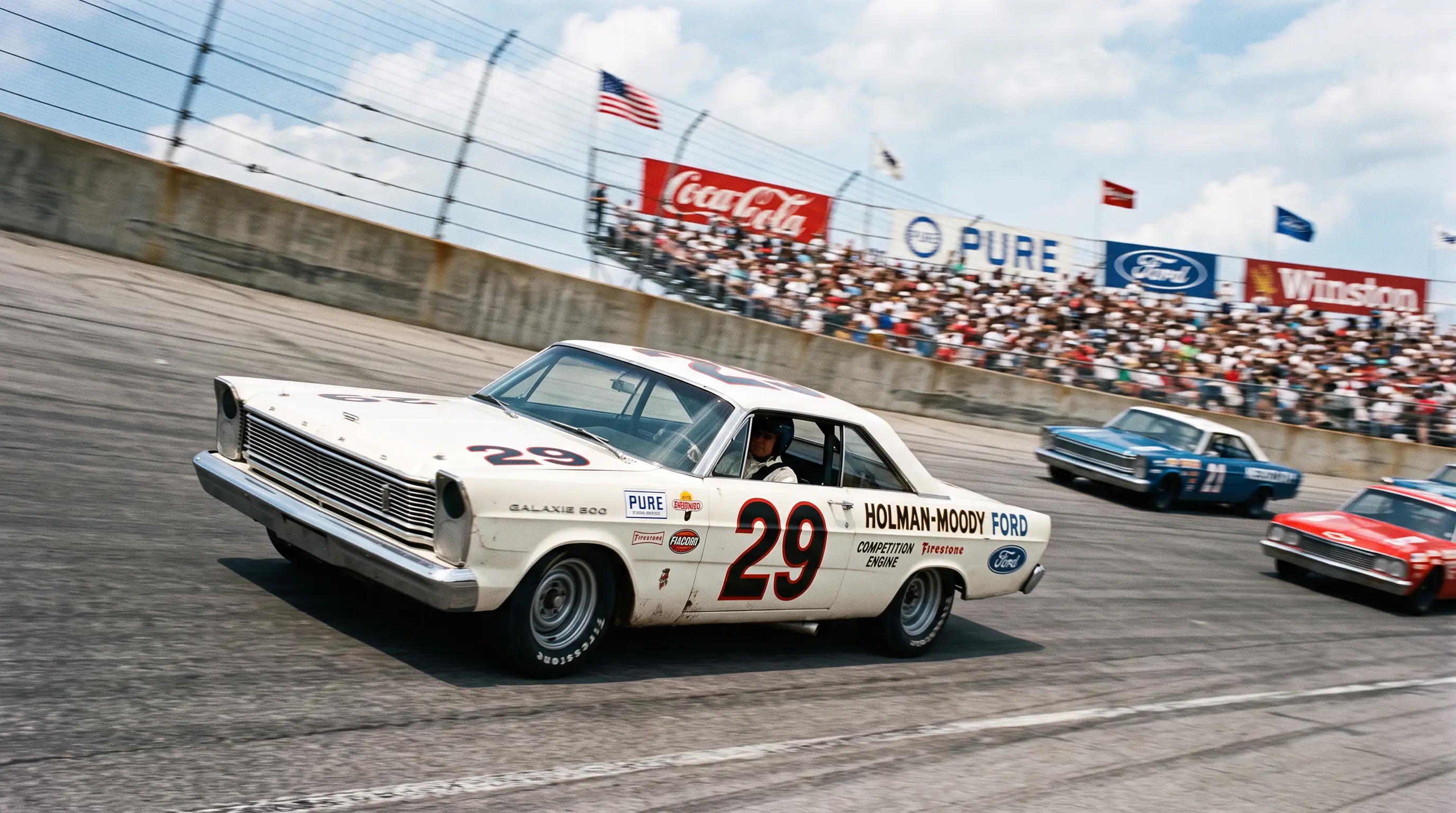
Picture a NASCAR garage in early 1965, and the story that greets you is not one of a single dominant car so much as one of an entire field reshuffled by a rulebook fight nobody on the fan side fully understood at the time. Chrysler had pulled its factory hemi teams out over homologation disagreements with NASCAR, and into that vacuum rolled Ford, with the Galaxie as its primary weapon on the superspeedways. What followed was one of the stranger, most lopsided seasons in the sport's early history, and the 1965 Galaxie sat right at the center of it.
A season shaped by who wasn't there
NASCAR's 1965 season is remembered as much for its absences as for its competition. Chrysler's decision to sit out large portions of the year after NASCAR restricted the hemi engine left Ford facing a thinner field of top-tier factory competition than it otherwise would have, and Ford's teams, running the full-size Galaxie, took full advantage. Drivers piloting the Galaxie racked up a lopsided share of wins that season, a dominance that record books still note today, though serious fans and historians have always been careful to add the asterisk: a meaningfully weaker field of competition inflates any single manufacturer's win total, and 1965 is the textbook example of that dynamic in NASCAR history.
That context does not erase what Ford and its drivers accomplished, but it does explain why the season carries a slightly complicated legacy rather than a clean triumphant one. The Galaxie was a genuinely capable, well-developed racing package by 1965, built on years of Total Performance investment from Ford, but it also got to prove that capability against a field missing one of its most formidable competitors for much of the year.
The car underneath the racing livery
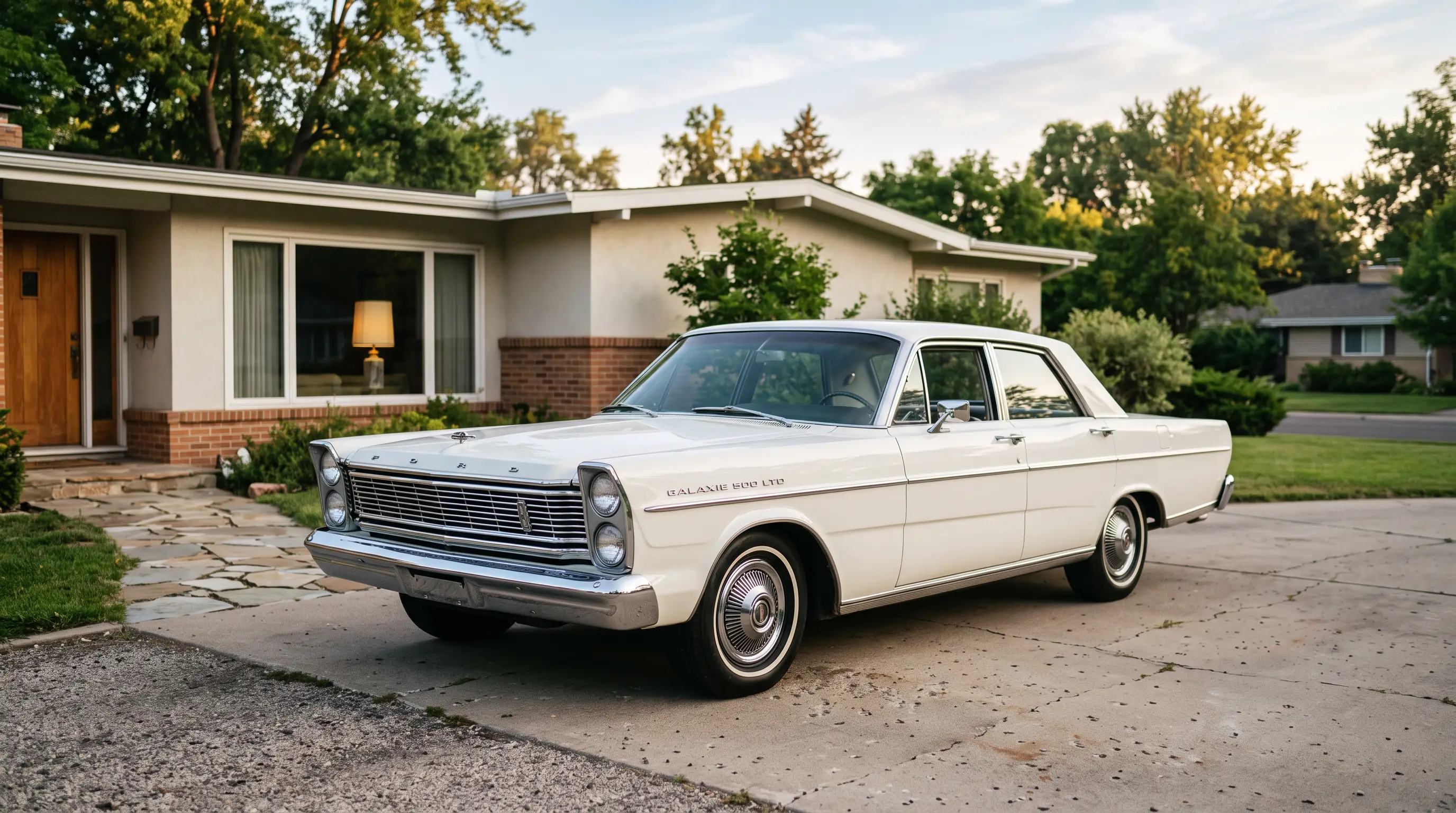
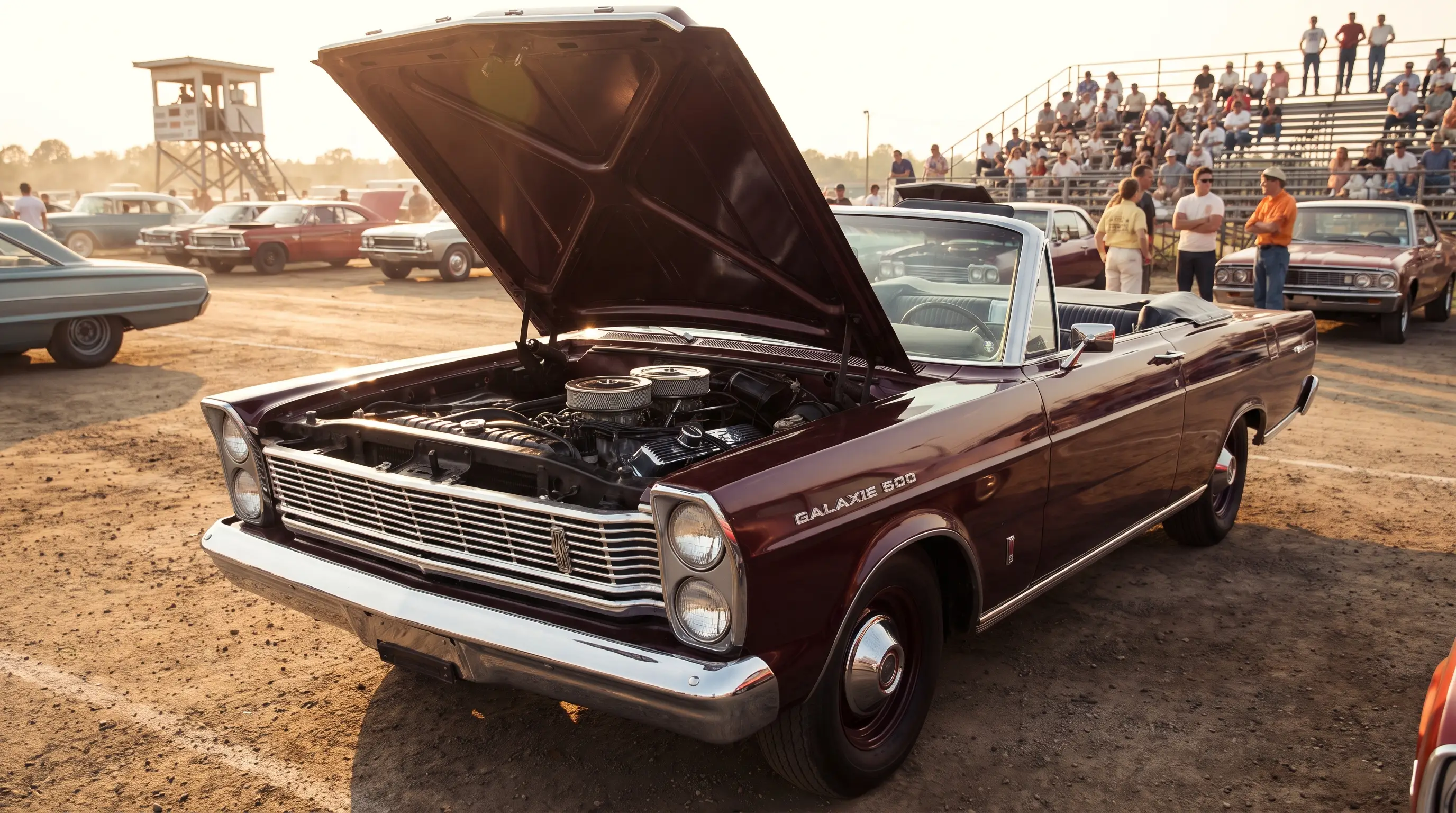
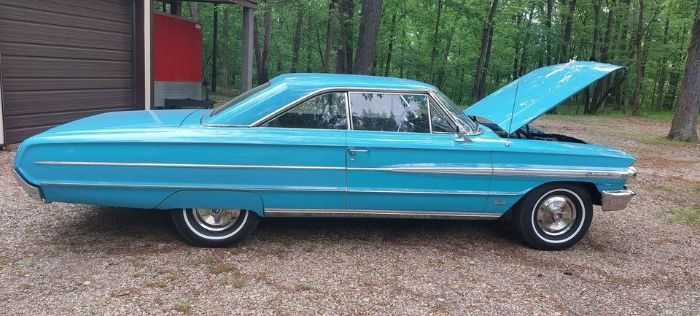
The Galaxie that ran NASCAR ovals in 1965 shared its basic silhouette with the redesigned street car sitting in dealership showrooms that same year, the same stacked-headlight face and all-new body that buyers saw when they walked onto a Ford lot. Underneath, of course, the racing versions were built to a completely different standard than anything a customer could option from a dealer, but the visual connection between the race car and the showroom car mattered enormously to Ford's marketing during the Total Performance era. Fans watching a Galaxie take the checkered flag on Sunday were, in theory, looking at a shape they could go buy on Monday, even if the actual mechanical package under a race car's skin bore only a family resemblance to what left the factory.
That connection between racetrack and showroom was not incidental. It was the entire strategy behind Ford's Total Performance push throughout the mid-1960s, the idea that racing success would translate directly into showroom credibility. A turbulent, top-heavy season like 1965 tested that strategy in an interesting way, since a manufacturer that wins too easily against a depleted field risks the victories reading as hollow rather than impressive to the sport's more knowledgeable fans.
Ford's marketing team understood that risk and leaned into it anyway, betting correctly that most casual fans would remember the winning far more than they would remember the specific circumstances behind it. Serious NASCAR historians have kept the asterisk alive in the decades since, but at the time, a checkered flag was a checkered flag, and Ford's dealers were happy to let the wins speak for themselves in the showroom regardless of who else was or was not on the track that Sunday.
Drivers who carried the Galaxie's banner
Several drivers built or cemented their reputations behind the wheel of a Ford Galaxie during this stretch of NASCAR's Total Performance era, piloting cars prepared by some of the sport's most respected teams of the period. The relationships between Ford, its teams, and its drivers during these years produced some of the more storied partnerships in the sport's early history, the kind of collaborations between manufacturer, crew chief, and driver that fans still discuss at length today. Readers curious about one of the specific personalities associated with the Ford NASCAR program during this period can find that story treated in depth elsewhere on this site, alongside a related story covering a different side of the 1965 Galaxie's public identity that year.
What tied these drivers and teams together was a shared investment in making the Galaxie a genuinely competitive package rather than simply a beneficiary of a thin field, and the engineering work that went into the race cars during this period fed back, in smaller ways, into how Ford thought about performance on the street side of the lineup as well.
These team relationships also outlasted any single season's results. Crew chiefs and drivers who built their reputations on the Galaxie during the mid-1960s carried that credibility forward as Ford's racing efforts evolved through the rest of the decade, and the fan loyalty built during years like 1965 gave those teams a following that stuck with them well after the specific circumstances of that turbulent season had faded from casual memory.
"You can't tell the story of the 1965 season without mentioning who wasn't racing that year, but you also can't pretend Ford's cars and drivers weren't genuinely good. Both things were true at once, and that's what makes the season worth talking about instead of just recording."
- Patrick Walsh
A legacy with an asterisk, and a lasting one anyway
Decades later, the 1965 NASCAR season occupies an odd place in the sport's memory: statistically one of the most dominant years any manufacturer has ever posted, and yet almost always discussed with the immediate caveat about who was missing from the field. That complicated legacy has not diminished how central the Galaxie remains to the story of Ford's Total Performance era. The car proved capable when it got the chance, the drivers who ran it built real careers on the back of that success, and the connection between the track and the showroom kept the street-going Galaxie tied to a genuine competition pedigree rather than a marketing fiction. Readers wanting the fuller context of that model year, the redesigned body, the new LTD, the 427 option, and everything else Ford was doing alongside its racing program, can find it in our 1965 ford galaxie retrospective.
For anyone drawn to that era today, whether by the racing history or simply the look of the car, there is a straightforward way to connect with it directly. Buyers browsing Galaxies for sale now are shopping for the same basic shape that turned laps on NASCAR's biggest ovals during one of the sport's strangest, most talked-about seasons, a piece of that story sitting in a driveway rather than a museum.