
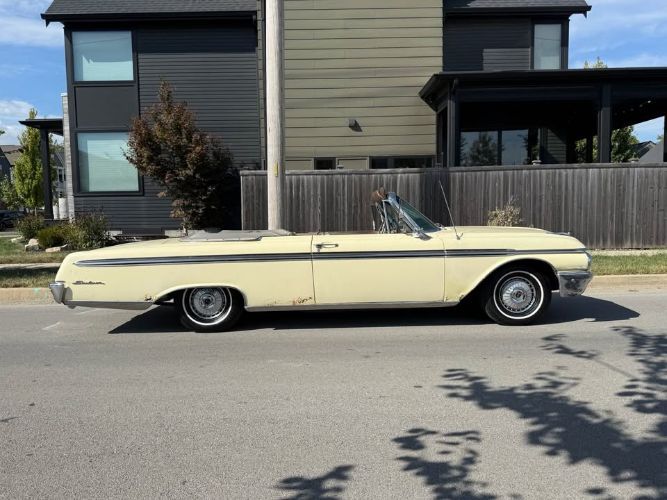
A quick clarification before anything else, because it matters for anyone trying to correctly identify a car: by 1965, Ford had already retired the Sunliner name from its full-size convertible lineup, a badge that had marked Ford's open cars from the early 1950s all the way through the 1964 model year. The 1965 full-size Ford convertible carried on that Sunliner tradition in spirit, an open-top variant of the Galaxie 500 built on the year's all-new body, even though the factory badge on the car itself simply read Galaxie 500. Collectors and enthusiasts still sometimes reach for the older Sunliner name informally when discussing these cars, a nod to the lineage rather than a factory designation, and that history is worth untangling before getting into what actually made the 1965 convertible worth documenting.
The 1965 Galaxie Convertible in the New Body
The 1965 Galaxie 500 convertible carried the Sunliner tradition in spirit onto Ford's all-new body, and documenting a genuine one takes real diligence.
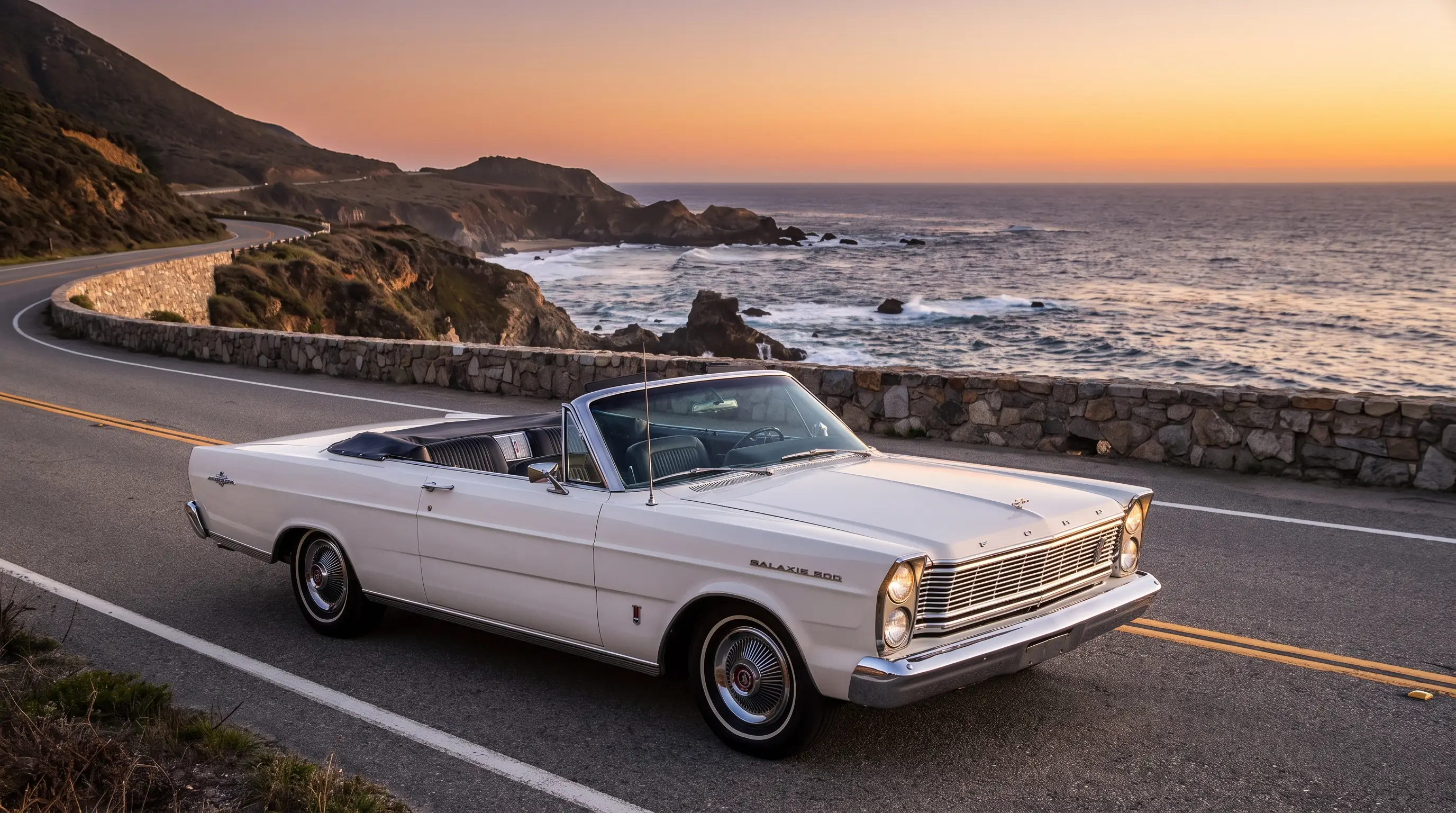
An open car on an entirely new body
Every full-size Ford for 1965 rode on the new perimeter frame and wore the redesigned stacked-headlight sheet metal, and the Galaxie 500 convertible was no exception. Building a proper convertible on an all-new platform is never a trivial exercise, since removing a fixed roof changes the structural math of a car in ways engineers have to compensate for elsewhere in the body. Ford's convertible received additional reinforcement in the frame and rocker structure to make up for the rigidity lost without a steel roof, a detail that rarely gets discussed alongside the more visible styling changes of the 1965 model year but that mattered enormously to how the car actually held together and drove.
The result, when done well, was a full-size convertible that carried the same lower, wider stance as its hardtop and sedan siblings, with a power-operated top mechanism that folded away cleanly beneath a hard tonneau panel when lowered. Ford had years of experience building convertibles by 1965, and that experience showed in how well integrated the open-top Galaxie 500 looked compared to some of its competitors' more obviously compromised convertible offerings.
That experience mattered because a poorly executed convertible conversion tends to announce itself immediately, through visible cowl shake over rough pavement or a top that never quite disappears cleanly under its tonneau panel. Ford's engineers, having already worked through these problems on earlier full-size convertibles, applied lessons learned from prior model years to the entirely new 1965 platform rather than starting the reinforcement calculations from scratch, and the resulting car held up well against period criticism that newer, less experienced manufacturers in the convertible market sometimes did not escape.
Documenting a genuine 1965 convertible
For collectors, the Galaxie 500 convertible carries a documentation burden that hardtop and sedan versions of the same car simply do not face in the same way. Convertibles were built in meaningfully lower numbers than closed-body Galaxies across the full-size range, and the desirability gap between an open car and a closed one creates real incentive, unfortunately, for less scrupulous sellers to represent a modified or incorrectly converted car as an original factory convertible. Verifying a genuine 1965 convertible means checking the body tag and matching build codes against known factory documentation, confirming the frame and floor pan show the correct convertible-specific reinforcement, and treating any car without a clear paper trail with appropriate caution regardless of how good it looks in person.
That caution is not paranoia. It reflects a market reality that shows up across nearly every desirable convertible from this era of American production, where the premium a genuine open car commands over its closed counterpart creates exactly the incentive structure that produces questionable conversions.
The safest approach for a buyer is treating the paperwork as the primary evidence and the car itself as supporting material, rather than the other way around. A body tag can be read in minutes. Matching that tag against surviving factory records, when they exist, and against the physical evidence of correct convertible-specific reinforcement in the frame and floor pan takes longer, but it is the only reliable way to separate a documented original from a well-disguised conversion built from a donor sedan.
| Verification point | What to check |
|---|---|
| Body tag | Confirms body style code matches convertible designation |
| Frame and floor pan | Convertible-specific reinforcement should be present and unmodified |
| Top mechanism | Correct power-top hardware and tonneau panel fitment |
| Supporting paperwork | Build sheet or factory documentation cross-referenced against the body tag |
Why the open car mattered to the year's story
The convertible occupied a specific place in Ford's 1965 lineup, a halo body style that let the year's new design language show off in a way no closed roof could match. With the top down, the clean beltline and the lower, wider stance the redesign delivered were on full display, unobstructed by roof pillars or a fixed greenhouse. Ford's dealers used convertibles prominently in showroom displays and print advertising for exactly this reason, since an open car photographed well and drew attention on a lot in a way a sedan simply could not compete with.
That showroom role also meant the convertible tended to be optioned generously, since buyers willing to pay the premium for an open top were frequently the same buyers willing to check additional boxes further down the order sheet. Surviving 1965 Galaxie 500 convertibles today often turn up with desirable options that were less commonly paired with base sedans, a pattern collectors have come to expect rather than a coincidence.
That tendency toward generous optioning also means a well-equipped convertible today often represents a genuinely complete snapshot of what a full-size Ford could be ordered with in 1965, power windows, upgraded interior trim, and stronger engine choices all showing up more frequently on these cars than on the average sedan from the same model year. For a researcher, a heavily optioned convertible with matching documentation is as close as this era gets to a rolling catalog of the full-size Ford's available features.
"An open car from this era is a documentation project as much as a purchase. The body tag and the build sheet tell you more about what you're actually buying than the top ever will."
- Sarah Whitfield
Placing the convertible in the wider 1965 story
The Galaxie 500 convertible's story does not stand entirely apart from everything else Ford was doing with the full-size line that year. It shared the same new frame, the same body, the same stacked-headlight face, and the same coil-sprung ride improvement that reshaped how every 1965 Galaxie felt on the road. Readers who want to read the background on that full redesign will find the convertible's place in the lineup easier to appreciate once the broader context of the model year is clear.
For collectors and enthusiasts hoping to find a classic Galaxie convertible specifically, patience tends to pay off more than urgency. Genuine, well-documented examples surface less often than their closed-roof counterparts, and the extra time spent confirming a car's paperwork before committing is rarely time wasted given how much the documentation, rather than the appearance alone, determines whether a car is truly what it claims to be.
Sources and notes
Related Reading

Third-generation classic car collector specializing in pre-war American and European coachbuilt automobiles. Researcher and concours enthusiast.
Related Listings - Ford Galaxie




Comments
Be the first to comment on this article.