
A 4th gen Camaro drag car starts with more horsepower per dollar than almost anything else from the 1990s. That's the good news. The bad news is that the factory built these cars to run 14-second passes on street tires, not to take a beating on sticky rubber every Saturday night for a decade. The parts that remember the difference live behind the driver, not under the hood.
Car Features
7 min read
The Fourth-Gen Camaro at the Drag Strip
What a stock 1993 to 2002 Camaro ran in the quarter mile, LT1 or LS1, the T56 and the 10-bolt, and how to make a fourth gen hook.
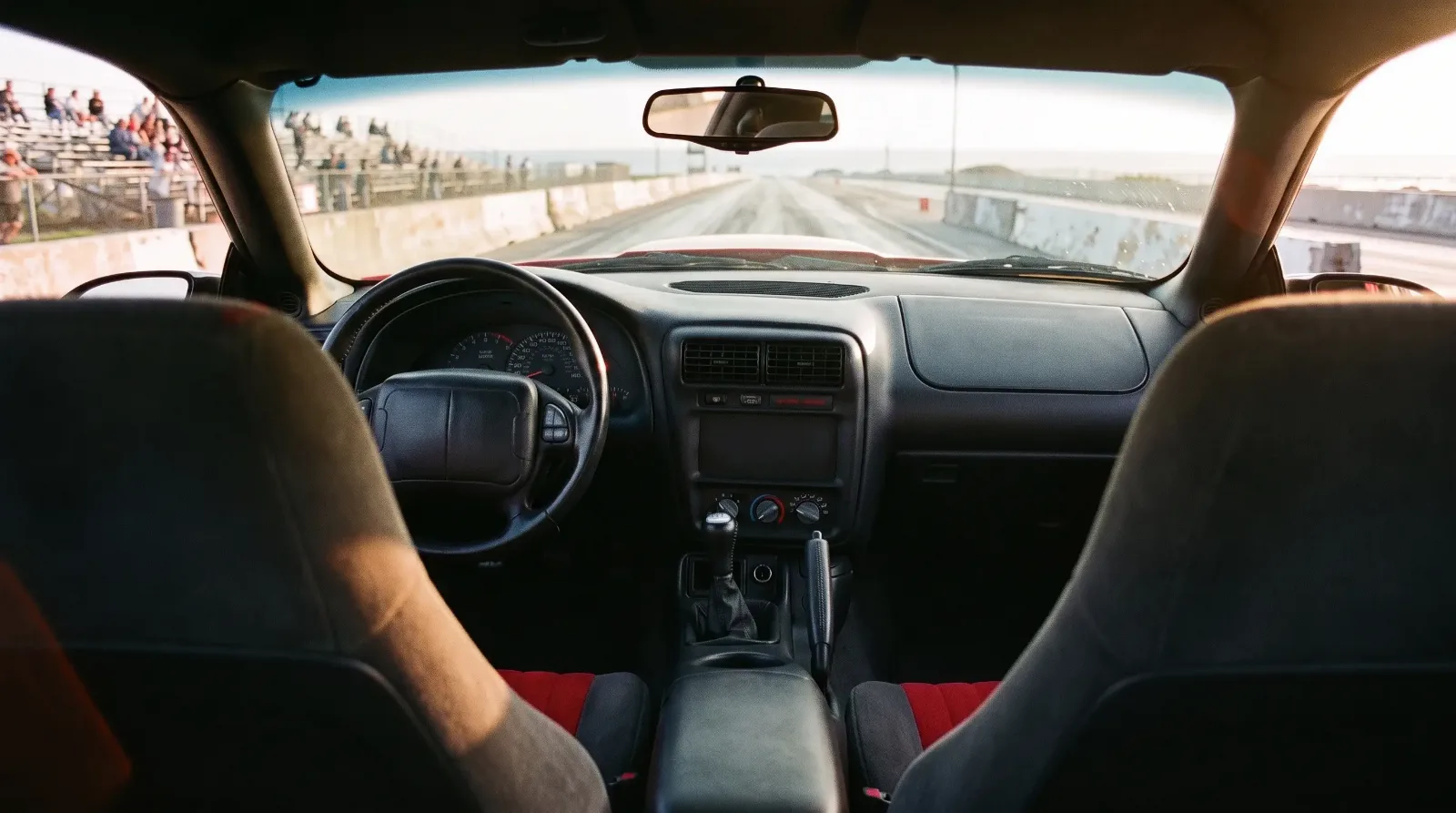
The road-course side of things, the Trans-Am cars and the endurance entries, belongs to the wider racing Camaro story. This one is about the strip. What a stock 1993 to 2002 car actually ran when it was new, which engine to start with, and what gives up first when you start asking for more.
What a stock fourth gen ran in the quarter mile
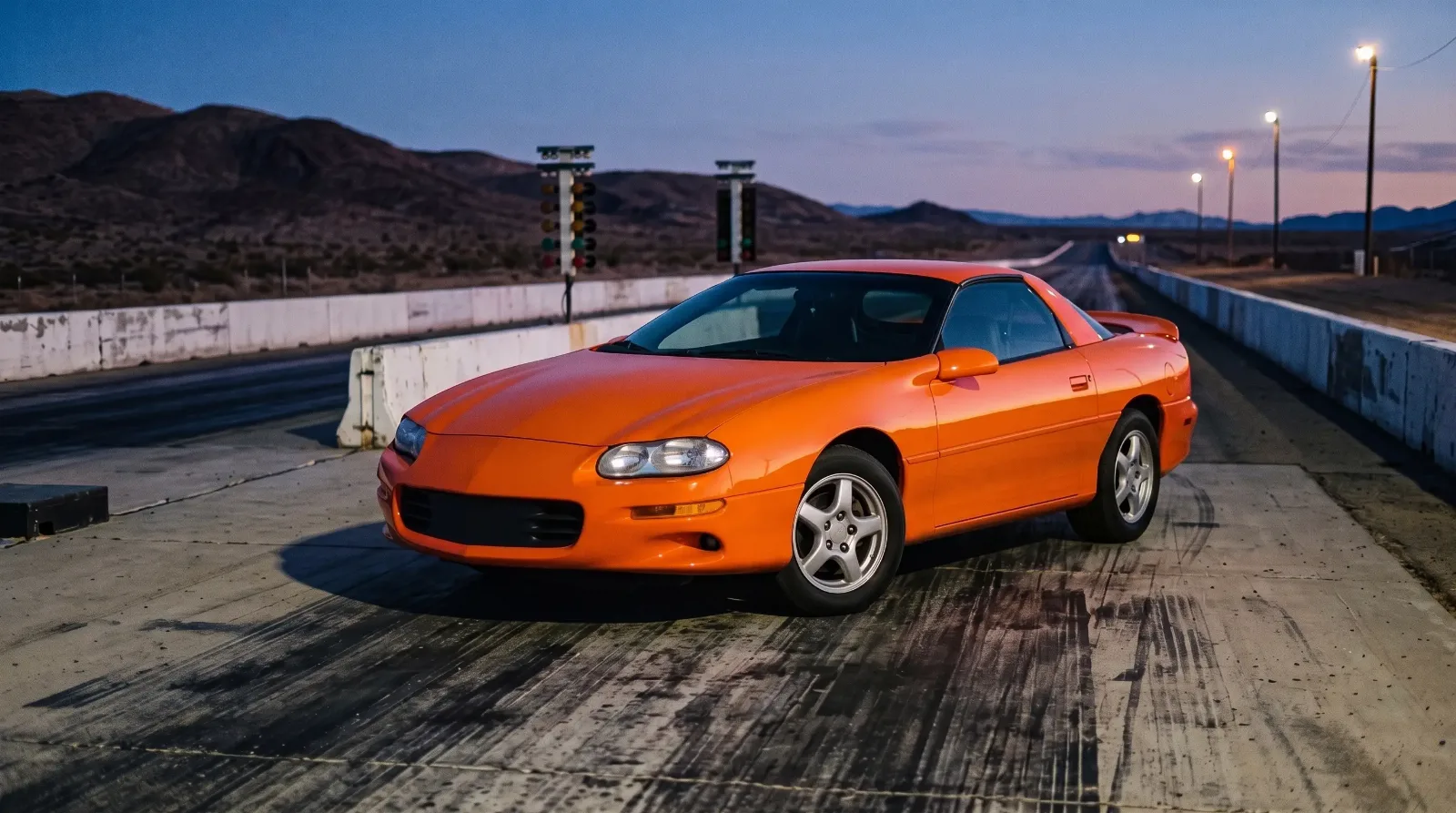
Start with the timeslips the testers printed. Catalog horsepower changed almost every other year. The clock didn't care about the catalog.
| Car (as tested) | Rated output | Quarter mile | Tested by |
|---|---|---|---|
| 1993 Z28, LT1 | 275 hp | 14.0 s | Car and Driver |
| 1994 Z28, LT1 | 275 hp | 14.9 s at 95 mph | MotorWeek |
| 1996 base, 3800 V6, automatic | 200 hp | 16.2 s at 84 mph | The Auto Channel |
| 2000 SS convertible, LS1, automatic | 320 hp | 14.5 s at 103.5 mph | The Auto Channel |
| 2002 SS 35th Anniversary, LS1, manual | 325 hp | 13.5 s at 108 mph | MotorWeek |
Read that table twice. The quickest car on it is the 2002 SS with a manual, at 13.5 seconds and 108 mph. The 2000 SS convertible with an automatic ran a full second slower on only 5 fewer rated horsepower. It also weighed 3,557 lb as tested, against 3,298 lb for the V6 coupe from the same outlet. Weight is the one modification that costs nothing, and a convertible starts the game behind. If you're building for the strip, buy the coupe.
The 1993 Z28 deserves a second look too. It ran 14.0 seconds for Car and Driver on 275 hp, in the first year of the fourth generation Camaro. The early cars were never slow. The LS1 just made people forget them. MotorWeek's 1994 Z28 had the same 275 hp and needed 14.9 seconds at 95 mph. Same engine, different strip, different day. Compare timeslips from one source, not across them.
LT1 or LS1: choosing the engine for a 4th gen Camaro drag car
The LT1 powered the Z28 from 1993 to 1997. It was rated 275 hp through 1995, then 285 hp for 1996 and 1997 after OBD-II and dual catalytic converters arrived. The SLP-developed 1996 and 1997 SS got 305 hp from the same engine. For 1998 the all-aluminum LS1 took over, rated 305 hp and 335 lb-ft in the Z28 and 320 hp in the SS. By 2001 and 2002 those ratings were 310 and 325.
On paper that's a modest step. At the track it's bigger, for three reasons. The LS1 is about 95 lb lighter than the iron-block LT1, and that weight comes off the nose. It doesn't have an Opti-Spark tucked under the water pump, waiting for a coolant drip. And it takes to tuning like few engines of its time. John Heinricy, the Chevrolet engineer behind the 1LE, has denied that the LS1 was underrated, but he has also said little more than tuning software separated a Camaro LS1 from a Corvette LS1. Read that sentence again if you own a laptop.
You will hear that the LS1 really made 350 hp and GM printed a smaller number. Nobody has shown the paperwork. Don't build your plan on a forum rumor.
The LT1 isn't a write-off. It's cheaper to get into, and the parts to make it faster are out there. Just know what you're buying. Reverse-flow cooling sends the oil temperature up, the rear intake manifold seal leaks oil, and the Opti-Spark lives under the water pump. On an LT1, a water pump job and an ignition job are the same job, so do them together.
T56, 4L60E and the 10-bolt behind them
V8 cars came with a Borg-Warner T56 six-speed or a four-speed automatic: the hydraulic 4L60 for 1993 only, then the electronic 4L60E from 1994. Both have their fans in the staging lanes. Both send their torque to the same place.
The six-speed's hydraulic clutch is slow to release. That's hard on the synchros and hard on the 10-bolt differential. From 1994, six-speed cars also got a 3.42 rear gear in place of the 3.23 used in 1993, which helps the launch. They also got CAGS, the skip-shift that pushes you from first to fourth at light throttle. You'll meet it on the way to the track.
Now the part nobody puts in the classified ad. The fourth gen kept the third gen's floor pan and its live rear axle. That light-duty 10-bolt came from the 1975 Monza in the first place and carried into the Camaro with the rest of the rear suspension. It was sized for a street car with a stock engine and street tires. Add sticky tires and a hard launch, and you are testing it every pass.
"Everybody wants to talk about the engine. Nobody wants to talk about the rear axle until it's in pieces on the return road. Budget for the back of the car first and the front of the car second."
Mike Sullivan
The torque arm and getting the car to hook
The rear suspension is the layout GM first put under the 1975 Monza: vertical coil springs, a track bar across the car and a long torque arm running forward beside the driveshaft. Compared with the Vega it replaced, that design moved the instant center from under 2 ft to nearly 6 ft. Every Camaro from 1982 to 2002 used it with minimal changes.
For the strip that's better news than it sounds. The torque arm resists axle wrap and helps plant the tires when the car launches. Most of the suspension catalog for these cars exists to control it: adjustable arms, firmer bushings, revised mounts. Where people go wrong is the order of the work. A loose track bar and tired trailing links will let the axle wander, and a pricey torque arm can't fix what the cheaper parts are doing wrong. Replace the worn rubber first, then make it adjustable, then go shopping for the expensive bits.
Same rule for tires. A stock suspension on a drag radial will teach you more than a fully adjustable one on worn street tires. Change one thing, make a pass, read the slip.
The fourth gen in Pro Stock, and why the street cars matter more
The fourth gen did put a Camaro back in the NHRA Pro Stock winner's circle. Kurt Johnson won the Sears Craftsman Nationals at Gateway International Raceway in Madison, Illinois, on June 28, 1998, driving the all-new ACDelco Camaro Z28 on its debut weekend. He ran 7.056 seconds at 195.31 mph to beat Jeg Coughlin's 7.169 at 194.25.
Be honest about what that car was. A Pro Stock entry is a purpose-built race car wearing a Camaro-shaped body, and the Camaro never owned the class in this era. Johnson raced an Oldsmobile from 1993 to 1995 and a Pontiac Firebird from 1996, and Coughlin's 2000 title car was an Oldsmobile Cutlass. Larry Morgan also ran a Raybestos Camaro Z28 in 1998.
The real fourth gen drag story happens on test-and-tune nights. It's a used Z28 with a cold-air lid, a tune and a set of drag radials, driven to the track and driven home. The Camaro's racing history has its glamour chapters, from Trans-Am to the Le Mans entries. This chapter is louder, cheaper and full of people who check the rear axle fluid before they check the weather.
Sources and notes
- Hagerty: fourth-gen F-body values, the 1993 Z28 test figures and LT1 weak points
- GM-EFI: MotorWeek retro, 1994 Camaro Z28 vs Mustang GT
- The Auto Channel: 2000 Camaro SS convertible road test
- MotorWeek: 2002 Camaro SS and Firebird road test
- Motorsport.com: Gateway 1998 Chevy notes, Kurt Johnson's Camaro win
- ESPN: 2000 AutoZone Nationals Pro Stock results, Coughlin's Cutlass
Related Reading
Have a
Chevrolet Camaro
for Sale?
Reach thousands of serious classic car collectors across the US.
Sell It Here →
Selling a classic? Here's how: compare the places to sell classic cars
Are You a Classic Car Dealer?
List your full inventory and connect with targeted classic car buyers.
Join as a Dealer →
#camaro z28
#camaro ss
#chevrolet camaro
#LS1 Camaro
#4th gen Camaro
#LT1 Camaro
#Camaro drag racing

About the author
Mike Sullivan
Detroit-area muscle car enthusiast and restoration specialist with three decades of hands-on experience working on American iron.
Related Listings - Chevrolet Camaro




Comments
Be the first to comment on this article.