
Camaro Trans-Am racing in the 1980s did not really start until 1983. Before that, the car that had owned the series in the late 1960s had gone 14 years without getting back on top. Then a pair of Budweiser Camaros showed up and won 10 of the 12 rounds. That is a season, not a comeback. What follows is the short list of years that matter between 1983 and 1995, who drove, what they won, and what any of it has to do with the Z28 in your garage. Spoiler: less than the decals suggest.
Car Features
6 min read
The Camaro in 1980s and 1990s Trans-Am Racing
From the 1983 Budweiser sweep to Pruett's 1994 title: the Camaro's Trans-Am seasons of the 1980s and 1990s, who won, and what it means for your Z28.
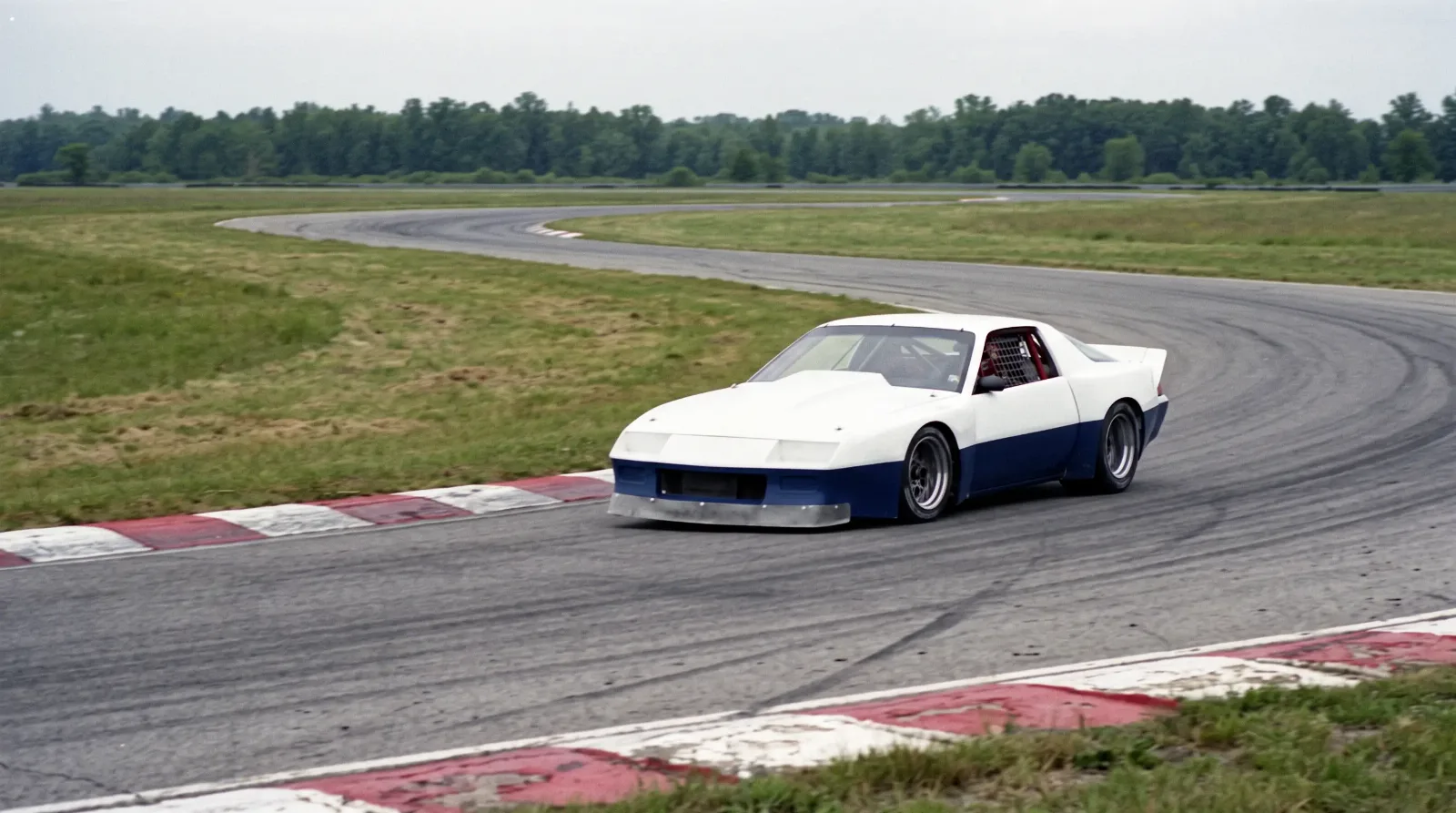
The early chapters, Penske and Donohue and the original Z/28, are a different story, and there is more on that here. This one picks up in the era of fuel injection and big glass hatches.
Camaro Trans-Am racing in the 1980s: the 1983 sweep
The 1983 Trans-Am season belonged to the DeAtley team and its Budweiser-sponsored Camaros. David Hobbs drove the No. 29 car. Willy T. Ribbs drove the No. 28. Between them, Camaros won 10 of 12 rounds.
Hobbs took the title with 158 points and 4 wins. Ribbs finished second with 148. When your closest rival is your own teammate, the other teams were not much of a problem. One race tells the season. At Summit Point on 15 May 1983, Hobbs led all 50 laps and won. Nobody passed him all day.
Put that in context. A Corvette driven by Eppie Wietzes had won the 1981 title, so Chevrolet was not a stranger to the top step. But the Camaro, the car whose Z/28 was built for this series in the first place, had been shut out since the 1960s. 1983 fixed that in one year.
1986: Dallenbach changes teams and wins again
Here is the season that gets mixed up in race histories. Wally Dallenbach Jr. was the 1985 champion, but he won that one in a Mercury Capri. For 1986 he was Chevrolet's lead driver, and he won it again in a Camaro with 165 points. Some summary tables list him in the Capri for both years. The individual 1986 race results show his wins came in the Camaro, and the series' own history calls him Chevrolet's lead driver that year. Trust the race results.
He was not the only one winning in a Camaro that year. Greg Pickett won two rounds in a Camaro too, and between them Camaros took 7 wins in 1986, one of them a non-points race at Sears Point. Dallenbach's No. 4 Camaro was entered by Protofab Racing.
The 1990 title went to Tommy Kendall in a Chevrolet Beretta. Yes, a Beretta. If you meet a man who says every Chevy Trans-Am title of that decade was a Camaro, buy him a drink and correct him gently. The 1981 title was a Corvette's. The 1990 title was a Beretta's. The Camaro's are 1983 and 1986.
| Season | Driver | Result | Notes |
|---|---|---|---|
| 1983 | David Hobbs | Champion, 158 points, 4 wins | DeAtley/Budweiser No. 29; Camaros won 10 of 12 rounds |
| 1986 | Wally Dallenbach Jr. | Champion, 165 points | Camaros won 7 races (Dallenbach, Pickett) |
| 1991 | Scott Sharp | Champion, 6 wins | Teammate Jack Baldwin second, 70 points back |
| 1992 | Jack Baldwin | Champion | Beat teammate Sharp at the final turn of the final race |
| 1993 | Scott Sharp | Champion, 6 wins, 9 poles | Third straight title for American Equipment Racing |
| 1994 | Scott Pruett | Champion, 3 wins | Manufacturers' title went to Ford |
| 1995 | Ron Fellows | Second, 5 wins | Behind Tommy Kendall's Mustang |
1991 to 1995: one team, three titles, then Pruett
The early 1990s were the Camaro's strongest stretch of the era, and most of it came from one shop. Buz McCall's American Equipment Racing won three straight drivers' titles from 1991 to 1993, all three in Camaros.
Scott Sharp won in 1991 with 6 wins. His teammate Jack Baldwin was second, 70 points behind. In 1992 they swapped places, and it went down to the wire. Baldwin won the title at the final turn of the final race. That is about as close as a championship gets without a coin toss. In 1993 Sharp was back on top with 6 wins and 9 poles.
Think about that from the shop floor. The same team, the same make, two drivers trading the title back and forth for three years. The mechanics on that crew earned their paychecks. Keeping two cars at that level for three seasons is the hard part of racing, and nobody hands out trophies for it.
Scott Pruett took the 1994 title in a Camaro with 3 wins. Here is the catch: Ford won the manufacturers' title that year. Three wins and a drivers' championship while the other make collects the factory trophy. Racing math is not always fair. In 1995 Ron Fellows moved to a Camaro and won 5 races, but Tommy Kendall and his Mustang beat him to the title. Wikipedia's history of American Equipment Racing counts Pruett's 1994 title as the team's fourth straight. It is the only source I found that says so, so take it as likely rather than settled.
One more correction for the record. The 1998 title went to Paul Gentilozzi in a Corvette, not a Camaro. Keep that one straight too.
What the race cars had to do with your Z28
Not much, mechanically. The 1980s and 1990s Trans-Am Camaros were purpose-built race cars wearing a Camaro-shaped body. A 1990 season guide spells out the rules: a purpose-built tube-frame chassis, a composite body, and stock taillights, which were often the only production parts on the car. They shared a name and a silhouette with the showroom car. They did not share your Z28's 305, your T-tops or your torque arm bushings. Anyone who tells you a street IROC-Z is "basically the Trans-Am car" is selling something.
The IROC series is the other place people get confused. It put 12 drivers from different kinds of racing in identically prepared tube-frame Camaros, and it gave the street IROC-Z its name. Those were race cars too, and you can read the details on how they were built. The racing that did use showroom hardware was SCCA Showroom Stock, where the 1LE package went to work, and John Heinricy won the 1989 SCCA Escort and Firestone Firehawk titles in a 1LE. That is the racing your street Camaro can actually claim kin to.
"A Budweiser stripe kit on a street Z28 adds nothing but a story. Ask the seller for the race history. If he hands you a decal sheet, you have your answer."
Mike Sullivan
So why should a street owner care? Because results like 1983 and 1991 to 1993 are what kept the Camaro's performance name alive in years when the showroom cars were not exactly fast. A third-gen buyer in 1984 was paying partly for a reputation, and the Trans-Am wins were part of what built it. That is worth knowing. It is not worth paying extra for a replica livery.
The Camaro also kept winning at the drag strip once the fourth generation arrived. Kurt Johnson won Pro Stock at Gateway in June 1998 in the new ACDelco Camaro Z28 on its debut weekend. That story belongs with the fourth-gen drag cars, not here. On the road courses, the table above holds the seasons worth remembering: six drivers' titles and one strong second place. Not bad for a nameplate that went 14 years without a title before 1983.
Sources and notes
Related Reading
Have a
Chevrolet Camaro
for Sale?
Reach thousands of serious classic car collectors across the US.
Sell It Here →
Selling a classic? Here's how: the best sites to sell a classic car
Are You a Classic Car Dealer?
List your full inventory and connect with targeted classic car buyers.
Join as a Dealer →
#chevrolet camaro
#camaro racing
#trans-am series
#1980s cars
#1990s cars
#David Hobbs
#Scott Sharp
#Scott Pruett

About the author
Mike Sullivan
Detroit-area muscle car enthusiast and restoration specialist with three decades of hands-on experience working on American iron.
Related Listings - Chevrolet Camaro
Comments
Be the first to comment on this article.