
The fourth-generation Camaro looks like one car from 1993 to 2002, and at a distance it was. Every one came from the same plant at Sainte-Thérèse, Quebec, on the same 101.1-inch wheelbase, with the same steeply raked windshield. Up close, though, the 4th gen Camaro years split into a sequence of small and large changes, many of them made quietly between one model year and the next. Knowing which year brought which change is the fastest way to date a car, check a seller's claims and understand why two Z28s that look alike can drive so differently. This is the year-by-year record, kept to what the production data and the factory changes support.
Car Features
7 min read
Fourth-Gen Camaro Years: What Changed From 1993 to 2002
A year-by-year record of the 4th gen Camaro years, 1993 to 2002: production totals, engine changes, the 1998 LS1 facelift and the details that date a car.
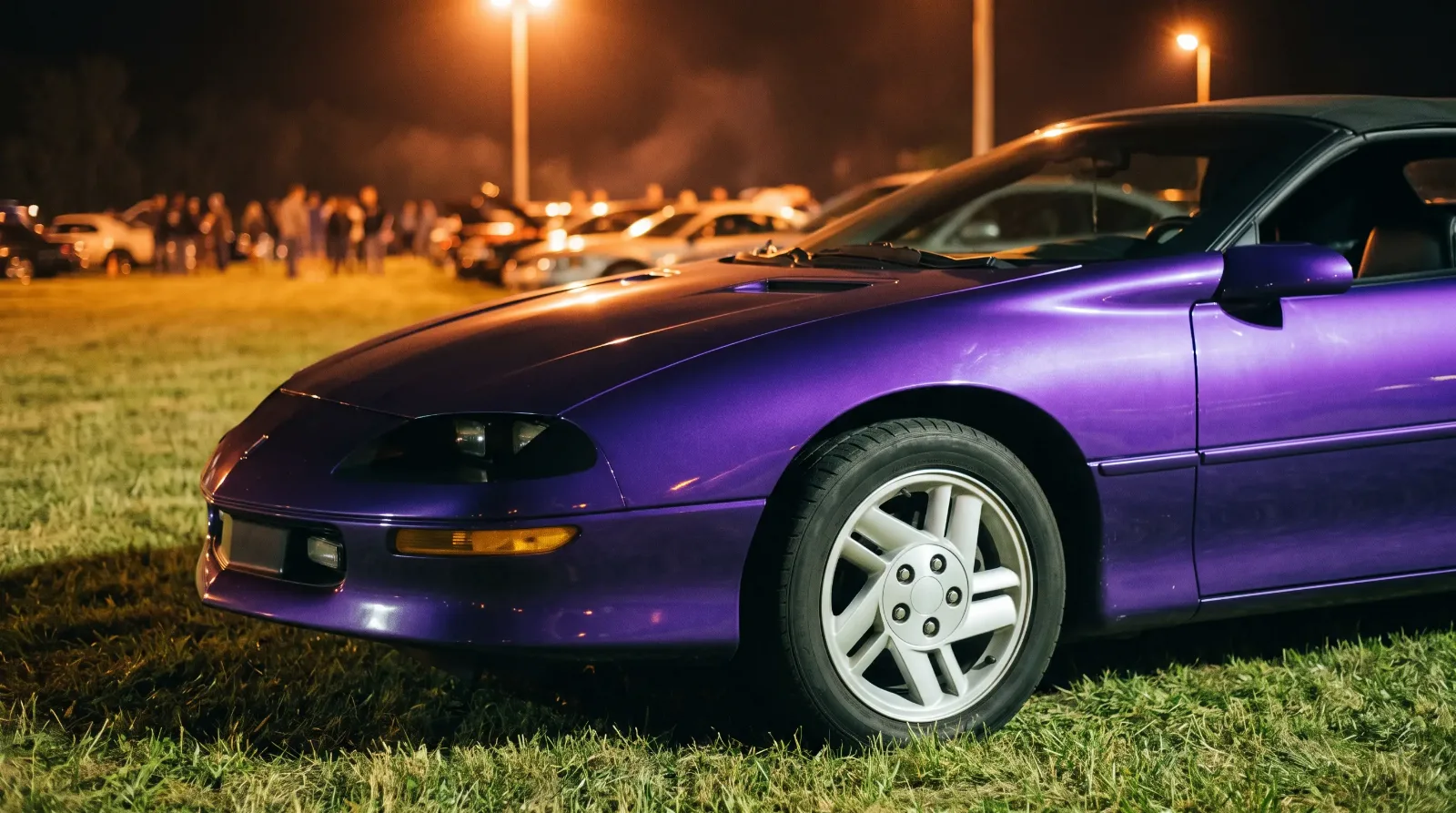
The 4th gen Camaro years at a glance
Production figures for this generation vary by source, sometimes by several thousand cars in a single year. The table uses one consistent set, the Hagerty totals, and flags the two years where other references disagree most. For 1997 and 1998 no GM figure settles the gap, and Wikipedia gives 48,495 for 1998.
| Model year | Production | The change that dates it |
|---|---|---|
| 1993 | 39,103 | New body; coupes only; LT1 Z28, 3.4 V6 base |
| 1994 | 119,799 | Convertible returns; 4L60E automatic; mass airflow |
| 1995 | 122,738 | 3800 V6 joins mid-year; traction control on Z28 |
| 1996 | 61,362 | OBD-II; Z28 at 285 hp; SS and RS return |
| 1997 | 60,202 (others: 54,972) | New interior; tri-color taillights; 30th Anniversary |
| 1998 | 54,026 (others: 47,218 to 49,218) | New front end; LS1 V8; four-wheel discs standard |
| 1999 | 42,098 | Plastic fuel tank; Torsen differential |
| 2000 | 45,461 | Four-spoke wheel with radio controls; new colors |
| 2001 | 29,009 | LS6 intake; lowest production of the run |
| 2002 | 41,776 | 35th Anniversary SS; last car built August 27, 2002 |
The shape of those numbers matters. The generation peaked in 1995 and never came close again. For the wider context of why the line ended, this piece covers the full generation from launch to closure.
1993 to 1995: the LT1 car settles in
The 1993 car was new in most of the ways that mattered, but not all. It kept the third-generation floor pan and live rear axle, and added a short and long arm front suspension, rack-and-pinion steering, dual airbags and R134a air conditioning. The base engine was the 3.4-liter L32 V6 at 160 hp. The Z28 used the 5.7-liter LT1 at 275 hp and 325 lb-ft, an engine introduced in the 1992 Corvette. Only coupes were built.
Several details are true of 1993 alone, and they are the quickest way to confirm a first-year car. The gauges have yellow lettering, which turned white for 1994. The automatic is the hydraulic 4L60. The engine management is speed density, run by an ECM with a removable Memcal chip.
For 1994 those 1993-only parts were replaced together. The 4L60 became the electronic 4L60E, the ECM became a PCM, mass airflow replaced speed density, and fuel injection became sequential. Six-speed cars gained the CAGS skip-shift that moves the lever from first to fourth at light throttle, and their axle ratio went from 3.23 to 3.42. The convertible came back in base and Z28 form, 7,260 of them. Leather seating appeared as an option, taken by 1,209 buyers.
1995 brought two additions and one quiet fix. ASR traction control arrived on the Z28 as a $450 option. The 3800 Series II V6 joined the 3.4 partway through the year, so 1995 is the only year a buyer could choose between two V6 engines. And the vented Opti-Spark ignition unit, first used on the 1994 B-body cars, moved to the F-body for 1995.
1996 and 1997: OBD-II, the SS and a new interior
For 1996 every Camaro moved to OBD-II diagnostics and dual catalytic converters. The Z28's LT1 went from 275 to 285 hp in the process. The 3800 V6 became standard on all base cars at 200 hp, and the V6 RS returned with its own front fascia and side ground effects. The bigger news was the SS, the first Camaro to carry the name since 1972. It was developed with SLP Engineering, and its LT1 was rated at 305 hp.
The production drop that year has a specific cause. An 18-day strike over outsourcing idled 81,500 GM workers in March 1996, and Camaro output fell to 61,362, roughly half of 1995.
1997 brought a new interior, the tri-color taillights that stayed through 2002, and air conditioning as standard on every Camaro. It was also the 30th Anniversary year: 4,533 cars in Arctic White with Hugger Orange stripes, at a $575 premium. At the very top sat 108 SS cars that SLP converted to the LT4 engine, rated at 330 hp, and priced at about $40,000 new.
"Dating a fourth-gen car is mostly a matter of small parts. Gauge lettering, the taillight colors and the steering wheel will tell you the year faster than any brochure photo will."
Tom Ramirez
1998: the LS1 and a new face
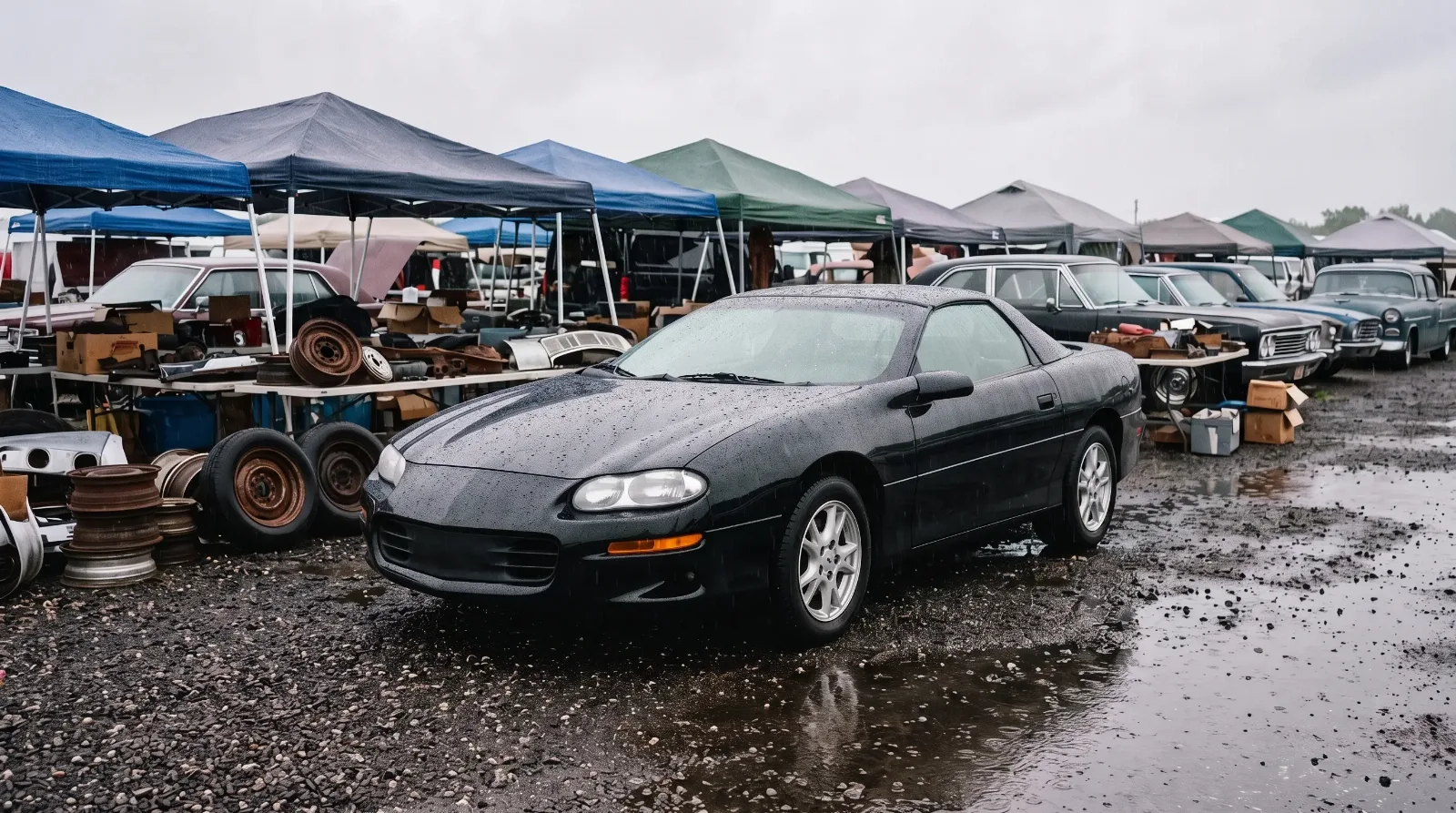
1998 was the largest single change after launch. The four recessed headlamps gave way to streamlined composite lamps, with a redesigned hood, front fenders and front fascia; owners later named this front the "Catfish." Under the hood, the all-aluminum LS1 replaced the iron-block LT1, a year after it appeared in the C5 Corvette. In the Z28 it was rated at 305 hp and 335 lb-ft. Four-wheel disc brakes became standard on all Camaros, and the front calipers went from one piston to two.
The model lineup shifted too. The RS was dropped and replaced by the Y3F Sport Appearance Package. The SS became an in-house option, RPO WU8, rated at 320 hp with a forced-air hood; 3,025 were built that first year. For the full record of those cars, the details are in the LS1 SS history.
One correction belongs here. A widely repeated claim says the LS1 was badly underrated in the Camaro. GM engineer John Heinricy has denied that it was underrated, while noting that little more than tuning software separated a Camaro LS1 from a Corvette LS1. The published rating is the one to use.
1999 to 2002: the details that date a late car
The last four years changed in smaller steps, which makes the details more useful for dating. For 1999 the steel fuel tank used since 1982 gave way to a 16.8-gallon plastic tank, an oil-life monitor was added, the Z28 and SS got a Torsen differential, traction control became available on the V6, and Hugger Orange joined the color chart. For 2000 an optional four-spoke steering wheel with radio controls replaced the two-spoke wheel used since 1993, new 10-spoke 16-inch wheels appeared, Monterey Maroon Metallic was added, and Black was renamed Ebony.
2001 brought the LS6 intake manifold, a revised camshaft and the removal of EGR on V8 cars, which raised the Z28 to 310 hp and the SS to 325 hp. Production stopped early that year to prepare for the final cars, and only 29,009 were built, the lowest total of the generation.
The final year was 2002, and its signature car was the 35th Anniversary SS, sold only with the SS package: 3,369 buyers paid $2,500 for it. The last fourth-generation Camaro left Sainte-Thérèse on August 27, 2002, and GM kept both the first and the last 2002 cars for its museum. The nameplate returned in 2010 with the fifth generation; for how all of the classic years connect, see the full Camaro story.
Sources and notes
- Chevrolet Camaro (fourth generation), Wikipedia
- 1997 Chevrolet Camaro production and options, Hagerty
- 1998 Chevrolet Camaro production and the new front end, Hagerty
- Fourth-gen Camaro, 1993 to 2002: the one that died first, Hagerty
- Fourth-generation F-body year-by-year changes, WS6.com FAQ
- 1967 to 2002 Camaro production numbers, Classic Industries
Related Reading
Have a
Chevrolet Camaro
for Sale?
Reach thousands of serious classic car collectors across the US.
Sell It Here →
Selling a classic? Here's how: where to sell your classic car online
Are You a Classic Car Dealer?
List your full inventory and connect with targeted classic car buyers.
Join as a Dealer →

About the author
Tom Ramirez
Corvette researcher and historian based in Bowling Green, Kentucky. Two decades documenting Corvette production history from original factory records.
Related Listings - Chevrolet Camaro




Comments
Be the first to comment on this article.