
Fifteen model years, one platform, and a car that started out as a sensible economy coupe and finished as the 5.0 an entire generation of enthusiasts grew up on. That is the short version of the Fox body Mustang years, 1979 to 1993. The longer version is a run of specific changes, most of them made one model year at a time, and their order explains a lot about how the car is remembered.
Car Features
7 min read
The Fox Body Years: How the Mustang Changed, 1979 to 1993
A year-by-year timeline of the Fox Mustang: engines, ratings, facelifts and production from the 1979 debut to the last car in August 1993.
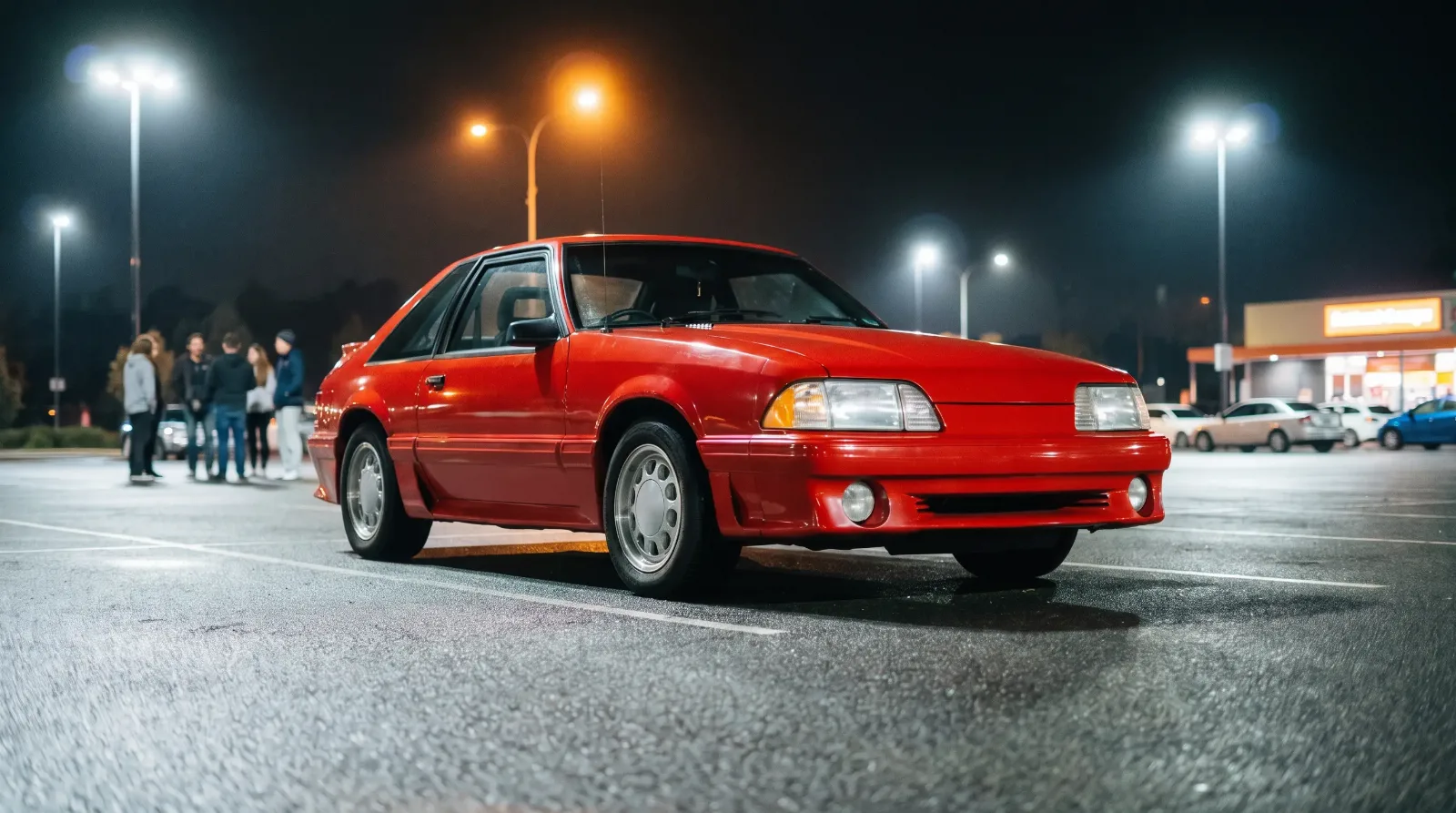
This piece is the timeline: what changed, in which year, and what the factory numbers say about it. For why Ford built it and what it meant, read the longer history of the Fox Body Mustang.
Reading the Fox body Mustang years as three eras
The Fox Mustang is easiest to follow in three blocks. From 1979 to 1981 it was a new, lighter car with an engine lineup that got weaker as it went. From 1982 to 1986 Ford rebuilt the V8 side almost every year, from a 157 hp two-barrel to a 5.0 with sequential port injection. From 1987 to 1993 the shape and the engine were essentially settled, and the changes moved to the details until SVT's first Cobra in the final year.
| Model year | Notable change | Top V8 rating (SAE net) |
|---|---|---|
| 1979 | New Fox platform; notchback and hatchback; 2.3 turbo offered | 302: about 140 hp |
| 1980-81 | 302 replaced by a 4.2 (255) V8, automatic only; T-top added for 1981 | 4.2: about 120 hp |
| 1982 | GT returns with the 5.0 HO, two-barrel | 157 hp |
| 1983 | Convertible returns; four-barrel 5.0; T-5 five-speed mid-year | 175 hp |
| 1984 | LX replaces GL and GLX; SVO arrives as a 1984½ | 175 hp |
| 1985 | Roller cam on manual cars; last carbureted V8 | 210 hp |
| 1986 | Sequential multiport injection; 8.8-inch rear axle on V8 cars | 200 hp |
| 1987 | Aero nose, new dash and console | 225 hp |
| 1989 | Mass-air-flow EFI replaces speed-density | 225 hp |
| 1990 | Driver airbag standard | 225 hp |
| 1991 | 16-inch five-spoke wheels on V8 cars; twin-plug 2.3 at 105 hp | 225 hp |
| 1993 | 5.0 rerated; first SVT Cobra | 205 hp (Cobra 235 hp) |
1979 to 1981: lighter, cleaner and short on V8
The 1979 car rode on the Fox platform that had arrived a year earlier under the Ford Fairmont and Mercury Zephyr. The wheelbase grew to 100.5 inches, about four inches more than the Mustang II, and yet the new car weighed roughly 200 pounds less. Ford found the savings in urethane bumpers, a soft front fascia, and thinner doors and glass. The body tested at a drag coefficient of 0.44 as a hatchback and 0.46 as a notchback.
The engine list that first year tells you Ford had not quite decided what the car was for. The base engine was an 88 hp 2.3 four. A turbo version of it shared the top of the order sheet with the 302 V8, rated at about 140 hp. A 109 hp 2.8 V6 was dropped during the year because of supply problems, and a 3.3 inline six rated at 89 hp joined the list early in the year. Five engines in one model year. Base prices were $4,494 for the notchback and $4,828 for the hatchback.
The first year was also the best year. Ford built nearly 370,000 Mustangs for 1979, and no later Fox came close. Then the 302 disappeared. For 1980 the only V8 was a 4.2-liter (255 cubic inch) engine rated at roughly 120 hp and sold with an automatic only, the lowest-rated V8 Mustang Ford ever offered. The turbo four stayed in the catalog into early 1981 before reliability problems ended it. Production fell to 271,322 for 1980 and 182,552 for 1981. The 1981 model did add a T-top option, and it was the last year for the Ghia and Cobra trims.
1982 to 1986: the 5.0 comes back
For 1982 Ford revived the GT name, absent since 1969, and put a 5.0 High Output V8 in it. In two-barrel form it made 157 hp. Production kept sliding, to 130,418 for 1982 and 120,873 for 1983, but the direction of the car had changed. From here almost every model year brought a measurable gain on the V8 side.
The 1983 engine got a 600 cfm Holley four-barrel and 175 hp, and the T-5 five-speed arrived partway through the year. The convertible came back too, the first Mustang convertible since 1973, and the car gained its first exterior Blue Oval. For 1984 the trim names were reshuffled: LX replaced GL and GLX. In the spring Ford's Special Vehicle Operations group added the SVO, a 2.3 turbo with an air-to-air intercooler rated at 175 hp. It listed at $15,585, more than double the price of a base Mustang.
The 1985 car lost its grille in favor of a slot intake in the nose. Manual-transmission V8s got a roller camshaft, new heads and less restrictive manifolds, and the rating rose to 210 hp. That was the last carbureted V8 Mustang. The SVO received flush composite headlamps as a 1985½ model and climbed to 205 hp. For 1986 the 5.0 switched to sequential multiport fuel injection. The rating dipped to 200 hp, but this was the engine Ford kept developing to the end. V8 cars also got the 8.8-inch rear axle. Production recovered to 224,410. The SVO ended after 1986 at 9,844 cars in total.
1987 to 1993: one face, one engine, a long finish
Ford announced the 1987 update in August 1986. The whole line got an aerodynamic nose with flush headlamps, following the SVO, plus a new dashboard and console. GTs added louvered taillamps, side skirts and 15-inch turbine wheels. The update reworked the front of Jack Telnack's design without replacing it, and the 5.0 went to 225 hp at 4,200 rpm and 300 lb-ft at 3,200 rpm with E7TE heads. The LX 5.0 package put that engine in the plainer car for $1,885.
The Fox was not supposed to last this long. Ford had developed a front-drive, Mazda-based car, code ST-16, as the next Mustang. In 1987 Alex Trotman ruled that it was not a Mustang, and it went on sale as the Ford Probe. With no replacement coming, the next six years were refinement. Mass-air-flow fuel injection replaced the speed-density system for 1989. A driver airbag became standard for 1990, and the tilt wheel was dropped. The 1991 cars got 16-inch five-spoke wheels on the V8 models, a twin-plug head that took the 2.3 to 105 hp, and a base price that passed $10,000 for the first time.
The last year brought two changes. The 5.0 was rerated to 205 hp and 275 lb-ft. The explanation published at the time was a more accurate rating method, since the earlier figures predated the mass-air system, together with minor cam profile changes and the hypereutectic pistons that went into every 302 that year. And Ford's new Special Vehicle Team, which had shown the car at the 1992 Chicago Auto Show, delivered the 1993 SVT Cobra: GT-40 heads, 235 hp at 4,600 rpm, rear disc brakes and 17-inch wheels, the first on a factory Mustang. SVT built 4,993 of them, plus 107 Vibrant Red Cobra R race cars.
What the production records say about the whole run
Production peaked at nearly 370,000 in 1979, fell to about 120,000 to 130,000 in 1982 and 1983, recovered to 224,410 in 1986, then slid to fewer than 80,000 in 1992 before the final year came in at roughly 114,000 to 115,000. One caution: after 1986 the published year-by-year counts disagree by thousands of cars depending on the source, so any single late-Fox figure should be read as approximate.
"Look at the build numbers next to the spec changes and the odd thing about the Fox jumps out. The car sold best in its first year, before the 5.0 HO even existed, and some of its most important engineering arrived in the years when Ford was building the fewest. The factory kept improving a car it had already planned to replace."
Tom Ramirez
The same caution applies to the total. Published figures run from about 2.52 million to more than 2.6 million cars for 1979 to 1993, and the gap most likely comes from counting basis, model year against calendar year and whether exports are included. Assembly is clearer: Dearborn and San Jose until San Jose closed in 1983, plus Cuautitlan Izcalli, Mexico, from 1979 to 1984 and Valencia, Venezuela, then Dearborn alone from about 1984.
The last Fox Mustang left the line on August 26, 1993. It did not take the platform with it. The 1994 SN95 rode on an updated version called Fox-4, which kept the floor pan and the front crossmember. Fifteen years of changes, and the newest Mustang still started from the old car's floor.
Sources and notes
- Wikipedia: Ford Mustang (third generation), production table and year-by-year changes
- Wikipedia: Ford Mustang SVO
- MustangSpecs: 1979 Ford Mustang engines, prices and production
- MustangSpecs: 1987 Ford Mustang
- MustangSpecs: 1992 Ford Mustang production by body style
- MustangSpecs: 1993 Ford Mustang production and the 205 hp rerating
Related Reading
#Ford Mustang
#fox body mustang
#mustang production numbers
#5.0 HO
#Mustang SVO
#1987 Mustang
#1993 SVT Cobra

About the author
Tom Ramirez
Corvette researcher and historian based in Bowling Green, Kentucky. Two decades documenting Corvette production history from original factory records.
Related Listings - Ford Mustang




Comments
Be the first to comment on this article.