
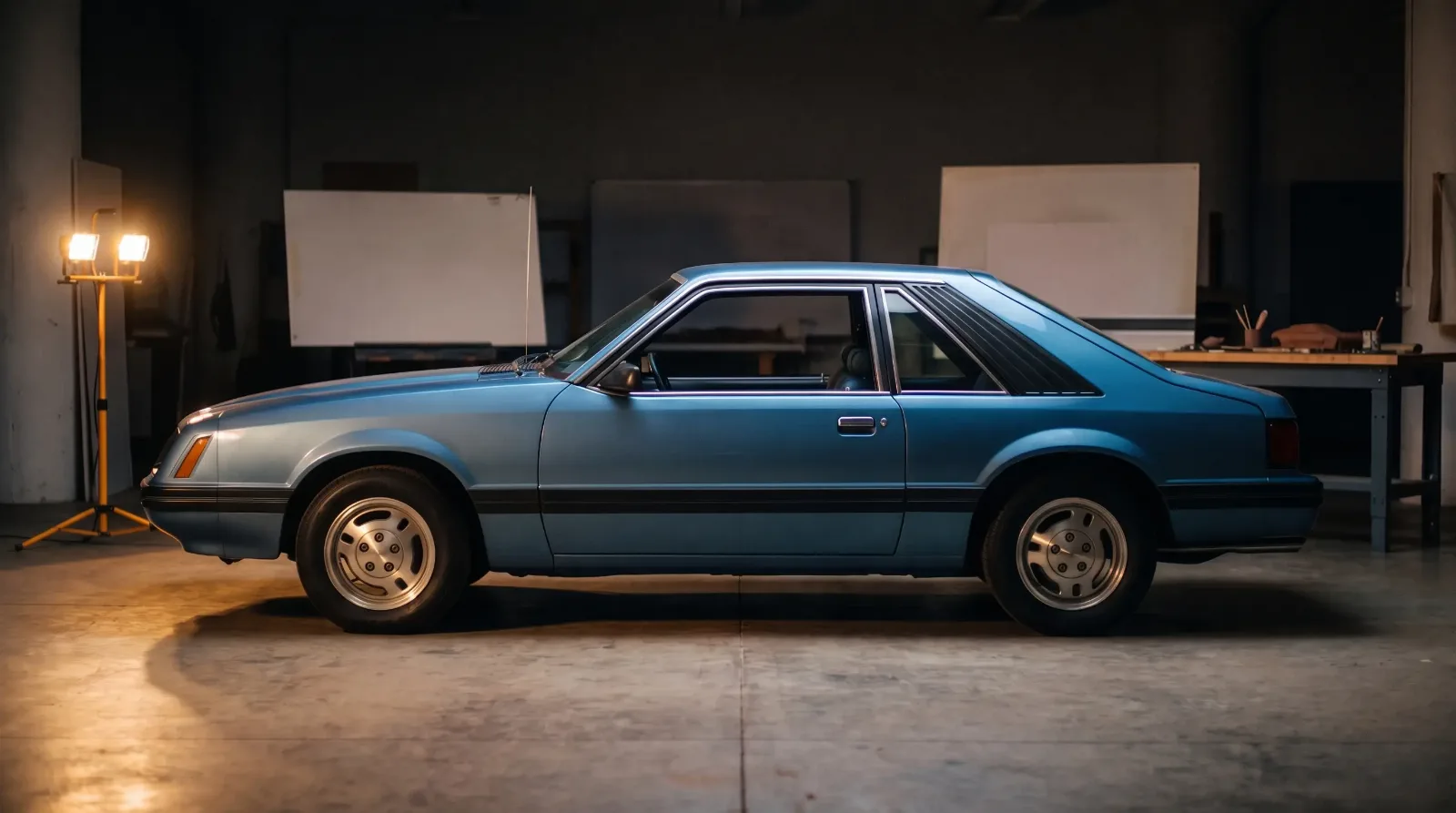
Strip a 1979 Mustang down to bare metal and the first thing you notice is how little there is to it. The doors and glass are thinner than the Mustang II's. The bumpers are urethane, and so is the soft front fascia. That was the plan. The Jack Telnack Mustang was drawn to cheat the wind and shed weight at a time when most American cars still looked like they had been cut out of a sheet of plywood, and the shape held on, with one big nose job, all the way to 1993.
Car Features
6 min read
Jack Telnack and the Fox Body's Aero Shape
How Jack Telnack's group drew the 1979 Fox Mustang: the 1975 to 1976 timeline, the rival proposals, the drag figures and the weight it shed.
This is about the shape and the man whose group drew it. For the whole generation, engines and all, read the full story. Here we stay on the sheet metal.
Who Jack Telnack was when Ford handed him the Mustang
John J. Telnack was born in Detroit in 1937 and came out of ArtCenter in 1958. By 1966 he was chief designer at Ford of Australia, and in 1974 he became vice president of design at Ford of Europe. That is a long way from Dearborn, and I think it shows in the car he came home to draw.
He did not stay in Europe long at the top. In April 1975 Ford brought him back to Dearborn as executive director of North American Light Car and Truck Design. The new Mustang landed on his desk almost immediately. My read, and it is only a read, is that the car you see in 1979 looks like it was drawn by someone who had just spent time around European sedans and was tired of chrome and vinyl. Nothing on it is there for show.
How the Jack Telnack Mustang won the job
The platform came first. Lee Iacocca approved the Fox platform in December 1973, and it went into production under the 1978 Ford Fairmont and Mercury Zephyr, a pair of sensible family cars. Where the Fox name itself came from is a separate tangle, and there is more on that here. What counts here is the brief: take a platform built for a compact sedan and make a Mustang out of it.
Ford did not hand that job to one studio. Telnack's group had competition from another Dearborn design team and from Ghia in Italy. All three put up proposals. Telnack's won, and the timeline from there was tight by the standards of the day.
| Date | Milestone |
|---|---|
| December 1973 | Lee Iacocca approves the Fox platform |
| October 1974 | A Fox-based replacement for the Mustang II is confirmed |
| April 1975 | Telnack named executive director, North American Light Car and Truck Design |
| July 1975 | Design work on the new Mustang begins |
| July 1976 | Near-final prototype |
| September 1976 | Production approval |
| 1978 model year | Fox platform debuts under the Fairmont and Zephyr |
| 1979 model year | Fox Mustang goes on sale |
A year from the first design work to a near-final prototype, fourteen months to production approval. Anybody who has shaped a body by hand knows how fast that is. There was no time to fall in love with ideas that did not work.
Aero numbers in an era of square cars
Ford published drag coefficients for the new car: 0.44 for the hatchback and 0.46 for the notchback. Ford claimed those were the lowest figures on the road at the time. Today those numbers look ordinary. In 1979 they were the point. The hatchback in particular has a long, gently sloped roof running into a short deck, and the nose drops away from the windshield instead of standing up square to meet the air.
The weight story is the part builders appreciate. The 1979 car came in roughly 200 pounds lighter than the Mustang II it replaced, at a curb weight of about 2,700 pounds, even though it was bigger. Wheelbase went from 96.2 inches to 100.5, and overall length from 175.0 inches to 179.6. Ford found the savings in urethane bumpers, a soft front fascia, and thinner doors and glass. Every one of those is a body decision, not an engine decision. Telnack's shape is light because the panels are light.
"People talk about the Fox like it was a plain car. It was a disciplined car. Take the bumpers and the trim off and the body still reads clean, from the nose to the back of the roof. That is the hardest thing to draw, and plenty of cars from that decade could not do it."
Jim Vasquez
The shape also took add-ons without falling apart, which is a good test of any body. When Ford built the Indy pace car replicas for 1979, it bolted on an air dam with fog lamps and a three-piece rear spoiler, and the car looked purposeful rather than cluttered. A fussy body would have turned into a mess. The Fox just looked faster. The design also dropped one Mustang signature: the tri-bar taillights, which went away with the 1979 car and did not come back until 1994.
How the shape carried through to 1993
The basic body Telnack's group signed off in 1976 stayed in production for fifteen model years, and the changes along the way were mostly at the ends of the car. In 1983 the Mustang wore a Blue Oval on its exterior for the first time. In 1985 the nose went grille-less, with a slot intake. The SVO pushed the aero idea further, with a drag coefficient of roughly 0.38 to 0.39, a functional hood scoop for its intercooler, a biplane rear spoiler, and flush composite headlamps from the 1985½ model on.
Then for 1987 the whole line got an SVO-style aero nose with flush headlamps, a new dashboard and console, and on the GT, louvered taillamps and side skirts. That is the biggest single change the Fox ever had, and it is still a nose and tail job. The doors, the roof and the basic proportions carried over from the 1979 car. Stand a 1979 hatchback next to a 1993 one, cover the ends with your hands, and you are looking at the same body.
What came after the Fox for Telnack
The Mustang was the start of something, not a one-off. Telnack and his teams are credited with the 1979 Mustang and with the aerodynamic turn Ford took after it, the 1983 Thunderbird and the 1986 Taurus. Those two cars are where the rest of the industry noticed. The Fox Mustang is where the thinking first showed up in a car a working person could afford.
Don Kopka had held Ford's design vice presidency since Gene Bordinat stepped down in 1980, and when Kopka retired in 1987, Telnack moved up. He was elected a Ford vice president in June 1987 and led Ford design until he retired at the end of 1997, when J Mays succeeded him. For how the Mustang's look moved from the 1960s originals through the Fox and beyond, this piece traces the whole line. The Fox is the chapter where the Mustang stopped trying to look like a bigger car and started looking like a lighter one.
Sources and notes
Related Reading

About the author
Jim Vasquez
Southern California hot rod and custom car builder with roots in the traditional kustom kulture scene.
Related Listings - Ford Mustang




Comments
Be the first to comment on this article.