
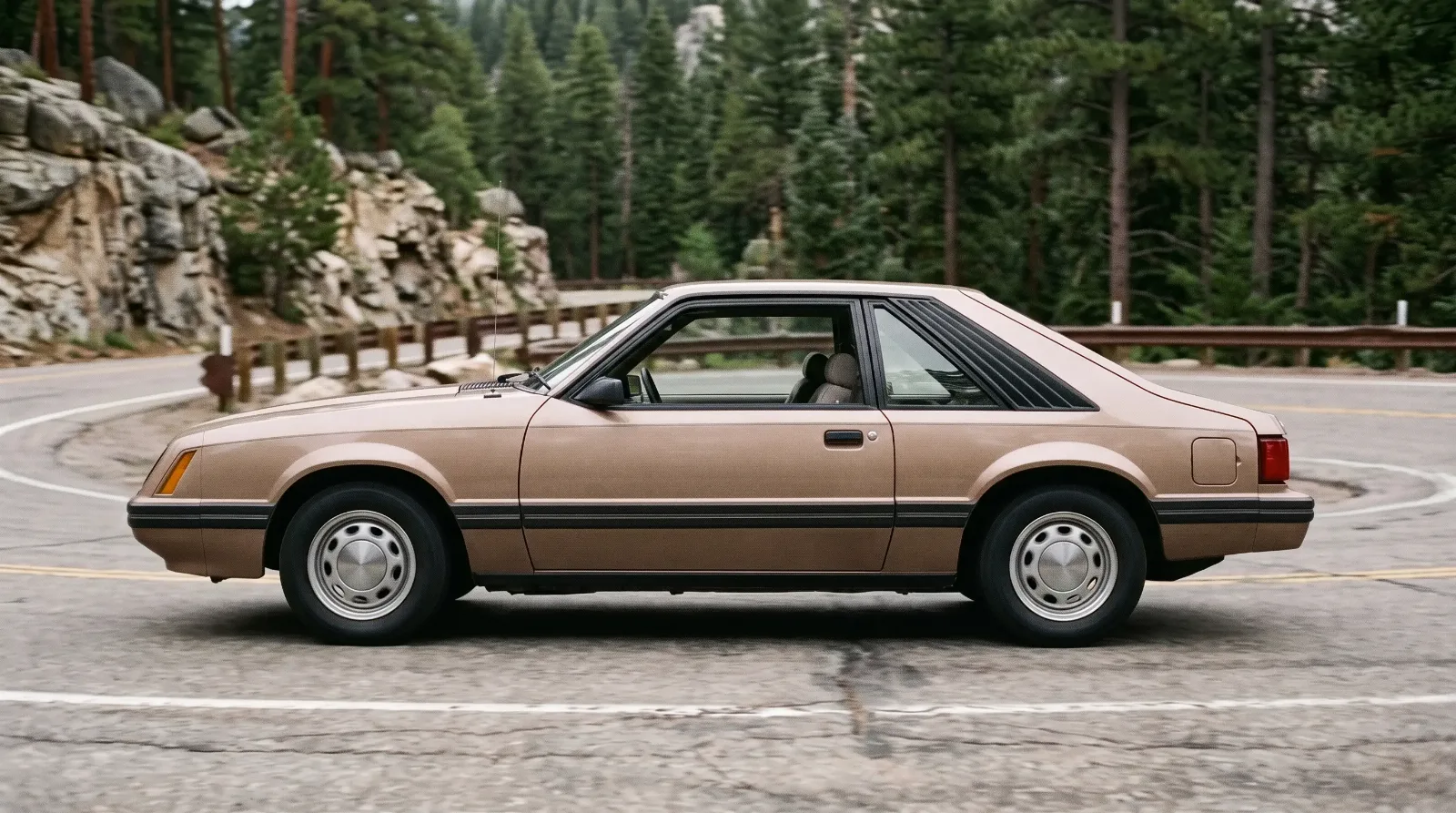
What is a Fox body Mustang? It is a Mustang built for the 1979 through 1993 model years on the platform Ford called "Fox." That platform was a rear-drive unibody, and the Mustang was not the first car to use it. The 1978 Ford Fairmont and Mercury Zephyr were. "Fox body" is simply the name of the chassis family, carried over onto the car and then into the hobby's everyday speech.
Car Features
7 min read
What Is a Fox Body Mustang? Where the Name Comes From
Fox was Ford's code name for the platform under the 1979 to 1993 Mustang. What the record shows about the name, and what it does not.

That much is on paper. Why Ford chose the word "Fox" is a different matter, and it is the part most retellings fill in with a confident guess. The documented record is thinner than the folklore. This piece separates the two. For the full model-year history of the 1979 to 1993 Mustang, the parent article covers the cars themselves; here the subject is the name.
What is a Fox body Mustang, by the record
The definition is tight. A Fox body Mustang is any Mustang from the 1979 model year through the last Fox car, which left the line on August 26, 1993. The wheelbase is 100.5 inches (some sources print 100.4), about four inches longer than the Mustang II it replaced. Body styles over the run were the two-door notchback, the three-door hatchback and, from 1983, a convertible, the first Mustang convertible since 1973.
How many were built depends on whose count you trust. Wikipedia gives 2,518,948 for 1979 through 1993. Jalopnik says more than 2.6 million. The gap probably comes down to counting method, model year against calendar year, or whether export cars are in the total, but I have not seen a primary Ford figure that settles it. The best single year was the first: 369,936 cars in 1979.
Inside that span the hobby draws its own lines, most famously between the early four-headlight cars and the flush aero-headlamp cars that took over the line with the 1987 facelift. Those differences belong to the Fox years and are covered there in detail. The name, though, covers all of them equally. A 1979 Ghia and a 1993 Cobra are both Fox bodies.
Fox was a platform code, not a model name
The first thing to get straight is that Ford never sold a car called the Fox in this country. "Fox" was an internal program and platform name, the same kind of label Ford used throughout the period. The Mustang II, for comparison, came out of two competing programs: a Maverick-based proposal code-named "Ohio" and a Pinto-based one called "Arizona," with Arizona chosen in July 1971. The Mustang that followed the Fox was assigned the code name SN95 in May 1990.
The Fox platform itself was formally approved by Lee Iacocca in December 1973. Hal Sperlich, then Ford's vice president of product planning, had pushed a broader "World Car" idea behind it, and that ambition was dropped by 1974. What remained was a North American rear-drive platform, compact by the standards of the day, light by design, and meant to carry a whole family of Ford, Mercury and Lincoln models. Over its life those included the Mercury Capri, the 1980s Thunderbird and Cougar, the LTD and Marquis, and the Lincoln Mark VII.
| Date | Fox platform milestone |
|---|---|
| December 1973 | Fox platform formally approved by Lee Iacocca |
| By 1974 | Sperlich's "World Car" concept dropped |
| October 1974 | Ford confirms a Fox-based replacement for the Mustang II |
| July 1975 | Design work on the Fox Mustang begins |
| September 1976 | Fox Mustang approved for production |
| Model year 1978 | First Fox cars: Ford Fairmont and Mercury Zephyr |
| Model year 1979 | Fox Mustang launched; 369,936 built that year |
| August 26, 1993 | Last Fox body Mustang built |
| Model year 1994 | SN95 Mustang on the updated "Fox-4" platform |
Where the name came from, and what the record does not say
The most common explanation you will hear is that Ford named the platform after the Audi Fox, the name Audi used in the United States for its small 80 sedan from the 1973 to 1979 model years. It is a tidy story. The published platform histories say otherwise: the Fox platform shares the name of the Audi Fox but was not named after it. What Ford did do was benchmark a European subcompact during development, which is likely how the two got tied together in the retelling.
So who picked "Fox," and why? I have looked for that answer in the material that shows its sources and have not found it. No product planner, executive or memo is named as the origin of the word in anything I would cite. It is possible the reason was never more than a list of available code names. It is also possible a document exists that has not been published. Either way, a writer who tells you the precise reason is telling you more than the record holds.
That is not a failing of the story. Plenty of internal code names in the industry were picked for no reason that survives, and the useful fact is the one that is documented: Fox was a platform, approved in 1973, first sold in 1978, and the Mustang was its best-known product.
How "Fox" became "Fox body"
The term moved from Ford's engineering vocabulary to the hobby's because enthusiasts needed a way to separate this generation from the cars on either side of it. "Third-generation Mustang" works on paper. Nobody says it at a car show. The platform name did the job in one syllable, with "body" attached to it. When that longer form first turned up in print is another thing I have not seen documented. The phrase stuck through the 5.0 years, when these cars were everywhere at drag strips and on the street, and it has outlived the cars' time in production by more than three decades.
It also helps that the platform marked a clean break. The 1979 Mustang was about 200 pounds lighter than the Mustang II it replaced, thanks to urethane bumpers, soft fascias and thinner doors and glass. Jack Telnack's team designed it, and it measured a drag coefficient of 0.44 as a hatchback, which Ford claimed was the lowest on the road at the time. The car felt new, and a new name for the generation came naturally. For where it sits in the line from 1964 onward, the broader Mustang history gives the long version.
Where the Fox body ends: the SN95 question
This is where people argue, and where the paperwork and the hobby disagree a little. The 1994 Mustang, code name SN95, rode on an updated version of the Fox platform that Ford called "Fox-4." Ford spent a reported $700 million on the update. The floor pan and front crossmember carried over. The wheelbase grew to 101.3 inches. By lineage, the SN95 is a Fox descendant, and the Mustang was the last vehicle on the Fox platform in any form.
By usage, the Fox body ends in 1993. Ask anyone who owns one. The SN95 has its own name, its own body and its own following, and calling a 1995 GT a Fox body will usually get you corrected. Both statements are true at once: the SN95 is built on Fox bones, and it is not a Fox body.
"The name is easy to define and hard to explain. Fox was a platform code. The Mustang wore it from 1979 to 1993. Why Ford chose that word, I have not seen documented, and I would rather say that plainly than pass along the Audi story one more time."
Tom Ramirez
For anyone checking a specific car, the dates are the test. A Mustang built for the 1979 through 1993 model years is a Fox body. From 1981 on, the 17-character VIN carries the model year in the tenth position, B for 1981 through P for 1993; the 1979 and 1980 cars predate that standard. Whether you are reading a restoration thread or browsing Fox Body Mustangs for sale, that is the working definition everyone uses, and it is the one the record supports.
Sources and notes
Related Reading


About the author
Tom Ramirez
Corvette researcher and historian based in Bowling Green, Kentucky. Two decades documenting Corvette production history from original factory records.
Related Listings - Ford Mustang






Comments
Be the first to comment on this article.