
France did not invent Art Deco as an automotive style, but its coachbuilders pushed it further than anyone else attempted. The reasons were structural as much as artistic. Paris in the 1930s had a small population of extremely wealthy clients, a handful of chassis makers willing to sell rolling frames without bodies, and a cluster of workshops staffed by craftsmen who had spent years hand-shaping metal. Put those three things together and you get the most extravagant automotive design of the pre-war era.
Car Features
6 min read
How French Coachbuilders Led Art Deco Motoring
French coachbuilders had wealthy clients, bare chassis, and hand craft on their side. The result was the most extravagant Art Deco design of the era.
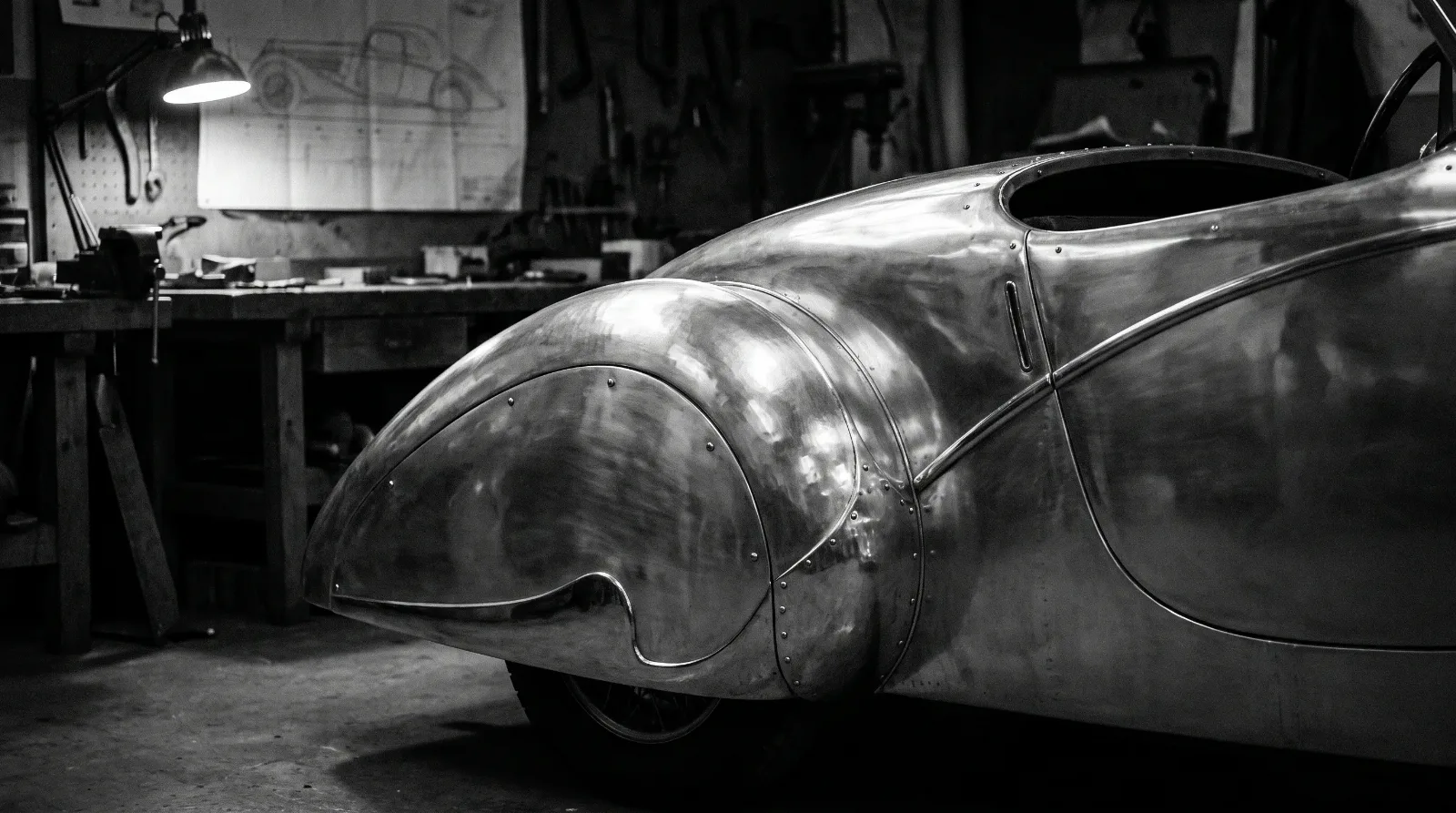
Understanding how that system worked, who supplied what, and which houses actually deserve the reputation they carry today, is essential for reading a French coachbuilt car correctly. For the broader design language these cars grew out of, see our deep dive on french art deco cars.
A different model of car-building
In France, as in much of pre-war Europe, a luxury manufacturer typically sold a bare chassis: frame, engine, running gear, and not much else. The buyer then commissioned a body separately, choosing a coachbuilder based on reputation, personal taste, and often a personal relationship with the shop's owner. This split meant the mechanical engineering and the visual design came from two entirely different disciplines, each pursuing its own excellence without much interference from the other.
The arrangement produced cars that were, in effect, custom-tailored suits built on a standardized frame. No two bodies needed to be identical even on the same chassis type, and the best clients specifically wanted something no one else had. That demand for individuality is what drove the coachbuilders toward increasingly dramatic, personal interpretations of the Deco idiom rather than a single house style shared across the industry.
Figoni et Falaschi and the teardrop signature
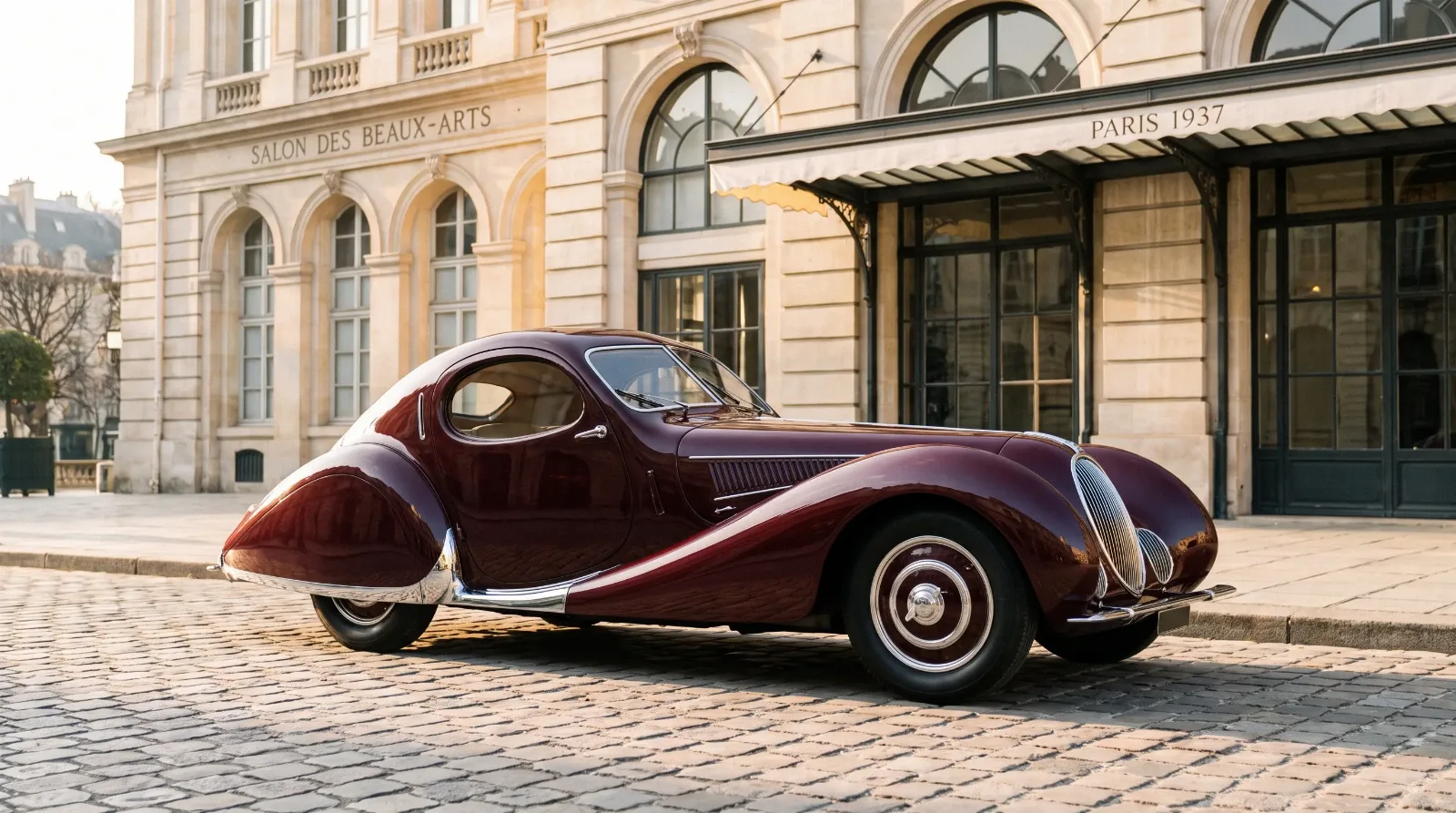
Joseph Figoni, working with business partner Ovidio Falaschi, became the most celebrated of the French coachbuilders, largely through a series of teardrop-bodied cars built on Talbot-Lago and Delahaye chassis in the mid-to-late 1930s. Figoni's bodies flowed in one continuous curve from nose to tail, with fully skirted rear fenders, faired headlamps, and a low, raked stance that made the cars look fast standing still.
The firm's work was hand-built over wooden bucks, and the panels were wheeled and hammered until the surfaces read as a single unbroken form. That process took enormous labor for each individual car, which is part of why so few were built and why surviving examples now command such attention at auction and in concours judging.
What made Figoni's approach distinct was his reported reluctance to accept a hard edge anywhere on a body. Where a lesser shop might resolve a difficult transition with a crease or a seam, Figoni's craftsmen kept wheeling and hammering until the panel flowed without interruption. That preference shows up most clearly in the fully skirted rear fenders, a detail that required the metalworkers to carry a single curve much further around the wheel opening than a conventional fender demanded, and it is part of why a genuine Figoni body is so difficult to reproduce convincingly today.
Saoutchik, Franay, and the competing houses
Figoni was not working alone at the top of the market. Jacques Saoutchik ran a rival shop known for a more dramatic, ornate visual language, favoring bold two-tone paint schemes and sweeping chrome trim that emphasized a body's length rather than its smoothness. Where Figoni's cars read as fluid, Saoutchik's read as theatrical, and collectors today can usually tell the two apart from a single photograph once they know what to look for.
Franay was a third significant house, working across a range of French and imported chassis with a somewhat more restrained hand than either Figoni or Saoutchik. Together, these firms and a handful of smaller shops defined the top tier of French coachbuilding, and their competition with one another is part of what pushed the style toward its most extreme expressions by the end of the decade.
The chassis makers behind the bodies
None of this coachwork existed without a chassis to sit on, and the pairing of chassis maker to coachbuilder is central to how these cars are valued and understood today. Delahaye, Delage, Talbot-Lago, and Bugatti supplied most of the frames that carried the finest French Deco bodies. Each maker had its own reputation among coachbuilders and clients alike. Delahaye chassis were prized for a chassis that handled well enough to support a sporting body without sacrificing the ride quality a formal client expected, while Delage leaned toward a more conservative, dignified mechanical character that suited the restrained bodies it often wore.
| Chassis maker | Common coachbuilder pairing | Character |
|---|---|---|
| Talbot-Lago | Figoni et Falaschi | Teardrop, fluid, low stance |
| Delahaye | Figoni et Falaschi, Saoutchik | Sporting and formal bodies alike |
| Delage | Various Parisian houses | Elegant, often more restrained |
| Bugatti | In-house and select outside houses | Distinct, factory-influenced style |
This division of labor is why studying a French Deco car means studying two names, not one. The chassis maker set the mechanical foundation and the underlying proportions the coachbuilder had to work within, while the coachbuilder determined everything a viewer actually responds to. Learning to recognize both hands in a single car separates a serious collector from a casual admirer, and it is the same instinct worth applying to any coachbuilt car regardless of nationality, a subject covered in more depth if you keep reading.
Why French coachbuilt cars still set the standard
Nothing in American production of the same period attempted what these French shops achieved, mostly because nothing in the American system allowed for it. A production line, even a luxury one, had to answer to volume and cost in ways a one-client, one-body Parisian workshop never did. The French cars represent Art Deco pursued without the usual manufacturing compromises, which is a large part of why they still set the ceiling for value and design ambition in the pre-war field.
"A French coachbuilt car from this period was never really about transportation. It was a client and a craftsman agreeing on how far a shape could go, and the surviving examples still carry that ambition in every panel."
Sarah Whitfield
The same design instincts that shaped these cars did not stay confined to the automobile. Streamline styling was moving through architecture, rail travel, and industrial design at the same moment, and the parallels are worth tracing if you want the fuller picture, which you can find in a related read.
Sources and notes
- RM Sotheby's - 1937 Talbot-Lago T150-C SS Goutte d'Eau Coupe by Figoni et Falaschi
- Supercars.net: 1937 Talbot-Lago T150C SS history and specifications
- Gooding and Company - Talbot-Lago T150-C-SS Teardrop Coupe press release
- Wikipedia: Figoni et Falaschi
- Wikipedia: Delahaye chassis history
- Hagerty - Delahaye Figoni et Falaschi Narval Cabriolet wins Best in Show
Related Reading
Have a
Classic Car
for Sale?
Reach thousands of serious classic car collectors across the US.
Sell It Here →
Are You a Classic Car Dealer?
List your full inventory and connect with targeted classic car buyers.
Join as a Dealer →

About the author
Sarah Whitfield
Third-generation classic car collector specializing in pre-war American and European coachbuilt automobiles. Researcher and concours enthusiast.




Comments
Be the first to comment on this article.