
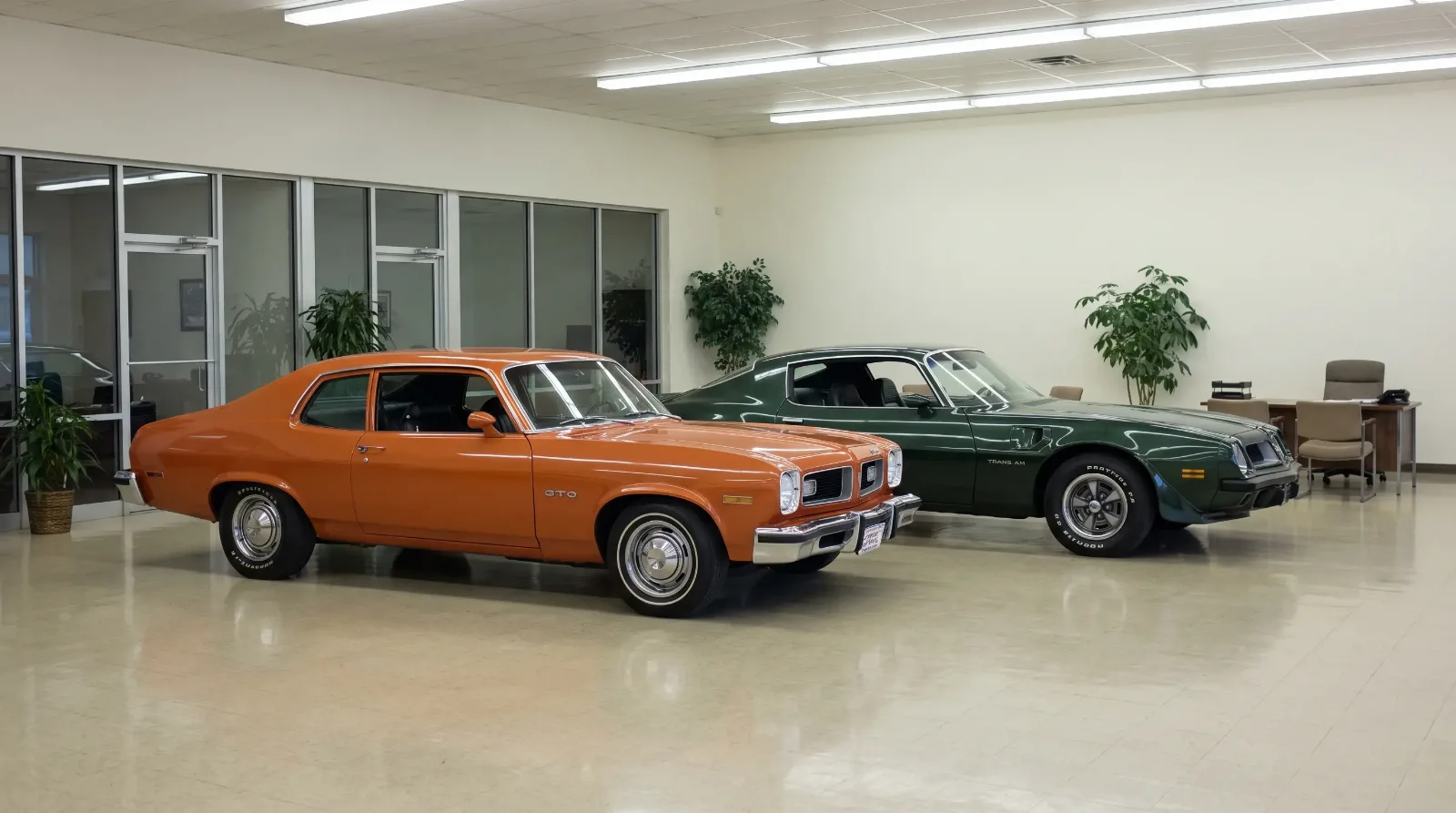
A showroom in early 1974 tells you more about the muscle car era's ending than any sales chart does. Walk the floor and the GTO sits next to a Firebird, a Grand Am, a Ventura, cars competing for the same shrinking pool of buyers who used to want exactly one thing and now wanted something else entirely, something quieter, something that didn't cost a fortune to insure or fill with gas. The GTO wasn't dying alone. It was going down with an entire category, and it happened to be one of the more visible casualties because its whole identity had been built on the thing the market was walking away from.
Car Features
7 min read
How the GTO's Death Foreshadowed the Muscle Era's Collapse
The GTO started the muscle car era in 1964 and became one of its clearest symbols of decline a decade later, as insurance, emissions, and fuel prices closed in industry-wide.
A category, not just a car, in decline
Every manufacturer that had built a reputation on midsize V8 performance was navigating the same collapse by 1973 and 1974. Chevrolet's Chevelle SS had already been pared down to a shadow of its late-1960s self. Plymouth's Road Runner and Dodge's Super Bee were fading fast, squeezed by the same insurance surcharges and emissions requirements hitting Pontiac. Ford had already walked away from most of its serious midsize performance offerings. This wasn't a Pontiac problem or a GTO problem. It was an industry-wide reckoning, and the GTO's very public downsizing in 1973 and its move to a compact platform in 1974 just made Pontiac's version of the story more visible than most, because the car changed shape twice in two years while everyone watched.
What the GTO's fall actually signaled
There's a reason the GTO's decline gets used as the shorthand for the whole era ending rather than any of the other cars going through the same thing at the same time. The GTO had been first. It launched the entire muscle car category in 1964, and there was something almost poetic about it also being one of the clearest examples of that category's unwinding a decade later. When a car that started a movement gets forced onto a compact economy platform and eventually discontinued entirely, the symbolism does a lot of work that a sales chart alone never could. Enthusiasts who lived through both moments, the 1964 launch and the 1974 finale, felt the full arc of the era condensed into a single nameplate's history.
"You could feel it happening in real time if you were paying attention. The GTO didn't fall apart on its own. Everything around it was falling apart too, and the GTO just happened to be the car people were watching when it happened."
Patrick Walsh
The forces working together, not separately
Insurance premiums on performance cars had been climbing steadily since the late 1960s, pushing the traditional GTO buyer, often young, often single, often a repeat customer for exactly this kind of car, out of the market entirely. Emissions regulation forced compression ratios down and added hardware that ate into real output across every manufacturer's lineup, not just Pontiac's. The October 1973 oil embargo then delivered the psychological blow, sending gas prices climbing and making horsepower-first marketing feel tone-deaf almost overnight. None of these forces acted alone. They compounded, each one making the others worse, and by 1974 the combination had reshaped what American car buyers wanted from a midsize coupe almost completely.
A dealership floor in early 1974
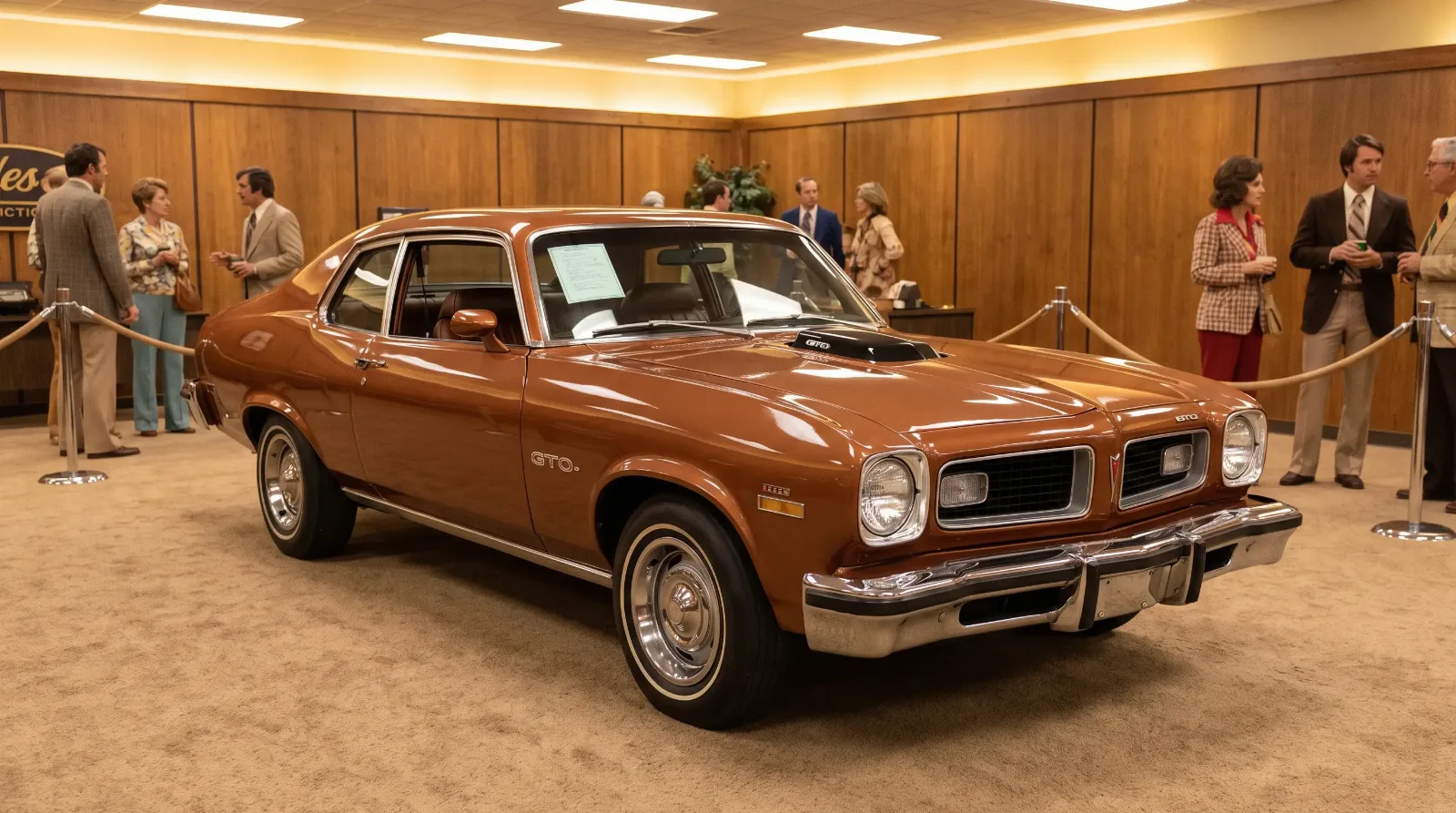
Picture that showroom for a second longer. A salesman walking a customer past the GTO option box on a LeMans order sheet in early 1974 wasn't pitching the same car his counterpart had pitched in 1966. He was pitching a compact coupe with a single detuned V8 option, competing on the same floor against a Firebird that still had some swagger left in its marketing and a Grand Am that was quietly becoming Pontiac's new idea of a personal-luxury performance car. Customers who ten years earlier would have walked straight to the GTO without a second look were now cross-shopping three or four different nameplates, weighing insurance quotes and fuel costs alongside horsepower for the first time in the segment's history. That shift in the buyer's mindset, more than any single spec change, is what tells you the era was actually ending rather than just going through a rough patch.
Salespeople on the ground felt this before the sales charts fully reflected it. Repeat GTO buyers, the customers who had traded up through two or three model years of the car, started asking different questions in 1973 and 1974: what does this cost to insure, what's the fuel economy, is there a smaller engine option. Those aren't questions a muscle car salesman was used to fielding a few years earlier, and the fact that they became routine says as much about where American car culture was heading as any single piece of legislation did.
What survived the collapse
Not every performance nameplate died in this period. Some, like Pontiac's own Trans Am, found a way to keep a performance identity alive through the leanest years of the mid-1970s by leaning harder into styling and image while the engineering caught up to new regulations over time. The GTO didn't get that chance, in part because Pontiac's own product strategy shifted resources toward the cars that were still finding an audience. That's a business decision as much as an engineering one, and it's part of why the GTO's ending feels more final than some of its contemporaries, several of which eventually returned or evolved rather than disappearing outright.
What enthusiasts lost besides horsepower
There's a cultural dimension to this decline that gets flattened when the story is told purely through sales figures and horsepower ratings. The muscle car era had built an entire subculture around cruising strips, dealership rivalries, and a shared language of displacement and compression ratios that a whole generation of young drivers grew up fluent in. Watching that identity dissolve over a few short years, replaced by conversations about fuel economy and insurance brackets, changed what it meant to be a car enthusiast in America almost overnight. The GTO's ending was one visible marker of a much larger cultural shift, one that took the better part of a decade to fully play out but that felt sudden and disorienting to the people living through it in real time.
Why this moment still resonates
The muscle car era didn't end with a single announcement or a single bad year. It wound down gradually, through insurance tables, EPA regulations, and a fuel crisis that arrived at the worst possible moment for cars built around big-displacement V8s. The GTO's story compresses that entire multi-year unwinding into one nameplate's final two model years, which is exactly why it still gets used as the reference point for how the era closed. To see the specific decision that finally ended the GTO nameplate rather than just detuning it further, read on, and for the full two-year account of how Pontiac fought to keep the car alive against all of this pressure, the Goat's last chapter lays out the complete timeline from the 1973 Colonnade redesign through the car's final model year.
Sources and notes
Related Reading
Have a
Pontiac GTO
for Sale?
Reach thousands of serious classic car collectors across the US.
Sell It Here →
Are You a Classic Car Dealer?
List your full inventory and connect with targeted classic car buyers.
Join as a Dealer →

About the author
Patrick Walsh
Automotive journalist covering classic car shows, events, and the enthusiast community across North America.
Related Listings - Pontiac GTO

Comments (1)
T
Tom Addison
1 month ago
Any suggestions on marque clubs for this car? Trying to find someone who really knows this platform in my region.