
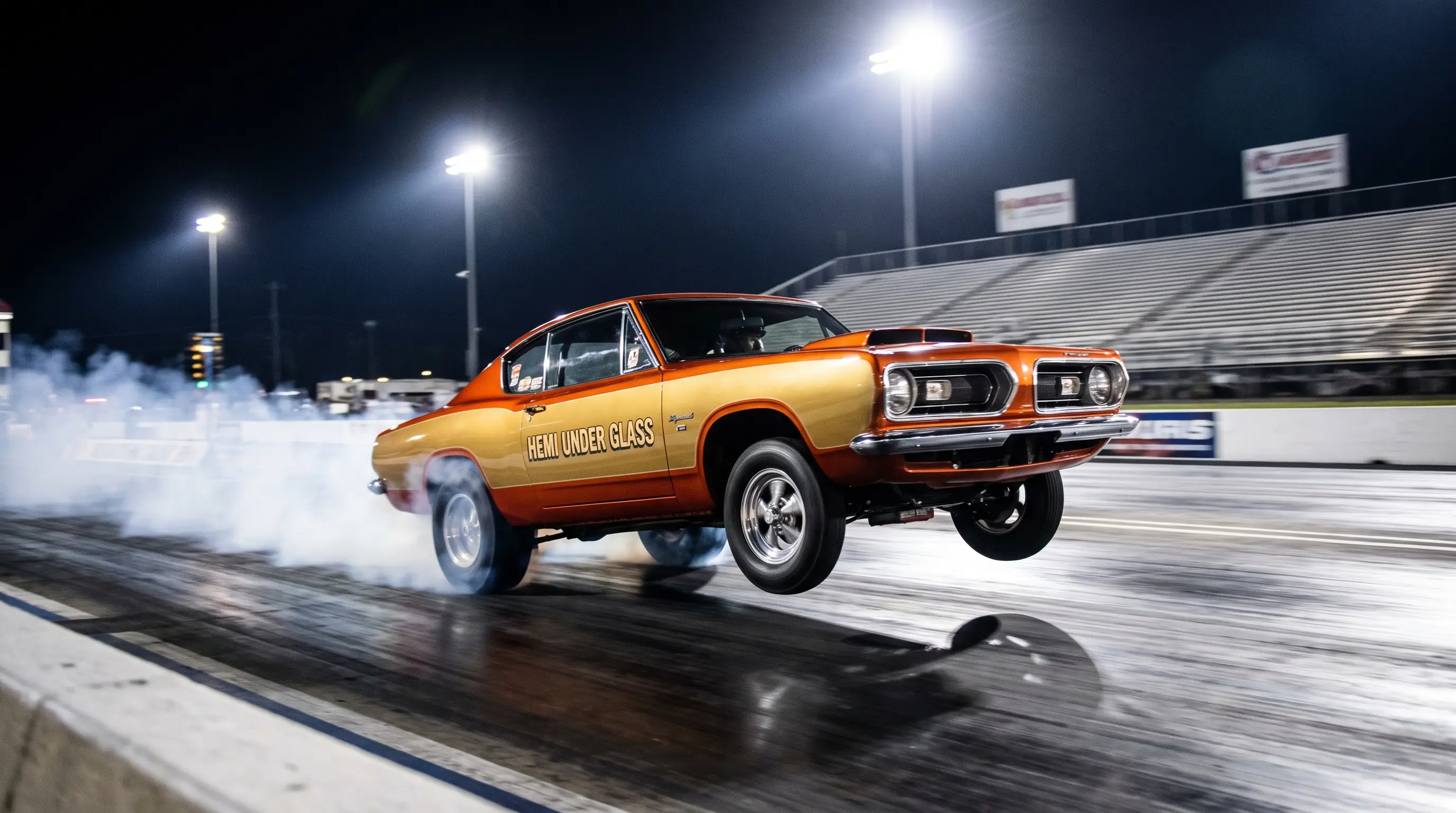
Hemi Under Glass Barracuda is the name that made a career out of driving on two wheels instead of four. It was never a production car, and it was never meant to be. It was an exhibition machine, built to put on a show at drag strips across the country, and it did that job well enough to become one of the most recognized names to ever wear the Barracuda badge.
Car Features
6 min read
Hemi Under Glass: The Wheelstanding Barracuda
Hemi Under Glass moved a Hemi engine to the back seat of a Barracuda and turned it into a rear wheel drag strip spectacle. Here is how it worked and why it mattered.
An engine where the back seat used to be
The concept was simple and the execution was radical. Take a Barracuda fastback, move the Hemi engine to the rear of the car where the back seat normally sat, and shift the weight distribution hard enough that the front wheels would lift off the pavement under full throttle. The name told you exactly what you were getting. You could see the Hemi through the rear glass, sitting where nobody expected an engine to go.
This was not a stunt built once and forgotten. Hurst Performance campaigned Hemi Under Glass wheelstanders from the mid 1960s well into the following decade, with driver Bob Riggle behind the wheel for most of that run, and the wheelstanding act became a fixture of drag racing exhibition programs at a time when match races and funny car shows drew serious crowds looking for something more theatrical than a straight up quarter mile pass.
Why it worked as a show car
Weight transfer is the whole secret behind any wheelstander, and Hemi Under Glass exploited it about as aggressively as a car built on this platform could. Moving that much mass behind the rear axle meant the front end had almost nothing holding it down the moment the clutch dropped and the throttle opened. The car would rise onto its rear wheels and, in the hands of a skilled driver, stay there for a genuinely long stretch of track before coming back down.
Driving a car in that configuration took real skill, not just a heavy foot. Steering input, throttle modulation, and knowing exactly when to back off before the car looped or came down hard were all part of the job. The drivers who piloted these cars over the years earned their reputation the hard way, one exhibition pass at a time.
Consistency mattered as much as spectacle. A wheelstander that flips or loops in front of a paying crowd is a bad night for everyone involved, and the touring program behind Hemi Under Glass understood that the show only worked if the car came back down safely, pass after pass, at venue after venue, for years on end. That reliability, quietly built into a car that looks anything but tame, is part of why the name still carries weight with people who never saw a single run in person.
Crowds at these events were not drag racing purists looking for a clean elapsed time. They were people who wanted a spectacle, and a Barracuda rising onto its rear wheels for the length of an entire quarter mile pass delivered exactly that, night after night, at tracks that otherwise ran a fairly predictable rotation of similar looking cars making similar looking passes.
What it means for the Barracuda's legacy
Hemi Under Glass never sold a single unit to a retail customer, and it never needed to. What it did was put the Barracuda name in front of drag racing crowds who might never have cross-shopped the car against a Mustang or Camaro otherwise. A car doing a full quarter mile pass on its rear wheels is the kind of thing people remember and talk about for years, and that word of mouth mattered more to Plymouth's image in this era than any single magazine road test.
The car also cemented the Barracuda's connection to drag racing culture specifically, separate from its identity as a street pony car. That dual identity, street car on one hand and drag strip showpiece on the other, is part of why this generation of Barracuda still draws such a wide range of collectors today, from people chasing a numbers matching Formula S to people who just want a piece of drag racing history on their wall.
It is worth remembering how unusual this kind of exhibition marketing was even for its own era. Most manufacturers relied on print advertising, dealership displays, and the occasional sanctioned race entry to build performance credibility. Plymouth got a traveling stunt show out of the arrangement instead, one that put the Barracuda name in front of crowds who came specifically to see something they could not see anywhere else. That kind of organic exposure is hard to buy at any price, and it happened here almost by accident, born out of a simple engineering trick rather than a deliberate advertising campaign.
| Detail | Note |
|---|---|
| Base car | Second generation Barracuda fastback |
| Configuration | Hemi engine relocated to rear of chassis |
| Purpose | Drag strip exhibition wheelstander |
| Legacy | Linked Barracuda name to drag racing exhibition circuit |
Where it fits in the bigger story
Hemi Under Glass is a sideshow to the mainstream production history of this generation, but it is a sideshow that stuck in people's memory harder than plenty of cars that actually sold in real numbers. For the full account of how this generation of Barracuda developed on the production side, our second generation barracuda retrospective covers the platform, the body styles, and the engine options that buyers could actually order. If you want to see how the era's styling decisions shaped everything from the show car to the showroom floor, a related story digs into that angle directly. And if this whole conversation has you wanting the real thing in your own garage, there are Barracudas for sale now worth a look.
"People ask if Hemi Under Glass was just a gimmick. Sure it was a gimmick. It was also the best marketing the Barracuda ever got, and nobody at Plymouth had to write a single ad to make it happen."
- Dan Reeves
Hemi Under Glass never had to compete on a spec sheet, and that is exactly the point. It competed for attention, and it won that fight decisively enough that people are still telling the story fifty years later. Few cars from this era can claim that kind of staying power in the public imagination, production numbers or not.
Sources and notes
Related Reading

About the author
Dan Reeves
Performance engine builder from North Carolina's motorsports corridor, focused on swaps, forced induction and making real, repeatable power.
Related Listings - Plymouth Barracuda
Comments
Be the first to comment on this article.