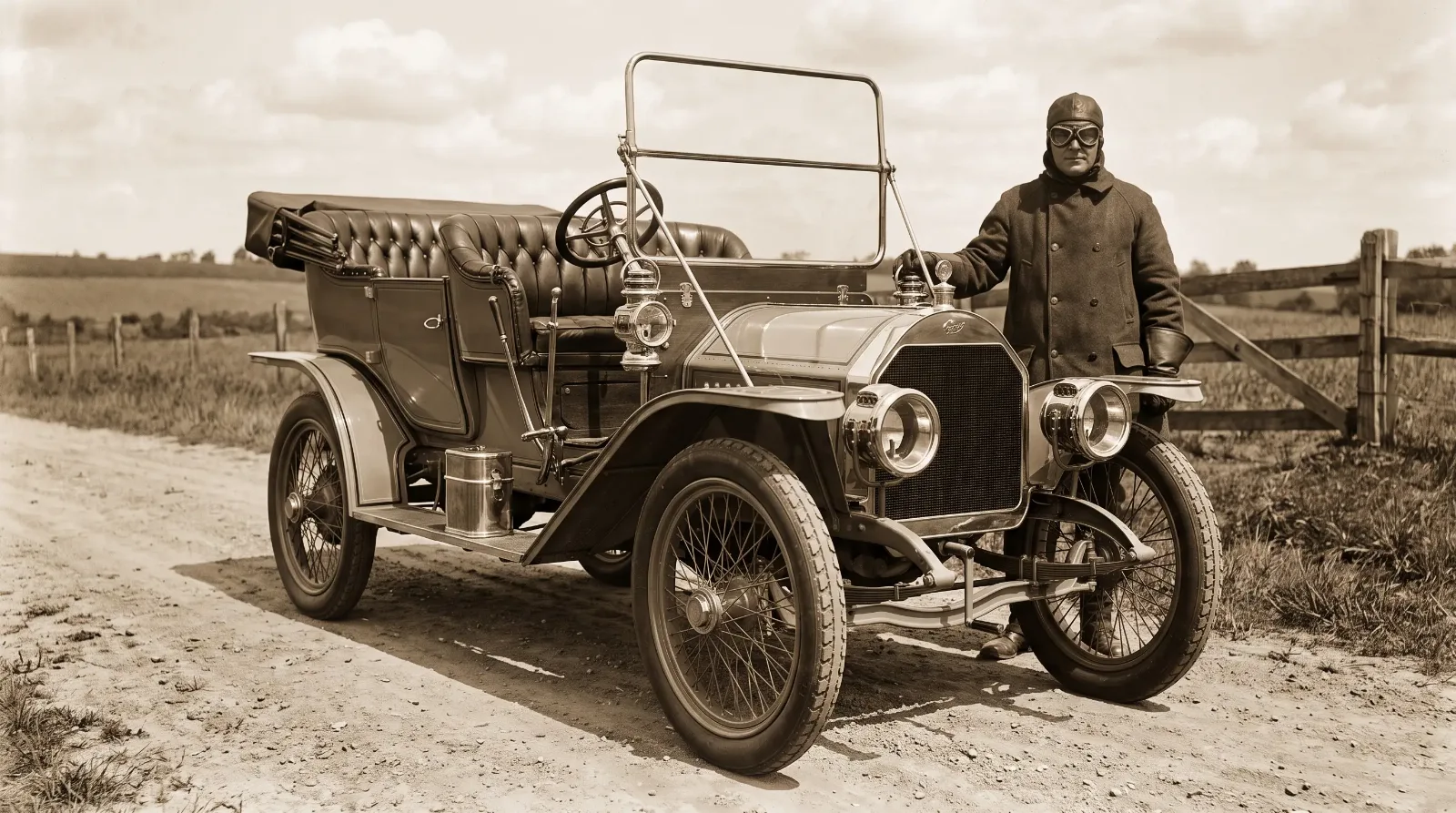
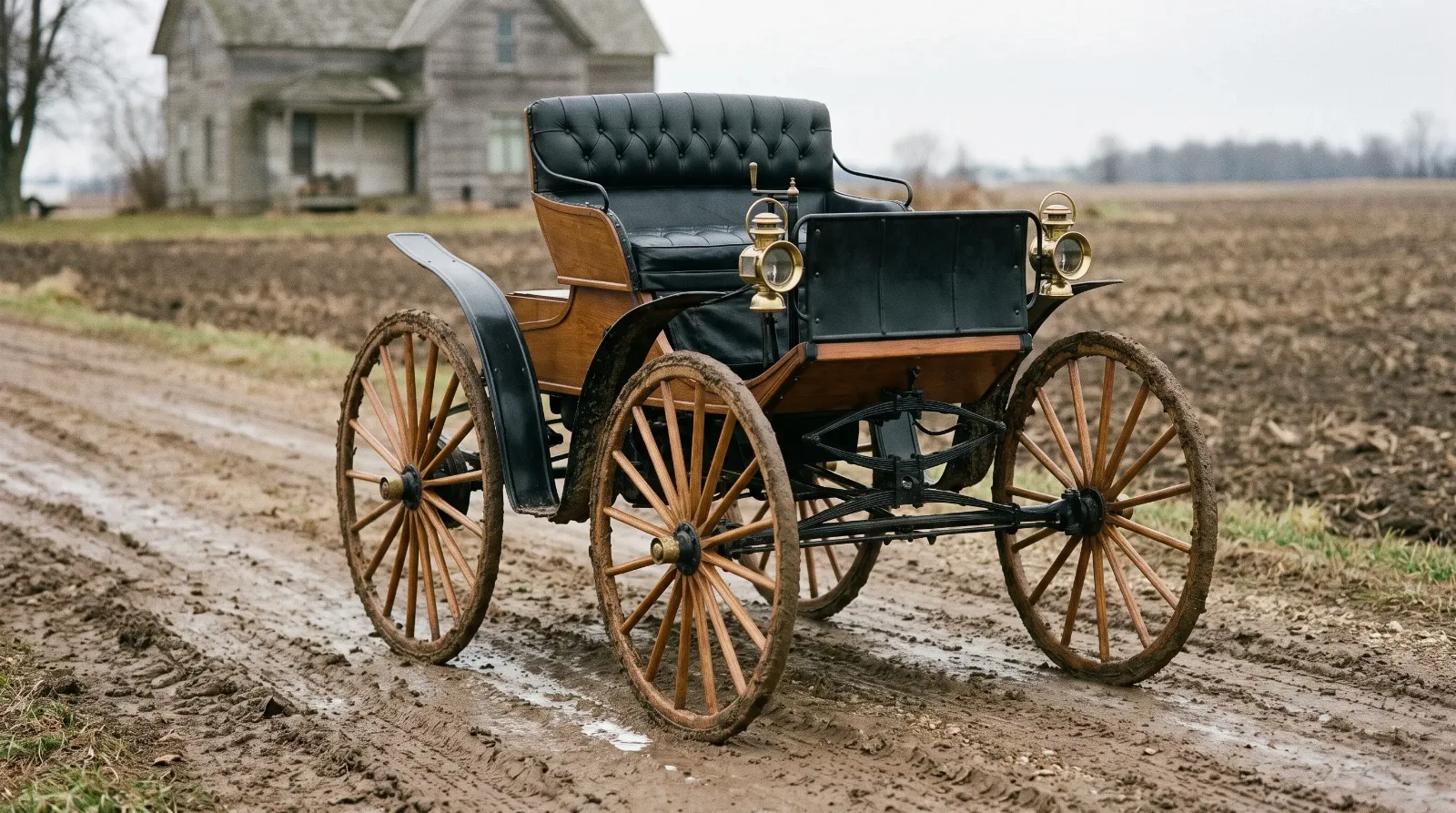
Go to a small-town car show in farm country and every so often you will see one of these sitting off to the side, tall skinny wheels, a buggy-style body, looking more like a horse carriage that lost its horse than what we normally picture when somebody says "brass era car." That is not far off from the truth, and that is exactly why these things sold as well as they did to the folks who bought them.
What a high-wheeler actually was
High-wheelers, sometimes called motor buggies, were built with tall wooden wheels, often in the 38 to 44 inch range and sometimes larger, carried over almost directly from horse-drawn buggy construction, mated to a simple gasoline engine and a basic drivetrain. Companies like International Harvester, Holsman, and a long list of smaller regional builders sold these things directly to rural buyers who did not care one bit about looking like a fancy city automobile. They cared about a machine that could get them down a muddy farm road without getting stuck.
And that is the whole pitch, right there. City car buyers wanted low, sporty-looking machines with real ground clearance sacrificed for style. Farmers wanted the opposite. Tall wheels cleared ruts, rocks, and mud that would have high-centered a lower touring car, and the simple, often air-cooled engines used in these buggies were built to be fixed by a farmer with basic tools, not shipped back to a dealer for factory repair.
Why they looked the way they did
The buggy body style was not laziness or a lack of ambition on the builder's part. It was a direct, practical carryover from a design that had already proven itself for generations on rural roads. A high-wheeler's suspension, such as it was, leaned on the same tall wheel and simple axle logic that made a horse buggy ride tolerably well over rutted dirt, because the roads had not changed just because the power source had.
Some of these machines used solid rubber tires rather than pneumatic ones, trading ride comfort for durability and a far lower chance of a puncture stranding a farmer miles from the nearest town. That was the right trade for the buyer these builders had in mind, even though it meant a rougher, bouncier ride than a contemporary pneumatic-tired touring car.
For the wider brass era picture these buggies fit into, alongside the touring cars city buyers were choosing at the same time, the antique high wheeler buggies guide lays out the full range of what was on the road in this period.
Why they mostly disappeared
The high-wheeler's advantage shrank fast once two things happened at roughly the same time. Rural roads slowly improved as counties and states invested in road building through the 1910s, narrowing the gap between what a tall-wheeled buggy could handle and what a lower, more conventional car could manage. And the Model T, with its own respectable ground clearance and a price that kept falling thanks to assembly line production, offered farm buyers a real alternative that did not look, or ride, quite so much like a leftover buggy.
By the mid-1910s, most of the dedicated high-wheeler builders were gone or had switched to more conventional automobile designs. The category did not fail because the idea was bad. It solved a real problem for its moment, and then the problem it solved, bad roads and the need for a rugged, farmer-serviceable machine, got smaller as infrastructure and mainstream cars both improved.
"Folks laugh at the high-wheeler now because it looks awkward next to a proper touring car, but it was built for a real job and it did that job. A farmer buying one of these was not trying to impress the neighbors. He was trying to get to town and back without getting stuck in a rut that would have stopped a fancier machine cold. That is honest engineering, built for the customer in front of you instead of the customer you wish you had."
— Gary Nowak
What survives and what to know if you find one
High-wheelers are genuinely rare today, rarer in some ways than comparable touring cars from the same window, because they were built as working farm tools rather than treasured possessions, and a lot of them were used hard and eventually scrapped once they wore out or got replaced. A surviving, complete example draws real curiosity at a show precisely because most people, even serious old car folks, have never seen one up close.
If you find one, expect wooden wheel condition to be the first thing worth checking closely, since these machines share the same dried-wood and loose-spoke risks as any brass era wooden wheel, and expect parts to be scarce, since so few builders made these and even fewer parts suppliers ever catered specifically to them. What you get in return is a genuinely different piece of automotive history, one built for the farm rather than the boulevard, and a conversation starter that most brass era collectors will not have an easy answer for either.
The bigger lesson in the high-wheeler story
These odd, tall-wheeled machines are a good reminder that the early automobile was never a single, unified product chasing one ideal design. It was dozens of builders solving different problems for different buyers, city and country, rich and modest, at the exact same moment in history. The high-wheeler lost out in the long run, but for its brief run it was exactly the right car for the customer it was built for, and that is worth remembering the next time somebody tells you the early car industry was all headed toward the same destination from the start.
Curious how fast these early cars actually managed, high-wheelers included, once the road allowed for it? Read on for a straight look at real top speeds from the 1910s, separating showroom claims from what these cars could actually do.