
Model A brakes are easy to describe and surprisingly easy to misunderstand. Ford fitted the 1928 to 1931 Model A with four-wheel mechanical drum brakes, worked entirely by steel rods, with no hydraulic fluid anywhere in the system. That sounds primitive until you set it beside what came before: the Model T stopped with a band squeezing a drum inside the transmission, and nothing at all at the front wheels. The Model A put a brake on every corner of the car. This piece looks at how that rod system moves force from your right foot to four drums, why Ford split it the way it did, and what changed between the first cars and the last.
Car Features
8 min read
Four-Wheel Mechanical Brakes on the Model A
How Model A brakes work: rods, 11 in drums and a rear-biased split, plus the June 1928 hand brake change and the 1931 switch to cast iron drums.
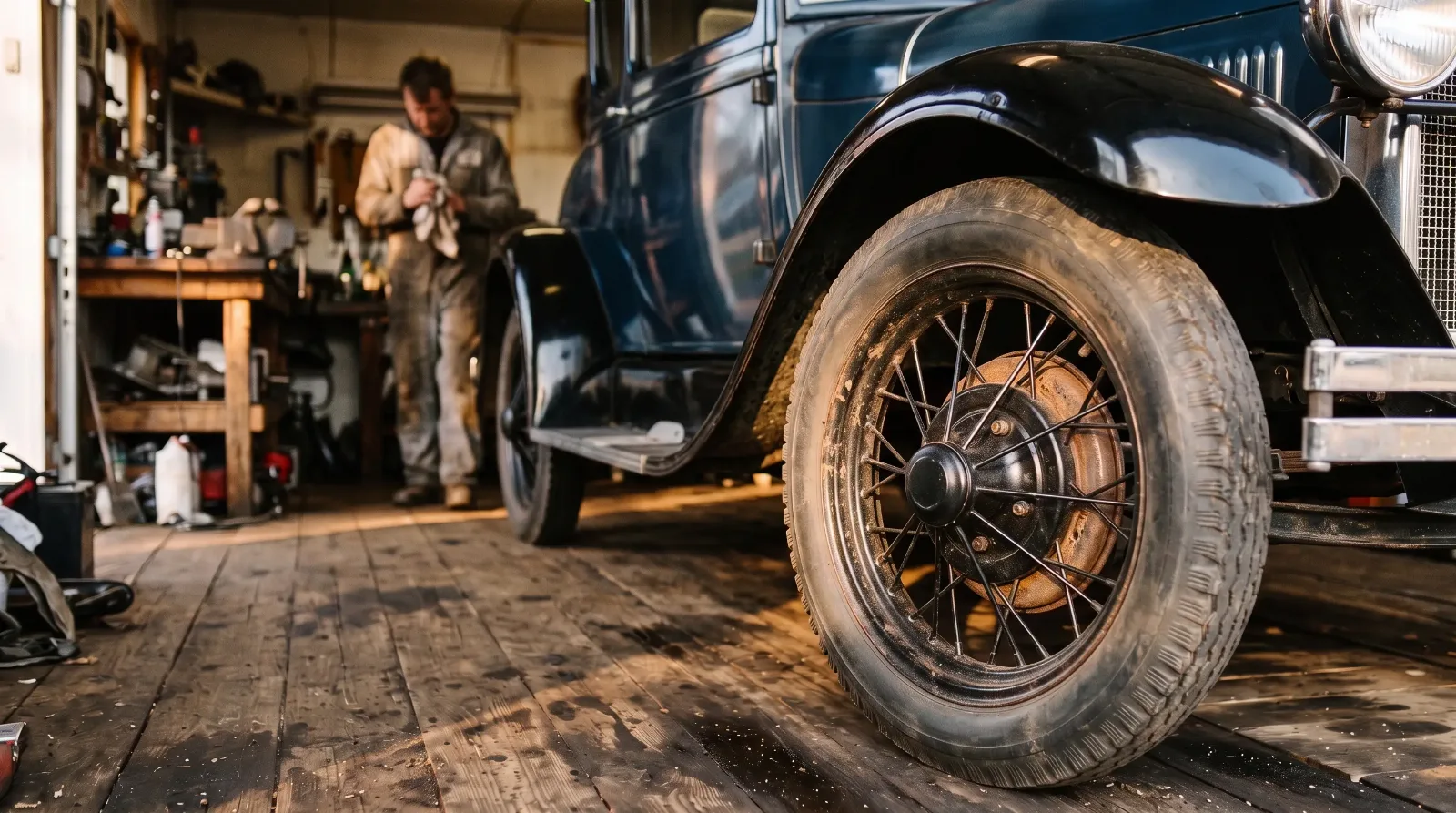
From one transmission band to four drums
The starting point matters, because it explains why the Model A felt like such a jump. On a Model T, the right pedal tightened a band around a drum in the planetary transmission. That band slowed the driveshaft, and the driveshaft slowed the rear wheels through the differential. The floor hand lever worked a separate pair of small brakes in the rear drums, which doubled as the parking and emergency brake. There were no service brakes at the wheels and none at the front. Ford did enlarge the brakes on the 1926 to 1927 Improved Model T, and owners who wanted more bolted on aftermarket outer-drum brakes such as the Rocky Mountain sets, with 11-3/4 in drums on the rear hubs.
The Model A threw that layout out. Its brake pedal sits in the center, between the clutch on the left and the gas pedal on the right, the arrangement drivers still use today. Pressing it applies shoes inside drums at all four wheels. Edsel Ford reportedly had to talk Henry Ford into accepting both the sliding-gear transmission and the four-wheel brakes, which tells you this was not an obvious choice inside the company in 1927. If you want the engine and drivetrain side of that transition, the details are in our engine guide.
How Model A brakes turn a pedal push into stopping force
A mechanical brake system is a chain of levers. Each link either multiplies force or redirects it, and every joint along the way loses a little to friction and slack. On the Model A, the pedal pivots on a cross shaft running under the floor. Rods run from levers on that shaft forward to the front wheels and back to the rear wheels. At each wheel the rod pulls the lever of an actuator, and the actuator drives a wedge between rollers on the ends of the two shoes, spreading them outward against the inside of the drum. That is the whole principle: internal expanding shoes, pushed by rods instead of by fluid pressure.
Two consequences follow from using rods. First, the force each wheel receives depends on the geometry of the levers, so the front-to-rear split is built into the hardware. The figure usually given for the Model A is roughly 40 percent front and 60 percent rear. Rear bias made sense on a light car with narrow tires: lock the fronts and you lose steering, lock the rears and you are only embarrassed. Second, the system is only as balanced as its adjustment. A hydraulic system equalizes pressure on its own because fluid pushes equally in every direction. A rod system does not. If one rod has more free travel than its partner, that wheel engages later, and the car pulls toward the side that grabs first.
The front wheels add a further problem, because they steer. A rod that pushes on a brake lever has to keep working as the wheel swings left and right on its kingpin, so steering must not apply or release the brake by itself. Ford's answer was to send the force down the steering pivot. The front actuators sit on the spring perches above the kingpins, and an operating pin running inside each hollow kingpin carries the push down to the wedge in the drum, so the force travels along the axis the wheel turns about. The layout lasted through 1931, and the 1932 cars kept rod-operated brakes.
"People call rod brakes crude. I call them honest. Every bit of force at the drum came from your leg, through parts you can see and measure with a ruler. When a Model A stops badly, the cause is almost always sitting in plain view."
Emily Chen
Drums, shoes and the 1931 change
All Model A drums share an 11 in internal diameter. What changed was the material. From 1928 to 1930 the drums were stamped steel on steel hubs. For 1931 Ford switched to cast iron drums, front and rear. Cast iron is heavier, but it resists distortion under heat better than thin stamped steel, and a drum that stays round keeps the shoes in full contact. The 1931 shoes are listed at 1-3/4 in wide. When Ford moved on to the 1932 cars, the drums grew to 12 in.
| Item | Model T (1909 to 1927) | Model A (1928 to 1930) | Model A (1931) |
|---|---|---|---|
| Service brake | Band on a drum inside the transmission | Four-wheel mechanical drum brakes, rod operated | Four-wheel mechanical drum brakes, rod operated |
| Brakes at the front wheels | None | Yes | Yes |
| Parking or emergency brake | Hand lever, rear-drum brakes | Hand lever; early cars had a single rear brake system | Hand lever |
| Drum inside diameter | Not on our sheet | 11 in | 11 in |
| Drum construction | Not on our sheet | Stamped steel on steel hubs | Cast iron |
| Approximate brake split | Rear only | About 40 percent front, 60 percent rear | About 40 percent front, 60 percent rear |
Modern owners often fit cast iron drums to earlier cars for exactly the reason Ford changed them. The Model A Ford Club of America's touring class rules lists cast-iron drums among the changes that carry no point deduction, alongside items such as turn signals and a second tail lamp. A car shown in the stricter originality classes is another matter.
The early 1928 hand brake and the June changeover
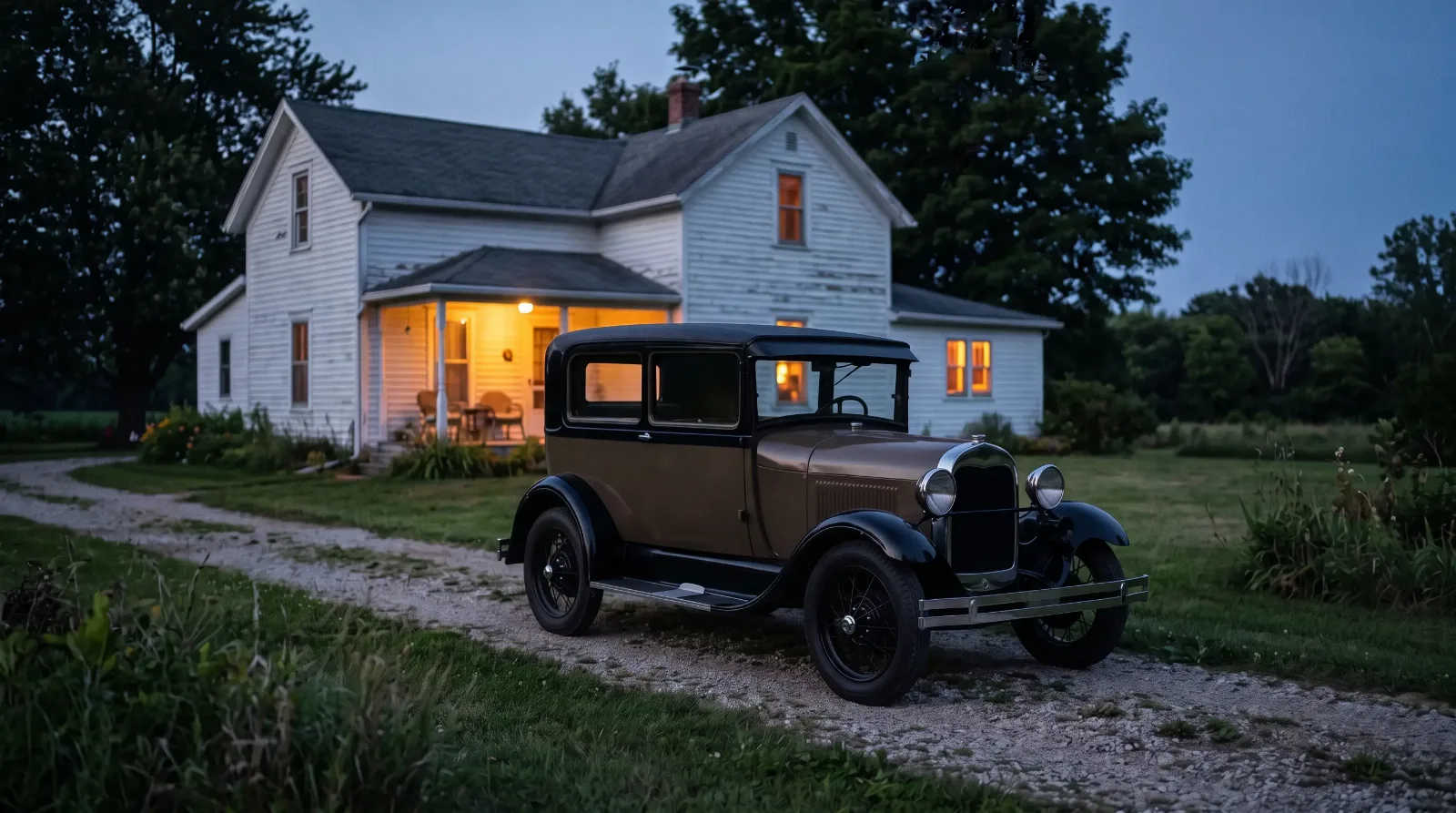
The first Model As did not have the parking brake arrangement most owners know. Early cars used a left-side hand brake lever working through a single rear brake system, so the service brake and the emergency brake shared hardware at the rear wheels. Club research based on owner questionnaires puts the changeover in the window of 10 to 22 June 1928, between engine numbers A-155,000 and A-177,486, for US passenger cars. After it, the emergency brake became a separate system, with its own linings inside the rear drums, working independently of the foot brake.
Ford's own parts book recorded the split. The early single-rear-brake lever carried the number A-2236-AR, superseded by A-2236-B on 1929 to 1931 cars. That "R" suffix is part of why collectors call the earliest cars "AR" models, though the term was never a Ford model name. A smooth running-board apron, with no bump for the emergency brake rod, is one of the details restorers use to spot an early car.
From an engineering standpoint the change is easy to justify. If the parking brake shares its shoes and linkage with the service brake, a single failure, such as a broken rod or a badly worn rear lining, can take out both. Separating them means a fault in one leaves the other available. The early arrangement worked, but the revision closed a weakness that would have been obvious to anyone who thought about failure modes.
Keeping rod brakes honest today
Well-adjusted Model A brakes stop the car in a straight line and are adequate for the speeds the car was built for. Poorly adjusted ones are the source of most of the complaints. Since the system has no self-equalizing feature, the work is mechanical and methodical.
Suspension condition has more to do with braking than many owners expect. When the nose dives and bounces under hard braking, the tire contact patch varies and the front wheels lose grip at the moment you need it. The Model A's hydraulic lever shocks were part of what made four-wheel braking usable on 1928 roads, and the Houdaille shocks deserve the same attention as the brake rods when a car is being sorted.
The bigger lesson is in the comparison. The Model T relied on one band in a gearbox. The Model A spread the work across four drums with a fixed, deliberate split, and that is the basic arrangement every car since has used. The fluid came later. The logic was already there in 1928.
Sources and notes
- Ford Garage: Model A front brake operating pins inside the kingpins
- Ford Garage: Model A front brake actuators
- Ford Garage: 1931 rear brake drum
- MAFCA, The Restorer: Early Birds (early 1928 hand brake changeover)
- Model A Ford Club of America: vehicle judging and touring class
- Wikipedia: Ford Model A (1927 to 1931)
Related Reading
Have a
Ford Model A
for Sale?
Reach thousands of serious classic car collectors across the US.
Sell It Here →
Selling a classic? Here's how: where to sell your classic car online
Are You a Classic Car Dealer?
List your full inventory and connect with targeted classic car buyers.
Join as a Dealer →

About the author
Emily Chen
Bay Area engineer with a deep focus on vintage Japanese and European performance cars. Approaches classic car research and restoration with an analytical eye.
Related Listings - Ford Model A

Comments
Be the first to comment on this article.