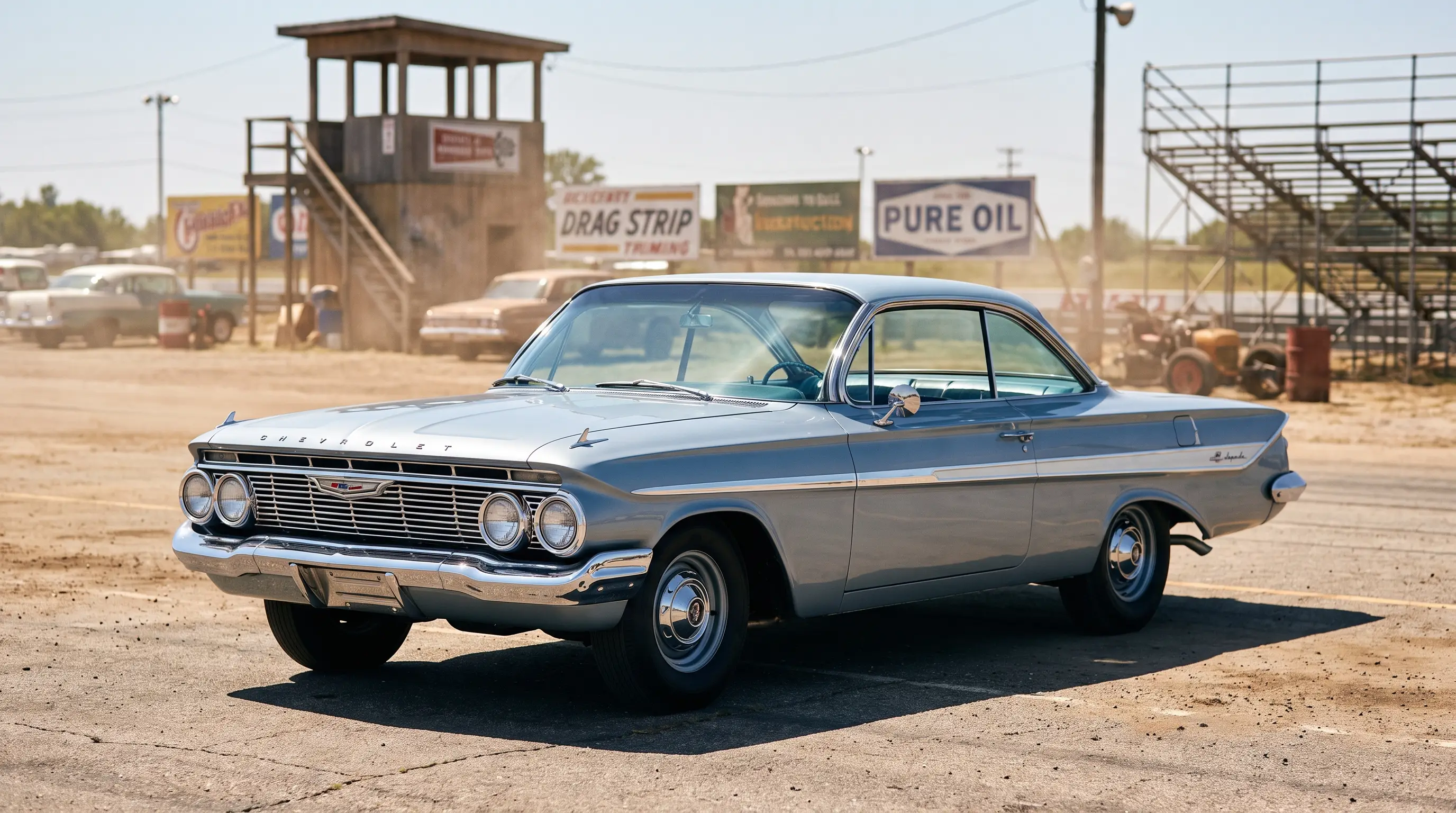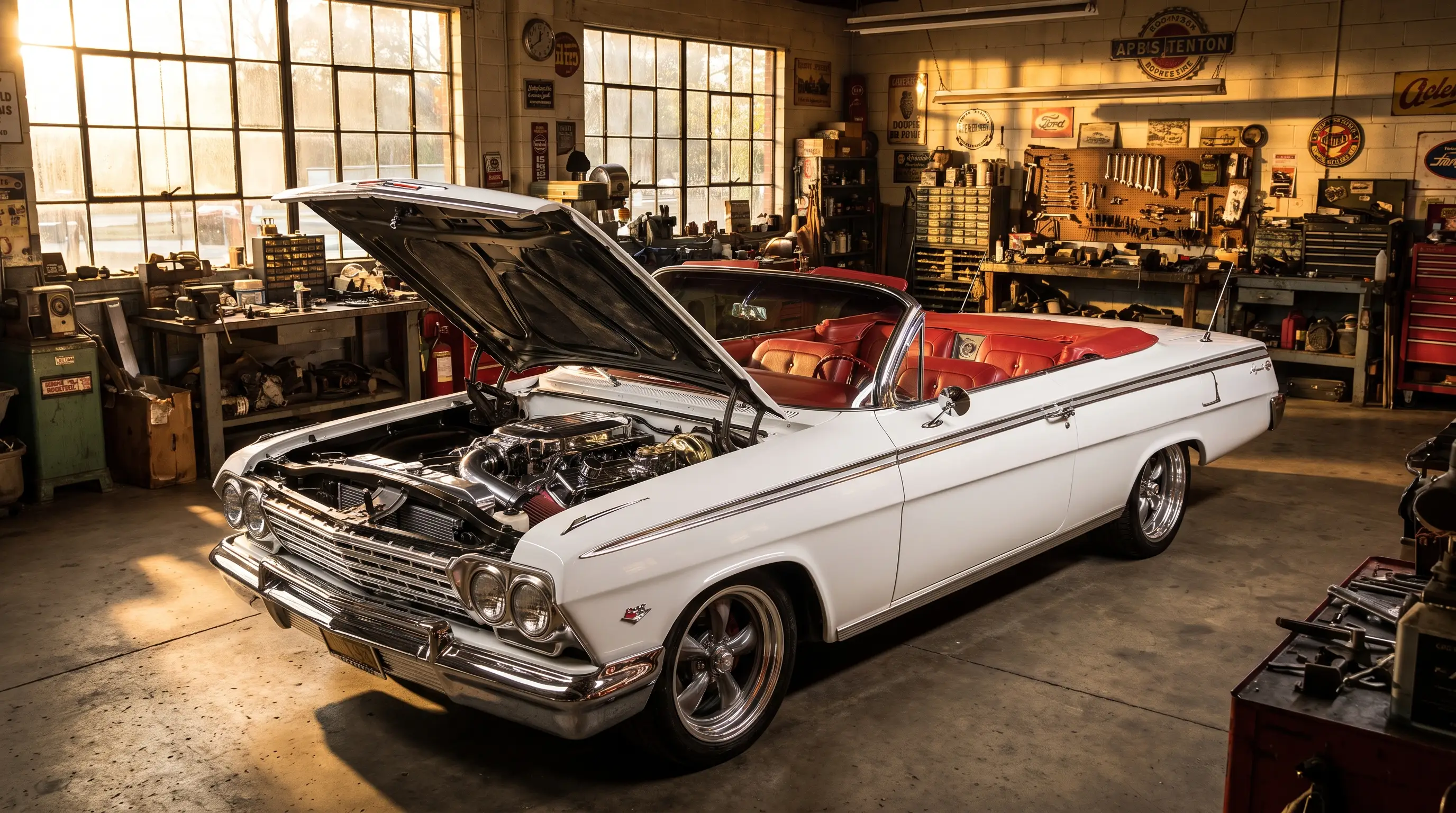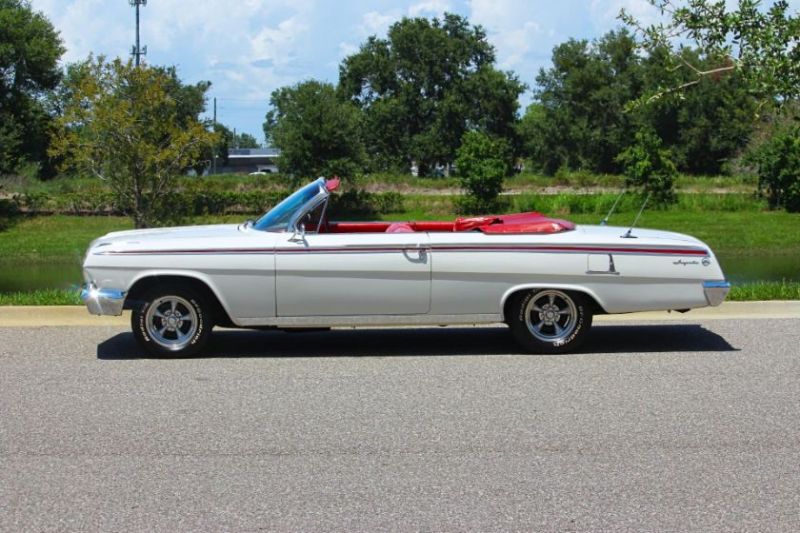
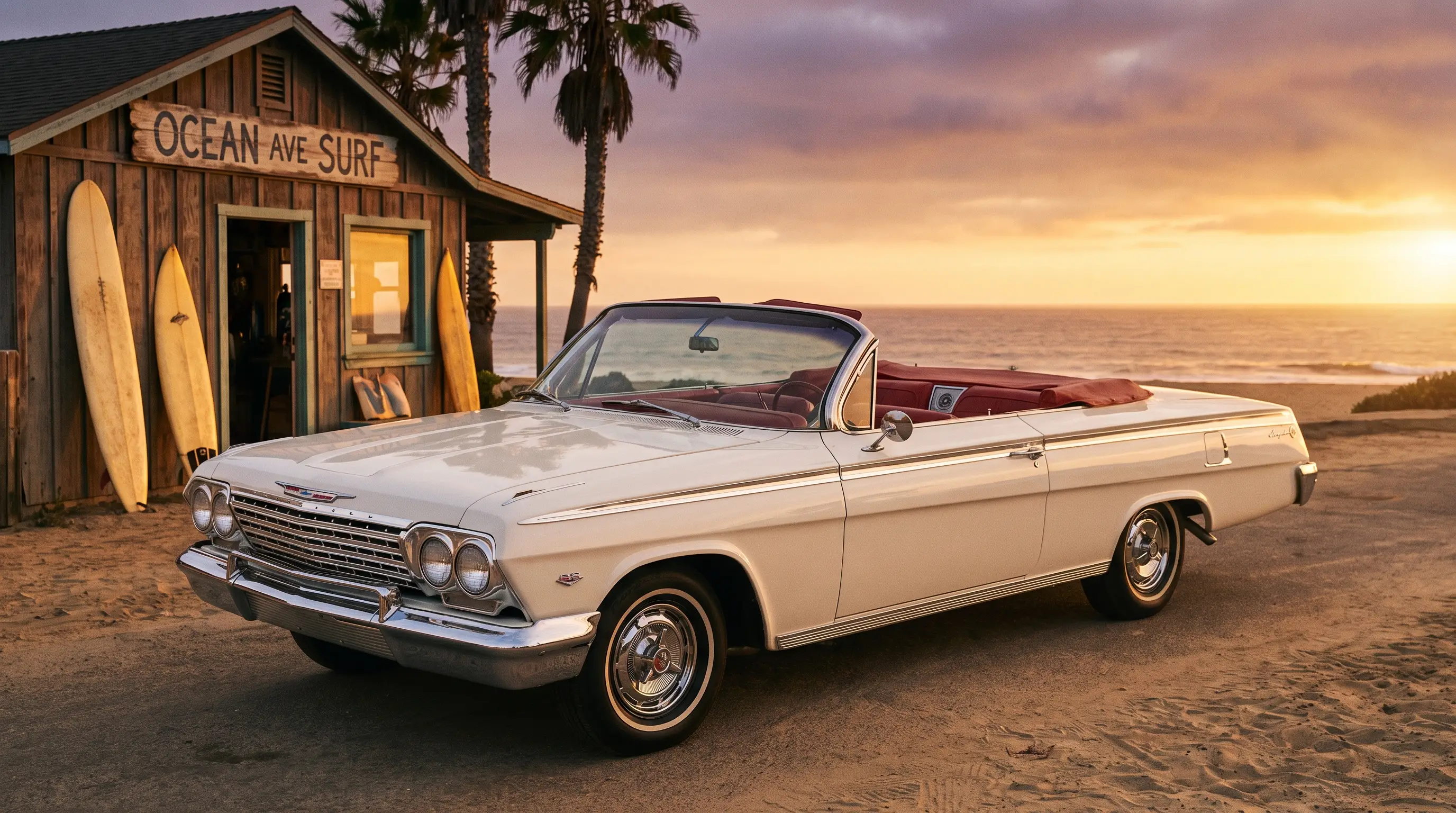
The 1962 Impala 409 is the car the song made famous before most buyers ever sat in one. Two and a half years after Chevrolet dropped the W-block 348 into full-size cars, the division bored and stroked its way to 409 cubic inches, and for 1962 that engine finally got the body it deserved. This is the year the numbers stop being a rumor and start being a build sheet.
The engine came first, the song came second
Chevrolet built the first 409s for 1961, a limited run stuffed into Bel Airs and early Impalas for buyers who already knew what they wanted. By 1962 the 409 was a regular order code on the option sheet, rated at 380 horsepower with a single four-barrel and 409 horsepower with dual quads, an easy number for a marketing department to love and an easier one for a rock and roll band to steal. The Beach Boys released "409" in June 1962 as the B-side of "Surfin' Safari," and the song spent a single week on the Billboard Hot 100 that October, peaking at number 76, yet it did more for the engine's reputation than any dealer brochure ever could.
None of that changes what the engine actually was: a big-valve, big-bore descendant of the 348 Turbo-Thrust, with a stronger block, better heads, and a solid-lifter cam in dual-quad form. It was not subtle. It was not meant to be.
What buyers actually got in 1962
Order a 409 in a 1962 Impala and you got a car built around the drivetrain, not a luxury cruiser with a big motor bolted in as an afterthought. Heavier front springs, a stiffer frame, and in many cases a four-speed manual came along for the ride. Chevrolet was not hiding the intent. This was a full-size car built to run a stoplight-to-stoplight fight and win it, then still carry four adults to church on Sunday. That duality is the whole appeal of the 1962 Impala 409, and it is why the car still draws a crowd at shows six decades later.
The two-door hardtop and convertible got most of the attention, and rightly so, since that is where the 409 badge photographed best. But the engine could be had across the Impala line for 1962, which means surviving cars come in more body styles than most people assume, including some four-door sedans and station wagons that buyers today rarely expect to see wearing a 409 badge on the fender.
1962 also brought a new, cleaner roofline to the full-size Chevrolet line, with less of the finned excess that had defined the late 1950s. That restraint suited the 409's personality well. The car did not need to shout with its sheet metal when the engine bay already made the point. Buyers who ordered the SS package on top of the 409 got bucket seats, a center console, and instrumentation aimed at a driver who actually wanted to know what the engine was doing, not just that it was loud.
Numbers that matter more than the myth
| Spec | 1962 409 (single 4-bbl) | 1962 409 (dual quad) |
|---|---|---|
| Displacement | 409 cubic inches | 409 cubic inches |
| Horsepower | 380 hp | 409 hp at 6,500 rpm |
| Carburetion | Single 4-barrel | Dual 4-barrel |
| Transmission options | 3-speed, 4-speed manual, Powerglide | 4-speed manual typical |
The dual-quad 409 hp figure is the one everyone quotes because it matches the displacement, a coincidence Chevrolet's marketing team was not about to let pass unmentioned. Whether every engine actually made that number on a dyno is a separate conversation, one gearheads still argue about at swap meets.
Rarity and what it means today
A real numbers-matching 1962 409 Impala, especially a dual-quad four-speed car, is not something you find at a used car lot. Production of 409-equipped Impalas for the year was a fraction of total Impala output, and fewer still survive with original engines, original documentation, and bodies that have not been reshelled or clones built up from a base car and a crate motor. That gap between what is claimed and what is real is where buyers get burned, and where careful ones make money.
Part of the scarcity is simple attrition. These were young men's cars in period, bought to be driven hard, raced on weekends, and traded in a few years later once the next big engine came along. Bodies got wrecked, engines got swapped out for fresher blocks, and paperwork got thrown away because nobody in 1965 thought a used Chevrolet needed a paper trail. The cars that survived intact usually did so by accident, tucked in a garage or a barn by an owner who simply stopped driving them rather than by any deliberate act of preservation.
For the origin of the whole story, including how Chevrolet got from the 348 to the 409 in the first place, where this started lays out the groundwork this article builds on.
The song's long shadow
It is worth saying plainly that "409" the song made "409" the engine bigger than it might have been on mechanical merit alone. Plenty of period engines matched or beat the 409's output without ever becoming a household name. The Beach Boys gave Chevrolet a piece of free, permanent advertising that no other manufacturer's big-block ever got, and that cultural attachment is baked into the price of a real car today. A buyer paying for a documented 1962 409 Impala is paying partly for the engineering and partly for six decades of the song still playing on classic rock radio.
That is not a complaint. It is just an honest accounting of where the value actually comes from, and why a 409 commands attention that a mechanically similar, less famous engine from the same era simply does not get.
"Everybody wants the song car. Fewer people want to pay for the documentation that proves they actually have it."
- Dan Reeves
Buying one now
If you are shopping, the 1962 Impala 409 rewards patience over enthusiasm. Verify engine casting numbers against the car's build sheet before you get emotionally attached. A correct dual-quad car with a clean Protect-O-Plate or factory invoice is worth real money. A recreation with a period-correct engine swapped in later is still a good car, just not the same car, and the price should reflect that difference honestly. Buyers who skip that step tend to pay collector money for a driver-quality clone.
For those ready to look at what is actually on the market right now, there is a classic Impala for sale listing worth a look before you commit to a private-party deal sight unseen.
The bottom line
The 1962 Impala 409 earned its reputation the hard way, on strips and streets, before a hit song made it a household name for people who had never seen one in person. Sixty years on, the car still separates buyers who do their homework from buyers who just want the story. Do the homework.