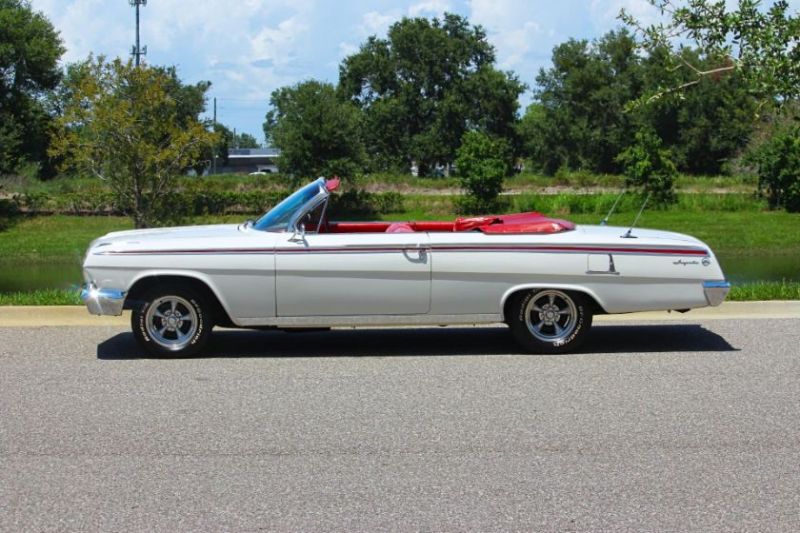
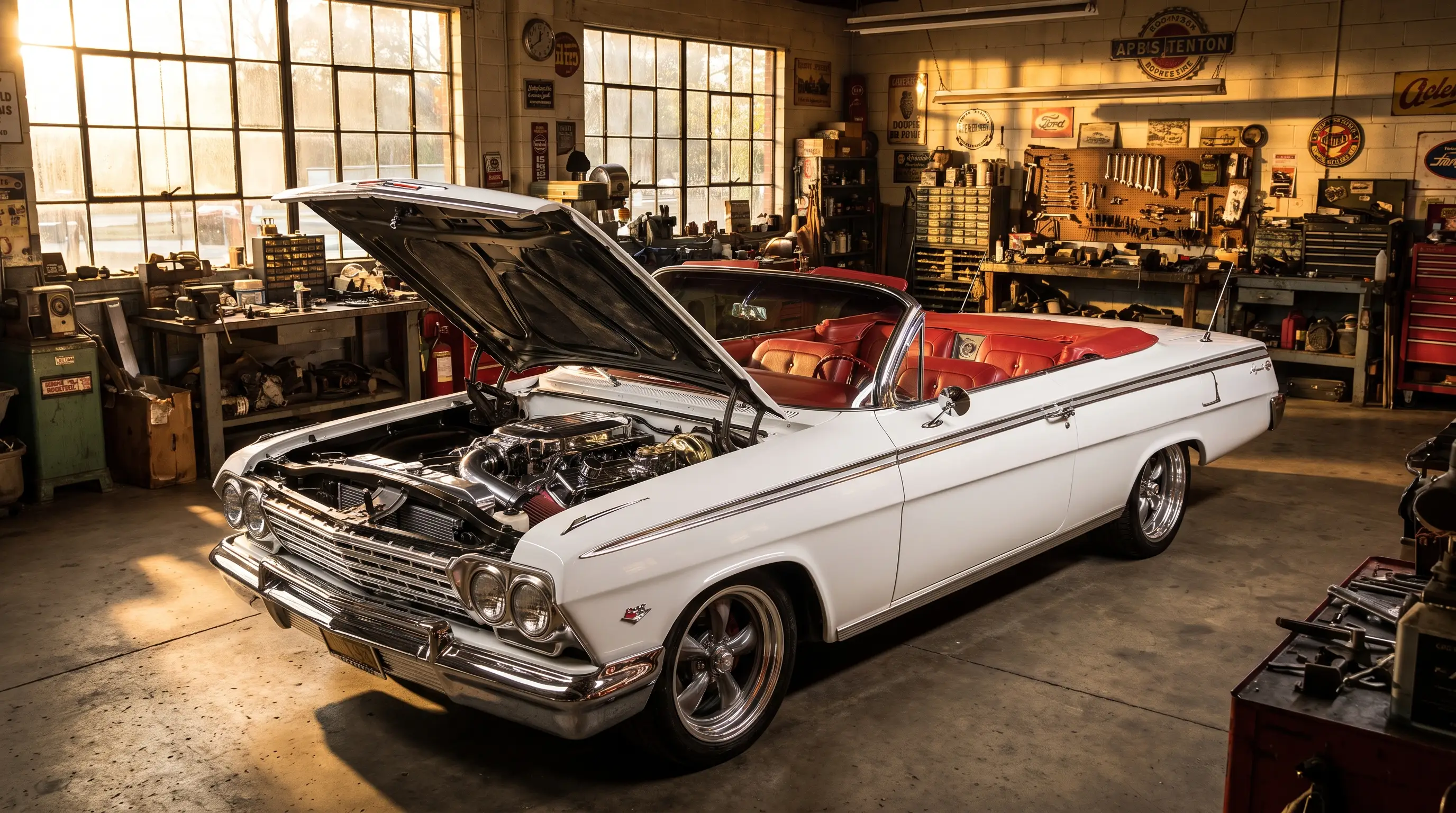
Ask a Chevrolet person to explain the difference between the 409 and the 427, and you will usually get a history lesson whether you wanted one or not. The 409 vs 427 question is really a question about two separate engine families, one built in the W-block era and one built after Chevrolet moved on to the Mark IV design, and the Impala carried both at different points in the 1960s.
The W-block line ends with the 409
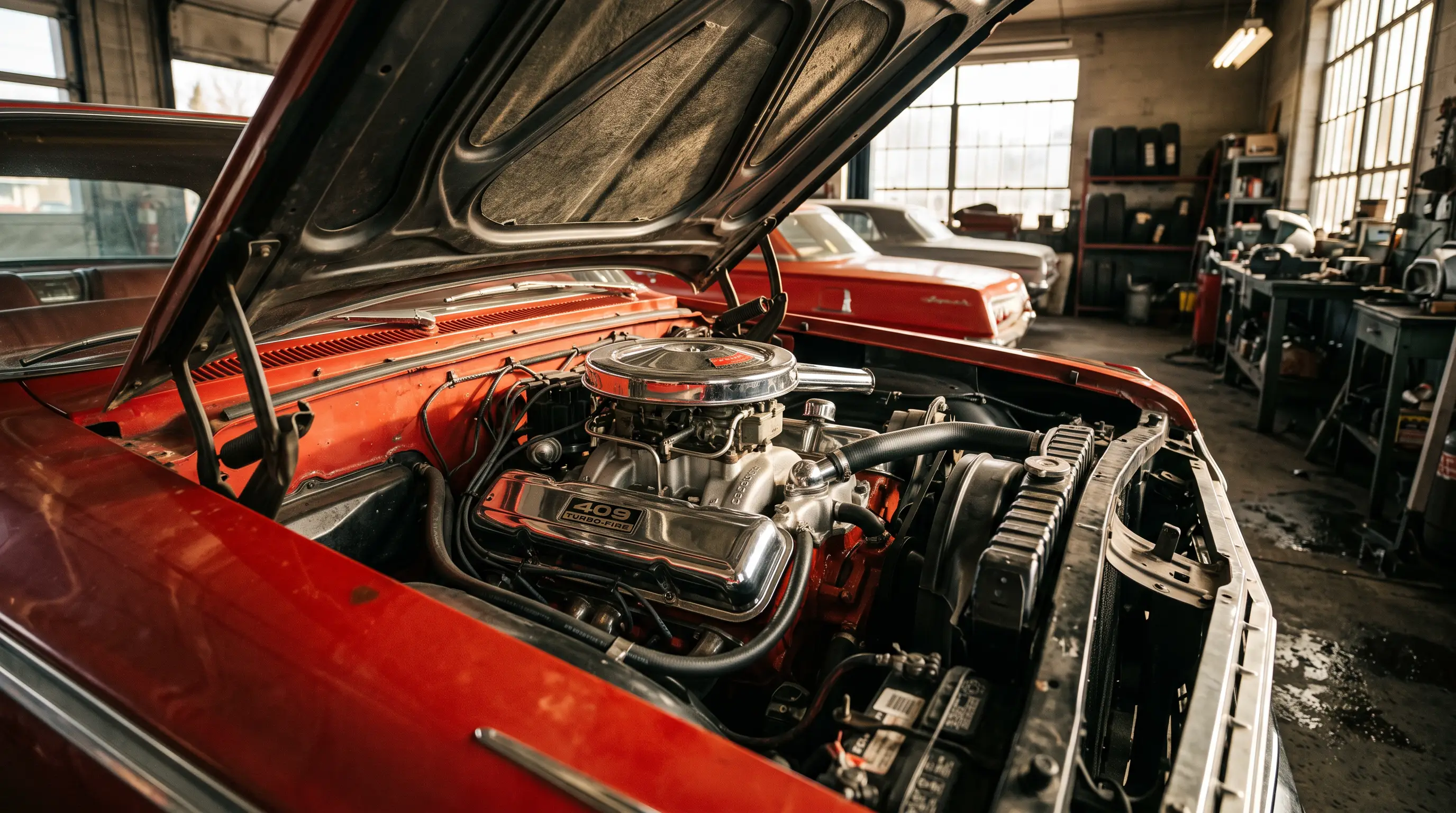
The 409 is the last big development of Chevrolet's W-series big-block, the family that started life as the 348 in 1958. Chevrolet bored and stroked the W-block to reach 409 cubic inches for 1961, then refined it through 1965. It is a distinctive-looking engine, with valve covers and an intake geometry that give it a scalloped, almost industrial appearance compared to what came after it. By the time the 409 reached the end of its run, Chevrolet had already started developing its replacement.
The Mark IV arrives and changes the conversation
The 427 that matters most to Impala history is not a W-block at all. It is a Mark IV big-block, the same family that gave Chevrolet the 396 and later the 454. The Mark IV Impala engines, badged as the Turbo-Jet line, arrived starting with the 396 in 1965, rated at 325 hp or 425 hp depending on tune. The 427 version followed for the Impala SS beginning in 1966, offered at 390 hp or 425 hp through the late 1960s, with later SS 427 cars rated as low as 385 hp to 400 hp as emissions tuning crept in toward 1969. This is a completely different engine architecture from the 409, sharing a name convention with earlier big Chevys but nothing under the valve covers.
Confusing the two is an easy mistake, and it is the single most common error in casual Impala conversation. The W-409 and the Mark IV 427 are not the same engine wearing two names. They are two separate engineering programs that happened to power the same nameplate a few years apart.
The engineering reasons behind the switch matter more than most casual conversations give them credit for. The W-block's unusual combustion chamber and valve cover geometry, the very thing that gave it that scalloped look, also limited how far Chevrolet's engineers could push airflow and cooling as displacement climbed. The Mark IV was designed from the outset with room to grow, which is exactly why it eventually stretched from 396 cubic inches all the way to 454 without needing a wholesale redesign. The 409 never had that kind of runway left in it.
How to tell them apart under the hood
Visually, the two families are not hard to separate once you know what to look for. The W-block's valve covers sit at a pronounced angle, following the block's distinctive scalloped deck, and the whole engine looks narrower and taller than a Mark IV of similar displacement. The Mark IV, including any Impala 427, sits lower and wider, with valve covers that run in a more conventional straight line and a bellhousing pattern that will not accept W-block accessories. Anyone shopping a car described simply as having a "big-block 427" needs to ask which family it actually is, since the number alone does not tell you.
Why the distinction actually matters to a buyer
| Point of comparison | 409 (W-block) | 427 (Mark IV) |
|---|---|---|
| Engine family | W-series, descended from 348 | Mark IV, descended from 396 |
| Peak Impala years | 1961 to 1965 | 1966 to 1969 (396 available from 1965) |
| Reputation basis | Beach Boys song, early big-block drag racing | NASCAR and street muscle, broader factory output |
| Parts interchange | W-block specific, not shared with later big-blocks | Shares architecture with 396 and 454 |
If you are buying, selling, or just trying to understand what sits under the hood of an Impala at a show, knowing which family you are looking at changes what parts fit, what the car is actually worth, and what story it tells. A 409 has a scarcity built on a short production window. A 427 Mark IV Impala has a different scarcity built on how the car was optioned and how many survived intact rather than raced hard and used up.
"They are not cousins. The 409 and the Mark IV 427 are from two different families that happened to marry into the same car."
- Emily Chen
Where each engine actually shines
The 409 built its legend on a short, loud window of cultural relevance. It was the engine of a hit song and of early-1960s drag strips, and its reputation outran its actual production numbers by a wide margin. The Mark IV 427, by contrast, built its reputation across a longer stretch of the decade, in more body styles, and with a broader footprint in both racing and street use. Neither is objectively better. They solved different problems in different years for a company that was still figuring out how big a production big-block could realistically get.
Think of it this way. The 409 is a specific moment frozen in amber, tied to a particular year and a particular song. The 427 Mark IV is a longer-running story, one that stretches from mid-decade muscle cars through the following generation of full-size performance Chevrolets. Buyers drawn to a single, sharply defined legend tend to gravitate toward the 409. Buyers who want a broader menu of body styles, model years, and states of tune tend to end up shopping the Mark IV family instead, whether that means a 427 or eventually a 454. Neither choice is a wrong one, it just depends on which kind of story you want parked in your own garage.
For the full account of how the W-block reached 409 cubic inches in the first place, the full story covers the engineering path that led there.
What this means for today's market
Both engines have their own collector followings, and neither audience much wants to be told the other engine is the "real" one. What matters more practically is documentation. A 409 or a 427 Mark IV that can be tied to its original build sheet, casting numbers, and factory paperwork will always outsell a car with a great story and no proof. If you are shopping either engine, get comfortable reading casting codes before you get comfortable writing a check.
Parts availability is another practical difference worth weighing. The Mark IV family stayed in production long enough, and in enough variations, that reproduction and even some remaining original parts are easier to source for a 427 than for a 409. Anyone planning to actually drive one of these cars regularly, rather than trailer it to shows, should factor that into which engine family they are more comfortable owning long term.
To see what is actually available right now, you can browse classic Impala listings and compare how sellers are describing engine provenance across both eras.
Sources and notes
- Wikipedia: Chevrolet big-block engine
- Automobile Catalog: 1969 Chevrolet Impala SS-427 Sport Coupe specs
- Automobile Catalog: 1968 Chevrolet Impala SS-427 425-hp specs
- Mac's Motor City Garage: Inside the '63 Chevy 427 Mystery Engine (Z11)
- autoevolution: The Story of the 1963 Chevrolet Impala Z11
- Classic Industries: 1965-1969 Chevy Impala Specs & Body Styles