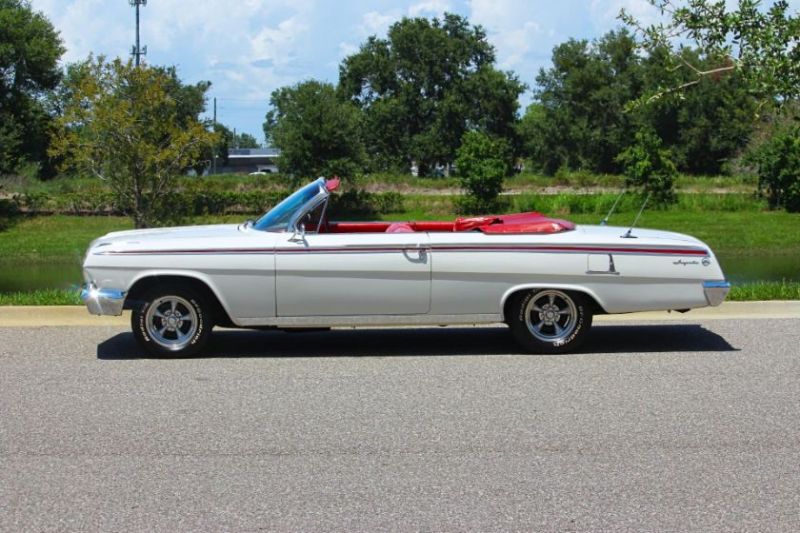
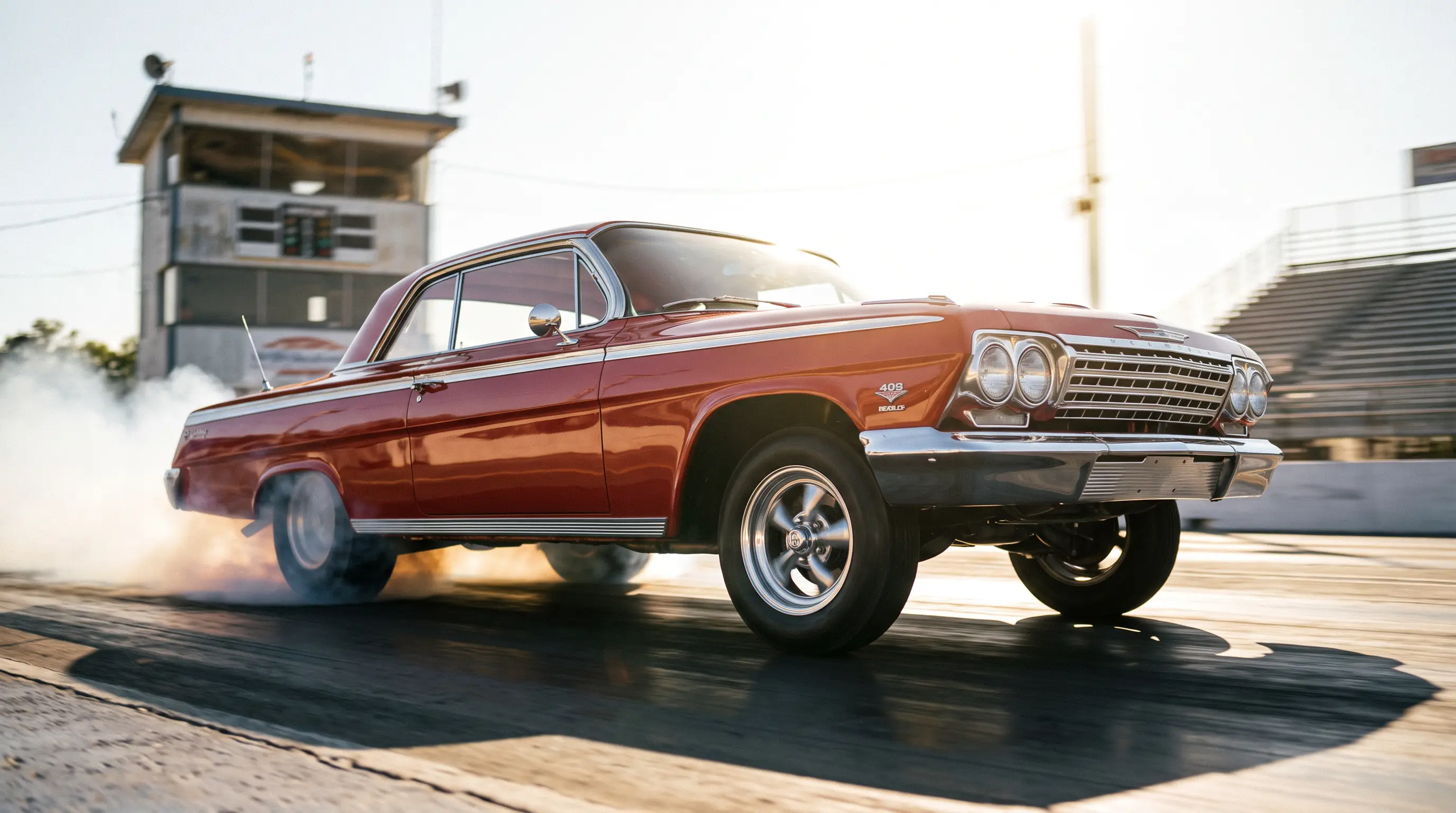
409 drag racing is where the engine earned its reputation before the Beach Boys ever put it in a song. Chevrolet's big-bore W-block found its natural home at the strip in the early 1960s, and the results there did more to build the 409's legend than any factory brochure could have managed on its own.
A factory engine with a factory racing program behind it
Chevrolet was not shy about supporting drag racing in the early 1960s, at least until corporate policy shifted later in the decade. The 409, offered with dual four-barrel carburetion and a solid-lifter cam, was built with enough headroom to respond to the kind of tuning independent racers and dealer-backed teams were doing at strips across the country. Full-size Chevrolets were not the lightest cars on the grid, but a well-sorted 409 Impala or Bel Air could hang with purpose-built machinery, and that made the engine a fixture in NHRA's Super Stock ranks through 1961 and 1962, with 1962 standing as the class's high-water mark since that year's rules required all-factory components rather than over-the-counter parts.
The rivals it had to beat
Ford's 406 and 427 FE-series engines and Mopar's Max Wedge 413 and 426 were the 409's regular company at the strip in this era, and the rivalry between the three manufacturers played out on Sunday afternoons at strips across the country long before it played out in dealer showrooms. Each brand had its own approach to the same basic problem, cramming as much displacement and airflow as possible into a car heavy enough to still be street legal. The 409 held its own in that company, which is a bigger compliment than it sounds given how seriously Ford and Chrysler were investing in factory drag racing support at the time. Names like Dave Strickler, Hayden Proffitt, and "Dyno Don" Nicholson made the 409 a regular winner through 1961 and 1962, including Nicholson's Stock Eliminator win at the 1961 NHRA Winternationals and Strickler's Super/Stock win over Proffitt at the 1962 season's contested events, with quarter-mile times in the 12-second range at speeds approaching 120 mph.
What made the 409 competitive
- Large displacement for the era, giving real torque off the line without exotic tuning.
- Dual-quad induction that responded well to further carburetor and cam work.
- A stronger bottom end than the 348 it descended from, able to handle sustained high-rpm abuse.
Racers leaned on all three. A 409 out of the box was quick. A 409 built specifically for the strip, with the induction and valvetrain dialed in past factory spec, was a genuine contender against engines that on paper looked far more purpose-built.
The gap between street cred and strip results
| Context | What the 409 offered |
|---|---|
| Street driving | Strong low-end torque, real-world usability, cruise-night presence |
| Stock-class drag racing | Competitive times against full-size rivals from Ford and Mopar |
| Modified/tuned drag racing | Serious headroom for cam, carb, and compression changes |
The engine's street reputation and its strip reputation reinforced each other. A car that could run respectable quarter-mile times on a Saturday night and still be driven to work on Monday was exactly the sales pitch Chevrolet wanted, even if the marketing department never had to say it directly. The song did that work for them.
Why this history still shapes the collector market
A 409 with documented drag racing history, whether it ran at a sanctioned strip in period or was simply built and driven hard by an owner chasing quarter-mile times, occupies a different place in the market than a car that spent its life garaged and unraced. Some buyers want the raced history, since it connects the car directly to the culture that made the 409 famous. Others want the untouched, low-mile survivor precisely because raced cars tend to have been modified, repaired, and rebuilt in ways that complicate originality claims. Neither preference is wrong. They are just different collecting philosophies chasing the same engine.
Photographs and period timing slips carry real weight for a car with claimed drag history. A grainy black-and-white photo of a specific car at a specific strip, matched to a chassis number or a distinctive trim detail, does more to establish a car's period racing pedigree than any verbal account passed down through a family. Serious buyers of raced 409s should ask for exactly this kind of documentation rather than accepting a general claim that "this car used to race."
Readers who want the fuller account of how the 409 built its reputation beyond the strip, including its cultural moment, should look at the whole picture for the complete story.
"A stock 409 was quick enough to embarrass people who should have known better. A built one was a different animal entirely."
- Dan Reeves
The bodies that carried the engine
Not every 409 racer was a two-door hardtop with an SS badge. Plenty of period drag cars started life as plain-Jane Bel Airs or even base-model Biscaynes, stripped of trim and sound deadening and fitted with a 409 pulled from a wrecked donor car. That practicality is part of what made the 409 an accessible racing engine rather than an exotic one confined to top-trim show cars. A racer with a modest budget could build a genuinely quick car around a 409 without needing the most expensive body style on the lot, and that democratic streak is part of why the engine's reputation spread so widely through grassroots racing rather than staying confined to factory-sponsored teams.
What survives from that era
Genuine period drag cars are scarce today for the same reason most raced machinery is scarce. They were used up. Engines got rebuilt past any meaningful original specification, bodies got dented and patched, and many cars eventually got parted out once a faster combination came along. What survives tends to fall into two camps, cars carefully preserved by an owner who recognized their significance early, or cars that simply got parked and forgotten rather than deliberately protected. Both types show up at auction today, and both can carry real value if the history is documented, but they tell very different stories about how the car spent its life. A buyer deciding between the two should be honest about which story they actually want to own, since the two paths lead to very different ownership experiences down the road.
The bottom line on the 409's strip legacy
409 drag racing history is not a footnote to the engine's story, it is a big part of why the engine has a story worth telling at all. The horsepower figures and the hit song get the headlines, but the strip results are what convinced serious buyers in period that the 409 was more than a marketing gimmick. That reputation still carries weight with today's collectors.
If that history has you looking to own a piece of it, you can shop classic Impala listings and compare what is currently on the market, race history and all.