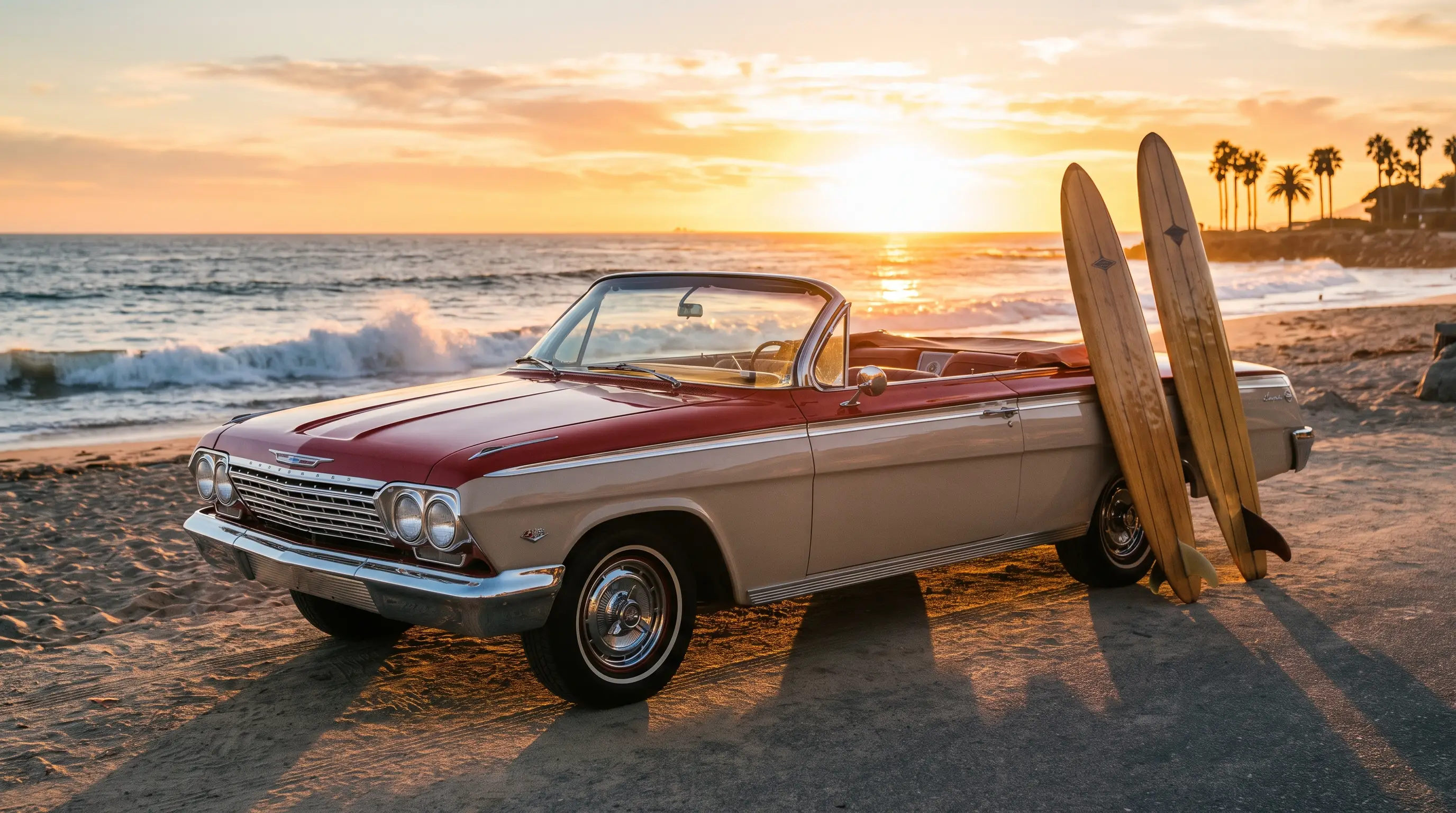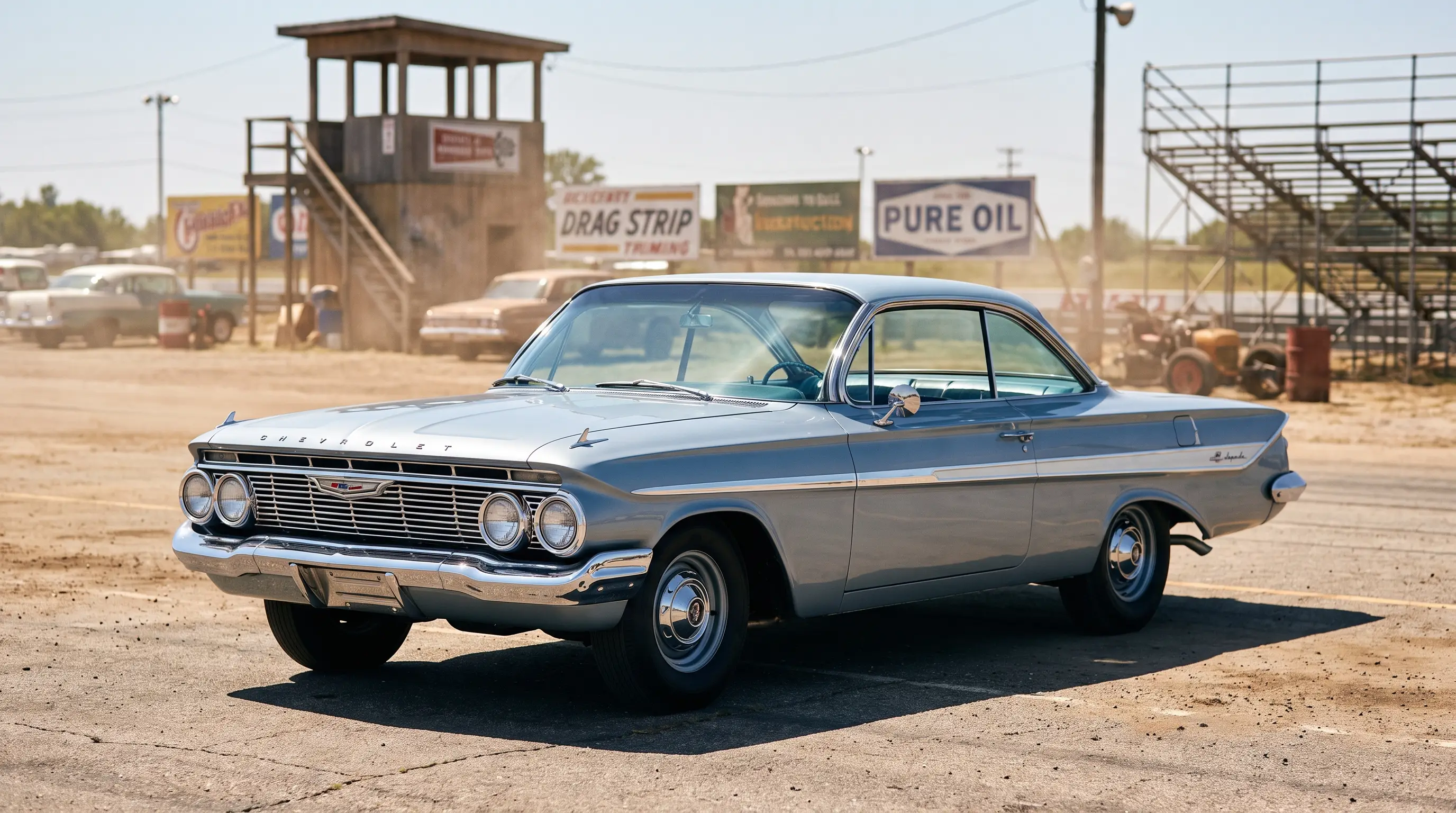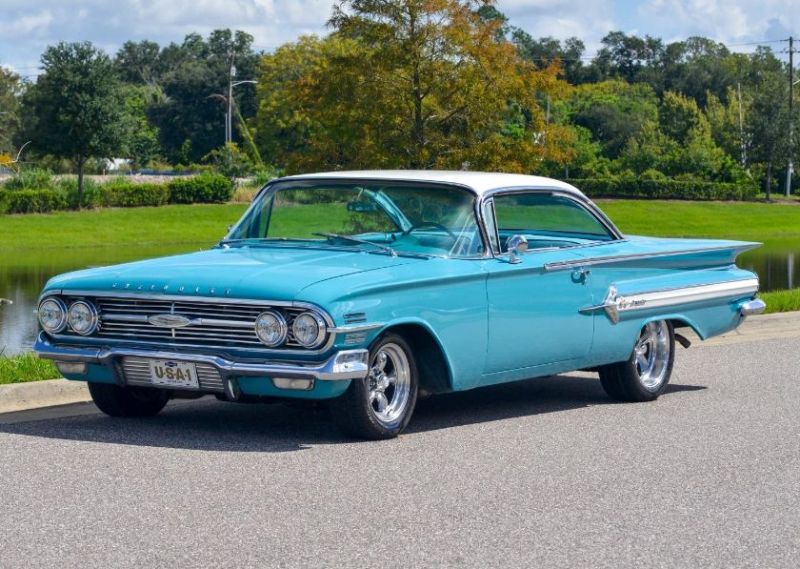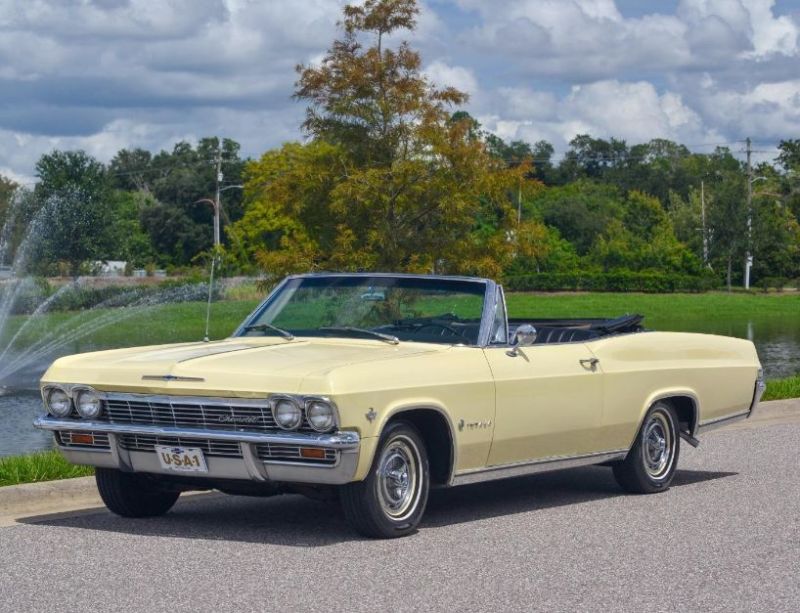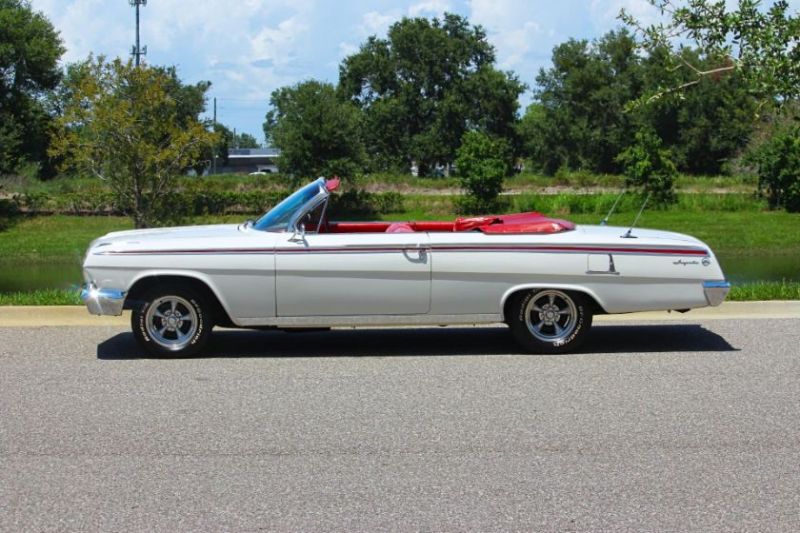
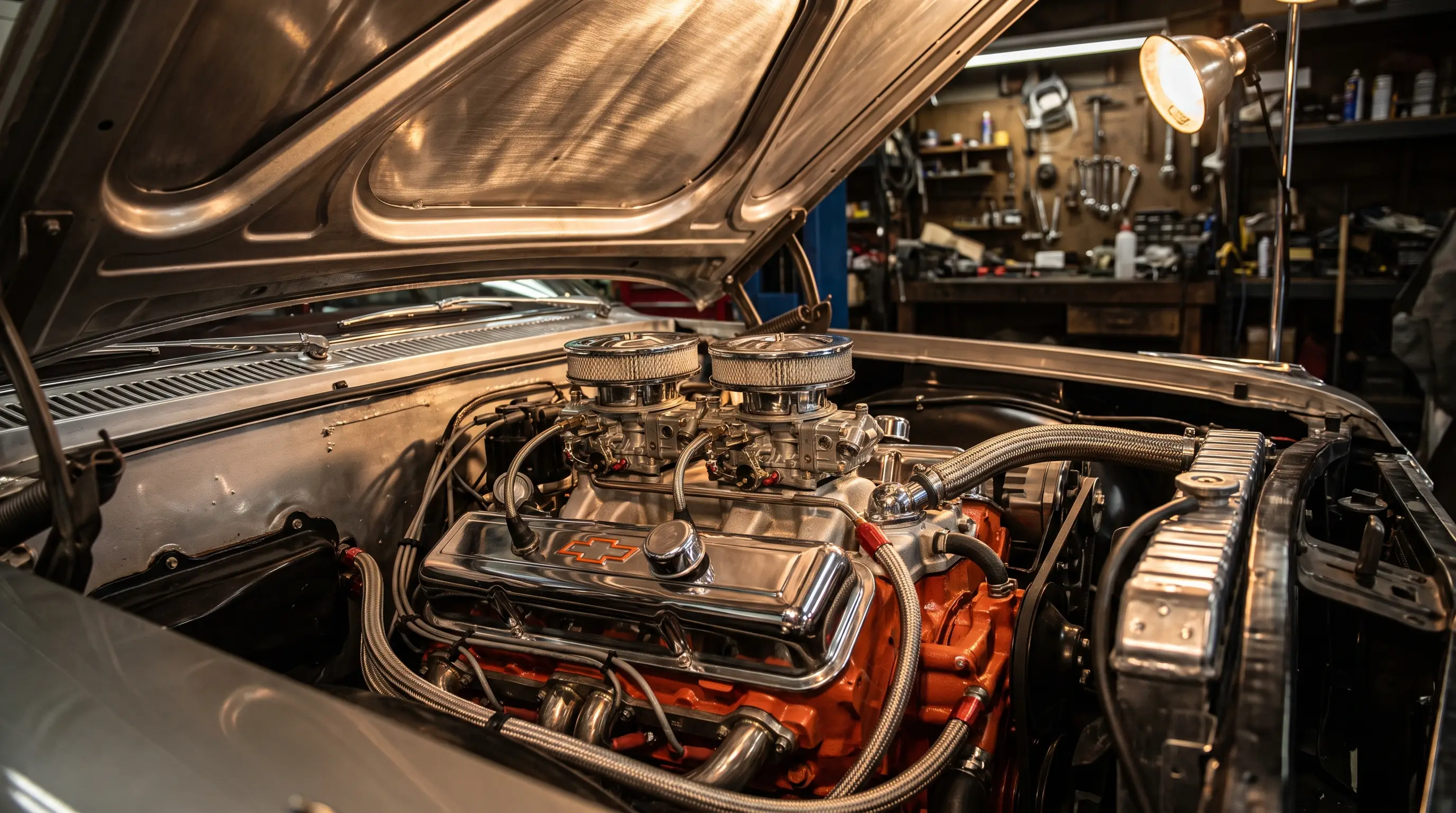
The dual quad 409 is the version serious collectors chase, and the reason is simple once you understand what dual quad actually means. Two four barrel carburetors instead of one, more air and fuel available at the top of the rev range, and a factory rated output that put this specific configuration at the top of the 409 lineup. Everything else about the 409 story runs through this configuration eventually.
| Aspect | Single four barrel 409 | Dual quad 409 |
|---|---|---|
| Carburetion | One four barrel carburetor | Two four barrel carburetors, progressive linkage |
| Street manners | Consistent across the rev range | Mild at low speed, aggressive under hard throttle |
| Verification needs | Standard casting and build sheet checks | Casting numbers plus intake and linkage documentation |
| Market premium | Baseline for a documented 409 | Meaningful premium over single carburetor cars |
What dual quad actually changes
A single four barrel 409 is a strong engine on its own. Adding a second four barrel carburetor changes the breathing characteristics enough to move the output figures noticeably higher, and Chevrolet marketed the dual quad option specifically to buyers who wanted the strongest street legal version of the engine available. The dual quad setup was rated at 409 horsepower for 1962 and climbed to a factory rated 425 horsepower for 1963 and 1964, well above the single four barrel version's output in each of those years. The result was an engine that held its own at the strip against anything else in its class from the era, and did it with a factory warranty behind it rather than aftermarket parts bolted on after the sale.
The two carburetors did not work identically across the rev range. Progressive linkage meant the second carburetor came into play under harder acceleration, giving the engine reasonable manners at low speed and real bite once the driver got into it. That is a detail people miss when they picture dual quad setups as simply doubling everything. The engineering was more considered than that, built to be drivable on a Tuesday and dangerous on a Saturday night at the strip.
How the option was ordered
Buyers who wanted the dual quad configuration had to check a specific box on the order form, and dealers who understood the performance market knew to steer serious buyers toward it. This was not a setup a customer stumbled into by accident. It required knowing the option existed and being willing to pay the added cost over the standard single carburetor 409. That deliberate ordering process is part of why documentation on genuine cars tends to be more traceable than people assume, provided the original paperwork survived along with the car.
Numbers, not nostalgia
I will keep this section blunt because that is the whole point of my job. The dual quad 409 earns its reputation on documented output, not on vague reputation alone. Compare it honestly against its rivals from the same era and it holds up. That is rarer than people assume in this hobby, where plenty of legendary configurations get more credit from repetition than from actual dyno numbers. The dual quad 409 does not need the benefit of the doubt. The figures back the reputation.
That said, buyers should not assume every 409 badged car with two carburetors on top is a genuine factory dual quad. Aftermarket dual quad intake setups exist, some installed decades ago and aged into the car's history well enough to look original at a glance. Verifying casting numbers and factory documentation is not optional if a seller is asking dual quad premium pricing.
"Two carburetors on top of an engine proves nothing by itself. The block casting number and the factory paperwork prove whether it is real."
- Dan Reeves
| Configuration | Carburetion | Market position |
|---|---|---|
| Standard 409 | Single four barrel | Strong, common baseline for the engine family |
| Dual quad 409 | Two four barrel carburetors, progressive linkage | Top of the 409 lineup, real documented premium |
Living with the setup
Owners who actually drive a dual quad car regularly describe a similar experience. Around town, the engine behaves close to a well tuned single carburetor setup, because the progressive linkage keeps the second carburetor mostly out of the picture until the driver asks for real acceleration. Get into the throttle hard and the second carburetor opens, and the character of the car changes noticeably. That duality is part of why the configuration earned its reputation honestly rather than through advertising alone. It rewarded drivers who understood how to use it and stayed civil for drivers who did not.
Maintenance on a genuine dual quad setup takes more attention than a single carburetor engine, simply because there are twice as many adjustment points and a linkage system that needs to stay synchronized to work as designed. A neglected dual quad setup can run poorly in ways that make the car feel worse than a properly tuned single carburetor 409, which is part of why documented service history matters almost as much as build documentation when evaluating one of these cars for purchase.
What it means at purchase time
A genuine, documented dual quad 409 commands a real premium over its single carburetor sibling, and that premium is earned rather than inflated hype. Buyers should expect to pay for the configuration, expect to verify it carefully before paying, and expect the resale value to hold up well if the documentation is solid. This is one of the few corners of the classic muscle car market where the premium tracks closely with genuine, provable performance rather than pure story value.
- Cross check carburetor setup against block casting numbers and factory build records
- Understand the progressive linkage design before assuming a simple doubling of output
- Expect a real, earned price premium over single carburetor 409 examples
For the broader history of how this engine developed inside the Impala lineup, read the background before you go shopping specifically for a dual quad example. If you want to trace the engine back to where it started, the story of its debut is worth a look too. And when you are ready to compare what is actually on the market, you can shop classic Impala listings to see current asking prices for documented dual quad cars.
The dual quad 409 is one of the rare cases in this hobby where the legend and the spec sheet actually agree with each other. That alone makes it worth the extra homework before you buy.
I have gone over enough of these engines to know where sellers cut corners, and the most common shortcut is a correct looking dual quad manifold bolted onto an engine that never left the factory configured that way. It looks right in a photo. It does not check out against the casting numbers, and it does not carry the documentation a genuine example should have. A buyer who skips that verification step is not necessarily buying a bad engine, but they are almost certainly overpaying for a configuration the car does not actually have, and that gap between what was paid and what was actually delivered is money that does not come back at resale.