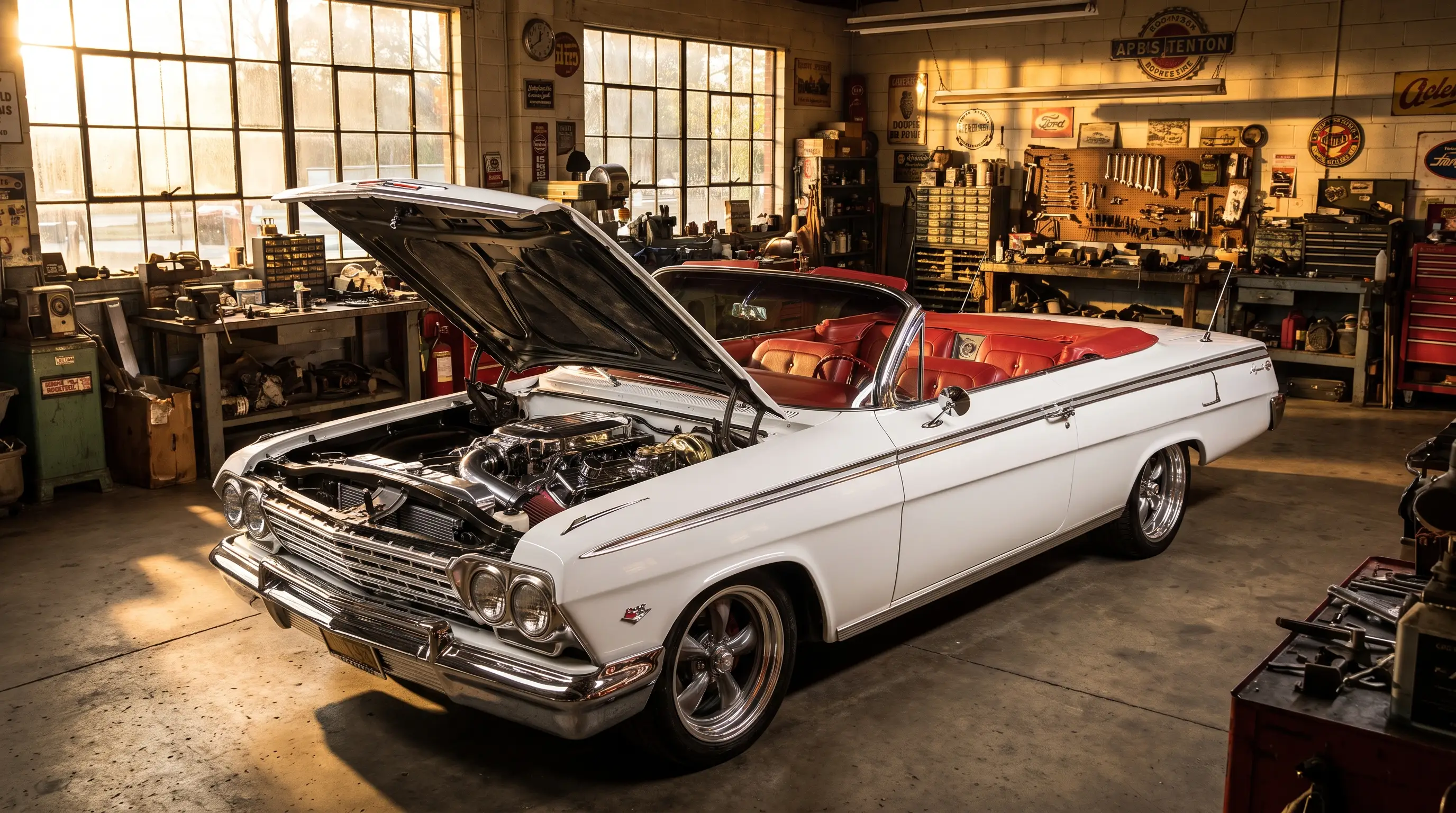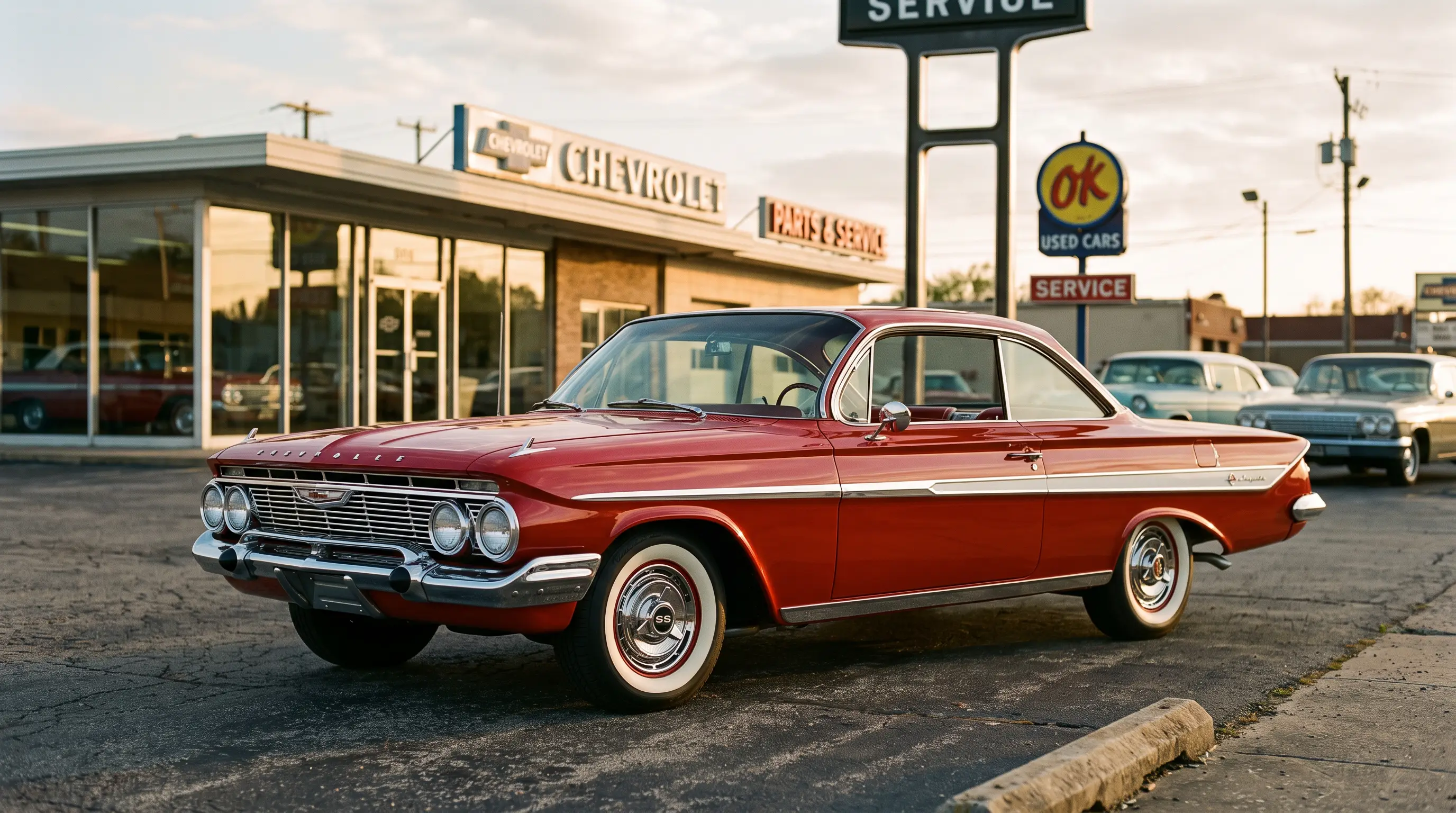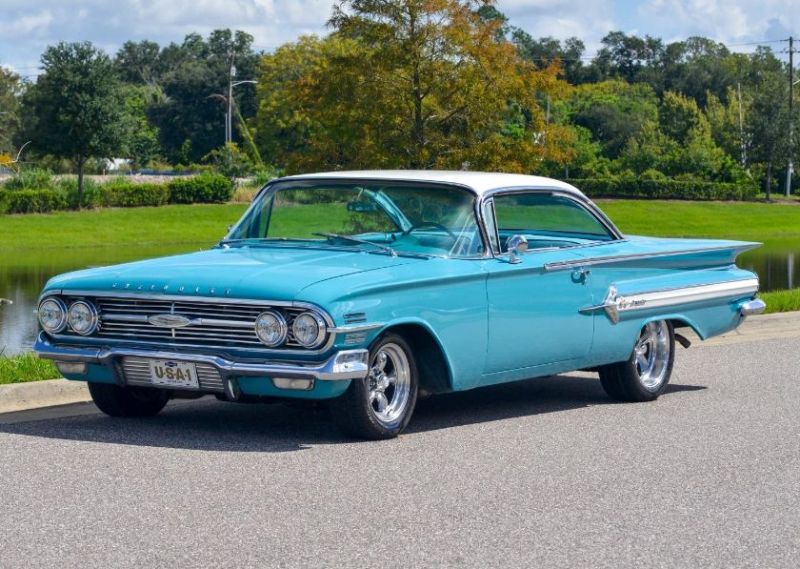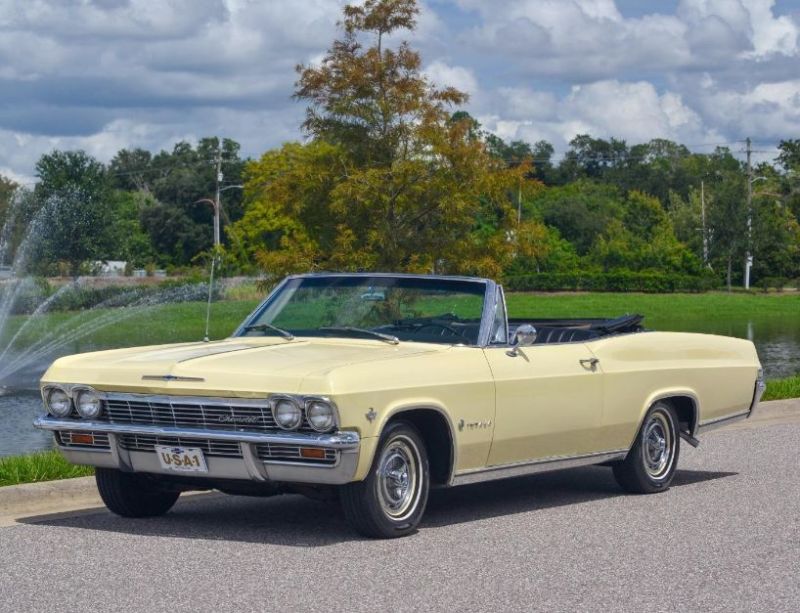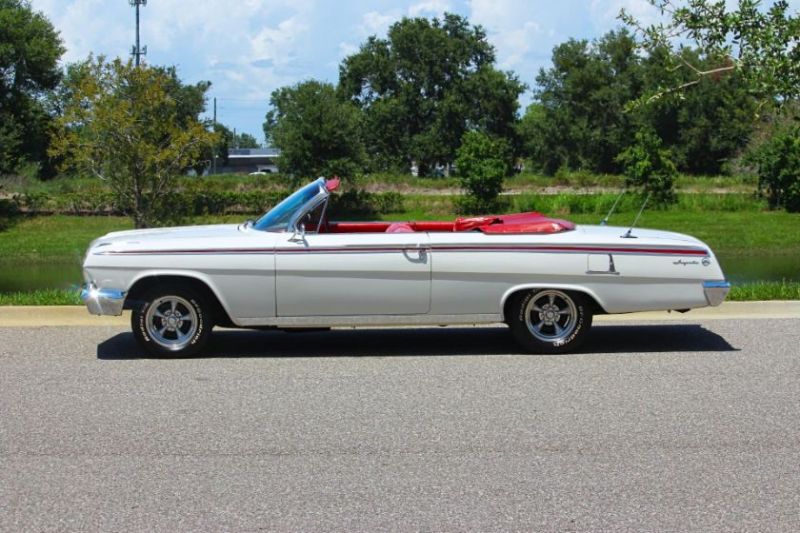
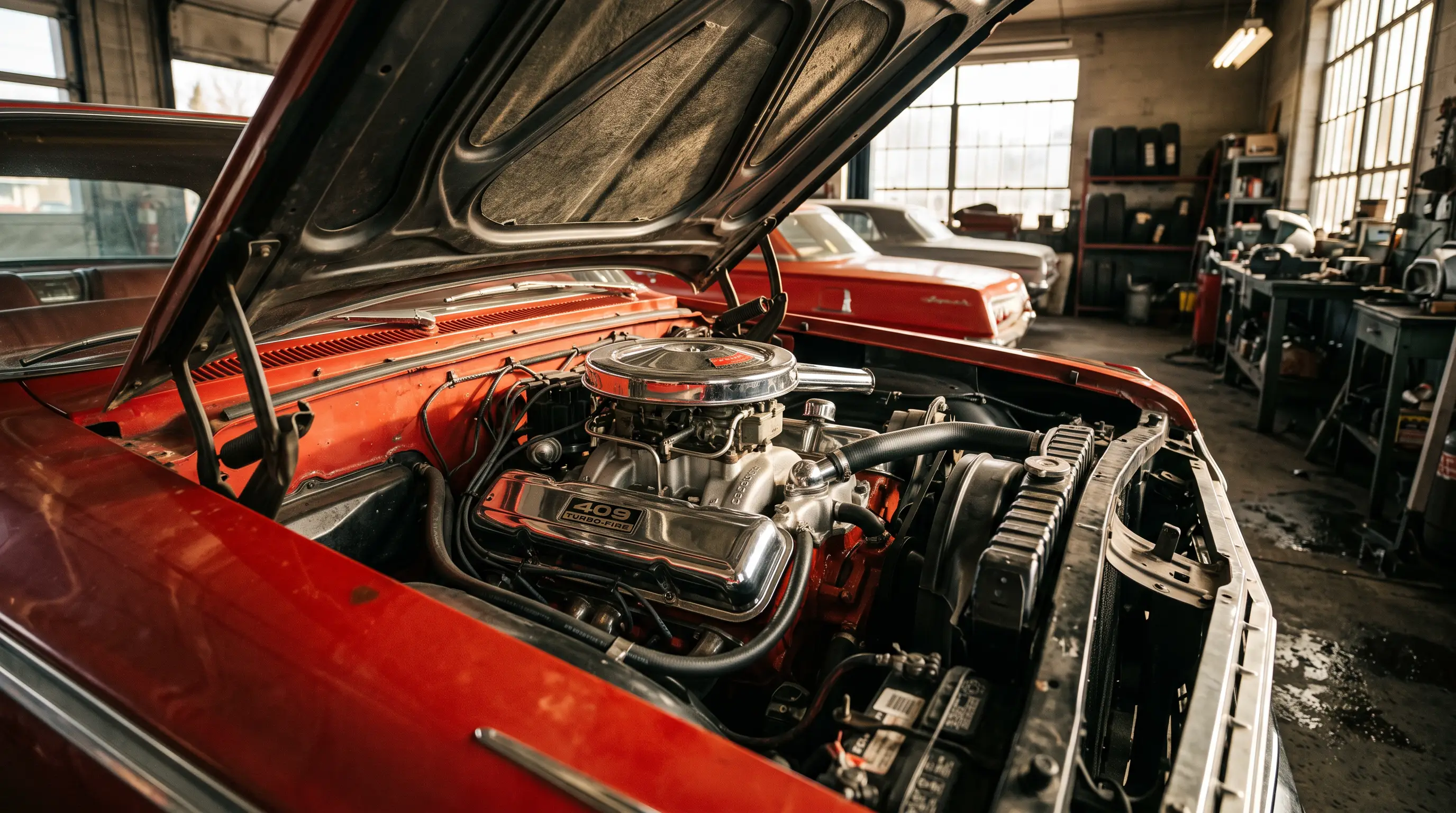
The road from 348 to 409 W series engines is really the story of Chevrolet learning how far one engine block could be pushed before it needed to be replaced entirely. Chevrolet's W-block, the company's first big-block V8, started as a 348 in 1958 and finished its run as the 409, the engine that ended up backing a hit song and a decade of drag strip bragging rights.
1958: the 348 arrives
Chevrolet introduced the 348 cubic inch W-block in 1958, its first true big-block, built to answer Ford and Chrysler's larger displacement engines and to give the full-size Chevrolet, including the brand-new Impala trim, a genuine performance option. The 348 got its "W" nickname from the shape of its valve covers when viewed from the front, a distinctive scalloped design that set it apart visually from every small-block Chevy on the lot. In its strongest early form, the 348 with triple two-barrel carburetion, badged Tri-Power, was the performance flagship of the lineup.
The 348 was not designed as a pure performance engine first. Chevrolet needed it primarily for trucks and for full-size passenger cars that were getting heavier every year, and the W-block's low-end torque suited that job well. The performance version came about because Chevrolet's engineers and its dealers both understood that a heavier, more powerful Impala needed an engine with real muscle behind it, not just bigger numbers on a spec sheet. The 348 gave them both.
1959 and 1960: quiet refinement
Between the 348's debut and the 409's arrival, Chevrolet spent 1959 and 1960 refining the W-block rather than reinventing it. Compression ratios crept up, cylinder heads were revised, and the Tri-Power option continued to anchor the top of the performance lineup. These were not headline years for the W-block, but they mattered. Chevrolet's engineers were learning exactly how far the basic architecture could be pushed before something had to give, knowledge that fed directly into the decision to bore and stroke the block out to 409 cubic inches.
Growing the block: 1961 and the first 409
By 1961 Chevrolet had bored and stroked the W-block to 409 cubic inches, offering it in limited numbers that year. Early 409s made 360 horsepower at 5,800 rpm with a single Carter AFB four-barrel, a strong number for the era but not yet the figure that would make the engine famous. Chevrolet built only 142 of the RPO 580 409s for 1961, a genuine specialty order for buyers who already followed the division's racing program closely.
1962: the number matches the song
For 1962, Chevrolet offered a dual four-barrel 409 rated at 409 horsepower at 6,500 rpm, a marketing coincidence too perfect to ignore, and the Beach Boys released "409" that June as the B-side of "Surfin' Safari." This is the version most people picture when they hear "409," even though it represents just one specific configuration in a broader engine family that spanned several years and states of tune.
| Year | Displacement | Notable configuration |
|---|---|---|
| 1958 | 348 cubic inches | Tri-Power triple two-barrel option |
| 1961 | 409 cubic inches | First 409, single 4-barrel, limited availability |
| 1962 | 409 cubic inches | Dual 4-barrel rated 409 hp |
| 1963 to 1965 | 409 cubic inches | Three tunes offered at 340, 400, and 425 hp through 1964; 1965 dropped to 340 and 400 hp before the Mark IV took over |
Why Chevrolet eventually moved on
The W-block, for all its early success, had real limits. Its unusual valve cover geometry and combustion chamber design made it harder to develop further than a more conventional layout would have been, and by the mid-1960s Chevrolet was already replacing it with the Mark IV big-block family, which debuted as the 396 in 1965 and eventually grew into the 427 and 454. The 409's final Impala model years overlapped with the Mark IV's arrival, which is part of why casual fans still mix up the two families. They are not the same engine wearing a bigger number. The W-block ended with the 409, and everything that came after used a different design entirely.
There is a lesson in that transition worth sitting with. Chevrolet did not wait until the W-block was a dead end to start planning its replacement. The Mark IV was already in development while the 409 was still winning at the drag strip and topping the charts on the radio. That kind of forward planning is easy to overlook when you are focused on one engine's story, but it explains why the changeover happened as smoothly as it did rather than leaving a gap in Chevrolet's big-block lineup.
The full picture of how that 409 legend actually played out, on the street and in the culture around it, is in our 409 impala retrospective.
"Chevrolet squeezed everything it could out of the W-block before walking away from it. The 409 was the last word, not a first draft."
- Dan Reeves
What this means for collectors today
Knowing where an engine sits in this timeline matters when you are looking at a real car. A 1958 348 Tri-Power, a 1961 single-quad 409, and a 1962 dual-quad 409 are three different points in the same development story, with different production numbers, different survival rates, and different values attached. Buyers who understand the family tree tend to spot inconsistencies in a seller's story faster than buyers who just know the word "409."
The 348 in particular gets overlooked by buyers chasing 409 headlines, and that oversight can be an opportunity. A documented Tri-Power 348 Impala from 1958 or 1959 represents the actual starting point of this whole engine family, at a price that usually sits well below what a comparable 409 commands. For a buyer who cares about the full arc of the story rather than just the most famous chapter, an early 348 car has a case to make that gets ignored far too often.
The 1963 through 1965 409s deserve similar attention. These later cars sometimes carried higher-output tunes than the famous 1962 dual-quad, yet they trade for less because they lack the direct cultural tie to the Beach Boys single. That gap between engineering merit and market price is exactly where a patient, well-informed buyer can find real value in this family of engines. It rewards research over impulse, and it rewards buyers who read casting numbers instead of relying on a seller's memory of what a car used to have under the hood.
For readers who want to see the production side of this story worked out in more depth, a related story covers how many of these cars actually left the factory.
If you are ready to shop rather than just read, there are Impalas for sale now spanning multiple years of the W-block era, from the earliest 348 Tri-Power cars through the final refined 409s.