Most people who love the Chevrolet El Camino do not immediately connect it to the Impala. They picture a coupe utility, a car in the front and a bed in the back, a product of Chevrolet chasing Ford's Ranchero into a market nobody was sure Americans actually wanted. But the 1959 el camino connection to the Impala is not a footnote. It is the whole reason the El Camino exists in the shape it does, and understanding that relationship changes how you look at both cars.
Answering Ford, using what was already on hand
Ford had introduced the Ranchero for 1957, built off the Fairlane platform, and it sold well enough that Chevrolet's product planners could not ignore it. Rather than engineer an entirely new body from scratch, Chevrolet did what any efficient manufacturer does when a competitor validates a niche. It reached for the platform already sitting in the pipeline, which for 1959 was the all new full-size Chevrolet body shared across the Biscayne, Bel Air, and Impala lines.
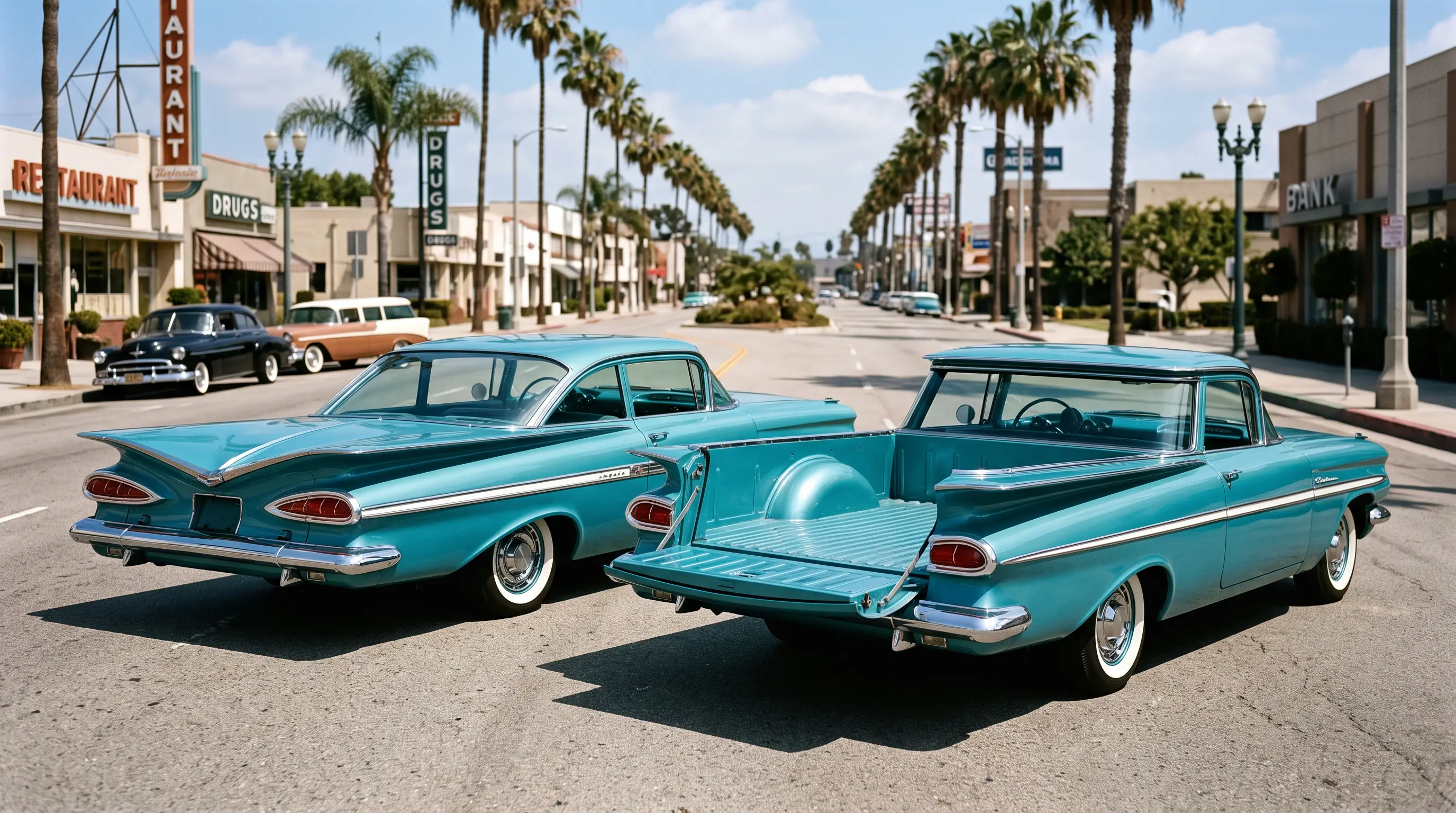
That decision put the El Camino on the same wheelbase, the same basic front sheet metal, and the same dramatic batwing rear styling cues as the passenger cars, including the top-line Impala. Look at a 1959 El Camino from the cowl forward and you are essentially looking at a 1959 Impala. The doors, the dashboard, the windshield, the front fenders, all of it comes from the same tooling that built the passenger sedans and hardtops that year.
Built on the wagon architecture
The more precise engineering answer is that the El Camino shared its structure most closely with the Chevrolet station wagon line rather than the sedan specifically, since both needed a reinforced rear frame section to handle cargo loads the standard sedan chassis was not built for. But the wagon itself was offered across Biscayne, Bel Air, and Impala trim, so the El Camino inherited the same underlying platform that any 1959 Impala wagon buyer would have driven away in, just with a bed welded on instead of a rear cabin.
This is why period literature sometimes describes the El Camino loosely as an "Impala-based" vehicle even though Chevrolet never sold a trim level formally called the Impala El Camino. The styling cues, the available engines, and even some of the interior trim options borrowed directly from the Impala parts bin, because sharing components across the full-size range was the whole point of the platform strategy for 1959.
Why the batwing styling mattered here more than anywhere else
The 1959 full-size Chevrolet's rear styling, with its wide horizontal fins and cat's eye taillights, is often discussed purely as passenger car design language. On the El Camino, that same rear treatment did something unusual. It turned a working vehicle into a styling statement, because the tailgate and rear fenders carried the same dramatic wing shape that made the Impala instantly recognizable. No other coupe utility on the market that year looked remotely like it, and that visual link to the flagship passenger car is a large part of why the 1959 El Camino still draws crossover interest from Impala collectors today, not just from truck enthusiasts.
Engineering the bed without breaking the platform
Turning a unibody-adjacent passenger platform into a cargo hauler was not a simple matter of removing a rear seat and welding on sheet metal. Chevrolet's engineers had to reinforce the frame section behind the cab to handle load stresses the standard sedan chassis was never designed for, borrowing solutions already proven on the wagon body style. That shared reinforcement is the real engineering thread connecting the El Camino to the rest of the 1959 full-size lineup, more so than any single cosmetic detail.
The result was a vehicle that could genuinely carry a payload while still riding, handling, and looking like the passenger cars it shared a showroom floor with. That duality, a real Impala-adjacent driving experience paired with genuine hauling capability, is exactly what made the concept appealing to buyers who wanted something more distinctive than a plain pickup truck but still needed to move cargo.
A short run, then a long gap
Chevrolet built the El Camino for only two model years on this generation, 1959 and 1960, before dropping it entirely and not bringing the nameplate back until 1964 on the smaller Chevelle platform. That short window is part of why these first-generation trucks carry outsized interest relative to their original sales volume. Chevrolet was still testing whether the coupe utility concept had real staying power in the American market, and the full-size platform experiment ended before the answer became clear one way or the other.
When the El Camino returned in 1964, it rode on the intermediate Chevelle platform rather than the full-size Impala-adjacent architecture, which means the 1959 to 1960 trucks remain the only El Caminos ever built with a direct structural and styling tie to the full-size Impala family. That distinction alone makes them a unique branch of the broader Impala story rather than a separate, unrelated product line.
"You cannot tell the story of the 1959 Impala honestly without mentioning the El Camino, because for two years Chevrolet was literally putting the same sheet metal on a truck bed and calling it something else. The connection is not folklore, it is on the build sheet."
- Sarah Whitfield
What this means for collectors today
For anyone assembling a collection built around the 1959 to 1960 Chevrolet full-size story, the El Camino fills a genuinely distinct niche. It is the version of that platform built for utility rather than image, yet it carries nearly all the same visual drama as the flagship Impala hardtop or convertible. Parts commonality with the passenger car line also means many mechanical components, trim pieces, and even some interior parts overlap directly with Impala sourcing, which is useful information for anyone restoring either vehicle.
Readers who want the complete picture of how the 1959 and 1960 model years fit together, styling decisions and all, should read our complete history covering both years in depth. And for anyone who has read this far and decided the platform itself, in whatever body style, deserves a place in their garage, it is worth taking a look at what is currently available. You can browse classic Impala listings to see how this generation's passenger cars are trading today, since pricing trends across the Impala line tend to track closely with interest in the rarer El Camino variant built from the same bones.
One platform, two very different reputations
The Impala became Chevrolet's flagship image car for the next several decades. The El Camino became a cult object, alternately mocked and celebrated, that eventually outlived the full-size platform that spawned it by riding out its later years on the Chevelle and then the Malibu. But both stories start in the same place, on the same 1959 assembly line, sharing the same dramatic styling department decisions. That is the real 1959 el camino connection, and it is a more direct one than most casual observers ever realize.