Factory records rarely get the credit they deserve for settling arguments, but they are the fastest way to understand the 1962 impala ss and why it matters more than casual history gives it credit for. This was the year the Super Sport stopped being a mid-year afterthought and became a properly cataloged Chevrolet option, ordered from day one of the model year rather than added partway through it.
The year the SS became a real order code
The 1961 SS had been introduced partway through the model year, a late addition that dealers had to learn to sell on the fly, with production numbers small enough that many buyers never even saw one in person. For 1962, Chevrolet corrected that. The SS package was available from the start of the model year, listed properly in dealer literature, and ordered as a defined option rather than a curiosity a salesman had to explain from memory. That single change, moving the SS from mid-year surprise to full-year catalog item, is why factory historians treat 1962 as the true beginning of the SS as an ongoing product rather than a one-off experiment.
Production reflected that shift immediately. Where 1961 SS numbers were counted in the low hundreds (approximately 453 units by factory count), 1962 jumped to 99,311 units, an enormous increase that shows just how much pent-up demand existed once Chevrolet made the SS package easy to order rather than something a buyer had to specifically ask a dealer about.
What the 1962 SS actually included
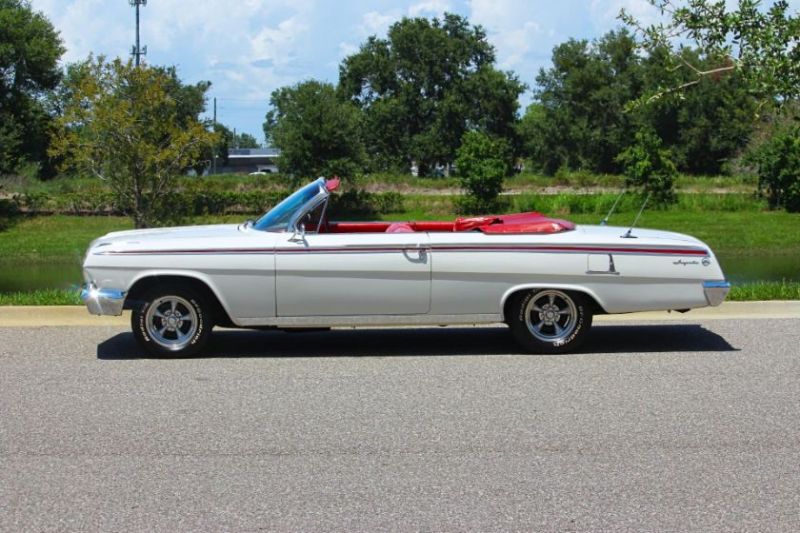
The package itself covered the same territory the SS would keep for years afterward: bucket seats, a center console, specific exterior trim and badging, and a chassis package that included stiffer springs and a larger front stabilizer bar to sharpen handling over a standard Impala. Engine choices ran from mild to genuinely quick, topping out with the 409 cubic inch V8, an engine that would go on to become closely associated with the early SS years and even get its own reputation in period car culture well beyond Chevrolet's own marketing.
What made the 1962 package notable from a factory-history standpoint is how deliberately it was assembled compared to the improvised 1961 version. Chevrolet's engineers had a full model year to plan the option properly, coordinating trim, chassis, and engine availability in a way the rushed 1961 introduction never allowed. The result was a more coherent product, and one that dealers could actually explain to a customer without stumbling through a list of exceptions.
Reading the factory paperwork correctly
One correction worth making here, because it gets repeated often enough to have become accepted as fact: the 1962 SS was not yet its own separate model designation the way the SS would eventually become later in the decade. It remained an option package on the Impala, meaning the build sheet and cowl tag reflect an Impala with an SS option code rather than a standalone SS model line. That distinction matters to anyone doing serious research on a specific car, because it changes exactly which codes and documents should be checked to confirm authenticity.
Getting details like that right is most of the job. A great deal of what circulates about early SS Impalas online gets these small structural facts wrong, treating every SS year as identical when the paperwork behind them changed meaningfully from one year to the next.
"People want a clean story where the SS just appeared fully formed. It didn't. 1962 is the year Chevrolet actually built the option properly for the first time, with the paperwork and planning to match, and that groundwork is why the SS survived long enough to become the model people remember today."
- Tom Ramirez
Where 1962 fits in the bigger production picture
Looking at the 1962 SS in isolation only tells part of the story. The real value in understanding this specific year comes from seeing how its production numbers compare to the years around it, since the SS's popularity swung significantly across the decade depending on styling changes, engine availability, and competition from Chevrolet's own smaller performance models later on. For a full breakdown of how those numbers moved year over year, a related story lays out the production figures across the entire SS run in detail.
For readers who want the complete arc of the badge itself, from its improvised 1961 debut through its later years as a fully independent model, our impala ss retrospective covers the whole timeline in one place.
What a 1962 SS is worth chasing today
Because 1962 marked the transition from rare experiment to established option, surviving cars from this year occupy a specific niche among collectors: rare enough to be interesting, common enough that a serious buyer can actually find one without years of searching. Engine and trim combinations vary widely, so verifying the cowl tag and engine codes against factory records remains the only reliable way to confirm what a specific car actually is before paying a premium for it. Buyers curious what is currently available across the full SS lineup, 1962 included, can look through Impalas for sale now to compare pricing and condition across the years that followed this one.
What the factory paper trail actually looks like
For anyone doing this kind of research directly, the useful documents are the cowl tag, the trim tag, and where available the original build sheet, none of which are glamorous and all of which take patience to decode correctly. The cowl tag encodes body style, trim level, and paint and interior color codes, while the engine block itself carries casting numbers and stamped codes that should match what the factory paperwork claims was installed. None of this is difficult once you know what you are looking at, but it does require slowing down rather than trusting a seller's description at face value.
This is where a surprising number of buyers get tripped up. A car can look completely correct, right badge, right seats, right color, and still have a mismatched engine or a mid-year replacement part that changes its actual authenticity. The paperwork is boring compared to the styling, but it is the only part of the car that cannot be faked convincingly without real effort, which is exactly why serious buyers learn to check it first and admire the trim second.
Regional Chevrolet clubs and marque registries have done a lot of the heavy lifting here over the decades, cross-referencing surviving build sheets and dealer records to build a clearer picture of exactly what left the factory in 1962. That kind of accumulated documentation is worth more than any single seller's word, and it is freely available to anyone willing to spend an afternoon with a registry archive before writing a check.
The 1962 SS does not get the attention that later, faster years receive, but from a factory records standpoint it is arguably the more important year. It is the point where Chevrolet decided the Super Sport was worth building properly rather than testing quietly, and everything that followed built on that decision.