
Picture a Friday night parking lot in the late 1980s. A Camaro sits under the sodium lights with its nose low to the asphalt, fog lamps set into the grille, a stripe running along the rocker and five letters on the door. The owner leans on the fender with his arms crossed. Everyone in the lot knows what the car is, and most of them have already decided something about the person who bought it. That split, admiration on one side and a smirk on the other, is the IROC-Z stereotype in a single frame. It is also the reason the car still matters.
Car Features
7 min read
How the IROC-Z Became an '80s Icon and a Punchline
The IROC-Z was the Camaro to have in the late 1980s, then the butt of mullet jokes. How one car carried both reputations at once.
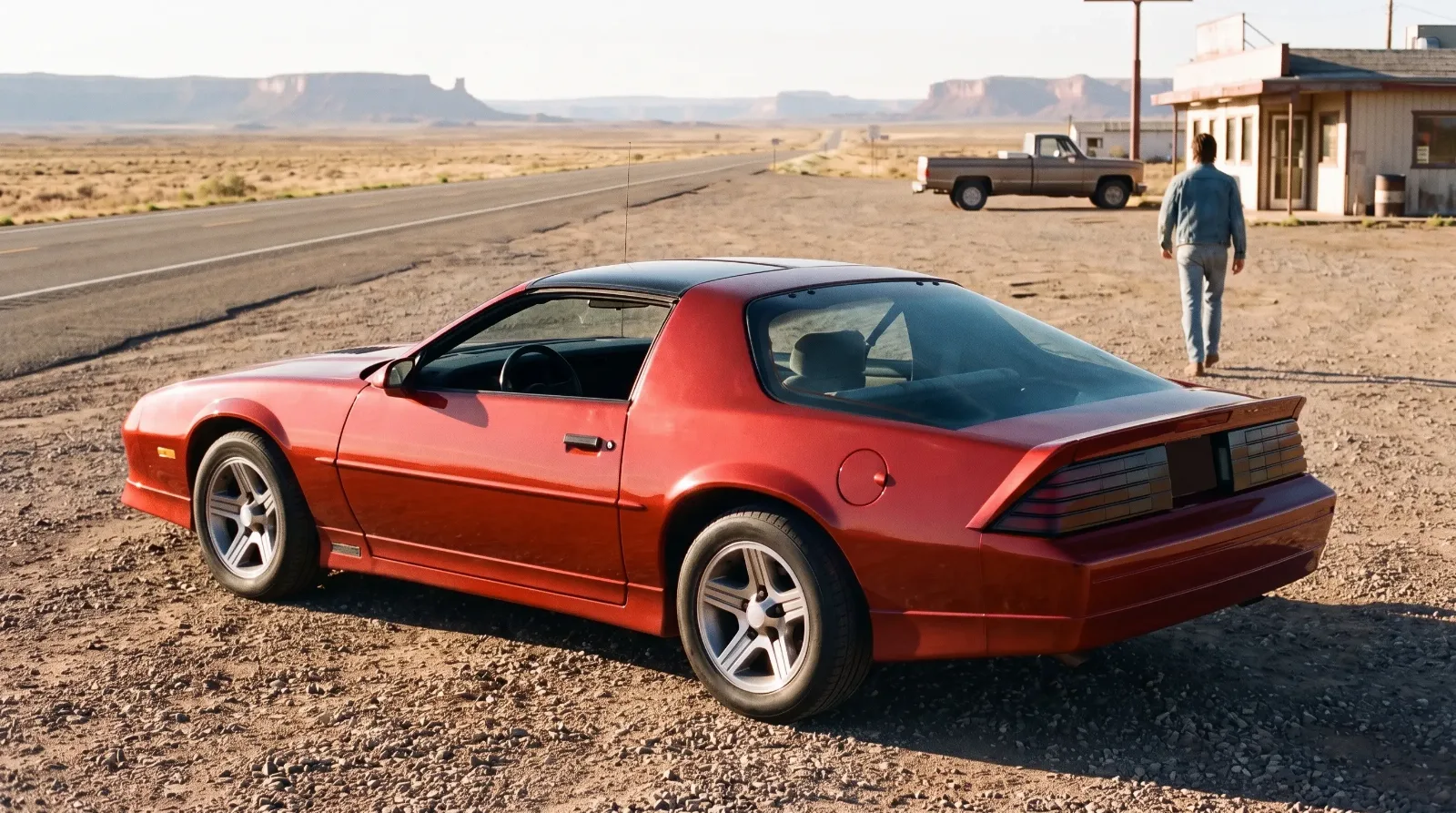
The IROC-Z ran from the 1985 to the 1990 model years, an option package on the Z28 that took its name from the International Race of Champions. The engineering story, from Tuned Port Injection to the 350, is told elsewhere, and the details of each year sit in the full history. This piece is about something softer and harder to measure: how one Camaro became shorthand for a whole decade, and then for a type of person.
The Camaro to have in the second half of the 1980s
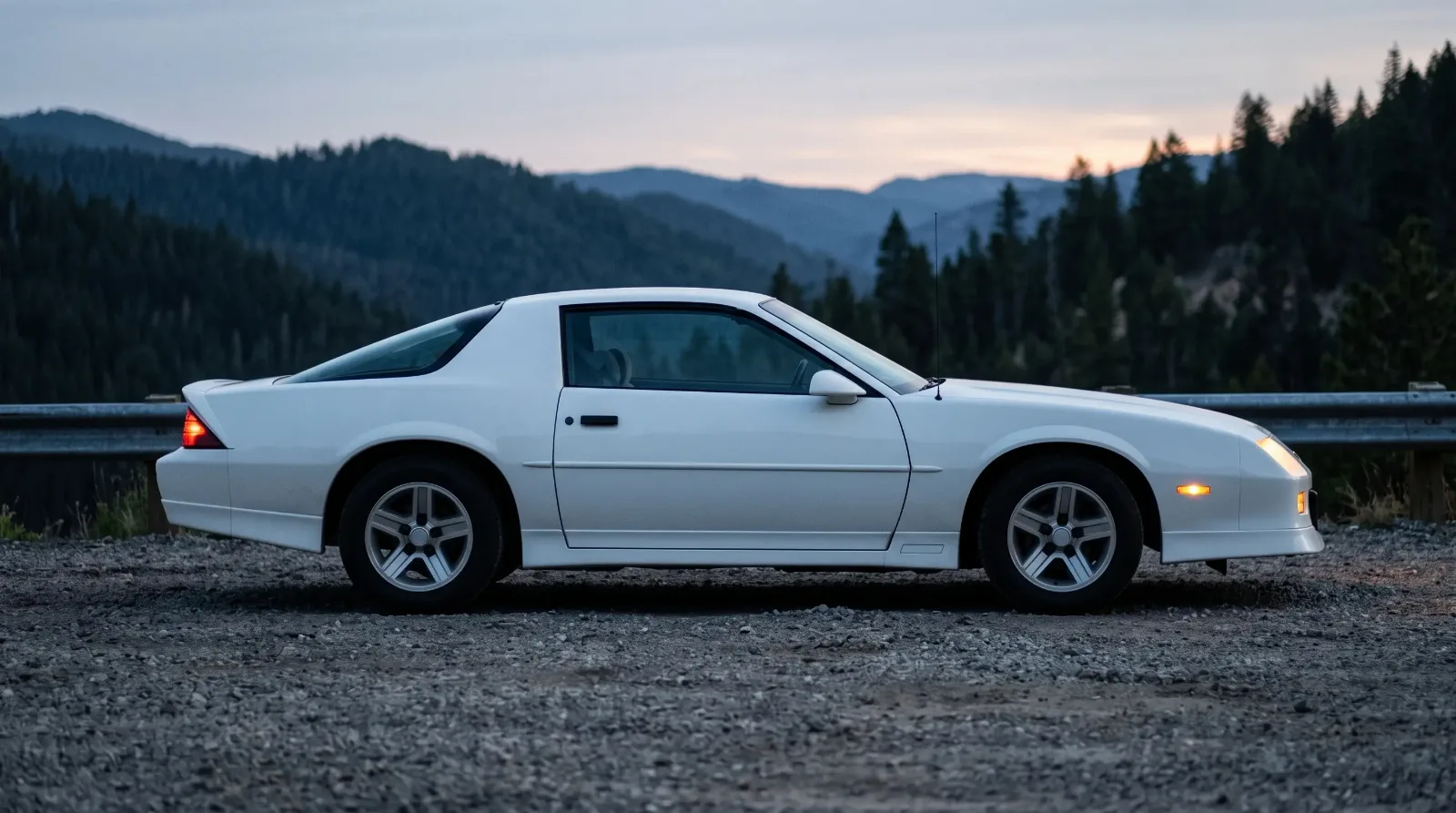
It started with a car that looked like a promise. The 1985 package added fog lamps in the grille, rocker extensions, a deeper front air dam, louvered hood inserts and those IROC-Z door decals. It sat half an inch lower than a Z28 and rode on 16-inch wheels, the first Camaro to do so, with Goodyear Gatorback tires that pulled 0.92 g on the skidpad. Under the hood, the top engine was the LB9 305 with Tuned Port Injection, rated at 215 hp.
The press noticed. In a 1985 MotorWeek comparison against the Mustang GT and the Firebird Trans Am, the Mustang was quickest in a straight line, but the IROC-Z was faster around the handling course and was judged the most refined of the three. Hagerty would later sum up the car's standing in that era plainly: for the second half of the 1980s it was "the Camaro to have."
And people had them. Chevrolet built 49,585 IROC-Zs in the 1986 model year alone. A loaded one could reach about $20,000 at a time when a 1985 Corvette started at $24,000, which put the look of a race car within reach of a young buyer with a steady job and a patient bank. Writers at Jalopnik and SlashGear now call it an icon of the 1980s, and they credit it, together with the 5.0 Mustang, with bringing V8 performance back to American streets after the lean years.
Selling a race series to the street
The name did a great deal of the work. In the real International Race of Champions, drivers from different kinds of racing met in identical cars, and from the 1984 season through 1989 those cars were Camaros. A buyer at the dealership was not getting a race car. He was getting the name of a series where champions drove Camaros, painted on his own door, and that was close enough.
Chevrolet's advertising leaned into the mood. A 1986 IROC-Z print ad carried the slogan "IROC 'n Roll," a pun that tied the car to radio, cassette decks and the open windows of a summer night. The Heartbeat of America campaign arrived in the same period and wrapped the whole brand in the same warm, loud, patriotic glow. Any honest account of the Camaro in pop culture has to include this car, and what made it famous was simple: there were a lot of them, and they were everywhere young people gathered.
That visibility cut both ways. A car that is rare stays a dream. A car that fills every high school lot becomes a character, and characters attract jokes.
| Model year | What people saw on the street |
|---|---|
| 1985 | The package arrives on the Z28: fog lamps, rocker extensions, deeper air dam, louvered hood inserts, door decals, 16-inch wheels; 21,177 built |
| 1986 | 49,585 built; the "IROC 'n Roll" print ad |
| 1987 | The 5.7 liter L98 arrives at 225 hp, for the coupe only and with an automatic only |
| 1988 | The Z28 name is dropped and the IROC-Z becomes the top model; door decals move to the rear of the door; 15-inch wheels standard, 16-inch optional |
| 1989 | Offered in bright blue, bright red, dark red, black and white |
| 1990 | The last year; a driver airbag is added; 4,213 coupes built |
Where the IROC-Z stereotype came from
The punchline grew in the years after the showroom. As the cars aged and changed hands, they got cheaper, and they found owners who drove them hard. Many were left outside through winters, crashed or scrapped. They became known for rattles, sagging doors and failing window parts, and they picked up a reputation as "fall-apart cars." A 2008 review at The Truth About Cars called the IROC-Z wheelspin-happy and hard riding and complained about the build quality, even as it predicted a future classic.
Then came the haircut. Hagerty, a company that insures these cars and has every reason to treat them kindly, still writes about the "old jokes about mullet-wearing owners." The image hardened into a cartoon: the feathered hair, the loud stereo, the car parked a little too close to the front door of the convenience store. One cultural essay, by a writer who grew up on Boston's North Shore, tied the IROC-Z to working-class and Italian-American car culture there, down to the old IROCs still cruising Revere Beach in the 1990s. That kind of local color is where stereotypes are born. Somebody's real cousin becomes everybody's joke.
"The joke was never really about the car. It was about who could afford one at nineteen, and how badly they wanted the whole street to know it."
Nora Beckett
Look closer and the stereotype says more about the people laughing than about the people driving. An IROC-Z was an expensive Camaro, the top of the range, the one a young buyer stretched for. Owning one was a statement of arrival in a decade that loved statements. When the cars fell into the hands of second and third owners, the statement stayed on the door even as the paint faded, and the distance between the decal and the reality became the joke.
From punchline back to icon
The kids who grew up around those parking lots are now the ones buying the cars. Hagerty has found that Generation X makes up about 32 percent of the collector market but owns about half of the IROC-Zs it insures. The same company that recalls the mullet jokes now writes, half smiling, about buyers who "aspire to grow mullets." The joke has not gone away. It has turned affectionate, the way a family tells the same embarrassing story every holiday.
Part of the shift is simple arithmetic. Hard use thinned the herd, so a clean, unmodified IROC-Z became scarce long before anyone thought to save one. Values began to climb around 2014, and its collector rise since then has surprised people who still remember the cars as cheap used transportation.
The name itself has an ending that gives it a quiet weight. Chevrolet did not renew its contract with the International Race of Champions, the series moved to Dodge Daytonas for the 1990 season, and the IROC-Z went with it. The 1990 run was short, with 4,213 coupes built. The 1989 car, the last full model year, with the 350 TPI and the new dual-converter exhaust, is covered here. When the Z28 name came back for 1991, the five letters on the door were gone for good.
What remains is a car that carried two reputations at once and never fully shed either. To one person, an IROC-Z on a summer night is the best version of being young. To another, it is a mullet on wheels. Both are remembering the same car, under the same parking lot lights.
Sources and notes
- Hagerty: Why on earth is an IROC Camaro worth more than a C4 Corvette?
- We Are the Mutants: Heartbeat of America, the Chevy Camaro IROC-Z 1985 to 1990
- The Truth About Cars: Capsule review, 1985 to 1990 Chevrolet Camaro IROC-Z (2008)
- Jalopnik: the Chevrolet Camaro IROC-Z as an 80s icon
- SlashGear: a closer look at the IROC-Z Camaro
- Motorious: MotorWeek retro review of the 1985 Mustang GT, IROC-Z and Trans Am
Have a
Chevrolet Camaro
for Sale?
Reach thousands of serious classic car collectors across the US.
Sell It Here →
Selling a classic? Here's how: where to sell your classic car online
Are You a Classic Car Dealer?
List your full inventory and connect with targeted classic car buyers.
Join as a Dealer →

About the author
Nora Beckett
Automotive features writer and photographer who tells the human stories behind the cars, from show fields to cross-country road trips.
Related Listings - Chevrolet Camaro




Comments
Be the first to comment on this article.