
The Jeep CJ8 Scrambler is what happens when a company that cannot afford a new truck decides to make one anyway. American Motors took the CJ-7, added ten inches of wheelbase behind the seats, dropped a short bed on the back, and sent it to dealers in 1981 as a pickup. It was not a clever thing. It was a cheap thing done well, which is a different kind of clever, and forty-some years later it is the most valuable regular-production CJ you can put in a garage. That still surprises people who watched them sit unsold on lots in Michigan through two winters.
Car Features
10 min read
The Jeep CJ-8 Scrambler: The Pickup CJ
AMC stretched a CJ-7 by ten inches, added a bed, and sold barely anyone on it. Four decades later the Jeep CJ8 Scrambler is the most valuable regular-production CJ of them all.
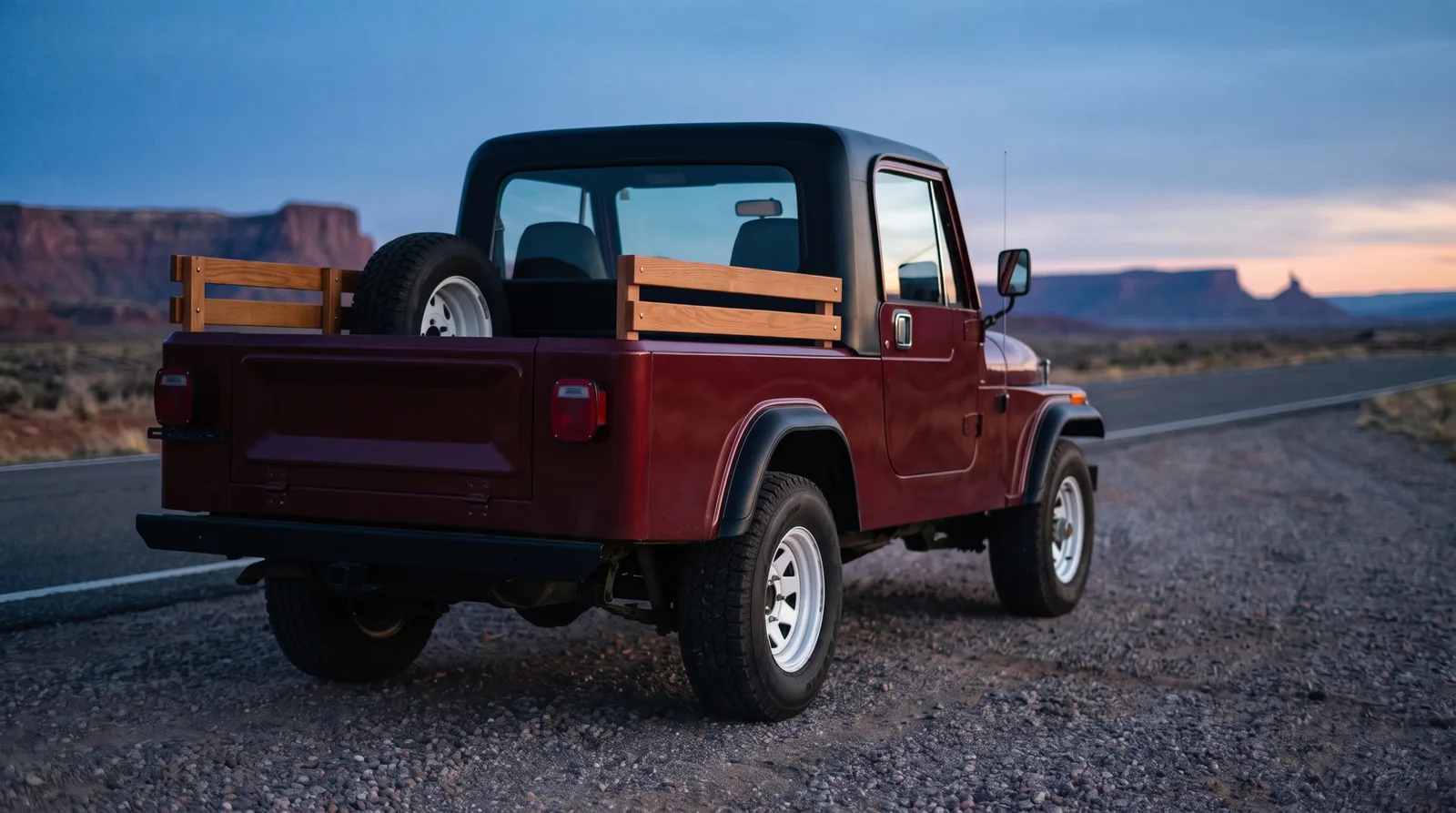
The pickup Jeep that AMC finally built
Jeep had been building small pickups since the 1940s. The Willys Jeep Truck ran from 1947 into the mid-1960s, and the Gladiator that followed it grew into the full-size J-series. What Jeep never had after the Willys truck died was a compact pickup with the CJ's proportions and the CJ's price. By the late 1970s that gap looked expensive. Toyota and Datsun were selling small pickups by the trainload, Ford and Chevrolet had answers, and AMC had nothing under the J-10 except a two-seat open Jeep with no cargo bed worth the name.
The company also had no money. AMC was in the middle of the arrangement with Renault that would eventually swallow it, and a clean-sheet compact truck was never on the table. So the engineers did what shops have always done when the budget runs out. They cut the frame, stretched it, and reused everything they could. The CJ-8 rides on a 103.5 inch wheelbase against the CJ-7's 93.5. Doors, hood, grille, windshield frame, dash, front sheet metal, drivetrain: all CJ-7. The new parts were the frame rails, the rear body tub, the bed, and the tops. If you have read our jeep cj history you already know that this is exactly how Jeep had operated since 1945, and the CJ-8 is the last time the trick worked at full strength.
They called it Scrambler in the United States, which was a marketing name and not a model designation. The build sheet says CJ-8. Both are correct and enthusiasts use them interchangeably, though the purists will tell you the Scrambler was technically the appearance package.
What you actually got in 1981
A base CJ-8 in 1981 was a spartan machine. Vinyl seats, rubber floor, a soft top if you paid for one, and a bed about five feet long behind the cab. Payload was rated around 1,000 pounds, which sounds modest until you remember the thing weighs a shade over 2,800 pounds empty and rides on leaf springs at both ends. The extra wheelbase did two useful things beyond carrying cargo. It settled the ride down considerably compared with a CJ-5, and it made the truck far less nervous at highway speed. Anyone who has driven an 83.5 inch CJ-5 on a windy interstate understands why that matters.
| Specification | Detail |
|---|---|
| Model years (US) | 1981 to 1985 |
| Wheelbase | 103.5 in |
| Overall length | approx. 177 in |
| Base engine | 151 cu in (2.5 L) four cylinder, GM-sourced |
| Optional engine | 258 cu in (4.2 L) AMC inline six |
| Transmissions | SR4 and T-4 four speed, T-5 five speed, T-176 four speed, TorqueFlite 999 automatic |
| Transfer case | Dana 300, part-time two speed |
| Axles | Dana 30 front, AMC 20 rear |
| Cargo bed | approx. 5 ft, payload roughly 1,000 lb |
| Approx. US production | roughly 27,700 units, 1981 to 1985 |
The bed itself was integrated into the body, not a separate box on a ladder frame the way a conventional pickup is built. That is worth understanding because it changes what the CJ-8 is. It is not a small truck that happens to look like a Jeep. It is a Jeep that happens to have a bed, and it behaves like one. The tailgate is a fold-down panel, the bed sides are body panels, and the whole rear structure carries load through the tub. Owners who treated theirs like a half-ton found out where the limits were.
Engines, gearboxes and the honest truth about pace
The base engine was the 151 cubic inch four, the GM-built unit everyone calls the Iron Duke, rated around 82 horsepower in Jeep tune. In a 2,800 pound truck with 4.10 gears and a two speed transfer case, that is adequate for a job site and thin on a freeway on-ramp. Most buyers ticked the box for the 258 cubic inch AMC inline six instead, which brought roughly 110 horsepower and a much healthier torque curve. The six is the engine the CJ-8 wants. It is also the one that makes the truck pleasant to own now, because it will pull a hill at 55 without the driver planning ahead.
Transmissions changed through the run. Early cars got the SR4 or the T-4 four speed depending on engine, the beefier T-176 came with the six in some configurations, and the T-5 five speed arrived later and is the one long-distance drivers hunt for. The Dana 300 transfer case underneath all of them is one of the better pieces AMC ever specified for a CJ, and it is a large part of why these trucks still get used. The engine story across the whole CJ family is worth a look too, because the 258 in a Scrambler is the end of a line that starts with a flathead four in 1945.
"Nobody bought a Scrambler because it was fast. They bought it because it would haul a cord of firewood up a two-track and then take the kids to school on Monday, and it did both without complaining."
- Mike Sullivan
Tops, half cabs and the trim ladder
Top choices are where the CJ-8 gets interesting to collectors. You could have a full soft top over the whole body, a soft top over the cab only, a full fiberglass hardtop, or the half cab hardtop that gives the Scrambler its most recognizable silhouette. The half cab is the one most people picture: hard roof and rear window over the front seats, open bed behind. It is also the configuration that has aged best in photographs, which is part of why clean half cab cars command a premium today.
Trim ran from a plain base truck up through the SR sport package, the SL, and the Laredo, which brought chrome bumpers, a chrome grille, better seats, and a level of interior finish that would have been unthinkable on a CJ-5 a decade earlier. Laredo Scramblers are the ones that show up in auction catalogs. There were also striping and decal packages that changed by year, and matching the tape to the build sheet has become its own small research hobby among owners.
The Overlander and the export Scramblers
Outside the United States the CJ-8 wore different badges. In Australia it was sold as the Overlander, and export markets took versions of the truck that never appeared in American showrooms. Some of those cars left the factory in right hand drive, and diesel options appeared in markets where fuel prices made the four cylinder look thirsty. These exports matter to collectors for a practical reason: a share of the surviving low-mileage Scramblers came back from Australia and elsewhere in the 2000s, when American values climbed high enough to make the shipping worth it.
There was also a right hand drive postal variant of the shorter CJ family, and buyers occasionally confuse those with Scramblers at a distance. They are not the same thing, and the wheelbase settles the argument instantly.
Why there are so few left
Total United States production over five model years was somewhere near 27,700 units, which is a rounding error next to the CJ-7's numbers. It sold poorly for reasons that had nothing to do with the truck. The early 1980s recession gutted small truck demand, gas prices had spooked buyers, AMC's dealer network was thinning out, and the Scrambler was priced uncomfortably close to a proper compact pickup that offered more comfort and better mileage. Buyers who wanted a work truck bought a work truck.
Then the survivors got used up. These were cheap four wheel drive trucks in snow country for twenty years, and the CJ-8's long body tub rusts in the same places a CJ-7 does, plus a few more. The bed floor, the rear crossmember, the body mounts, and the seams around the tailgate all collect salt. A great many Scramblers were parted out to keep CJ-7s alive because the front half of the car is identical. That is the quiet reason the survival rate is so low: the CJ-8 was worth more dead than alive for about twenty years.
What a Scrambler is worth now
The market flipped hard sometime around 2015 and never flipped back. A rough but honest six cylinder Scrambler that would have been a $6,000 truck in 2005 now trades well into five figures, clean driver-quality cars sit roughly in the $30,000 to $45,000 band, and the best restored Laredos with documentation have crossed roughly $60,000 at public sale, with the strongest modified and documented examples going well beyond that. That is CJ-7 money multiplied several times over for what is, mechanically, the same vehicle with a longer frame.
The reason is simple scarcity meeting fashion. Small trucks are fashionable again, the Gladiator gave the shape a modern reference point, and the supply of clean CJ-8s is fixed and shrinking. Buyers should be clear-eyed about what drives value in this corner of the market: originality of the tub and frame, an honest six cylinder drivetrain, a straight half cab or a correct top, and paperwork that proves the truck is what the seller says it is. Restomods with modern V8s and coil conversions sell fine, but they sell on their build quality, not on the CJ-8 badge. If you are ready to see what the current run of trucks looks like, shop classic CJ listings and compare a few before you fall for the first clean one you find.
The CJ8 Scrambler was a compromise built by a company running out of options, and it failed in the showroom on almost every measure that mattered in 1981. It is now the CJ that people chase hardest. There is a lesson in that somewhere about patience, or about how a vehicle that does one honest job well eventually finds its audience, even if the audience shows up thirty years late.
Sources and notes
Related Reading

About the author
Mike Sullivan
Detroit-area muscle car enthusiast and restoration specialist with three decades of hands-on experience working on American iron.
Related Listings - Jeep CJ





Comments (1)
T
Tony Marchetti
3 days ago
Half cab Scrambler!! Love it, love it!!
B
Barry Hutchins
3 days ago
Lovely truck, mind you, but I'd temper the enthusiasm a bit if you're shopping one up here. With the bed built into the tub, road salt gets into the whole rear structure at once, and you can't just swap a box the way you would on a pickup. That's a big part of why so many of the clean ones came back from Australia.