
The Jeep CJ-2A went on sale in 1945 as a farm machine. Not a recreational vehicle, not a car with off road pretensions, but a piece of agricultural equipment sold with a power take off and a drawbar, advertised alongside plows and belt driven saws, and priced against small tractors. That framing is the single most misunderstood thing about the first civilian Jeep, and it explains almost every design decision on the vehicle. Anyone who wants the wider arc can find more on the jeep cj elsewhere in this series. What follows is the first four years, from the factory paperwork outward.
Car Features
10 min read
The 1945 Jeep CJ-2A: The First Civilian Jeep
Willys sold the first civilian Jeep as farm equipment, complete with a power take off and a drawbar. The plan half worked, and it built an industry.
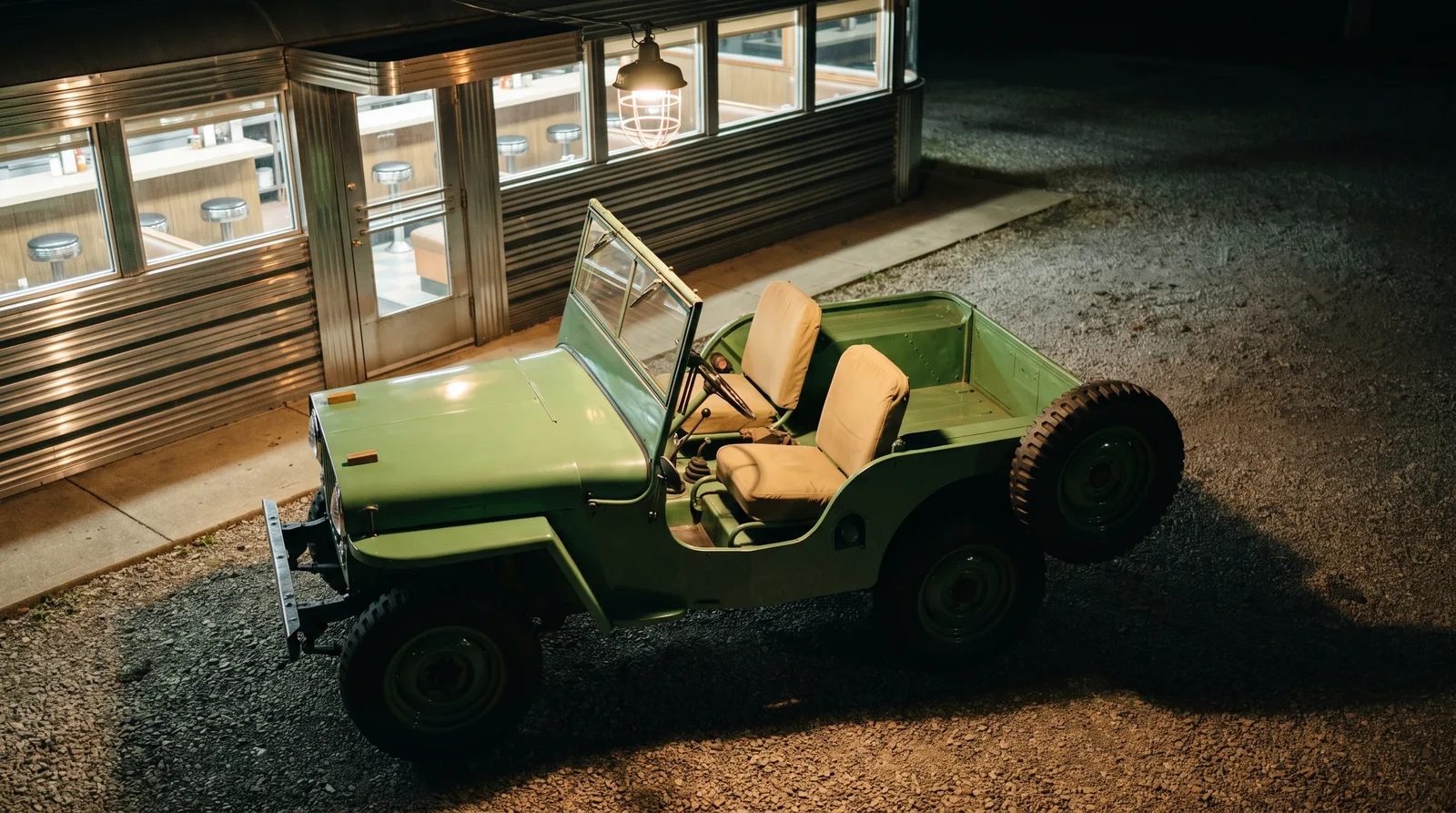
Willys-Overland began CJ-2A production at Toledo in July 1945, before the war in the Pacific had ended, with serial numbers starting at 10001. About 214,760 were built through 1949. It is the vehicle that turned a government contract into a consumer product line, and it is the direct ancestor of every Jeep sold since.
What Willys was actually selling
Read the 1945 and 1946 sales literature and the pitch is remarkably specific. The Jeep was presented as a replacement for a team of horses and a light tractor combined, with the added benefit that it could drive to town at road speed afterward. Willys published drawbar pull figures, belt horsepower figures and fuel consumption tables, and the dealer network included farm implement dealers who had never sold an automobile.
The name in the catalogs was the Universal Jeep. The word universal was doing real work. One machine, the argument went, would plow, disc, mow, haul, run a stationary engine through the belt pulley, pump water, power a welder and then carry the family to church. The base price at launch was around $1,090, which put it in the same conversation as a small tractor rather than a car.
That positioning is why the CJ-2A got a governor option, a Monroe hydraulic lift option, a center power take off, a rear power take off and a pulley drive. None of those things exist on a vehicle designed for weekends.
How it differed from the wartime MB
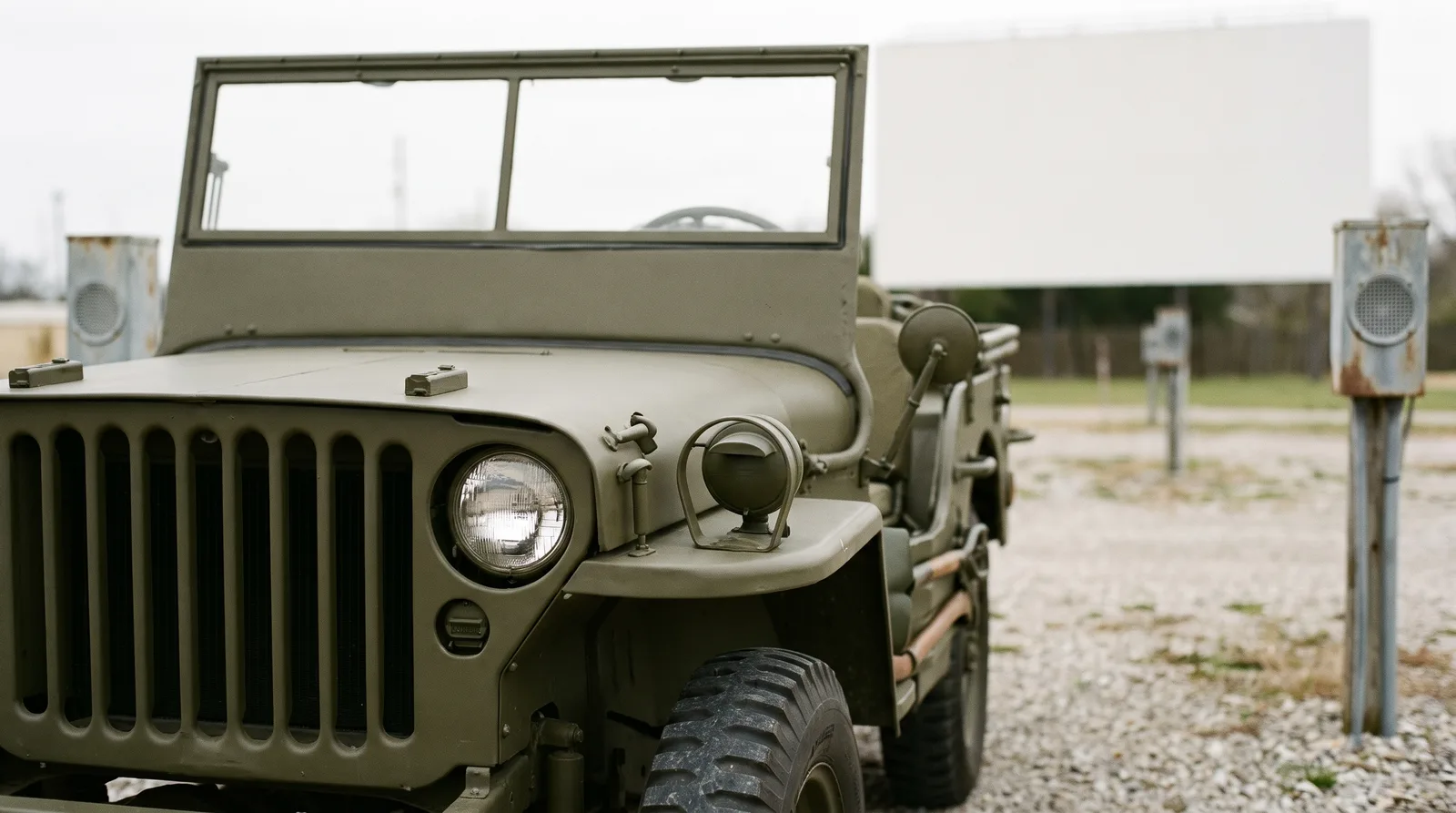
People still describe the CJ-2A as a khaki jeep painted a different color. The parts books say otherwise. The changes were substantial and every one of them followed from civilian use.
The spare tire moved from the rear panel to the driver's side of the body so that a tailgate could be fitted, since a farmer loading feed sacks needs a tailgate more than a soldier does. The headlights grew and moved outboard into the grille, which dropped from nine slots to seven, mainly because larger sealed beam units were needed for road driving. A stronger three speed transmission replaced the wartime unit. The rear axle was upgraded to a heavier assembly. Gearing was raised for road speed. The fuel filler moved outside the body so a jerry can was no longer poured over the driver's seat. Springs, clutch and cooling were all revised for sustained low speed work with an implement attached.
The tailgate carried a stamped Willys name, which is one of the small details that separates an honest tub from a replacement panel at ten paces.
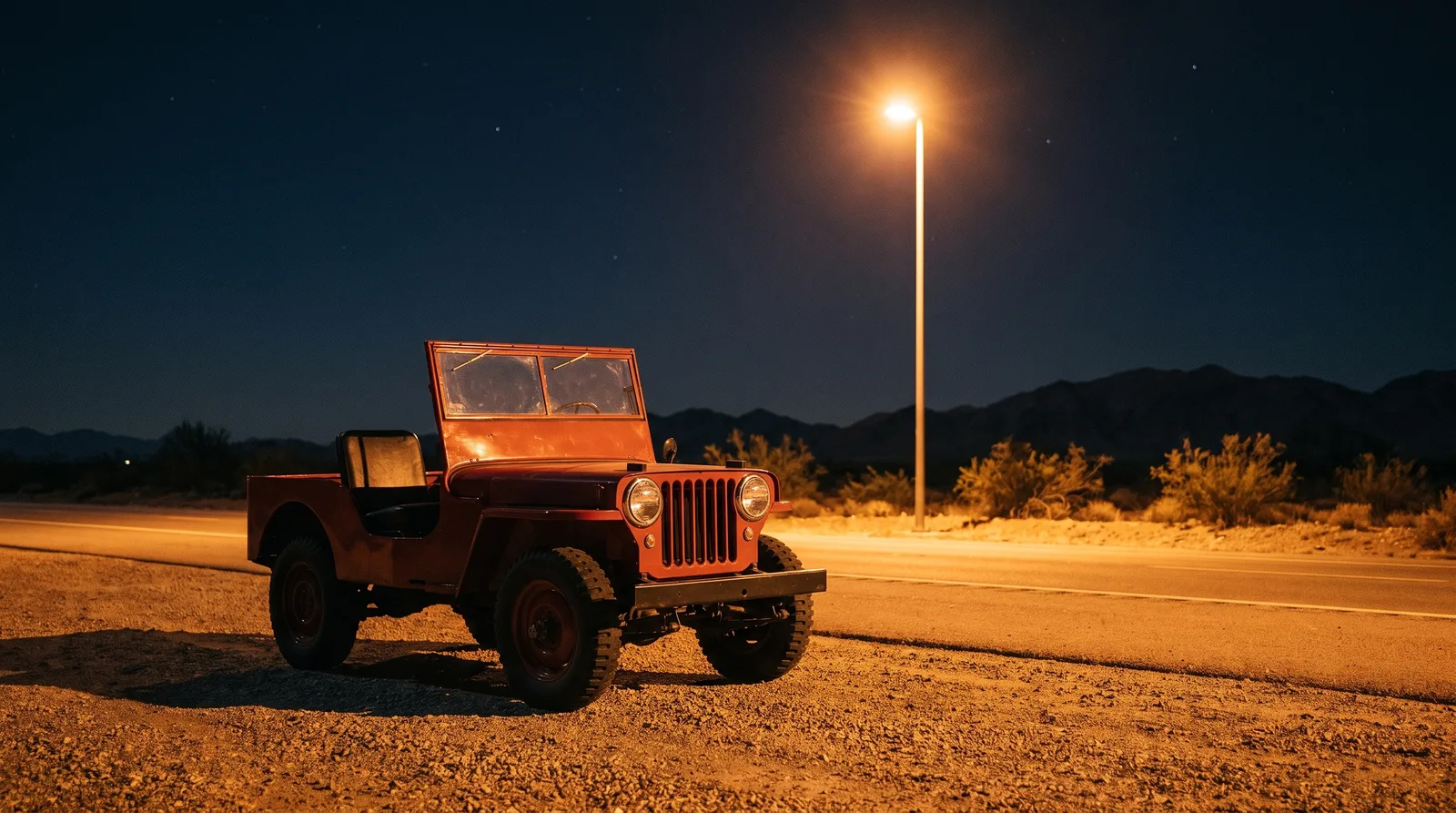
Color did more work than people credit. The wartime vehicle came in one finish for one reason. The civilian catalog offered a short list of names that sound like a seed company wrote them, including Pasture Green, Harvest Tan, Michigan Yellow, Normandy Blue, Picket Gray, Black and Luzon Red, most of them cataloged for the 1945 to 1947 model years before some combinations were dropped. Those choices were deliberate. A machine parked in a farmyard next to painted implements had to look like it belonged there rather than like military surplus, and buyers in 1946 had seen quite enough olive drab. Today a correct period color on an honest body is one of the first things an experienced eye checks, because seventy years of repaints have left a great many CJ-2As in shades Willys never offered.
| Specification | Willys MB (1941 to 1945) | Willys CJ-2A (1945 to 1949) |
|---|---|---|
| Grille slots | Nine | Seven |
| Headlights | Smaller, set inboard | Larger, set outboard |
| Spare tire | Rear panel | Driver's side body |
| Tailgate | None | Fitted, Willys stamped |
| Engine | 134.2 cu in Go-Devil four | 134.2 cu in Go-Devil four |
| Transmission | Three speed, wartime unit | Three speed, heavier unit |
| Fuel filler | Under driver's seat | External, body side |
| Implement provision | None | PTO, pulley drive, drawbar, hydraulic lift optional |
First year cars and the details collectors argue over
The earliest CJ-2As are their own subject. Only a small number were completed in 1945, about 1,824 units before the calendar turned, and those cars carry features that were changed almost immediately as production settled.
The most discussed is the column mounted shift lever fitted to the earliest vehicles, which was abandoned in favor of a floor shift early in the production run. Others include the early full floating rear axle arrangement, specific hood and body stampings, brass data plates, and a handful of hardware details that only matter if you are judging a car rather than driving it.
A gentle correction is due here, because this is where the hobby generates the most confident misinformation. Serial number ranges quoted online for these changes are approximations built from owner surveys, not from factory records. Willys did not publish a running change log for the civilian line, and the surviving Toledo documentation is incomplete. When somebody tells you a change happened at exactly a given serial number, ask where the figure came from. The honest answer is usually a forum thread from 2004.
"Half the CJ-2A facts in circulation started as one person's observation of one vehicle and became doctrine by repetition. The parts catalogs and the dealer service bulletins are still out there. They are dull, they are inconsistent, and they are the closest thing to primary evidence this model has."
- Tom Ramirez
The numbers, and what they actually mean
Production climbed hard and then fell. After the small 1945 run, output climbed to about 71,554 units in 1946, ran about 65,078 in 1947, rose again to about 74,122 in 1948, then dropped sharply to about 2,182 in 1949 as the CJ-3A took over. That curve tells the story of postwar America better than any advertisement. There was pent up demand, no competition, and a distribution network that could reach rural buyers.
The other number worth keeping is what happened afterward. Willys used the CJ-2A's mechanical package to launch an entire lineup: the Jeep Station Wagon in 1946, the Jeep truck in 1947 and the Jeepster in 1948. The civilian Jeep did not just survive the transition to peacetime. It funded a product range for a company that had been building the same passenger cars since before the Depression.
Why the farm strategy only half worked
The Jeep did not replace the tractor, and by about 1948 Willys knew it. The physics were against it. A tractor puts its weight over driven wheels turning slowly with enormous mechanical advantage. A 2,200 pound vehicle geared for 50 miles an hour cannot match that, no matter how many implements you hang on it. Farmers who bought one for plowing generally went back to a tractor for plowing and kept the Jeep for everything else.
Everything else turned out to be a very large market. County road departments bought them. Utility companies bought them. Fire departments, forestry services, oil field crews, ranchers, surveyors and rural mail carriers bought them. The vehicle succeeded as general purpose transport where roads were bad, which is precisely what it had been designed for in 1940 and precisely what the farm campaign had tried to talk it out of being.
That commercial reality shaped the following thirty years. Every later CJ was sold on capability and versatility rather than on implement compatibility, and the power take off quietly slid down the option sheet until it disappeared.
The CJ-3A and the end of the run
The CJ-3A arrived in 1949 and ran to 1953. It is close enough to the CJ-2A that people mix them up constantly, and the reliable external tell is the windshield: the CJ-3A uses a one piece glass with a vent, and it sits slightly taller. Underneath, the driveline was strengthened again and the rear axle upgraded. About 131,800 CJ-3As were built.
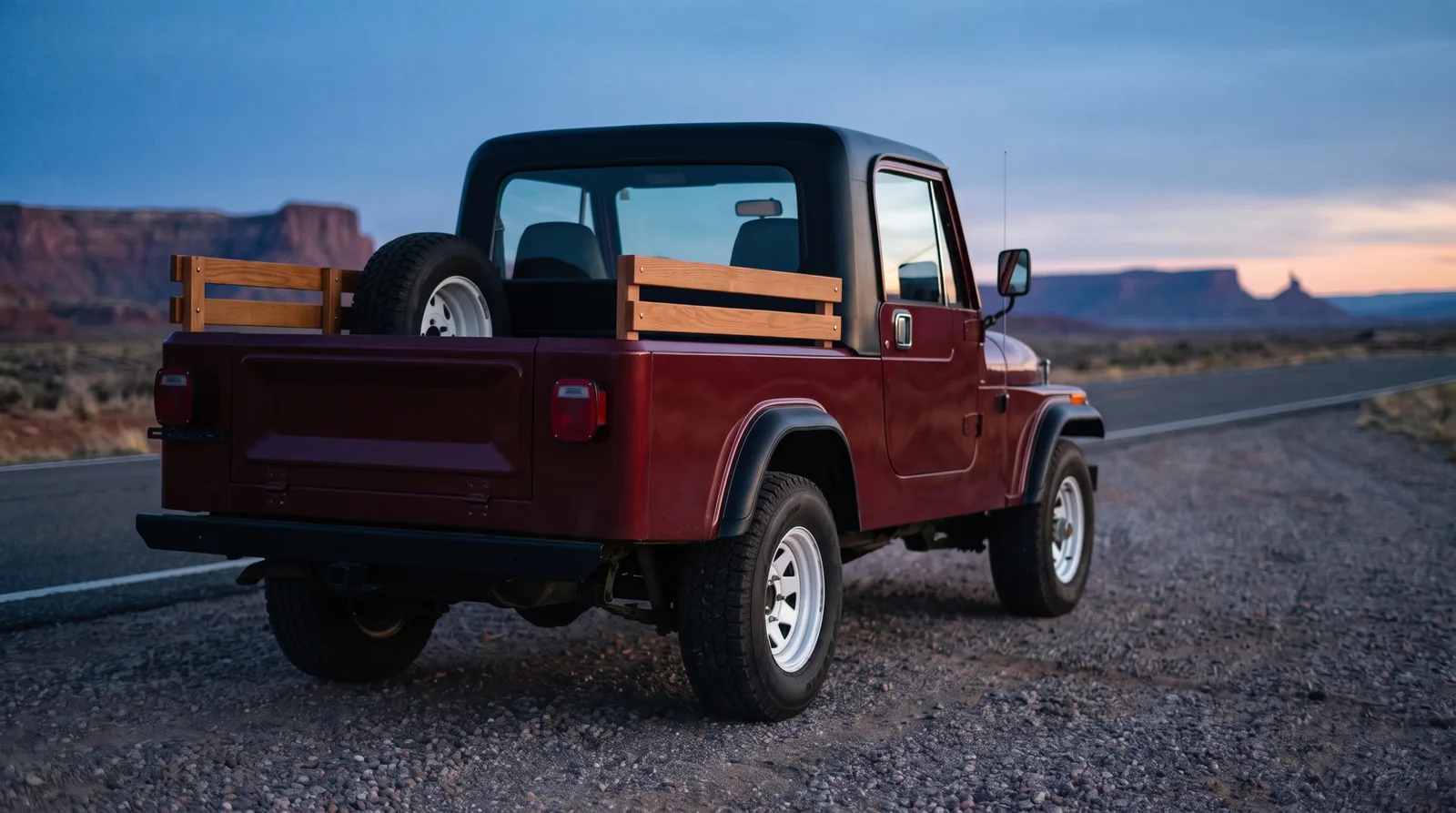
The CJ-2A therefore had a four year commercial life, which is short for a Jeep and long for a first attempt at a category nobody had proven existed. Its real successor was not any single model. It was the idea that a private buyer would pay for four wheel drive, and that idea kept a factory in Toledo busy for the rest of the century. The line eventually ran all the way to the CJ-8 Scrambler of the 1980s, which is more from this era for anyone who wants to see where the utility argument finally ended up.
Buying and living with one now
The CJ-2A is the least expensive way into a genuinely significant piece of American vehicle history, and that has been true for a long time. Mechanical parts are reproduced in depth, the engineering is simple, and there is a large community that has been documenting the model for decades.
The problems are specific rather than general. Frames and tubs corrode at predictable points and a presentable body can hide a poor structure. Very few of these vehicles retain their original engine, since the F-head and various small block conversions were fitted throughout the 1960s and 1970s when nobody thought originality mattered. Titles are a genuine issue in some states, because farm vehicles were frequently never registered for road use in the first place, and a Jeep CJ2A that spent fifty years on private land may have no paperwork at all.
Values reward two things: original configuration and honest history. A cosmetically restored car with a later engine, modern wheels and a repainted tub sits in one price band. A complete, correct, documented example with its implement hardware sits well above it, and first year cars with credible early features sit above that. If you are working out where your budget lands, spend an evening comparing what is actually on offer before you commit, since the spread between the two ends of this market is wider than most newcomers expect. Start by looking at what it costs to find a classic CJ in the condition you want rather than the condition you can afford to fix.
What makes the CJ-2A worth studying is not rarity, because it is not rare. It is that you can see a company reasoning in public. Willys took a vehicle built to a military specification, guessed wrong about who would buy it, sold two hundred thousand anyway, and learned enough in four years to build the business that followed. Very few first attempts get corrected that quickly, and almost none of them stay recognizable eighty years later.
Sources and notes
Related Reading

About the author
Tom Ramirez
Corvette researcher and historian based in Bowling Green, Kentucky. Two decades documenting Corvette production history from original factory records.
Related Listings - Jeep CJ





Comments
Be the first to comment on this article.