
The Willys Jeep is one of the few twentieth century vehicles whose design brief survives in the archive almost intact. That is unusual. Most cars were shaped by a committee, a stylist and a marketing forecast, and the paper trail dissolves into memos. The wartime quarter ton reconnaissance car began instead as a written government specification circulated in the summer of 1940, and every argument about who invented it can be checked against that document, against the bid correspondence and against the surviving pilot vehicles. What the archive shows is messier and more interesting than the version on the hood decal.
Car Features
10 min read
Willys Origins: From the War Jeep to the First Civilian CJ
A 1940 Army specification, three pilot vehicles and a 49 day deadline produced the most copied shape of the century. What the archive actually shows.
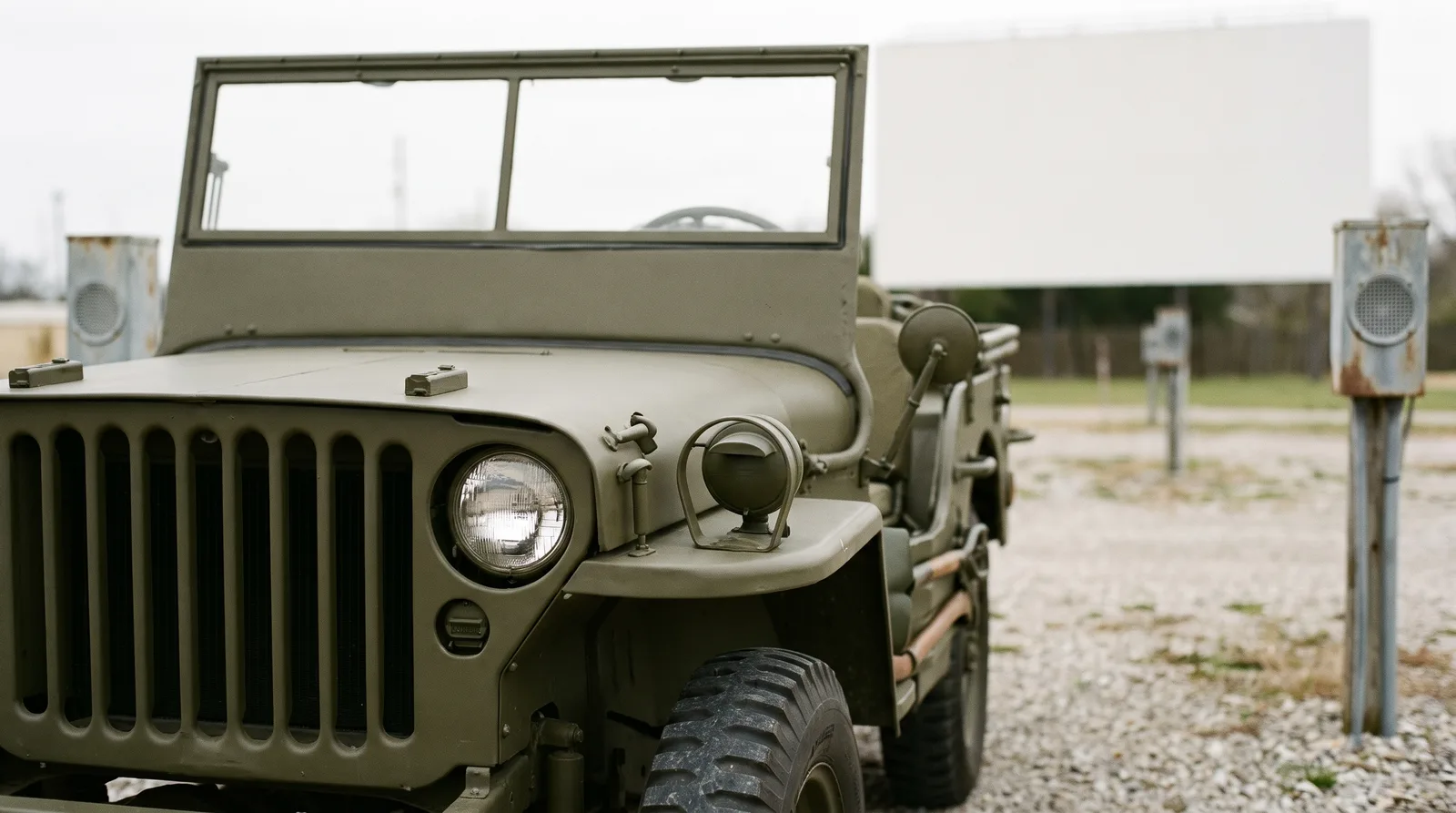
The short form: three companies contributed, one company built the vast majority, and the civilian model that followed the war was assembled from lessons learned in a hurry. Readers working through our jeep cj retrospective will find the postwar chapters there. This piece stays with the years before the CJ badge existed at all.
The 1940 specification and the company that answered first
In the early summer of 1940 the Quartermaster Corps circulated a requirement for a light reconnaissance vehicle to roughly 135 manufacturers. The terms were severe. Four wheel drive, a folding windshield, a low silhouette, an 80 inch wheelbase limit, a 660 pound payload and a curb weight ceiling of 1,300 pounds, a limit that proved unrealistic and was later relaxed to about 2,160 pounds. Bidders were given 49 days to deliver a running pilot vehicle. Two companies bid seriously.
The first was American Bantam of Butler, Pennsylvania, a small firm building licensed Austin derivatives and running out of money. Bantam had no engineering staff left to speak of, so it hired a freelance engineer named Karl Probst, who worked initially without a fee and produced the layout drawings in about five days. Bantam delivered its pilot vehicle to Camp Holabird in Maryland on 23 September 1940, inside the deadline. By any reading of the record, Bantam got there first.
What Bantam did not have was capacity. The Army wanted tens of thousands of vehicles from a supplier that could survive the war, and Bantam's plant and finances did not support that. Willys-Overland and Ford were both invited to submit, and both were given access to the Bantam data. That decision is the origin of every dispute that followed.
Three pilot vehicles, one surviving shape
By late 1940 the Army held three competing designs. Bantam's BRC, the Willys Quad, and the Ford Pygmy. Each company received an order for about 1,500 preproduction units, which produced the Bantam BRC-40, the Willys MA and the Ford GP. These are the vehicles a concours judge means when talking about the pre standardization era, and very few survive in original condition. Most were shipped abroad under Lend-Lease and consumed.
Willys won the standardization contract in the summer of 1941 on two grounds. Its bid price was lower, and its engine was substantially more powerful than either rival. The resulting vehicle, the MB, entered production late that year. Ford then built the same design under license as the GPW, so that a single set of drawings produced vehicles from two plants.
The physical evidence of that arrangement is one of the most useful authentication tools in the hobby. Ford stamped a script F into an enormous number of its GPW components, from bolt heads to axle housings to body parts, and those marks let a researcher separate a Ford built vehicle from a Willys built one even after decades of parts mixing. The stamped nine slot grille that everyone associates with Willys was itself a Ford contribution, adopted in place of the earlier welded slat grille because it was cheaper and lighter to produce.
| Model | Years | Approximate quantity | Notes |
|---|---|---|---|
| Bantam BRC-40 | 1940 to 1941 | About 2,600 | First pilot design, mostly sent abroad |
| Willys MA | 1941 | 1,555 | Preproduction, column shift, few survivors |
| Ford GP | 1941 | About 4,458 | Preproduction, distinctive front sheet metal |
| Willys MB | 1941 to 1945 | About 335,000 to 360,000 | Standardized wartime vehicle, sources vary |
| Ford GPW | 1942 to 1945 | About 277,900 | Built to Willys drawings under license |
| Willys CJ-2A | 1945 to 1949 | About 214,760 | First series production civilian model |
The Go-Devil, and why the engine decided the contract
The engine that won the war for Willys was a 134.2 cubic inch side valve four developed under Delmar Roos, the company's chief engineer, universally called Barney. It was not a new design so much as a rigorously improved one. Roos raised its rated output to about 60 horsepower at 4,000 revolutions with roughly 105 pound feet of torque, and, more importantly for the Army, he made it survive sustained abuse at those speeds.
Bantam's engine produced considerably less. Ford's produced less still. In a vehicle expected to carry a machine gun mount, a radio and four soldiers up a wet grade, that difference was decisive. The engine acquired the name Go-Devil in Willys advertising and kept it for two decades of civilian production, which is why a 1948 farm brochure and a 1943 technical manual describe the same block.
"When you examine an early tub, the marks of wartime tooling are still legible: the weld spacing, the panel gauge, the stamping numbers on the underside. These vehicles are documents. Read them before you refinish them, because the paint removes the evidence."
- Sarah Whitfield
Where the name came from, and why nobody can prove it
Two explanations compete and neither is settled. The first derives the word from the Ford designation GP, sometimes read as general purpose, slurred into a single syllable by soldiers. The second traces it to Eugene the Jeep, a small creature in the Popeye comic strip of the mid 1930s that could go anywhere and solve anything. Servicemen had used the word informally before 1940 for a range of unproven vehicles and equipment.
The moment the word attached itself in print is better documented. In February 1941 a Willys test driver demonstrated the vehicle in Washington, including a climb of the Capitol steps, and a newspaper reporter present asked what the thing was called. The answer given was jeep, and it appeared in print in the Washington Daily News on 19 February 1941, in a nationally syndicated article by reporter Katharine Hillyer. Willys advertising took the word from there, which produced a decade of legal argument, because a nickname coined by soldiers is not obviously anyone's property. Willys ultimately secured the trademark on 13 June 1950, after several earlier rejections from the Patent Office.
Planning the civilian model while the war was still running
Willys began preparing for peace early, and the surviving advertising proves it. Wartime Willys advertisements are not really about soldiers. They show the vehicle plowing, hauling, running a belt driven saw, and the copy addresses farmers directly. The company was building demand for a product that did not yet exist.
The engineering ran alongside. A handful of CJ-1A conversions were produced for evaluation, followed by the CJ-2, a preproduction civilian model built in a small run, generally cited as around 40 units and usually called the Agrijeep, distributed to agricultural colleges and demonstration sites in 1944 and 1945. These are among the rarest vehicles in the whole family and each surviving example is individually tracked by researchers.
The lessons went straight into the production model. The civilian vehicle needed a tailgate, so the spare tire moved to the side. It needed larger headlights set further apart for road use. It needed a stronger transmission, a power take off provision and a driveline geared for implements rather than for convoy speed. It needed a fuel filler outside the body. The result, announced in 1945, was the CJ-2A, and it is a related story worth reading in full, because the civilian and military vehicles differ far more than a casual glance suggests.
Period context: what else existed in 1945
It is easy to assume the Willys was competing against something. It was not. In 1945 there was no other mass produced light four wheel drive available to a private buyer anywhere in the world. Dodge built the larger Power Wagon from 1946. In Britain, Rover's Maurice Wilks ran a war surplus Willys on his own land and used it as the reference point for the Land Rover, which appeared in 1948 with a similar brief and a very different execution.
That absence of competition explains the marketing. Willys was not arguing that its product was better. It was arguing that a category existed at all, and it did so by publishing charts of drawbar pull, belt horsepower and fuel consumption against horse teams and small tractors. Sales literature of the late 1940s reads like agricultural extension material because that is exactly what it was imitating.
There is a second reason the vehicle had no rival, and it is one collectors underrate. An enormous share of wartime production never came home. Tens of thousands of jeeps went to the Soviet Union and to Britain under Lend-Lease, and tens of thousands more were declared surplus abroad and sold, abandoned or absorbed into local fleets rather than shipped back across an ocean at government expense. That dispersal is why unmodified wartime examples turn up in Greece, the Philippines and rural France to this day, and why survival rates vary so sharply by theater. It also seeded the aftermarket that later kept these vehicles running, since a war surplus jeep in 1947 was cheap, plentiful and completely unsupported by any dealer.
Authenticating an early car
For anyone assessing a wartime or early civilian vehicle as an artifact, the useful evidence lives in a small number of places. Serial and data plates, and whether their fasteners and finish match the surrounding metal. Body stamping numbers on the underside of the tub. Component date codes on axles, transmissions and generators. Ford script marks on GPW parts. Frame rail construction, which differs between production periods. And the layers of paint themselves, since an unrestored vehicle often carries its unit markings under later coats.
Reproduction parts are excellent now, which is a benefit for use and a problem for evaluation. A vehicle assembled entirely from new components can look flawless and carry no history at all. That is a legitimate thing to own, but it should be priced as what it is. When the paperwork is thin, the strongest documentation is usually long term photographic ownership history rather than any single certificate. Anyone starting the search should spend real time studying what correct examples look like before viewing CJs for sale now, because the education transfers directly into the price you pay.
The reason the origin story matters is that it explains the object. A vehicle designed in seven weeks to a rigid weight limit, built by two companies to one set of drawings, and then handed to a peacetime market that had never seen anything like it, was always going to be crude, adaptable and extraordinarily durable. Everything the CJ line did over the following forty years was an argument with those first constraints, and most of the time the constraints won.
Sources and notes
Related Reading

About the author
Sarah Whitfield
Third-generation classic car collector specializing in pre-war American and European coachbuilt automobiles. Researcher and concours enthusiast.
Related Listings - Jeep CJ





Comments (1)
G
Greg Mazur
3 days ago
Verify the grille: early MBs used the welded slat grille. Stamped came later.
L
Larry D.
3 days ago
Greg is right and I learned it the hard way at the diner, because a fellow came through on Route 66 one summer towing an MB on a flatbed and he swore up and down it was a 1941 and the slat grille proved it, and my cook, who drove one in the Army, walked out with his apron still on and looked it over and said the grille was right but half the bolts had the little script F on them, so it was a Willys wearing Ford parts, and the fellow just laughed and ordered another piece of pie and said he would sort it out in Tulsa.