
Willys-Overland put the CJ-3B into showrooms in 1953 with its taller hood and its taller inline four, and by every measure it was doing the job it was built for. But inside the engineering offices in Toledo, a different vehicle was already taking shape on the drafting boards, one that would carry the letters CJ-5 and would not leave production for thirty years. The jeep cj cj5 1955 launch was not a facelift. It was the first ground-up redesign of the civilian Jeep since the original CJ-2A rolled off the line in 1945, and it changed what buyers expected a Jeep to be.
Car Features
7 min read
The 1955 Jeep CJ-5 Launch That Redrew the Civilian Jeep
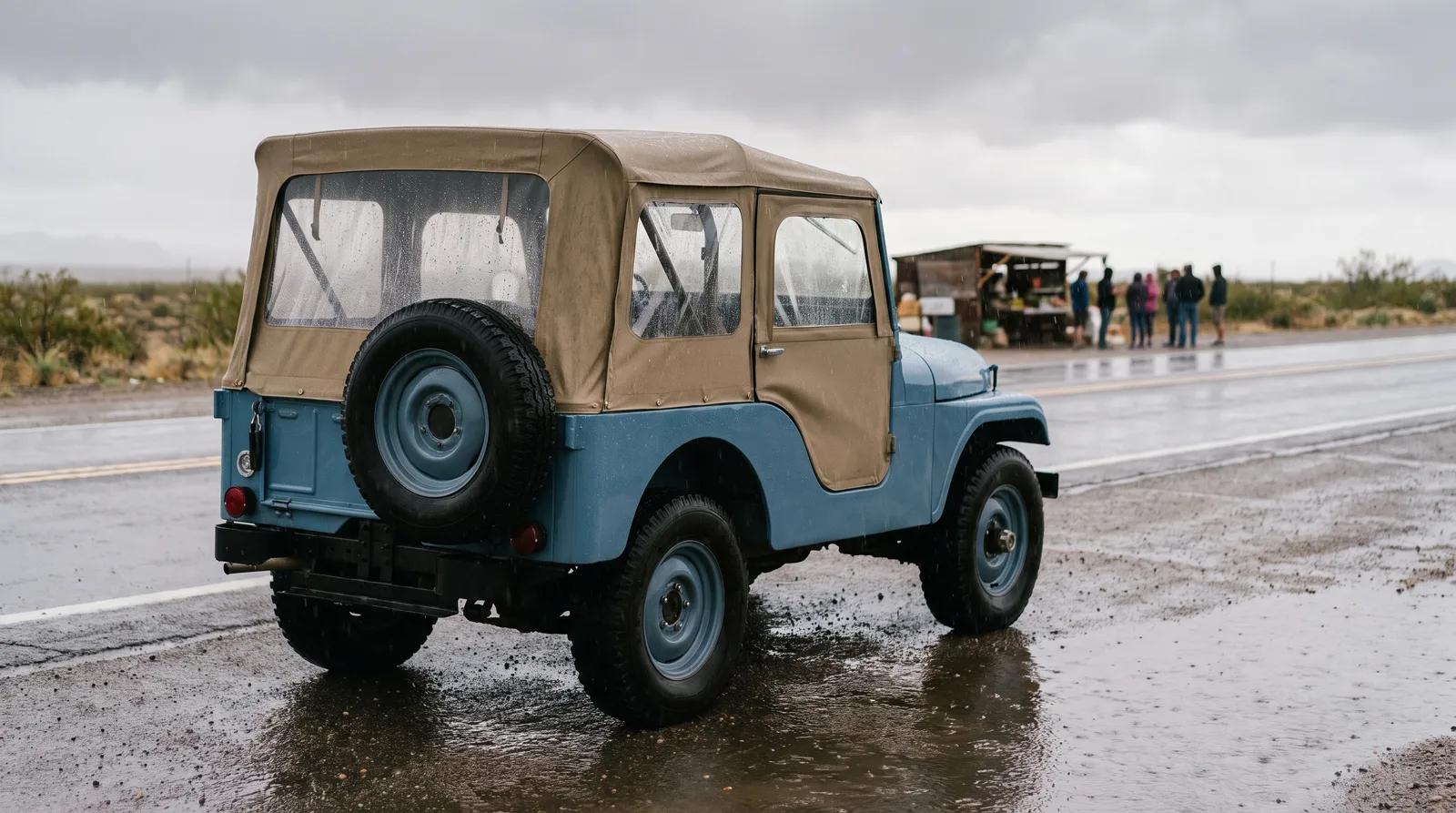
The 1955 CJ-5 was Willys' first full redesign of the civilian Jeep since 1945, borrowing its body straight from the Korean War era M38A1.
Why Willys started over
The M38A1, the military variant built for Korea, had proven something to Willys engineers that the earlier CJ-3A and CJ-3B never fully delivered: a rounder, lower-slung body with more interior room and a stronger frame held up better under real abuse. Willys had been building the M38A1 for the Army since 1951, and rather than let that engineering knowledge sit in a military-only vehicle, the company folded it into a civilian design. The result, introduced in the fall of 1954 for the 1955 model year, kept the general silhouette recognizable as a Jeep but widened the track, rounded the fenders, and gave drivers a wheelbase stretched to 81 inches, two inches longer than the CJ-3B it replaced.
That extra length mattered more than it sounds. It moved the front axle forward relative to the driver, softened the ride over washboard roads, and gave the cargo area behind the seats a few more usable inches. None of it was dramatic on paper. All of it added up to a Jeep that felt less like a stripped-down Army surplus vehicle and more like something a rancher or a hunter would choose on purpose.
The engine that carried it
Under the hood, Willys kept faith with the F-head "Hurricane" four-cylinder, a 134-cubic-inch engine rated at 72 horsepower, the same basic unit that powered the CJ-3B. The Hurricane's intake-over-exhaust valve arrangement was already a known quantity by 1955, praised for low-end torque and criticized, fairly, for being loud and thirsty by later standards. Willys did not reinvent the drivetrain for the CJ-5 launch. It reinvented the body and chassis around a proven engine, which kept the vehicle affordable and kept parts interchangeable with dealers who already stocked Hurricane components for the 3B.
How dealers and buyers reacted
Farm publications and outdoor magazines picked up the redesign quickly, and the early reviews leaned favorable. Buyers who had driven the boxier CJ-3A and CJ-3B noticed the improved ride first, then the extra cargo room, then the fact that the doors and windshield frame looked less like an afterthought. Willys marketed the CJ-5 hard to agricultural buyers and to the growing postwar recreation market, running ads that showed the Jeep pulling stumps in one panel and hauling a boat trailer in the next. The dual pitch, work vehicle by day and weekend adventure vehicle whenever the owner wanted it, became the template every later CJ generation would follow. For readers who want the full arc from there, jeep cj5 history traces the model across its entire three-decade run, and a related story digs deeper into the military lineage that shaped the CJ-5's body.
What set the CJ-5 apart from its predecessor
Compared side by side, the differences between the CJ-3B and the new CJ-5 are not subtle once you know where to look. The 3B kept flat fenders reminiscent of the wartime MB and GPW. The CJ-5 rounded them off, giving the front end a fuller, more modern stance. The windshield could now fold flat for off-road work, a detail carried over from military practice but refined for civilian sale. Willys also widened the rear track slightly, improving stability on the kind of rutted farm roads where the earlier Jeeps had a reputation for tipping wheels off the ground on hard turns.
| Spec | CJ-3B (1953-1968) | CJ-5 at 1955 launch |
|---|---|---|
| Wheelbase | 80 inches | 81 inches |
| Engine | 134 ci F-head four | 134 ci F-head four |
| Horsepower | 72 hp | 72 hp |
| Body style | Flat fenders, tall hood | Rounded fenders, lower stance |
| Windshield | Fixed frame | Fold-flat frame |
"The CJ-5 is the vehicle where Willys stopped apologizing for the war surplus look and started designing a Jeep on its own terms. Everything after 1955 is a variation on that decision."
- Tom Ramirez
A launch that outlasted its own decade
What makes the 1955 introduction remarkable in hindsight is not the specification sheet, which was modest even by mid-1950s standards, but the staying power of the platform underneath it. The CJ-5 would go through Willys ownership, then Kaiser ownership starting in 1953, then AMC ownership starting in 1970, picking up new engines, new options, and new trim levels along the way, but the basic body and frame architecture introduced for 1955 remained recognizably intact until the model finally gave way to the Wrangler YJ in 1987. Few American vehicles of any era can claim a production run that long on essentially one design foundation.
Collectors today treat the earliest Willys-badged CJ-5s, the ones built between 1955 and 1963 before Willys Motors was renamed Kaiser Jeep, as a distinct and desirable subset. They carry the simplest trim, the original Hurricane engine in its purest form, and a direct lineage to the M38A1 that few later CJ-5s can claim in the same way. Values on clean, unmodified examples have climbed steadily as buyers rediscover how much of the modern Jeep identity traces back to decisions made in Toledo in 1954. Anyone shopping that end of the market can look through CJs for sale now to see what condition and originality are commanding today.
There is a lesson in the CJ-5 launch that goes beyond nostalgia. Willys did not chase novelty for its own sake. It took proven military engineering, adapted it for a civilian buyer who needed reliability more than flash, and built a vehicle simple enough that a farmer with basic tools could keep it running for decades. That restraint is part of why so many 1955-era CJ-5s survive today, often still wearing their original engines. The jeep cj cj5 1955 launch did not try to be everything. It tried to be dependable, and in doing so it became the template for every civilian Jeep that followed.
None of that detail work matters if the fundamentals are gone. A CJ-5 with a rusted-through frame or a replaced body tub loses most of what makes the 1955 launch story worth telling in the first place, which is the direct line from a wartime design decision to a vehicle still running on American roads seven decades later.
Sources and notes
Related Reading

About the author
Tom Ramirez
Corvette researcher and historian based in Bowling Green, Kentucky. Two decades documenting Corvette production history from original factory records.
Related Listings - Jeep CJ

Comments
Be the first to comment on this article.