
Every club meeting has one guy who shows up with the story nobody quite believes until he pulls out the paperwork. Mine involves a member named Ray who brought a folder of his father's discharge papers to a swap meet in Ohio, set them on the hood of his CJ-5, and told anyone who'd listen that his old man had driven the military version of that exact Jeep through mud that swallowed men to the knee. That military version was the M38A1, and the jeep cj cj5 korean war roots run deeper than most owners realize when they buy a rounded-fender CJ-5 thinking it is just a prettier version of the earlier flat-fendered Jeeps.
Car Features
7 min read
From Battlefield to Backroad: The CJ-5 Military Bloodline
The civilian Jeep CJ-5 traces its body and engine straight back to the M38A1, the military Jeep built for the Korean War.
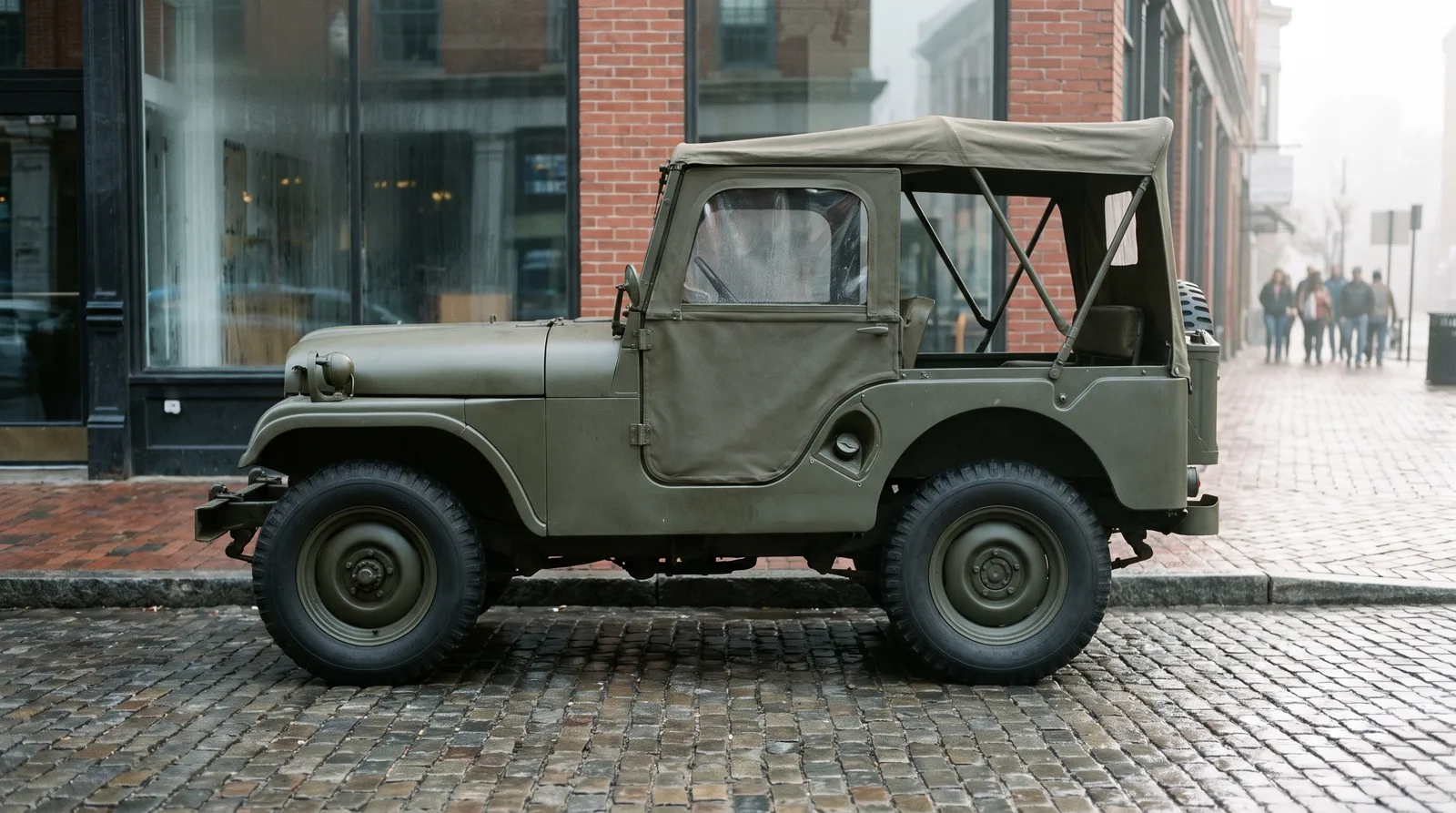
A Jeep built for a war the first ones weren't ready for
The original wartime Jeep, the MB and its Ford-built twin the GPW, had done its job in World War II, but Korea's terrain and the demands of a mechanized modern army exposed the limits of that 1941 design. The Army wanted more interior room for radios and equipment, a lower center of gravity, and a frame that could take a beating on Korean mountain roads. Willys-Overland answered with the M38A1, introduced in 1951, built around a new rounded body and a taller, more powerful F-head engine known as the Hurricane. It was not a modification of the old Jeep. It was a new vehicle wearing a familiar name.
Soldiers who drove the M38A1 in Korea found it tougher and more comfortable than its predecessor, though comfortable is a relative word for a vehicle with a canvas top and no doors. It hauled ammunition, towed light artillery, and carried wounded men down mountain trails where trucks could not follow. The Army ran the M38A1 hard, and the engineering data Willys collected from that service, the failure points, the stress fractures, the parts that held up and the parts that did not, fed directly into the next civilian design.
From battlefield lessons to a showroom floor
When Willys introduced the civilian CJ-5 for the 1955 model year, the resemblance to the M38A1 was not coincidental marketing. It was the same basic body shell, adapted with civilian trim, a tailgate instead of a fixed rear panel, and options like a passenger seat and a heater that no soldier ever got. The wheelbase, the rounded fenders, the general proportions all trace straight back to the military vehicle built for a war most Americans were eager to forget by the time the Jeep hit dealer lots. For the fuller account of how that civilian launch played out, our complete history covers the whole run from 1955 to 1983.
What strikes me most, sitting with old-timers at swap meets, is how many of them served in Korea themselves and came home wanting a piece of that machine in civilian form. Willys understood that pull. Its early advertising for the CJ-5 leaned on the Jeep's proven military pedigree even while pitching the vehicle to farmers and hunters who had never worn a uniform. The company knew that trust built in combat translated directly into trust at the cash register.
What separates a military M38A1 from a civilian CJ-5
Parked side by side, the two vehicles share a silhouette but differ in real ways. The M38A1 ran a 24-volt electrical system built for military radio equipment, blackout drive lights for night operations, and a stiffer suspension tuned for cargo hauling over rough terrain rather than passenger comfort. The civilian CJ-5 dropped the 24-volt system for a standard 6-volt setup shared with other Willys products, added a softer ride, and offered creature comforts no soldier ever saw, right down to an optional heater and a chrome grille.
| Feature | M38A1 (military) | CJ-5 (civilian, 1955) |
|---|---|---|
| Electrical system | 24-volt, radio-ready | 6-volt, standard duty |
| Lighting | Blackout drive light | Standard headlights only |
| Purpose-built for | Combat and cargo hauling | Farm, ranch, recreation |
| Engine | Hurricane F-head four | Hurricane F-head four |
"Every time I hear someone call the CJ-5 just a prettier flat fender, I remind them the body they're looking at was drawn for a war zone before it ever saw a dealership lot."
- Wayne Coburn
Why the military connection still matters to buyers today
Collectors chasing early CJ-5s sometimes overlook the M38A1 entirely, treating it as a separate niche for military vehicle buyers rather than the direct ancestor of the Jeep parked in their own garage. That is a mistake, because understanding the military roots changes how you read an early CJ-5's design choices. The fold-flat windshield, the reinforced frame rails, the placement of the fuel tank, none of it was arbitrary. Every one of those decisions came from lessons the Army paid for in Korea, and Willys simply carried the engineering forward rather than starting from scratch.
There is also a growing crossover market between military vehicle collectors and civilian CJ owners, with some enthusiasts owning both an M38A1 and a period CJ-5 side by side specifically to show the lineage. Prices on well-documented M38A1s have climbed as that crossover interest has grown, and it has pulled attention back toward the earliest, most military-adjacent CJ-5s built in the mid-1950s before Kaiser softened the design further through the 1960s.
Finding your own piece of that history
For buyers who want to own that connection directly rather than just read about it, the search usually starts with the earliest production years, when the CJ-5's kinship with the M38A1 was closest and least diluted by later trim changes. Those Jeeps carry a specific character, simple, stout, and built around an engine and frame proven under fire before they were ever offered to the public. Anyone hunting for one can start with the current listings and find a classic CJ that fits that early, military-rooted profile. It is, in a very real sense, the same Jeep Ray's father drove, just with the doors, the seat, and the heater the Army never bothered to include.
What to check before you buy the story
Plenty of sellers will lean on the military connection to talk up an ordinary CJ-5, so it pays to know the difference between real provenance and a good sales pitch. A genuine tie to the M38A1 lineage does not mean the individual Jeep served overseas. It means the design under the sheet metal shares the same engineering roots, nothing more, nothing less. If a seller claims their specific CJ-5 was a military unit converted for civilian sale, ask for documentation. Genuine M38A1s carry different data plates, different wiring, and different frame stampings than the civilian CJ-5, and a legitimate conversion will show clear evidence of that swap rather than a story with no paper trail behind it.
What buyers should actually look for is originality within the civilian line itself. Early Willys-badged CJ-5s from 1955 through the early 1960s, built before Kaiser's ownership brought softer trim and creature comforts further from the military template, hold the closest resemblance to their M38A1 ancestor. Frame rails, fuel tank placement, and the fold-flat windshield hinge all carry over almost unchanged from the wartime design in those early years. A rusted frame or a replaced body tub erases most of that connection, no matter how good the family story attached to it sounds.
I have watched more than one club member learn this the hard way, buying a Jeep on the strength of a story rather than the strength of the metal underneath it. The lesson holds for any CJ-5 with a claimed pedigree, military or otherwise. Enjoy the history, respect where the design came from, but inspect the frame before you believe the folder of paperwork sitting on the hood.
Sources and notes
Related Reading

About the author
Wayne Coburn
Longtime Corvette owner, judge and club figure who knows the cars, the records and the people behind them.
Related Listings - Jeep CJ







Comments (1)
S
Sergio
1 day ago
My uncle bought a surplus M38A1 in the seventies and spent a whole summer hunting 24-volt bulbs all over Cicero. Respect to the builders.